My community and many others have been watching in awe as Greta Thunberg makes waves around the world—her lone climate change protest in Sweden growing in a single year into a climate strike with millions of demonstrators around the world. Of course, Greta isn’t asking us to listen to her. She is asking us to listen to the science that will save us. And Greta is not alone: there are young indigenous female protesters like performance poet and peace activist Lyla June Johnston of the Dine (Navajo) and Tsetsehestahese (Cheyenne) peoples and water protector Autumn Peltier of the Anishnaabe people, who are speaking before the UN and in other public settings about global warming, and revitalizing our spiritual relationship with Mother Earth. Yet Greta knows that her fame (and her youth) gives her a platform. She is conscientiously using that platform to testify before Congress and the UN, Tweet, post on Facebook, and do whatever else she can do to make an impact. Recently, I’ve noticed that some people in my home Jewish community, when they post about Greta on social media, have given her a nickname: they call her “the prophetess.”
Cranes, seen gliding over the water, searching for food in muddy wetlands and flying overhead in beautiful formations, are graceful, elegant birds – masters of three worlds – air, land and water.
At the age of nine, I was taken to see the film Brother Sun, Sister Moon. It is a gorgeous film about the early life – and spiritual revelation – of Saint Francis of Assisi, or as I like to call him: Brother Francesco. As the final credits rolled, that first time seeing it, I couldn’t stop the tears from flowing. My Mom asked me what was wrong, and all I could say was, “I want to go be with him, I belong with him.” Her response was predictable: 1. I was Jewish. 2. He was dead. 3. I was a girl!
From that moment, though, I knew that in some past life I must have walked with Brother Francesco. I felt such a powerful kinship with him, with his connection to Spirit, with his rejection of “traditional religion” (and all its limitations and rules and exclusionary practices), and with his sense of Oneness with all beings, human and animal. He was always much more to me than “the patron saint of animals.” He heard a clear message from God/Spirit and listened to it, without question. And this listening brought him peace and purpose.Continue reading “Me and Brother Francesco by Rachel Hollander”
I’ve written some very personal things in my most recent posts sharing that I am working towards a rebirth. The terrain has been rough and I keep waiting for a smooth path to appear on the horizon; but it isn’t quite visible yet. There are many factors: single parenting, career, the mid-life crisis, menopause…NOT the musical (peri-menopause really, but you know what I mean). It’s like going through puberty all over again with bad skin, mood swings, insecurities abound; but a thousand times worse and with hot flashes, rage, and memory loss. I imagine some of you nodding your heads and laughing as you read this…or maybe crying depending on which way your mood is swinging. I’m learning to embrace Evelyn’s alter ego “Towanda” in Fried Green Tomatoes.
When we are struggling, it is easy to sink into despair and disconnect from the love that surrounds us. I often find myself overwhelmed with day to day life: prepping for classes, grading, packing lunches, helping with homework, getting dinner on the table, laundry, dishes, paying bills, etc. As women, we are supposed to be nurturers balancing it all while taking care of everyone around us. We are told this is our “god-given” role and that pressure can be crushing. I often wonder, who is going to take care of me?
Sometimes making a simple phone call or sending a text message feels like more than I can bear. I can’t make myself do it. I get stuck in the never ending cycle of the daily grind and I think I’ll get to the phone call, text message, or email tomorrow. And then, I blink and a month has passed.
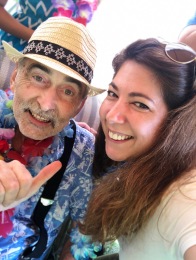
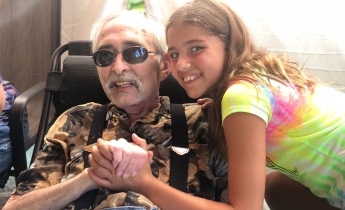
As I write this, I am grieving a great loss for our family. My dear Uncle Ralph, who I wrote about in a previous post, has made his journey to the spiritual realm. I last saw him a little over a month ago when my daughter Sarah and I baked him a cheesecake – a favorite family recipe that invoked the presence of the some of the women we’ve lost – my mother, grandmother, our Great Aunt Dee Dee (who the recipe originated with). When we left I promised to send a link with some articles, a recipe, and Sarah and I had planned to head back for another visit with a batch of cupcakes. I thought about it every day. And I put it off in favor of the daily grind, the aggravation, the despair, the hot flash, or “adulting.”
Sarah talked about Uncle Ralph often asking when we would go back and expressed her fear of not seeing him again. And then this morning, I heard the news. It sunk in my gut like a brick. And I thought about this song, “Some Lessons We Learn the Hard Way” where Melody Gardot laments:
Life goes away in a flash
Right before your eyes
If I think real hard well I reckon I’ve had some real good times
Well why do the hands of time
So easily unwind
Some lessons we learn the hard way
Some lessons don’t come easy
That’s the price we have to pay
During my last conversation with my uncle, he said he was so grateful for a second chance; entering hospice gave him the opportunity to recognize what is really important in life and all that he often lost sight of because of the daily grind — love. He knew that God was with him and he recognized the beauty of life as a divine gift.
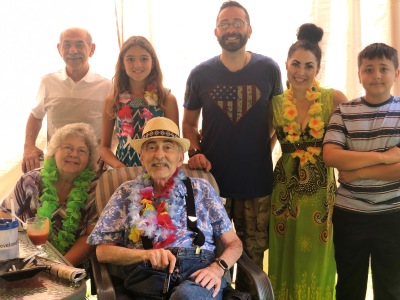
Uncle Ralph said it was as if he was having a living wake. Everyday people came to visit him; they shared stories and laughs, and he was reminded of how many people loved him. Now, he focused on spending every last moment deeply engaged in relationship. Uncle Ralph, Aunt Mary, their children Colleen and Tim, and grandson Jacoby spent their days sitting together appreciating the family they had grown into. Some might say they were wasting time; but really they came to understand the greatest lesson of our lives. It is those precious moments that we share with one another that matter. God is present in those moments. We experience the divine in relationship. My dear uncle has given me such a gift in this lesson.
Tonight, as I am writing, strangely a notification from Uber Eats popped up on my phone. It said I had a dozen Krispy Kreme donuts in my cart ready to be delivered. I opened the app and was going to delete it. But I accidentally placed the order. (Really it was an accident!) In pursuit of a healthier lifestyle, I haven’t had a Krispy Kreme donut in ages. I’ve convinced myself that the donuts were Uncle Ralph granting me grace from the other side…or maybe playing a practical joke; he was always the prankster. A reminder of the sweetness that life can bring if we embrace what we are supposed to.
Rest in peace, my dear Uncle Ralph.
Gina Messina, Ph.D. is an American feminist scholar, Catholic theologian, activist, and mom. She serves as Associate Professor of Religious Studies at Ursuline College and is co-founder of FeminismAndReligion.com. She has written for the Huffington Post and is author or editor of five books including Jesus in the White House: Make Humanity Great Again and Women Religion Revolution. Messina is a widely sought after speaker and has presented across the US at universities, organizations, conferences and on national platforms including appearances on MSNBC, Tavis Smiley, NPR and the TEDx stage. She has also spoken at the Commission on the Status of Women at the United Nations to discuss matters impacting the lives of women around the globe. Messina is active in movements to end violence against women and explores opportunities for spiritual healing. Connect with her on Twitter @GMessinaPhD, Instagram: @GinaMessinaPhD, Facebook, and her website ginamessina.com.
I was a pastor for 14 years. Yes, a queer, feminist, Baptist pastor. We exist. Simultaneously, I completed a PhD and was a professor, both at divinity schools and in a Women’s, Gender, and Sexuality Studies Dept. I could never find full-time, tenure-track work as a professor, which was my “in the box” dream. And my job as a pastor became incredibly toxic. Between the thick file folder full of hate mail and the sexist and heterosexist microaggressions, it was ultimately the microaggressions that did me in. I experienced a brief reprieve when I went to a little retreat center designed specifically for activists and artists. There, I began to heal. In healing, I discerned that it was time for me to leave. Not just that church, but perhaps the Church altogether. That little retreat center was a balm that gave me the space I needed to turn inward, recharge, examine the power systems designed to disempower queer women like me, and leave feeling inspired and empowered. Continue reading “Holy Woman Within: A Hawai’i New Year’s Retreat for Spiritual Creatives by Angela Yarber”
Once the new white pine forest that stretches out before me was part of a larger field that belonged to an old farm. The woods cascade down a steep hill on the east side of the house and run parallel with the brook that empties into another that crosses my property in the wetlands below.
Over a period of thirty – five years I have chosen to allow nature to decide how best to use this field and she turned it into a beautiful white pine forest. I created walkways through the young trees and moss covered pine strewn ground, and now, even during the hottest summer days a stroll under the pine boughs that create a protected arch overhead, is always refreshingly cool. The sweet scent of pine, moist earth, and nearby water creates a longing in me to breathe this perfume forever…The paths are like serpentine ribbons crisscrossing one another. Some take me to the brook, others climb a knoll I call cedar hill. Wild apple and cherry trees, chokecherries, hobble bush and partridge berry provide fruit for the animals that pass by, as do blueberries and brambleberries that are scattered on the hill in late summer. In some protected thickets wild animals bed down to sleep…Continue reading “Field of Dreams by Sara Wright”
I grew up within Christianity—one of the faiths that many religious scholars label as a Western tradition. It can be difficult at times to wrap my head around religious concepts and symbols labeled by those same religious scholars as Eastern traditions. Judaism, Christianity, and Islam come under the rubric of Western traditions while Hinduism, Buddhism, Sikhism, and Jainism are categorized as Eastern traditions.
Years ago I came across Diana Eck’s book, Encountering God A Spiritual Journey from Bozeman to Banaras. In the Preface, Eck writes: “I am a student, scholar, and teacher of the comparative study of religion. My academic specialization is the Hindu tradition….” Throughout her work, she explores the meaning of “God.” “What if,” she asks, “the names and forms of…God are many, limited only by our human capacity to recognize them?”Continue reading “Giving Up What You Do Not Have by Esther Nelson”
September 17 marks the feast day of 12th century Benedictine abbess and powerfrau, Hildegard von Bingen.
Born in the Rhineland in present day Germany, Hildegard (1098–1179) was a visionary and polymath. She founded two monasteries, went on four preaching tours, and wrote nine books addressing both scientific and religious subjects, an unprecedented accomplishment for a 12th-century woman. Her prophecies earned her the title Sybil of the Rhine.
Over eight centuries after her death, Hildegard was finally canonized in May 2012 and in October 2012 was elevated to Doctor of the Church, a rare and solemn title reserved for the most distinguished theologians.
But most people today know Hildegard best for her soaring ethereal music.
The first composer for whom we have a biography, she composed seventy-seven sacred songs, as well as Ordo Virtutum, a liturgical drama set to music.
Her melodies are completely unlike the plainchant of her era—or anything that has come before or since. Likewise her lyrics are highly original and feel fresh to us even today. She was the only 12th century writer to compose in free verse.
Hildegard and her nuns sang the Divine Office eight times a day. She believed that song was the highest form of prayer—the mystical power of music reunited humankind to the ecstasy and beauty of paradise before the fall, connecting the singer directly with the divine, and joining heaven and earth in celestial harmony.
I’ve spent years researching Hildegard. I’ve visited the sites of her abbeys along the Nahe and Rhine, studied her writings, and written a novel about her, Illuminations: A Novel of Hildegard von Bingen, published in 2012. I’ve had the privilege of discussing Hildegard’s life and work with scholars, musicians, and people of faith from around the world. But not until last month did I have the opportunity to experience firsthand what it would be like to sing Hildegard’s wondrous music.
In August I took part in a retreat entitled “Connecting Heaven and Earth: The Chant of Hildegard” at Hawkwood College in Stroud, southern England, led by renowned soprano Dame Emma Kirkby and by author, spirituality teacher, and musician Caitlin Matthews. I’ve been reading Caitlin’s sublime books from the moment she started publishing in the 1980s. Caitlin’s Sophia: Goddess of Wisdom, Bride of God is a spiritual classic I highly recommend. I also own and adore Emma’s iconic 1985 album, Feather on the Breath of God, which first introduced Hildegard’s music to a wide mainstream audience.
This course was open to singers of all abilities. I would describe myself as an enthusiastic amateur, better suited for folk songs than Hildegard’s soaring octave leaps, but as a lover of Hildegard, how could I not at least give it a try? I’ll confess I was somewhat intimidated to learn that many of the participants were professional or semi-professional singers who were quite adept at sight-reading and that some of the scores we worked with were not in modern notation but in the medieval neume pattern. I found our singing classes quite daunting, even grueling, for we were experiencing a heat wave and our classrooms were all south facing with huge glass windows and radiators we could not shut off!
Hildegard’s music is challenging, especially for amateurs like me. It requires a huge range of voice, from ascendant scales that even the experienced sopranos sometimes struggled with, to deeper, profounder notes. But as the weekend went on, I began to slowly grow in confidence, following the stronger voices around me, and enjoying the sheer beauty of the music.
Caitlin helped balance the retreat by sending us on outdoor walking meditations through the beautiful gardens and woodlands where we could meditate on Hildegard’s vision of Viriditas–the sacred as manifest in the green, growing world.
On our last evening, we performed a recital with an audience of one, a friend of one of the participants. Some of the more accomplished singers sang solos while the rest of us joined in the chorus and in other songs. Listening to the soloists, I nearly wept, it was so beautiful and transformative. Listening to Hildegard’s music, particularly when performed live, moves the spirit within. These sacred songs are literally uplifting, just like the dramatic leaps in scales. After our recital, our single audience member told us that she felt the music lifting her heart energy toward heaven.
Our evening recital at Hawkwood. Caitlin and Emma are front and center. I am the short one with the long hair in the back, on the right.
While writing Illuminations: A Novel of Hildegard von Bingen, I listened nonstop to CDs of Hildegard’s music, creating a wall of sacred sound that helped inspire and empower my writing. But singing her music live as an amateur was a completely different and possibly more authentic experience than listening to polished and digitally mastered CDs. Hildegard composed her music to be sung by her sister nuns, not all of whom would be accomplished vocalists. She might have had sisters who were tone deaf or had a very limited vocal range. In sacred song what matters most is the spiritual intention behind it, rather than talent or technique or polish. Each song is a prayer offered to the divine. Sacred song is all about the mystery of devotion rather than the mastery of notes or neumes. Singing in a group of like-minded women, even with such a broad range of ability as we had, we reached a sublime place, our voices joining, so that we could hear the Voice behind our individual voices.
“There is the music of heaven in all things,” Hildegard wrote. “But we have forgotten to hear it until we sing.”
If god is the wild, passionate, loud, sexual, sizzling, dancing fires of creation.
And should I ever forget my fiery, heavenly vision, the sun comes out every day to remind me.
And I ask myself, which is more miraculous? Our local star feeding earthly life?
Or me, reflecting the sun, feeling the passion, sizzling in response?
Jacob Dreams and So Do We
(inspired by Genesis 28:12)
As darkness slips into light,
dawn,
with its unique melody,
grows brighter.
As light slips into darkness,
dusk,
with its mysterious possibilities,
settles softly upon the land.
Creation is oneness, but we need duality to experience sex, symphonies, hot fudge sundaes.
Creation is pure love, but it is to the passions of the human heart that we owe our earthwalk
Dawn and dusk hold open the thresholds of mystery inviting our human hearts to experience . . .
The sacred dance where one becomes two becomes three.
The sacred song where three becomes two becomes one.
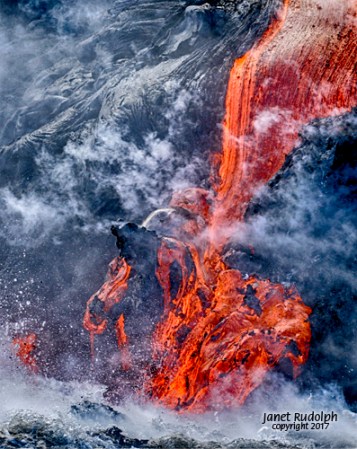
Pele’s Birth Dance
Twinkling stars ignite waves of fire that explode into a tumultuous, joyful noise:
“EH YEH, EH YEH, EH YEH.”
And Mother Earth awakens.
Matter bathed in Pele’s cauldron flares up, erupting into waves of baby earth while roaring:
“EH YEH, I AM, EH YEH.”
As seeds rise from great watery oceans of fire, my heart swells, breathing air into newly forged matter and causing my breath to become song:
“I AM, EH YEH, I AM.”
Fire,
that reflects flame-drenched stars,
that reflects Pele’s dance,
that reflects the passionate seed,
echoes within my belly until I glow with waves of love which burst forth to sing:
“I AM, I AM, I AM.”
And then . . .
Riding a watery wave that gushes forth new life, my newborn erupts from my body, then twinkles, then cries tumultuous joyful noise:
“EH YEH, EH YEH, WAHHHHhhhhhh.”
(Note: “Eh yeh” is God’s name in phonetic Hebrew as given to Moses in Genesis 3:14. “I am” is its traditional translation into English)
Janet Rudolph has written three books on the subject of ancient Biblical Teachings. One Gods: The Mystic Pagan’s Guide to the Bible,When Eve Was a Goddess: A Shamanic Look at the Bible, and the just recently released book,When Moses Was a Shaman. For more information visit her website at /www.mysticpagan.com/
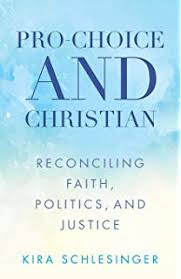
In 2015 Kira Schlesinger wrote piece for Ministry Matters about how her own pro-choice stance on abortion had become more complicated the more she explored the issue of abortion. The article was widely read and shared, as well as hotly debated by many. You can read this article and the many comments here. Out of the response to this article grew Schlesinger’s Pro-Choice and Christian: Reconciling Faith, Politics, and Justice.
The book does a great job of walking the fine line of being both academically engaging and an easy enough read to engage a book or Bible study group as well. Schlesinger uses the first couple of chapters to dig into the history of abortion, listing recorded examples of the process as early as 1300 BCE. From there she briefly walks the reader through the roughly 100 years (Comstock Act in 1873 until Roe v. Wade in 1973) during which abortion was illegal in the United States. Finally, she wraps up this beginning historical section with details about the generations after Roe v. Wade up to our current reality.


 My community and many others have been watching in awe as Greta Thunberg makes waves around the world—her lone climate change protest in Sweden growing in a single year into a climate strike with millions of demonstrators around the world. Of course, Greta isn’t asking us to listen to her. She is asking us to listen to the science that will save us. And Greta is not alone: there are young indigenous female protesters like performance poet and peace activist Lyla June Johnston of the Dine (Navajo) and Tsetsehestahese (Cheyenne) peoples and water protector Autumn Peltier of the Anishnaabe people, who are speaking before the UN and in other public settings about global warming, and revitalizing our spiritual relationship with Mother Earth. Yet Greta knows that her fame (and her youth) gives her a platform. She is conscientiously using that platform to testify before Congress and the UN, Tweet, post on Facebook, and do whatever else she can do to make an impact. Recently, I’ve noticed that some people in my home Jewish community, when they post about Greta on social media, have given her a nickname: they call her “the prophetess.”
 At the age of nine, I was taken to see the film Brother Sun, Sister Moon. It is a gorgeous film about the early life – and spiritual revelation – of Saint Francis of Assisi, or as I like to call him: Brother Francesco. As the final credits rolled, that first time seeing it, I couldn’t stop the tears from flowing. My Mom asked me what was wrong, and all I could say was, “I want to go be with him, I belong with him.” Her response was predictable: 1. I was Jewish. 2. He was dead. 3. I was a girl!
 I’ve written some very personal things in my most
  Sarah talked about Uncle Ralph often asking when we would go back and expressed her fear of not seeing him again. And then this morning, I heard the news. It sunk in my gut like a brick. And I thought about this song, “Some Lessons We Learn the Hard Way” where Melody Gardot laments:
 Uncle Ralph said it was as if he was having a living wake. Everyday people came to visit him; they shared stories and laughs, and he was reminded of how many people loved him. Now, he focused on spending every last moment deeply engaged in relationship. Uncle Ralph, Aunt Mary, their children Colleen and Tim, and grandson Jacoby spent their days sitting together appreciating the family they had grown into. Some might say they were wasting time; but really they came to understand the greatest lesson of our lives. It is those precious moments that we share with one another that matter. God is present in those moments. We experience the divine in relationship. My dear uncle has given me such a gift in this lesson.
 I was a pastor for 14 years. Yes, a queer, feminist, Baptist pastor. We exist. Simultaneously, I completed a PhD and was a professor, both at divinity schools and in a Women’s, Gender, and Sexuality Studies Dept. I could never find full-time, tenure-track work as a professor, which was my “in the box” dream. And my job as a pastor became incredibly toxic. Between the thick file folder full of hate mail and the sexist and heterosexist microaggressions, it was ultimately the microaggressions that did me in. I experienced a brief reprieve when I went to a little retreat center designed specifically for activists and artists. There, I began to heal. In healing, I discerned that it was time for me to leave. Not just that church, but perhaps the Church altogether. That little retreat center was a balm that gave me the space I needed to turn inward, recharge, examine the power systems designed to disempower queer women like me, and leave feeling inspired and empowered.
  Once the new white pine forest that stretches out before me was part of a larger field that belonged to an old farm. The woods cascade down a steep hill on the east side of the house and run parallel with the brook that empties into another that crosses my property in the wetlands below.
  I grew up within Christianity—one of the faiths that many religious scholars label as a Western tradition. It can be difficult at times to wrap my head around religious concepts and symbols labeled by those same religious scholars as Eastern traditions. Judaism, Christianity, and Islam come under the rubric of Western traditions while Hinduism, Buddhism, Sikhism, and Jainism are categorized as Eastern traditions.


 Feminism and Religion