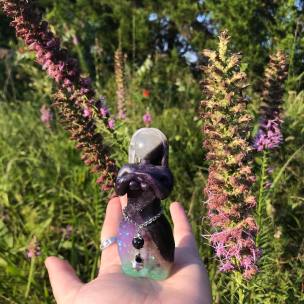
Musings on the Triune God by Natalie Weaver

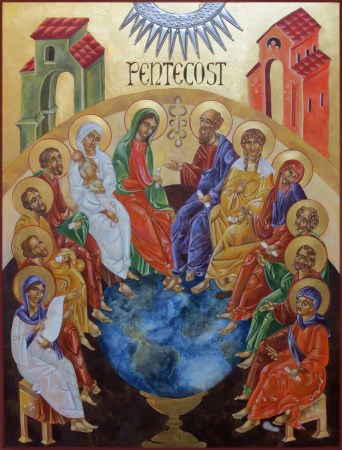
This past term I had the opportunity to teach courses on the Christian doctrines of Christology and Trinity.  My first inclination was to approach these doctrines from the perspective of their historical development. For, I find the historical study of doctrinal development to be a fascinating and liberating approach to theology because it delivers the searcher from the illusions of ubiquity and universality, even in matters of the most central tenets of faith.  When people can see doctrine in its political, polemical, and posited guises, we can be free from absolutization of belief in past expressions as well as in present permutations.

Yet, as much as I enjoy tours through the historical development of faith formulations, I found myself unable to really commit to this approach this year.  I was more concerned with allowing students space to think about Christ and to think about God.  I wanted to introduce the problems and tensions that have dogged Christian logic and practice for millennia, but I wasn’t interested in arriving at conclusions or teaching modern experts’ answers.  I wanted to create occasion for my students to answer for themselves questions of justice and mercy; theodicy; particularity; scandal; and more. Continue reading “Musings on the Triune God by Natalie Weaver”

Climate Change as a Socio-Spiritual Feminist Issue (Or 10 ways to be a leader in the era of climate change) by Nurete Brenner

Authorities have observed that climate change is a feminist issue because it disproportionately affects women. Among these, the United Nations has gone further to acknowledge that climate change is a feminist issue because women are on the forefront of adopting climate-change mitigating techniques and technologies. A recent UN report states that “women are key actors in building resilience and responding to climate-related disasters…” But overarching these admittedly important issues is the greater understanding – not mentioned by the UN report – that climate change is a feminist issue on the socio-spiritual level. This side of the issue is often overlooked because the institutions who compile reports are immersed in a masculine way of thinking.  

What do I mean by a masculine way of thinking and why do I label it in this seemingly gendered way? Masculine values are those of winning, achieving, proving, succeeding, counting, controlling. pursuit of achievement and status; individual self-reliance; strength and aggression. The UN climate report cited above goes on to say that “Enacting good policies requires quality data, so that we can quantify the issue and measure improvement…” Reports such as this make their points by tabulating numbers and citing statistics, not seeing that these are already masculine ways of expressions and that numbers can only ever tell part of the story.  These masculine traits and values are social constructs and not necessarily to be associated with the male biological sex. Both men and women and other-gendered can display masculine values and attributes but they are labeled masculine because society typically associates them with the male gender. Continue reading “Climate Change as a Socio-Spiritual Feminist Issue (Or 10 ways to be a leader in the era of climate change) by Nurete Brenner”

Lessons Mothers Might Teach Their Daughters by Elisabeth Schilling

There might be lots of lessons to consider. These lessons might have holes, for I’m not a wise sage, and I’m not really even a mother. As I am a couple of years from 40, I think about what lessons I would teach my daughter if I had one, lessons to honor her physicality, lessons to create space for her soul. What do you think of these lessons? Would I be a bad mother?

  1. Be self-sufficient, and work hard and do it early.

I think there is much to say about a woman making her own money so that she can be in relationships that honor her tendencies and desires and contribute in those relationships financially. I’m not sure why it is, but I still feel that we are in a time where most men are more given the idea they should be self-sufficient and work hard and early to do it and many women, although perhaps a hint of this, would not have this as the core of who they are. A woman should have her own money so that she can be free.

  1. Find a spirituality and a community that allows you to be confident in your internal wisdom and body and support learning about life skills.

Continue reading “Lessons Mothers Might Teach Their Daughters by Elisabeth Schilling”

Outtadeway-O: A Found Goddess of Public Transportation (well, you asked for Her last month) by Barbara Ardinger

Tall, hearty. sometimes pushy, and usually very loud, Outtadeway-O is easily able to propagate and multiply Herself so that we can find Her in crowded airport terminals, at bus and subway stops, and just about anywhere people are traveling from or to. She’s in charge of trains, planes, and taxi-cabs. She’s the One who, when we’re in a hurry to get somewhere on time, shouts, “Please, oh, please get out of the way!” Pilots, engineers, station masters, ticket agents, and ÜberAlles drivers all hear Her. You better bet they get out of Her way.

Although there are apocryphal reports that Outtadeway-O was present when Hannibal crossed the Alps (who do you think was in charge of those elephants?) and in the Roman Colosseum (She supercharged some of the chariots, horses, too), She’s most familiar as the gal in the New York subway system who kindly tells you which side of the tracks to stand on so you get on the train going in the right direction. Whether you’re lost in La Guardia, O’Hare, Hartsfield, or LAX (and in the smaller airports, too), She’s the gal in the uniform who explains how to use those dratted ticket machines on the curb and gives you a tidy map that shows where the gates are and how to find them without tripping over the people sleeping on the floor because their flights were delayed or canceled. She’s also the helpful agent who finds food for those people when they wake up and points them toward the bathrooms. Continue reading “Outtadeway-O: A Found Goddess of Public Transportation (well, you asked for Her last month) by Barbara Ardinger”

Islam is my Louvre – Part II by Valentina Khan

I was once asked “why do I stay Muslim”? That was the question prompt, and it begged an answer…Reason #2: I believe Islam has vagueness in the Quran (I answered Reason 1 and 2 yesterday…)

What do I mean by all this vagueness?

First of all, Judaism and Christianity-based characters have made appearances in Islam by way of shared stories and prominent shared figures: Adam, Abraham, Isaac, Ishmael, Lot, Aron, Moses, Job, Jonas, Noah, Jesus, Mary and so on. Growing up Muslim, these prominent religious figures across the Abrahamic spectrum were names that were mentioned time and time again as part of the religious history and teachings. So I feel a sense of relief, that as a Muslim, we are not sailing alone in the sea of faith with no shared history with any other faith, but we are on the same island (so to speak) with our Jewish and Christian brothers and sisters. Continue reading “Islam is my Louvre – Part II by Valentina Khan”

Islam is my Louvre by Valentina Khan

I was once asked “why do I stay Muslim”? That was the question prompt, and it begged an answer. A deep, well thought out, articulate, and concise answer. Shamefully, at that time in my life, I was stumped. I was speechless a long while, because I couldn’t think fast or clear enough to answer with sincerity. At that time, whatever I wanted to say, just sounded like the “schtick” — for example “oh, yes I stay Muslim because Islam stands for peace, and I’m a peaceful person so this is my biggest reason..(next day – terrorist attack by “Muslims” totally negating my “why”)… and other similarly situated examples as such. So, I knew my why had to be more layered, more significant and pragmatic, yet exciting.

It’s been a few years since, and I have thoughtfully mulled this question over and over in my head. From my social context, as devout as both sides of my family are to the faith, I personally, grew up as a “SoCal” girl. For me this means, I have many non-Muslim friends, and I have influences from all spectrums varying from interfaith efforts to intellectual atheists. Growing up and still today, I have conversations with women, especially, that go beyond following any type of faith tradition. Many of friends within my circles have used their faith as a roadmap to a “higher frequency”. Tuning into the world, into humanity, eliminating draconian mindsets, and living today trying to be in touch with all of it, rather than just a section of “it.” Continue reading “Islam is my Louvre by Valentina Khan”

Advocating Respect for Goddess by Susan de Gaia

I served as general editor for the recently published Encyclopedia of Women in World Religions: Faith and Culture Across History (2018/19 ABC-CLIO). It was an honor and a pleasure to work with a hundred and thirty wonderful scholars, many with expertise in female divinities. In working with a publishing house on this project, I negotiated for the capitalization of Goddess and other terms for the Female Divine.  

‘I recommend not capitalizing “goddess”’ – was the first reply I got on this question. It came from Anne, the development editor assigned to the project. Negotiations ensued. Continue reading “Advocating Respect for Goddess by Susan de Gaia”

Falling Down and Going Under by Sara Wright

I have been traveling across country during the past week from New Mexico to Maine, leaving one “home” for another wondering what the word even means for me these days. I suspect the word doesn’t refer to a place, but a state of mind/body that continues to elude me.

In a forested glen in Virginia I first heard the cardinals singing from the trees and smelled fragrant mounds of trailing honeysuckle that cascaded over every bush and lichened granite stone. For a while I seemed unable to soak in enough of the fully leafed out deciduous trees – trees dressed in miraculous shades of lime, deepening to dark spruce. My endless hunger for emerald green was finally appeased by endless rolling hills and blue tipped mountains. Continue reading “Falling Down and Going Under by Sara Wright”

Spring Blossoming: The Holy Orchard as Goddess by Jill Hammer

Every year when the cherries, pears, plums, and apple trees begin to bloom, I go out walking.  I look for every spot in my vicinity where white and pink blossoms are blooming in exquisite profusion like foam on an ocean. Every year I take photographs, even though I already have so many.  I walk at every hour of the day because, as the light changes, the colors change. I have albums and albums of pictures of my beloveds, the trees.

For me, the apple and cherry trees are a manifestation of Goddess.  Of course, everything is a manifestation of Goddess, but these, for me, have an extra measure of that life-giving beauty and abundance I associate with the indwelling Presence in the cosmos.  My enjoyment of the blossoms is both a sensual appreciation of the gorgeousness of Being and a poignant awareness that they will not last forever.  Sometimes these glories manifest for me as feminine, sometimes as masculine, and sometimes just as Life itself.


Continue reading “Spring Blossoming: The Holy Orchard as Goddess by Jill Hammer”

Holy Women of Pride: Queer Spirituality and Worship Resources by Angela Yarber

As we enter Pride month, do you ever finding yourself wishing there were unabashedly queer resources to aid clergy and people of faith in nurturing spirituality, celebrating queer families, or offering liturgies that celebrated revolutionary queer women? Look no farther! The Holy Women Icons Project—a non-profit seeking to empower marginalized women by telling the stories of revolutionary holy women through art, writing, and special events—has created three such resources. Thanks to a generous grant from The BTS Center, these affordable and accessible online retreats and resources are available for clergy and laity alike. Check out these three offerings, along with the revolutionary seven queer women of color who inspired them!

HWIP’s 7-Day Online Queer Spirituality Retreat is an opportunity to subversively queer your spirituality, and for the LGBTQ+ community to celebrate our spirituality without having to translate it through the lens of heteronormativity. Open to everyone, the Queer Spirituality Retreat features seven different queer women of color: Pauli Murray, Frida Kahlo, Perpetua and Felicity, the Shulamite, Marsha P Johnson, Guanyin, and Gloria Anzaldúa. The most important part of the retreat is, of course, the revolutionary queer women who make it possible. So, allow me to briefly introduce you to seven queer women of color… Continue reading “Holy Women of Pride: Queer Spirituality and Worship Resources by Angela Yarber”