Reflections on Trauma, Part I: Pink Pussyhats by Stephanie N. Arel

stephanie-arelI have been thinking frequently about trauma, about what perpetuates suffering and what supports the arduous journey of transforming traumatic experiences, especially in the aftermath of traumas of human design. The violation of bodies lies at the heart of such traumas. Thus, how we practice behaviors that refuse to denigrate bodies are critical and necessary to alleviating suffering and promoting the body’s dignity.

This idea of restoring the body’s dignity after trauma is magnified by the reality that trauma remains, stored in our bodies as a residual reminder of the traumatic event (s). Bessel van der Kolk reminds us, “The body keeps the score.” Continue reading “Reflections on Trauma, Part I: Pink Pussyhats by Stephanie N. Arel”

It’s a Small Thing in Relation to Everything Else: Or Is It? by Carol P. Christ

carol-p-christ-photo-michael-bakasYesterday morning when I learned about the Open Letter to Attorney General Sessions: Join Us In Selma On the Right Side of History, I paused Joy Reid’s interview with William Barber II in order to search for the petition site. The letter’s authors invited the Attorney General to join them in Selma to commemorate the 52nd anniversary of “Bloody Sunday” when peaceful marchers demanding the right to vote were attacked with billy clubs and tear gas. The Letter also asks the Attorney General, who was born in Selma, to join them in a non-partisan commitment to ensure the right to vote for all Americans. The letter calls upon the Justice Department to restore the protections against voter suppression enshrined in the Voting Rights Act.

I was pleased to sign the Open Letter because I have been thinking about how those who came together in the Women’s March and other marches can channel their energy into registering voters, helping them get the identification required by “voter suppression laws” enacted with the purpose of disenfranchising voters of color and elderly voters in nearly half of all US states. I believe it is imperative to focus a part of our energy on helping people to get the necessary ID’s while at the same time working to throw out every single rascal who voted for these laws. We must take back the state legislatures that have the power to enact voting laws. And we must do what we can to make sure that everyone who wants to vote is able to vote.

While I was adding my name to the petition, I was asked to check if I am a faith leader. Continue reading “It’s a Small Thing in Relation to Everything Else: Or Is It? by Carol P. Christ”

Springing Forward with the Wicked Witch by Barbara Ardinger

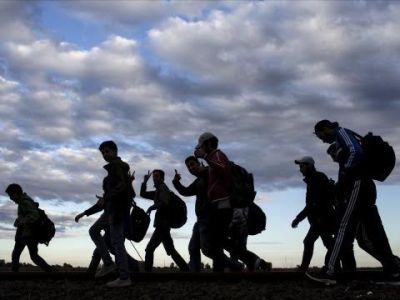
Barbara ArdingerEl Presidente was enlarging his war against his citizens. This meant the roads were more crowded than before with refugees fleeing the capital city for safety among the farmers on the plains and up in the hills. Some of these refugees arrived, of course, at the farm of the wicked witch.

Refugees

Whenever a family arrived, the witch would put on her wickedest face and voice (she’d been practicing) and tell the children she was going to roast them and eat them with mashed potatoes and baby gravy. The children believed her for about a minute and a half, whereas their parents just smiled as each family was taken in hand by the senior refugees and led to rooms where there were new beds. The tenured refugees had (with the witch’s permission) taken charge and somehow found enough lumber to build two new rooms (lean-tos) at the side of the house. They were also working the farm and doing whatever they could with other providers of shelter to make newcomers as comfortable as possible. All the farms across the plains and in the hills had nearly run out of food to feed their guests, but with the coming of spring and tiny green shoots already showing, many of the people were hopeful. Continue reading “Springing Forward with the Wicked Witch by Barbara Ardinger”

Drumming to the Universal Pulse in an Out of Sync World by Carolyn Lee Boyd

carolynlboydBeneath all being is a universal rhythm that is as deep as natural law and as easy to find as the beat of a drum.  After giving up an early interest in percussion 50 years ago when a school music teacher told me “girls don’t play drums, ” I discovered this in a World Rhythms  hand drumming class at a local music conservatory. The other students, our uber-patient teacher, and I were pounding away, practicing rhythms and counter-rhythms,  when we were suddenly all embraced by the flow of a single central pulse and, freed from the constant task of trying to stay on beat, created, for that moment, an entity of sound that was unique, beautiful and complex, and living.

Later I learned that “entrainment” is a well-researched phenomenon that happens when two or more entities in proximity naturally synchronize their rhythms. Entrainment causes roommates to menstruate on the same schedule, or clock pendulums to begin to swing at the same pace when placed near one another, or drummers to play perfectly on the same beat seemingly effortlessly. Continue reading “Drumming to the Universal Pulse in an Out of Sync World by Carolyn Lee Boyd”

Redeeming Gender, Softening Extremes by Chris Ash

Christy CroftLast month, I attended a lecture by Anglican theologian Adrian Thatcher on his recent book, Redeeming Gender. In this book, Thatcher draws upon the one sex and two sex theories described by Thomas Laqueur in his book, Making Sex: Body and Gender from the Greeks to Freud. Laqueur posits that until the eighteenth century, it was believed that women and men were two expressions of the same basic sex – that women were men whose reproductive organs were similar but found in the “wrong” places. Ovaries were internal testes, the vagina an inverted penis, and the labia a parallel for the scrotum – all making women flawed expressions of man.

This sets up a continuum in which there is one sex rather than two, with men as more perfect expressions of man, and women as inferior expressions. Thatcher argues that if the language, liturgy, and doctrines of the church arose in the context of the one sex theory, then Christianity’s foundational beliefs and practices are already compatible with acceptance of a spectrum of gender identity within a one-sex model, opening up new interpretations that allow for full participation of women and LGBTQ+ people within the church. While the old one sex theory as described by Laqueur is a spectrum from more to less perfection, from more to less like God, the spectrum Thatcher proposes is clearly progressive – one in which all places along the spectrum share in the same equality.

And yet it is still a linear spectrum, with extremes envisioned as opposites, as distant from each other. Continue reading “Redeeming Gender, Softening Extremes by Chris Ash”

A Lenten Reflection by Natalie Weaver

Natalie editedA friend recently asked me whether I believed in sin.  It was a strange question for me to consider because the concept of “belief” as applied to “sin” already suggests that sin itself is not a self-evident or manifest reality.  Considering the question, I had to answer that I didn’t actually believe in sin as an objective ontic something.  Hurt, wounds, violence, injustice, suffering – these are objective realities that I have no trouble identifying.  It was in naming the contrast or painful human experiences as sin with which I had the difficulty, since sin connotes moral, spiritual, intellectual, or volitional defect or evil.  My intuition pushes back against this reading of the suffering the world reflects, at least in the microcosm, the imperfection of creatures, or perhaps better put, animals, and in a best case scenario, animals in process.

As I considered this question, I discerned that what is typically identified as sin is a byproduct of the natural limit of animal or creaturely life.  This is to say, we are developmental, process-dependent, works of complex animal life.  We are imperfect in the truest sense – that is, we are not completed beings but ongoing verbs with past tense helping verbs and “ing” endings.   I have been trying; you have been growing; they have been seeking.  In Christian language the term we use is “eschatological,” which connotes that the process has an end or a purpose.  But, I am inclined to think this is just a more confident way of acknowledging the inevitable nature of worldly imperfection. Continue reading “A Lenten Reflection by Natalie Weaver”

We the People by Joyce Zonana

jz-headshotDuring the January 21st Women’s March in New York City, I was inspired and delighted by so many of the signs women and men had crafted to express their opposition to the current disastrous regime in the United States: “Grab America Back,” “Support Your Mom,” “Sad!,” “Miss Uterus Strikes Back.”  But one image stood out, mesmerizing me:  that of a woman proudly wearing an American flag as hijab, with a message below—“We The People Are Greater Than Fear.”  For several blocks as we made our way up Fifth Avenue, I walked beside a woman carrying that sign, and it became, for me, the most powerful symbol of the resistance we must all wage during the dark time ahead.


il_570xn-1174082361_2sxw
Poster by Shepard Fairey
images-1
Munira Ahmed photo by Ridwan Adhami

The image, based on a photograph of Munira Ahmed by Ridwan Adhami, was created for the Women’s March by graphic artist Shepard Fairey (who also designed the iconic image of Barack Obama, “Hope”).  It offers a striking visual challenge to a long-held orthodoxy, now brought to the fore by Donald Trump and his gang:  that Western-style liberal democracy (epitomized by the United States) is incompatible with Islam.  And, perhaps even more specifically, that Islam is incompatible with feminism.

Many Western women—including feminists—are still bound by the Orientalist worldview that encumbered our liberal feminist foremothers.   Continue reading “We the People by Joyce Zonana”

Reflections on Death, Evil, and Divinity by Carol P. Christ

carol-p-christ-photo-michael-bakasIn our book Goddess and God in the World, Judith Plaskow and I discuss and debate our contrasting and conflicting views of the nature of divinity and the cause of evil. In the passage that follows, I respond to Judith’s questions.

This brings us to the major philosophical issue that divides us: the nature of divine power and the relation of divine power to the world. It is fair to say that our major difference in this regard is whether the divine power is personal, conscious, intelligent, loving, and good. You ask, “If all we know of that exists is a mixture of the good and the bad . . . , if our creativity and the creative power that births and sustains the world brings forth both good and evil, then how can the Goddess be less than ambiguous? How can the Goddess be ‘the ground of all being’ if she does not ‘form light and create darkness, make weal and create woe’ (Isa. 45:7)? This question lies at the heart of our differences.

. . .

You ask whether “evil finally has less metaphysical warrant or reality than good” in my worldview. Continue reading “Reflections on Death, Evil, and Divinity by Carol P. Christ”

Despite Hollywood’s Activism, the Oscars are still White by Anjeanette LeBoeuf

AnjeanetteActivism and Politics have had a complex relationship with Hollywood. Now more than ever actors, directors, and many more associated with the media industry are using their voices, their positions, and their money to causes, political parties, and movements. More and more groups and reports are being generated stating the power of positive representation and even of the necessity of forward progress. Yet, despite the pressure and call for action, there still is heavy resistance, which can be most clearly seen during award season. Continue reading “Despite Hollywood’s Activism, the Oscars are still White by Anjeanette LeBoeuf”
She is Here by Mary Petiet

Mary Petiet photoOn the morning of January 20, 2017, the world watched Donald J. Trump stand on Capitol Hill for inauguration as the 45th president of the United States. He did not stand alone. Timothy Michael Dolan, Catholic cardinal and archbishop of New York, also stood, and he invoked the divine feminine as he opened the inaugural ceremony with a recitation of King Solomon’s prayer from the Book of Wisdom.

As Dolan stood before the capitol building, which houses the US congress, he called upon the divine feminine with the words:  “Now with you is wisdom, who knows your will and was there when you made the world, who understands what is pleasing in your eyes, what is conformable with your commands, send her forth from your holy heavens. From your glorious throne, dispatch her that she may be with us and work with us, that we may grasp what is pleasing to you. For she knows and understands all things and will guide us prudently in our affairs and safeguard us by her glory.”

She is here. Continue reading “She is Here by Mary Petiet”