Embodiment is a feminist principle which has, as its basis, two fundamental criteria. First, humans require their bodies to live. We must acknowledge that our existence is tied to our bodies. This fact grounds us in this world. Here, and not in some other-worldly place, we live out our lives. We are dependent on our bodies and what the world provides for our survival. In other words, humans are inseparable and interconnected to this world. Humans are not above nature as the Western hierarchical dualist mindset would suggest.
Second, embodiment challenges the hierarchical dualistic notion that the mind and body are separable by connecting the mind to the body. Humans do not exist because they think, as Descartes once said. Rather, humans exist because of a complex system of interactions between body and mind. Without the body, the mind fails and vice versa. The link between the mind and the body has led many feminist theorists to reject any sort of existence beyond this physical life. That is a topic for another time. Continue reading “Supporting Embodiment: Societal and Jewish Views on Body Modification by Ivy Helman”
It’s no secret that the holidays are often a difficult time for queer people. Disproportionately estranged from family, we often must create our own family. While these chosen families can be tremendously life-giving, it’s tough not to long for our families of origin during Christmas time. Many still in relationship with family are forced to retreat to the closet for fear of safety or exclusion this season.
Queer folk who have affirming families of origin still experience the twang of heteronormativity in holiday commercials, family events, and church services throughout December. There’s a reason why many refer to it as “Blue Christmas,” because, well, the holidays can leave us feeling pretty blue when our identities are invalidated, excluded, questioned, or marginalized.
In every nativity scene, we see images of a so-called “holy family” that likely doesn’t look very much like the family’s most queer folk create: a straight, cisgender couple, and a baby. This family is lauded by the Church as the quintessential iteration of what family should look like. When our families don’t look anything like this, it’s easy to see how celebrating the birth of Jesus is fraught with emotional and spiritual hardship.
Virgin de la Regla
There is good news, though. We can subvert this narrative of traditional family by queering the story. So, I’d like to talk a bit about the revolutionary power of queering Mary. Abolitionist and Women’s Rights Activist, Sojourner Truth, said it best at the 1851 Ohio Women’s Convention. Once a slave, Truth questioned the whitewashing done to women of color by white women working only for white women’s right to vote by asking the famed question, “Ain’t I a woman?” In that same speech, she notes that male clergy claim that women “can’t have as much rights as men ‘cause Christ was a man.”
This adage is familiar, not only to women, but also to LGBTQs who have been told that our iterations of family aren’t real or true or right because they don’t reflect the so-called holy family of Joseph, Mary, and Jesus. In an act of theological brilliance and subversion, Sojourner Truth poses this question to the male clergy gathered at the convention: “Where did your Christ come from? Where did your Christ come from? From God and a woman. Man had nothing to do with him!”Continue reading “Painting Mary(s), Queering Mary(s) by Angela Yarber”
It’s only been a month and I am still reeling from the US presidential election. I feel like I’m just beginning to emerge from the sense of loss and futility that has cloaked me. But I am beginning to move forward.
I don’t feel better. I’m still confused and discouraged about why people voted for Donald Trump. I’m very concerned about his cabinet picks and his proposed policies. But I am actively seeking a path forward and a path of resistance. I’m finding support in my spiritual practices and communities.
In the Christian calendar, we are in the season of Advent. Advent carries profound symbolism, and this year it is especially poignant for me. The word advent bears meanings of arrival, birth, and emergence. It’s the beginning of the Christian year, which is patterned on the life of Christ, but the year does not begin Jesus’ birth. That celebration is observed at Christmas, four weeks into the church year. The weeks preceding Christmas are a time of preparation and reflection on the need for the Incarnation. The Incarnation of God in the Christ Child may be a distinctly Christian doctrine, but I believe the need for it–even the idea of it–is found in other spiritual and religious teachings.
During this season of Advent, I have found great comfort in one biblical passage, Psalm 46:10, which translates as “Be still, and know that I am God.”
I take comfort here, when the rest fails me. I find myself, especially during this season, often unable to pray in the way I think prayer is supposed to be offered. Even though I know quiet, non-cognitive prayer that thrums like one’s heartbeat is as legitimate as a dozen rosaries or impassioned petitions, I sometimes struggle to affirm myself in this. Like many academic theologians, I get lost in my mind that knows too many critiques, deconstructions, and rational responses. I teach on the theology of suffering, and I spend hours every week with spiritual caregivers, healthcare providers, funeral directors, and chaplains, who discuss hospice, childhood cancers, car accidents, and stunning grief. I teach on pastoral care, spirituality, and addiction, where we explore the complicated nature of hope in the face of largely hopeless circumstances. I am not sure I ever believed in miracles or lucky rabbit feet. I am in equal parts terrified and dumbfounded by humanity’s divine pleas that go unanswered. I am, in addition to a dozen other descriptors, depending on the time of day, a critical realist, an empiricist, a stoic, perhaps an epicurean, definitely an existentialist, and, Lord, have mercy, a feminist. Prayer in both traditional ecclesial and fiery personal senses often struggles in this company.Continue reading “Be Still by Natalie Weaver”
I always felt curiously distant from the figure of Mary. I always sensed that there is so much there and yet, I could never connect to it emotionally.
The foil to Eve, vessel of Love, suffering mother. I wanted to love her, I wanted to feel her, I wanted to feel drawn to the mystery of Marian devotion. But I felt alienated by the vision of the feminine that she seemed to project: the pure, immaculate, virginal, submissive, obedient, quietly suffering.
Most days, I feel like the opposite of every single one of those qualities.
It’s exactly the kind of feminine archetype I don’t really relate to — the kind of person about whom people say, “oh, she’s really nice” as if yielding compliance and non-offensiveness are her primary attributes. The kind of woman who fades into the background, whose worth lies only in her utility to the patriarchal narrative. Continue reading ““Tricolor Mary: Encountering Three Faces of the Divine Feminine” by Simone Grace Seol”
In the past week I visited Cherry Ridge, Honesdale, Wayne, Pennsylvania in the Pokonos, where I was welcomed by my third cousin Marcia Perry Gager whose family never left the place where our ancestors settled. Marcia and I have been corresponding about our family’s history since Ancesty.com connected us about three years ago. During that time, together with another cousin, Debra Ball, we have managed to decipher the complicated history of Henry Iloff, his two wives, and their eighteen children.
My visit to Honesdale began at John’s Evangelical (formerly German) Lutheran Church. Following a last-minute discovery that the baptism, marriage, and funeral records of the church were not in the Wayne County Historical Musem archives as I had been led to believe, I made a call to the “emergency number” of Pastor Richard Mowery the day before our scheduled visit, not knowing how he would respond to this “not-really-emergency” invasion of his personal space. Continue reading “Down on the Farm by Carol P. Christ”
Midwinter, the winter solstice (December 21), is the shortest day and longest night of the year. I like to think of Yule, an old pagan name for the solstice season, as a time when we get to take a nice, long, peaceful nap between all those holiday parties. For this ritual, you need two candles (silver and gold), a blanket, and a small gift for yourself.
Santa Claus is really a shaman. He wears red and white and black (the three sacred colors of the so-called ancient triple goddess) and he’s fat because he’s well-fed. (A traditional shaman once told me never to trust a skinny shaman; if his people don’t provide for him, he’s not doing his job.) Santa flies from the frozen north, where the Saami (or Lapp) shamans still wield their full traditional powers. He’s drawn through the air by magical reindeer whose antlers symbolize the surging force of life. The Christmas tree is the world pole. From Mongolia to the American Southwest, shamans traditionally ascend the world pole to make their astral journeys. Santa knows everything, especially if we’ve been good or bad, and like karma itself, he brings us our just desserts. His gifts are the gifts of the spirit made material. His attendants, the toy-making elves, are the Old Ones who help the deserving and play tricks on the undeserving. Santa is not a god, but let’s honor him along with the solar gods and goddesses in our midwinter ritual. Continue reading “A Midwinter Ritual by Barbara Ardinger”
As the winter months approach, at least one “Christmas” gathering will be on my schedule. As this holiday has been co-opted by consumerism as evidenced by my memory of the throngs of sales and shoppers in large shopping centers to get “the perfect gift,” I wonder how to give the perfect gift to Mother Earth simultaneously. At the December meeting of my local chapter of the Sierra Club, one of the members passed out a list of gift ideas for a “low-impact” season. Some of the items on the list include or have inspired the following:
Gift Coupons for Services – cleaning out a garage, taking care of someone’s kids for the day, a home-cooked meal for a family, showing someone how to set up composting, teaching someone to knit.
Memberships/Lessons – Yoga classes from a studio, membership to a museum or a gym, art lessons, music lessons.
Gift Basket of Sustainability-Minded Products for Cleaning/Bath
Donations in Honor of Someone
I am sure many of us are already creative in our gift giving. So hopefully you will all comment and share your low-impact gift traditions. For those of us who haven’t quite transitioned or have never fully thought of pursuing this course of action, there can be some resistance encountered in those who receive low-impact gifts. Continue reading “Low Impact Giving as a Holiday Gift to Mother Earth by Elisabeth Schilling”
Ecclesiastes 3:14 – I know that whatever God does endures forever; nothing can be added to it, nor anything taken from it; God has done this, so that all that should stand in awe before him.
Nothing can be added or
taken away…
… then why does it feel like everything is lost?
You haul away the bodies while
we watch
— linking arms
— standing fast
against the tide of
grief that churns until
we can find
a distraction that makes us believe
life will return to
normal
I’m tired in that way that happens when mind-overload, followed incautiously into concrete corners, limits the ability to conceive of solutions and dig up hope. I’m tired of reading commentary and I’m tired of thinking about the seeming impossibility of resolution, though I seem to be doing both compulsively. I read the news and it is overwhelming. I read theory and it is immobilizing: the more I learn, the more I realize how every possible choice of action is complicated by its impact on some person or power structure.
I’m tired in that way that happens to people who take in the world just as fully through their bodies – through touch, sound, breath, feeling, and movement – as they do through their minds. I’m tired in the way of those whose hearts well love and grief that flow up in gentle washes or powerful surges until they must escape in sighs and sometimes tears.
We live in tiring times.
We love in tiring times.
For several years, I was a leader in New Thought churches that held strict adherence to the “Law of Mind-Action” – that we change the blueprint of the universe to manifest according to our thoughts and beliefs – and the “Law of Attraction” – that we attract all experiences into our lives based on our thoughts and beliefs, whether conscious or unconscious. Under both of these principles, the material world, and thus the body, are subject to the will of the mind – subservient, docile, and reactive – just as women (traditionally associated in many cultures with the land and processes of the body) were considered inferior to and expected to remain subservient to men. Continue reading “Positive Presence in Tiring Times by Chris Ash”


 Embodiment is a feminist principle which has, as its basis, two fundamental criteria. First, humans require their bodies to live. We must acknowledge that our existence is tied to our bodies. This fact grounds us in this world. Here, and not in some other-worldly place, we live out our lives. We are dependent on our bodies and what the world provides for our survival. In other words, humans are inseparable and interconnected to this world. Humans are not above nature as the Western hierarchical dualist mindset would suggest.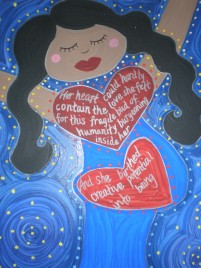
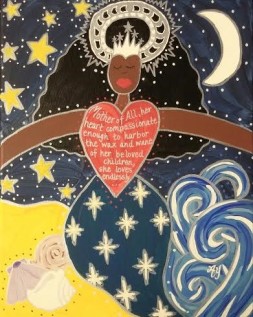

 Be still, and know that I am God.
 I always felt curiously distant from the figure of Mary. I always sensed that there is so much there and yet, I could never connect to it emotionally.
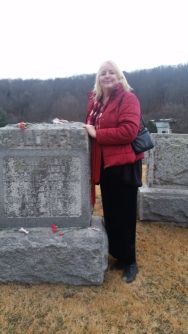 In the past week I visited Cherry Ridge, Honesdale, Wayne, Pennsylvania in the Pokonos, where I was welcomed by my third cousin Marcia Perry Gager whose family never left the place where our ancestors settled. Marcia and I have been corresponding about our family’s history since Ancesty.com connected us about three years ago. During that time, together with another cousin, Debra Ball, we have managed to decipher the complicated history of
  Santa Claus is really a shaman. He wears red and white and black (the three sacred colors of the so-called ancient triple goddess) and he’s fat because he’s well-fed. (A traditional shaman once told me never to trust a skinny shaman; if his people don’t provide for him, he’s not doing his job.) Santa flies from the frozen north, where the Saami (or Lapp) shamans still wield their full traditional powers. He’s drawn through the air by magical reindeer whose antlers symbolize the surging force of life. The Christmas tree is the world pole. From Mongolia to the American Southwest, shamans traditionally ascend the world pole to make their astral journeys. Santa knows everything, especially if we’ve been good or bad, and like karma itself, he brings us our just desserts. His gifts are the gifts of the spirit made material. His attendants, the toy-making elves, are the Old Ones who help the deserving and play tricks on the undeserving. Santa is not a god, but let’s honor him along with the solar gods and goddesses in our midwinter ritual.
  As the winter months approach, at least one “Christmas” gathering will be on my schedule. As this holiday has been co-opted by consumerism as evidenced by my memory of the throngs of sales and shoppers in large shopping centers to get “the perfect gift,” I wonder how to give the perfect gift to Mother Earth simultaneously. At the December meeting of my local chapter of the Sierra Club, one of the members passed out a list of gift ideas for a “low-impact” season. Some of the items on the list include or have inspired the following:
 I am tired.
