The Denied Trans-Childhood of Medusczka by Vanessa Rivera de la Fuente

13162008_266379727041652_171093612_n

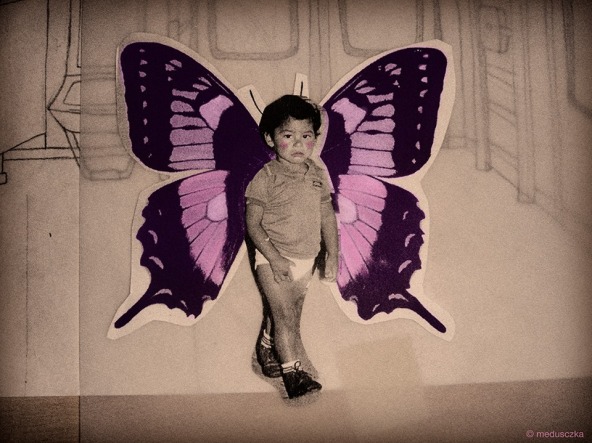
One of my articles in April featured one of the “Niñas Santas Trans”(1). I have been asked often where I came across her and if there are more liken her. Well, she is part of a colorful and provocative project of mexican trans-feminist artivist and illustrator Medusczka Gorgona, who developed a series of images that mix religion Mexican popular culture and trans identities to make visible the non-conforming childhood subjugated by heterosexual discipline.

I have known Meduscka for a while. I am personally fascinated with each one of those beautiful and cheeky “Niñas Santas Trans.” Now is your chance to meet her and her “Niñitas”(2), through this short interview she agreed to have for this site. Continue reading “The Denied Trans-Childhood of Medusczka by Vanessa Rivera de la Fuente”
American Renaissance Festivals and the Yearning for Merry England

mary costume arden forest
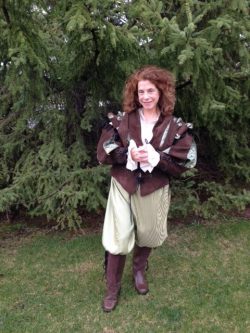
Mary sporting Elizabethan attire during her recent book tour for The Dark Lady’s Mask.

When I was a student in the 1980s, I spent my late summer weekends in another realm. Donning a green gown I had sewn myself, I became a Renaissance woman, or a low-budget facsimile thereof, my cheap, silver-plated goblet hanging from my belt to save me from the indignity of drinking from a paper cup.

For three summers from 1983 to 1985, I was a performer at the Minnesota Renaissance Festival, in those days a much more low-key and grassroots affair than it is today. My character was a historically inaccurate hybrid between a village minstrel and a faery queen out of A Midsummer Night’s Dream.  (I was trying very hard to channel Stevie Nicks.) I even spoke in a fake British accent, largely informed by Monty Python.

For the most part, I was unpaid, although I did earn minimum wage the summer I worked in the information booth. This involved giving directions and handing out site maps. The most exciting part was when some unsuspecting person asked the way to the restroom. Continue reading “American Renaissance Festivals and the Yearning for Merry England”

Tipping Points in Academe By Grace Yia-Hei Kao

I’ve been thinking a lot about tipping points of late.

According to Malcolm Gladwell’s debut book, The Tipping Point: How Little Things Can Make a Big Difference (2000), a tipping point is “the moment of critical mass, the threshold, the boiling point” when an “idea, trend, or social behavior crosses a threshold, tips, and spreads like wildfire.”

Continue reading “Tipping Points in Academe By Grace Yia-Hei Kao”

What Does Mother’s Day Mean in a Patriarchal and Matricidal Culture? by Carol P. Christ

Carol Molivos by Andrea Sarris 2When we seek immortality or spiritual “rebirth,” are we not saying that there is something wrong with the “birth” that was given to us through the body of our mothers? In She Who Changes and in “Reading Plato’s Allegory of the Cave as Matricide and Theacide,” I asserted that our culture is “matricidal” because it is based on the assumption that life in the body in this world “just isn’t good enough.”

What is so wrong with the life that our mothers gave us that we must reject it in the name of a “higher” spiritual life? The answer of course death.

Can we love life without accepting death?

Can we love our mothers if we do not accept a life that ends in death? Continue reading “What Does Mother’s Day Mean in a Patriarchal and Matricidal Culture? by Carol P. Christ”

What Czech Has Taught Me about Knowledge by Ivy Helman

20151004_161012Stalé mám žlutou knihu tak neumím slova.  (I’m still in the yellow book, so I don’t know the words).  Mluvíš o něčem ale nevím co říkáš.  (You are talking to me about something I don’t know what you are saying).  Neznám jí.  (I don’t know her).

The Czech language has three verbs that express knowledge.  The first umět expresses one’s ability.  Literally, one doesn’t know because one lacks the skill or hasn’t been taught how to do something.  The second vedět captures more the idea of stating facts or events.  It almost always requires a connecting word like “that, what, which, etc.”  One can’t use this verb with a direct object with one exception: to vím (I know (it)).  The third verb znát signals familiarity and it can only be used with a direct object.  So, if you want to ask if someone knows someone else, you use znát, if someone knows when the movie starts, vedět, and if someone knows how to play the piano, umět.

So in other words, the three sentences above are better translated as follows: I’m still in the yellow book so I haven’t learned the words; you are talking to me about something but I don’t understand what you are saying; I’m not familiar with her.

Continue reading “What Czech Has Taught Me about Knowledge by Ivy Helman”

Dance of Persephone: The Trata of Megara by Laura Shannon 

Laura Shannon square cropIn a previous post on FAR I explored Greek Easter customs which interweave Christian and pre-Christian beliefs.  Today I would like to take a closer look at one of these customs, the women’s ritual dance known as Tráta, ceremonially performed on ‘Bright Tuesday,’ the Tuesday after Easter. Versions of Tráta survive in the towns of Mégara and Elefsina just west of Athens, on the island of Salamína directly across from them, and in the surrounding area as far as Thebes.

Elefsina, of course, is Eleusis, where for over 2,000 years the Eleusinian Mysteries enacted the story of Demeter and her daughter Persephone’s descent to the Underworld. Choral dance was a central part of the ceremonies at Eleusis – as at other sacred sites including Delphi, Knossos, Athens, and Vravrona – and the ‘Well of the Beautiful Dances’ can still be seen at the archaeological site. It is a a visible reminder of the circle dancing which was a part of the initiatory experience, bringing cosmic order – symbolised by the circle – into the human world. This is still one of the functions of the Tráta as performed today.

Eleusis
Eleusis
Eleusis – ‘Well of the Beautiful Dances’

Continue reading “Dance of Persephone: The Trata of Megara by Laura Shannon “

Dear Mum by Jassy Watson

jassyMother’s Day is coming up on the 8th of May here in Australia and while I don’t agree with the commercialization of it all, I do believe that motherhood, maternal bonds, and the influence of mothers in society should be recognized and celebrated. The essence of this day is so much more than just giving a gift or saying Happy Mother’s Day, it is about truly letting our mums, whether they be maternal or just a mother figure in our life, know how much they are appreciated.

While celebrations commemorating and honouring motherhood date back to ancient times, it was not until the early 1900’s, through the efforts of Anna Jarvis that it became an official day of honour. Anna herself however also became resentful of the commercialization of the day after Hallmark started selling Mother’s Day cards in the 1920’s. She stood by her belief that it was a day to express gratitude, not one for profitable exploits and went as far as publicly protesting and boycotting Mother’s day to show her disgust at the companies who were taking advantage. Anna believed that we should be hand writing letters and cards and displaying our gratitude through actions, not by purchasing pre-made sentiments. I agree, mind you I have to say I don’t object to receiving wine and chocolates. Continue reading “Dear Mum by Jassy Watson”

Plato’s Diotima as a Symptom of Psychosis by Stuart Dean

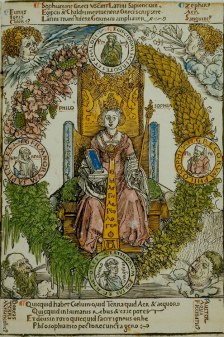
Stuart WordPress photoAs I mentioned in my January 30, 2016 post, Grace Jantzen in Foundations of Violence makes a compelling case that Diotima is a fictional figure.  She does not, however, adequately distinguish her from the poetizing female figures Parmenides and Boethius portray as instructing them in their respective works.  If nothing else, the quality of the poetry of Parmenides and Boethius betrays the influence of a very real woman: Sappho.

By contrast, Plato essentially portrays Diotima as the personification of his philosophy–his metaphysics–and it is hard to believe there was such an ancient Greek woman.  Although the term ‘metaphysics’ derives from a neologism coined in Greek centuries after Plato and Aristotle lived, its meaning (‘beyond’ (meta) the ‘natural,’ or ‘embodied’ world (physics)) appropriately characterizes what Diotima and hence Plato’s philosophy is all about.  A key passage is where she characterizes the most intense love as “gazing at and being with” the beloved, without even the need to “eat or drink.”  That leads her to ask rhetorically whether it would not be best to gaze at what is not “infected” by flesh and blood (Symposium (211 d-e)).

Philosophy, Albrecht Dürer (1502)(Die Bayerische Staatsbiliothek)

Continue reading “Plato’s Diotima as a Symptom of Psychosis by Stuart Dean”

I Used to Paint All the Time by Natalie Weaver

Natalie Weaver editedI used to paint and draw all the time as a child.  I thought about majoring in art as a college student, but I went to an institution that did not have any applied arts courses in the curriculum.  I had gone to college on a scholarship that I could not duplicate elsewhere, so I settled for a number of art history classes and gave up any formal pursuit of art.  However, when I had my children, I rediscovered art.  More accurately, I did not rediscover it so much as I fell in love anew.  For, I found in working with my children a tremendous liberation.  It did not matter if it was “good” or not, had the “right” form or not, used the medium “correctly” or not, or said something “properly.”  I learned all over again that people could have hearts for heads; skies could rain jellybeans; and skin could be blue just because you like it that way.
Doing art with my children opened up my courage to recognize creative expression as a sacramental act.  Both when it is done for overtly sacred purposes as well as when it is done for more secular ones, art of all media can be an outpouring of the spirit into the material world that allows one to say to another: here I am, this is what I have felt, did you see this, I’ve been there too.  Once freed from norms about how something ought to be used or made or discussed or interpreted, art has the potential to become revelatory, both of the human and also of the divine (or, perhaps better, of the human as divine). Continue reading “I Used to Paint All the Time by Natalie Weaver”

A Short Lesson in Subjugated Knowledges

“We” can give many answers for how to colonize someone; but for many of us, it often takes special training, years of education, reconstructive projects, task forces, books upon book of reading, listening through the loud and ever present static of dominant culture, constant vigilance, one’s own liberation, the liberation of others, etc. to learn how to think otherwise.

Sara FrykenbergIn her Presidential Address at the national meeting of the American Academy of Religion in 2011, Dr. Kwok Pui-lan outlined a history of Religious Studies and its relationship to colonial projects, challenging the membership to apply post-colonial theory and analysis to our scholarship and teaching, think with and relate to our global colleagues, and start asking questions about what studying religion does for us, “rethink[ing], reimagin[ing] and recreat[ing] our discipline.”[1] Responding to this call, I have been slowly working to include postcolonial discourse in each of my classes, lower division, upper division, graduate and undergraduate.

Continue reading “A Short Lesson in Subjugated Knowledges”