Putting Faith in Interfaith Dialogue by Esther Nelson

esther-nelsonWhy do it?  Sit around a table with people who profess a faith tradition different from our own, drink coffee, nibble on snacks, and talk.  What’s the point?  No doubt the reasons vary depending on the particular people getting together.  Nevertheless, there is the sense that if we “sit down together and talk together about our faiths,” we’ll “break down barriers,” and….then what?  Do we think (or hope) that those on the other side of the table will eventually “come around?”  Is conversion a goal?  Or, perhaps we just want to become more “tolerant” of other faiths.

So, for example, if Muslims share facts with Christians about the history of Prophet Muhammad, the Sunni/Shi’a division, and Shari’a law, will that help Christians tolerate Muslims?  Books on the history of religions abound.  Yet, religion-based violence flares around our globe.  Would learning about doctrinal beliefs–“truths” based on (usually male) interpretation of scriptural narrative–be helpful?  Christians understand Jesus to be God incarnate.  Muslims reject any doctrine that compromises the oneness of God.  Now what?  Are barriers broken down?  Are we more tolerant? Continue reading “Putting Faith in Interfaith Dialogue by Esther Nelson”

Enlivened Truth by Safa Plenty

aqua and red


My joy is rebellion, and so is my passion,
my excitement, and even my sexuality,
but only here where truth is kept secret.

Where joy exploding in my vocal cords
and coursing through my limbs is
silenced or censored looked upon as foreign
in this house haunted by sad spirits.


Where my passion rising above the lull
of everyday existence, more in tune with
childlike exuberance is drowned out by
the endless buzz of television noise.

Where my excitement for learning is
relegated to four walls of my blue bedroom,
and conversation and connection propels
me from our first floor to my sister’s
basement apartment.

Where my sexuality is cloistered inciting
fear that even its refined expression would
lead to some mythical disaster in which
men would prey on my delicate femininity.

Where my mind has constricted from being,
asked why I can’t force myself to be satisfied
with a linear spiritual existence or someone’s else
fears and expectations for my life.

My joy is rebellion, and so is my passion,
my excitement, and even my sexuality,
but with love as my fuel, I will be
a rebel with a cause and that cause
will be enlivened truth.

Safa N. Plenty ©2014


Postlude:
As an American Muslim women of African Caribbean, Native American, and European decent, this poem is a reflection on the remnants of both historical trauma and being partially raised in an ultra-conservative community . An experience I am still continuing to heal from. In essence, this is a deeply personal and poetic reflection on my own experience of how intergenerational trauma is often compounded by the practice of literalist interpretations of religion, particularly in my case, Islam. I am continuing a ten year journey in rediscovering my true cultural and spiritual heritage that had been partly denied me.  In writing this piece, I hoped to gain clarity on my path to heal and becoming a healer through a more fluid engagement with my own faith, while learning and benefiting from other faith traditions. Through a full engagement with  Sufism, an integral part of Islam’s sacred tradition, also known as the science of purification (Ihsan), I hope to continue on my journey of spiritual renewal and healing and to aid the world in healing from the fear and numbness that plagues us as moderns.

Safa N. Plenty is an educator and mental health counselor, who will be pursuing a Ph.D at Claremont Lincoln School of Theology with a focus in spiritual formation and peacebuilding.  She holds a Masters of Social Work from Columbia University and an undergraduate degree in interdisciplinary studies with a minor in Africana Studies. For the past two years, she has worked as a K-12 educational contractor and assistant counselor at a local community college. Her research interest include Sufism, Attachment to God, indigenous cosmology, particularly Native American and Somatic psychology. She is also interested in religious mysticism, mindfulness practice in Buddhism and the role of feminism and religion in cultivating a peacebuilding capacity among young Muslim women. She is currently working to develop a faith based healthy relationships program for Mothers and daughters. She enjoys writing poetry, research, and contemplative practice in art.


#YesAllWomen, the Darwin Debate, and the God Complex by John Erickson

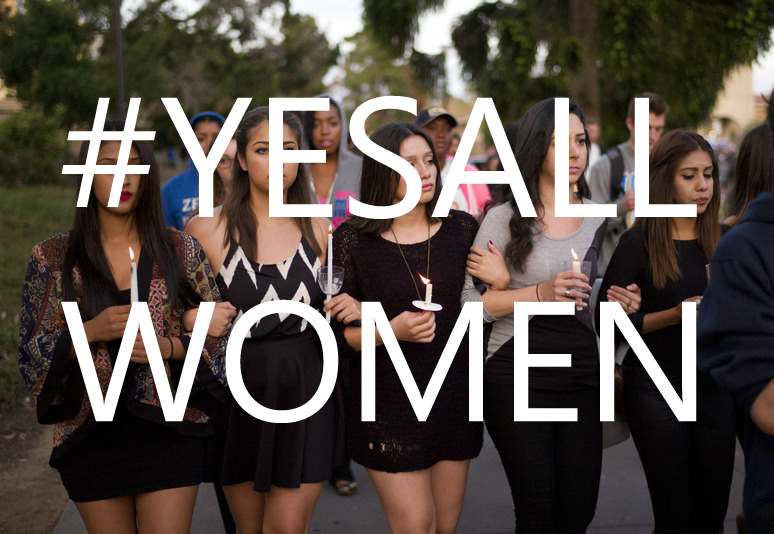
#YesAllWomen proved that although not all men commit horrible crimes against women, the men that often get the headlines and create the most controversy are the ones that need to be watched out for.

John EricksonThe one thing I typically will choose to do on the rare occasion that I’m able to sit down and relax is to watch a documentary.  While some people may go to the gym, read a book, or hang with friends, I typically choose to stay in, nestle up on my couch, and learn.  While on my last bout of relaxation, I chose to watch the HBO documentary Questioning Darwin. Although it offers very little new insight into the evolution vs. creationism debate, it does offer an interesting new way to look at the recent social media hashtag war feminists, allies, and supporters found themselves in over the #YesAllWomen movement that took the world by storm.

yesallwomen

Now, before I discuss #YesAllWomen, I have to admit that I did not enter into the safe space women created for themselves to tell tales of the horrible things they have and have had to face on a daily basis.  I firmly believe that men should not have entered into the digital space Continue reading “#YesAllWomen, the Darwin Debate, and the God Complex by John Erickson”

Redefining Spirituality, One Church for All by Andreea Nica

Andreea Nica, pentecostalismAs a former lover of Christ and ex-Pentecostalist, I had countless visions and dreams that one day I would be a spiritual leader. While growing up in the charismatic church, it was even prophesied that one day I would become one.

Nearly ten years after leaving the church, I carried a distrust in religion’s relationship with women and its barrier to free thought. My work as a freelance journalist led me to discover a spiritual women’s retreat held in North Bend, Washington. Inspired to experience a non-religious, spiritual gathering, I registered for the retreat held by Center for Spiritual Living (CSL) in Seattle.

CSL is described as a:

“Trans-denominational, inter-generational, not-your-usual church, that was started in 1921. A safe place for ‘the rest of us’ who are looking to connect with God/Higher Power/Universal Presence, but don’t really fit in with any one religion.”

The spiritual center’s core teaching philosophy derives from “Science of Mind” or Religious Science, a New Thought spiritual, philosophical, and metaphysical movement founded by practical mystic Ernest Holmes. The spiritual principles rely on the laws of physical science in establishing its core beliefs. Continue reading “Redefining Spirituality, One Church for All by Andreea Nica”

Gaming Empathy: The Spiritual Community of Journey by Sara Frykenberg

Sara FrykenbergThis past weekend I went to the annual meeting of the College Theological Society with my friends and colleagues from Mount Saint Mary’s College.   I gave a paper on the kind of spiritual community that is created within thatgamecompany’s 2012 video game release, Journey. Actually, I have mentioned the game before on this blog—but only in comments, usually when trying to defend particular genres. Today, I would like to correct this. Journey is not an apologetic; as I argued this weekend: it is an opportunity to form a kind of spiritual community within a unique and beautiful cyber-digital world. Continue reading “Gaming Empathy: The Spiritual Community of Journey by Sara Frykenberg”

Christian Sex Ain’t So Vanilla by Andreea Nica

Andreea Nica, pentecostalismMy recent literary digests have included memoirs and nonfiction audiobooks on sex, relationships, and non-monogamy. A recent listen, Open: Love, Sex and Life in an Open Marriage by feminist activist Jenny Block, provides insight into the paradigmatic features of open marriage drawing on the personal experiences of a bisexual woman. Currently, I’m musing over my latest read: The Ethical Slut: A Practical Guide to Polyamory, Open Relationships & Other Adventures written by psychotherapist Dossie Easton and author and sex educator Janet W. Hardy. Through my literary adventures, I can’t help but reflect on my own sexual conditioning and upbringing in the Pentecostal church.

The authors of these feminist-friendly, sex-positive books and social movements did not exist in the church I grew up in, and I feel quite saddened by this. While my sexual conditioning in the church was far from liberating, these reads have helped me realize that the religious community wasn’t as mundane as I thought. My early sex education which was conservative consisted of the anatomical and biological basics (Arizona education system, need I say more?) and early conditioning of sex morals and ethics in the church. The latter was more influential to my perception of sex, gender, and relationships. Of course the media and my peers constructed my views of sexual culture and gender norms, but the church had the greatest impact during my childhood and adolescence. Continue reading “Christian Sex Ain’t So Vanilla by Andreea Nica”

Donald Sterling, Racism, the Social Construction of REALITY, and the Power of WORDS by Paula L. McGee

My dissertation: The Wal-Martization of African American Religion and much of my work talks about the social construction of identity, racism, sexism and the power of brand®ed identities and celebrity.  I keep seeing images and hearing those WORDS or sound bites of Donald Sterling—owner of the Los Angeles  Clippers. His “racist” WORDS kept playing over and over in my head. Donald Sterling, the owner—or maybe the former owner—now banned for life—fined 2.5 million dollars—alleged adulterer—and an alleged racist.

Paula, you have to write about this and add to your literary and scholarly canon.  Then suddenly, like the burning bush in the Exodus narrative and the call of Moses, I started asking questions of myself and whether I am worthy to write these words. Dr. McGee, “What WORDS are academic, yet popular enough? “ More importantly, “How does this fit into your research?”  You want your blog to be on the top of a Google search tomorrow, when the thirty-something and under crowd find the right combination of WORDS to pull you into the browser of their lives.  Your last blog was about Preachers of LA.  How perfect. Your second blog, Reverend McGee will be about billionaire racist WORDS, alleged mistresses, rich ex-wives, and black basketball players. WORDS, WORDS, WORDS, WORDS!  Continue reading “Donald Sterling, Racism, the Social Construction of REALITY, and the Power of WORDS by Paula L. McGee”

Taking Time to Smell Your Roses: What Are You Grateful for This Spring? by Marie Cartier

MarieCartierforKCETa-thumb-300x448-72405I am taking this space, this month to share two very wonderful pieces of news. And I will make the caveat opening here: this is a blog about the benefits of gratitude and I am reaping them here—with a bit of shameless self-promotion. I am advocating here again for my work, my “book child”, as I did in my birth announcement blog!

As we move into spring, I want to step back and take stock of what I have planted that is coming into bloom. And with this, I hope to suggest to you all, dear readers, that you do the same. I (I’ll speak for myself here) tend to rush so much and feel I have so much to do that sometimes when something amazing happens that I have worked so hard for—it just passes me by, and I am on to the next thing before I get a chance to really acknowledge even what that amazing thing was. Continue reading “Taking Time to Smell Your Roses: What Are You Grateful for This Spring? by Marie Cartier”

My Afternoon with Amina Wadud: Some Pearls of Wisdom for a Warm Autumn in Santiago by Vanessa Rivera de la Fuente

Vanessa Rivera de la Fuente. Amina WadudAlbert Einstein said that there are two ways for understanding life: One, to believe nothing is a miracle; the other, to believe everything is a miracle. I think life is a bit of both. There are experiences that result from a chain of events we can easily recognize. Others are just a gift. My meeting with Amina Wadud was of the second kind – a beautiful gift from life in the beginning of the autumn in Santiago of Chile.

Meeting The Lady

Since I converted to Islam, around 5 years ago, and started my path now as a feminist Muslim, it is not possible to explain one without the other in my life history- the presence, words and activities of Amina Wadud have been a source of inspiration for me.

Her book, Quran and Woman, was the first approach to and basis for an Islamic Feminism that stands with strong feet against misogyny and fundamentalism in the name of religion. Her courage when she dared to preach a jutba (sermon) and lead a mix prayer – something still forbidden officially for women in Islam – led us to question our  physical place and its symbolic meaning in the mosque. Her vocation as a globetrotter, talking, meeting, and encouraging people in the world to build new meanings and communities based in freedom of spirit, made me understand that the message of Islam and its different reading on gender, is not only on behalf of Muslim women or Muslims in general, but is on behalf of all humankind, like a whole family looking for social justice and freedom, passengers in this big mosque and madrassa that is Allah’s creation.

Continue reading “My Afternoon with Amina Wadud: Some Pearls of Wisdom for a Warm Autumn in Santiago by Vanessa Rivera de la Fuente”

Religion: Trapped in Love Through Shame by Andreea Nica

Andreea Nica, pentecostalismI was first introduced to shame in the church. Shame paradoxically drew me closer to God, prevented me from committing sins, and helped me repress certain natural urges. The church I grew up in indoctrinated its congregation to believe that shame would transform us into true and wholehearted believers – that as carnal beings, we needed to feel both guilt and shame in order to be saved and transformed into spiritual entities.

One question that permeated my mind growing up, but I’d never dare to publicly ask:

Why would Jesus die for me when I never asked Him to? Continue reading “Religion: Trapped in Love Through Shame by Andreea Nica”