
The Tremble of Love: A Novel of the Baal Shem Tov by Ani Tuzman – Reviewed by Joyce Zonana

jz-headshotNever has it been more difficult for me to affirm that “love trumps hate” as during this unprecedented United States election season.  After watching the Republican Convention last July in mute horror, I took to bed for several days, overwhelmed by the presentiment that everyone–blacks, women, Jews, Latinos, Muslims, queers– other than a certain breed of white American males was doomed to shameless malignment and persecution.  The palpable hatred in Donald Trump’s acceptance speech seared me, arousing my ancestral memory of various persecutions of Jews, Muslims, and others–not something I usually think about or choose to foreground.  For several months now, I have been haunted (and almost paralyzed) by fear.
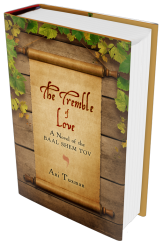
tremble-of-love-cover-3d-for-webHence Ani Tuzman’s The Tremble of Love: A Novel of the Baal Shem Tov has come as an especially welcome, healing antidote, affirming as it does the power of “unshakeable faith even in the presence of inhumanity” (473).  I cannot say that I fully have such faith, but this novel, if anything can, leads me towards it. Page after page is filled with compelling examples of love’s power to disarm hatred and assuage pain.

Early on, a tale is told of a young man fearlessly facing three would-be highwaymen who have stopped the wagon in which he is riding with a rabbi’s wife and her three children, one of whom is disabled:

Continue reading “The Tremble of Love: A Novel of the Baal Shem Tov by Ani Tuzman – Reviewed by Joyce Zonana”

Atonement, Forgiveness, and Feminism by Debra Guckenheimer

Photo by Michael Stepansky

As Rosh Hashana and Yom Kippur approach, I am in the midst of my annual process of asking forgiveness to everyone I have knowingly wronged in the last year. During this time, Jews atone for our wrong-doings. We are tasked with not only asking for forgiveness, but making things right with those we have wronged.

This year, I’m realizing that I have been missing out on so many aspects of forgiving. What about the forgiveness I am not aware I need? I need to learn to forgive us and to invite others to call me out on the ways I have inflicted harm on them. Continue reading “Atonement, Forgiveness, and Feminism by Debra Guckenheimer”

Women Beyond Belief by Karen L. Garst

karen_garst_imgIf you knew about me, you might ask, “Why does a former executive decide to abandon retirement and devote herself to writing a book about women leaving religion?” Of course if you knew me well, you would understand that I must have a worthwhile project. Idleness is not in my nature. But the path that led me to the publication of Women Beyond Belief: Discovering Life without Religion is, hopefully, an interesting one and reveals a shy girl, born in the nation’s hinterland, who matured into an ardent feminist and then moved on to expressing that feminism through writing about women and atheism.

When I mention in interviews that I grew up in Bismarck, North Dakota, most are able to guess that I was likely raised as a Lutheran. And they are correct. Trinity Lutheran Church, at the time a beautiful church with amazing stained glass windows, was the center of my life. Recently, my sister and I, who calls herself an agnostic, sang old hymns together on a road trip. With a 55,000 year history, it is no wonder that music leaves a deep impression on us. With long gowns, we walked down the aisle at Trinity singing “God’s Word is Our Great Heritage” in youth choir. It was a singular experience in my life that has no equal. This ALC church was fairly liberal though at the time there seemed to be a bit of a war going on with Catholics. Why else would I have asked my father at the tender age of seven if it would be okay if I married the Catholic boy who had just walked me home from school? Unpacking why I would think of marriage at seven must be left to another day. Learning Martin Luther’s catechism was arduous. I can honestly say I never understood it at all. Continue reading “Women Beyond Belief by Karen L. Garst”

The End is Nigh by John Erickson

How will the world end? No, it isn’t Lucifer himself coming from hell to bring in the end times, it is someone far worse, and his name is Donald Trump.

John Erickson, sports, coming out.When I was a little boy I was terrified that I would live to experience the end of the world.  Whether it was by an asteroid, Y2K, or a zombie plague, I would make myself sick by picturing these horrible things that could befall me and my family.  Although I was a precocious child, the crippling fear that would lurch its way up my stomach and into my head would sometimes make it impossible to sleep at night.  While I like to think I grew out of that phase, I now sit here feeling that way again.  I’m crippled with fear that the end of the world is at hand and there may be nothing we can do to stop it.   How will the world end? No, it isn’t Lucifer himself coming from hell to bring in the end times, it is someone far worse, and his name is Donald Trump.

By the time you’re reading this post, the first Presidential debate between Hillary Clinton and Donald Trump will have occurred and, no matter where you look, the aftermath will haunt us for weeks to come.  We will either be sitting here, coaxing in the sunlight that Clinton has, in proper fashion, just goaded Trump into revealing to the 100 or so million viewers that will have chimed in to viewing how completely dangerous he truly is, or will we be scurrying to uncover decade old bunkers that were used during the 1950s and the Cold War to take shelter from the fallout to come should, Donald Trump become the next President of the United States. Continue reading “The End is Nigh by John Erickson”

Voting for Hillary & the Real Meaning of Sanctity of Life by Marie Cartier

I just don’t trust Hillary,” a friend said. “Give me one good reason why I should vote for her—other than that, you know, she’s a woman—since I know you teach Women’s Studies.

OK. Here goes.

hillary-and-gunsI recently got a request for support from Gabby Giffords, who was shot on January 8, 2011. This U.S. Representative and eighteen others were shot during a constituent meeting held in a supermarket parking lot in Casas Adobes, Arizona, in the Tucson metropolitan area. Six people died, including federal District Court Chief Judge John Roll; Gabe Zimmerman, one of Rep. Giffords’ staffers; and a nine-year-old girl, Christina-Taylor Green. Giffords was holding the meeting, called “Congress on Your Corner” in the parking lot of a Safeway store when Jared Lee Loughner drew a pistol and shot her in the head before proceeding to fire on other people.

In her recent request for support, Rep. Giffords pondered why she didn’t die and six others had.  There is no answer—save for that, if there is God’s hand in this, she is the one who went on to fight against the all-powerful Gun Lobby who, for years on end continue to use big money to influence Congress.

On November 8th, we, the American people, will decide, for better or worse who is the next leader of the most powerful country in the free world. An important question to ask ourselves as we consider the candidates is: What does it mean to believe in the sanctity of life? Continue reading “Voting for Hillary & the Real Meaning of Sanctity of Life by Marie Cartier”

The Restorative Act of the Rite-13 Ritual by Katey Zeh

carpeI had never heard of the Rite-13 Ritual until I saw it listed on my worship bulletin a few months ago. My first reaction was to become annoyed when I saw the additional program item and to begin to calculate the additional minutes we were going to be sitting in our pew. Our nearly two-year-old daughter had just had her weekly meltdown over being left in the nursery, and all I wanted was for this liturgical hour to be over so I could scoop her up in my arms and take her home.

Started by an Episcopal Church in the 1980s the Rite-13 Ritual is modeled on the Jewish bar and bat mitzvah and intends to recognize adolescence as a time of transition in a young person’s life. After the opening hymn, six gangly, slightly awkward teenagers and their slightly nervous parents made their way up to the front of the congregation. They began with a reading based on Psalm 139: “God, investigate my life, get all the facts firsthand.” Most of their voices were barely above a mumbled whisper, perhaps due to the sheer discomfort of being center stage at church. In between each passage the youth read, the congregation responded, “Your creation is wonderful, and we know it well!” I’m a strong advocate for participatory worship, but this kind of of responsive reading always feels a little odd to me.

The last portion of the ritual, however, caught me off guard and left me in tears. The youth knelt down as their parents prayed a blessing over them. We couldn’t hear what was said, but watching these parents lovingly speak words of affirmation and encouragement softly into their children’s ears was beautiful. Now that I’m a parent, I couldn’t help but imagine what it might be like to stand in their place one day and pray a blessing over my daughter. But I don’t think that’s what brought on the tears.

I had a flash of a memory of a similar scene. I was also thirteen standing at the front of my church with my mother and a group of other youth and parents. We were not there to receive a blessing or to be affirmed, however, but instead to proclaim our commitment to sexual purity until marriage. It was the late 1990s and the True Love Waits movement was just ramping up. I guess you could say my church was an early adopter.

Instead of reciting Psalm 139, we spoke these words instead: “Believing that true love waits, I make a commitment to God, myself, my family, my friends, my future mate and my future children to be sexually abstinent from this day until the day I enter a biblical marriage relationship.” In this evangelical church of my childhood the only readily available affirmation of me as a teenager was tied to an ill-informed, naïve promise I was pressured to make about sexual abstinence for the foreseeable future and beyond.

It was a perfect example of the contradictory theological messages I got constantly from my faith community: God created you, so you are good. But you are also sinful, so you are bad. I remember a church friend once jokingly said, “You totally suck. But Jesus is great through you.”

Twenty years have passed since that True Love Waits Sunday, but as Madeline L’Engle wrote, “I am still every age that I have been.” Over those two decades, I’ve internalized that message of earned and performative self-worth I got as a teenager. It shifted from worth rooted in sexual purity to one tied to academic achievement, transformed to professional success, and then on to marriage and parenthood and the illusive “balance” of doing all of it simultaneously. I still yearn to hear those words of acceptance that I needed then and need to this day.

As I see it, the heart of the Rite-13 Ritual is a commitment on the part of young people to seek divine wisdom throughout the journey of life and for the community of faith to pledge to be a place of unceasing support, friendship, and care for them. No strings attached. I’ve kept that bulletin insert, formerly a source of annoyance, on a prominent place on my desk. I turn to it on particularly hard days as a constant reminder of the truth of my own sacred worth that can’t be lost or earned. It simply is. “Your creation is wonderful, and we know it well!”

Katey Zeh, M.Div is a thought leader, strategiest, and connector who inspires intentionalKatey Headshot communities to create a more just, compassionate world through building connection, sacred truth telling, and striving for the common good.  She has written for outlets including Huffington Post, Sojourners, Religion Dispatches, Response magazine, the Good Mother Project, the Journal for Feminist Studies in Religion, and the United Methodist News Service. Her book Women Rising will be published by the FAR Press in 2017.  Find her on Twitter at @kateyzeh or on her website kateyzeh.com

Weaving and Spinning Women: Witches and Pagans by Max Dashu: Reviewed by Carol P. Christ

carol p. christ photo michael bakasMax Dashu’s  Witches and Pagans: Women in European Folk Religion 700-1000 challenges the assumption that Europe was fully Christianized within a few short centuries as traditional historians tell us. Most of us were taught not only that Europe became Christian very rapidly, but also that Europeans were more than willing to adopt a new religion that was “superior” to “paganism” in every way. Careful readers of Dashu’s important new work will be challenged to revise their views. When the full 15 volumes of the projected series are in print, historians may be forced to hang their heads in shame. This of course assumes that scholars will read Dashu’s work. More likely they will ignore or dismiss it, but sooner or later–I dare to hope–the truth will out. Continue reading “Weaving and Spinning Women: Witches and Pagans by Max Dashu: Reviewed by Carol P. Christ”

“And God Said It Was So”: Donald Trump Is the Spittin’ Image of Bad Theology by Carol P. Christ

Carol P. Christ by Michael Bakas high resoultionI try very hard this election season to avoid reading about, watching, or listening to Donald Trump: the man is a liar, a cheat, a bully, a narcissist, a racist, a sexist, the list goes on. Yet even progressive commentators are talking almost exclusively about him. And now I am joining them–despite my best intentions.

Reflecting on why facts seem to matter so little to Trump, Patricia J. Williams characterizes his campaign as an exercise in one-way communication:

Freedom of expression is reduced to an arbitrary insistence upon one-way communication, a barked order. Making America “great again,” by this measure, is a command, not a hope. . . This assumption—the belief that communication flows in one direction only, that it is the role of some to speak and others only to listen—is a paradox that stifles rather than encourages debate.

Continue reading ““And God Said It Was So”: Donald Trump Is the Spittin’ Image of Bad Theology by Carol P. Christ”

Elegy for An Old Life Gone: A Feminist Says Goodbye to Football by Marcia Mount Shoop

MMS Headshot 2015

I married into your strange cadence
A drumbeat that never felt natural
All consuming was your intention
But I protected pieces of myself from your designs
And more pieces retrieved me
As you showed me your true colors
You were a ruthless, untrustworthy friend
You were a harsh, seductive suitor
You gave me just enough of what
I never dreamed of
To capture my attention
My intentions, all these years
You, an adored brother of the one I love
You, a superlative dissembler
And people love you for the mythic way you tell
A story
Yours, ours, theirs
I gave into parts of you, I found some contorted freedom there istock-football
Some iteration of voice
Some impulse to make the best of you
Laying you to rest is cumbersome, Continue reading “Elegy for An Old Life Gone: A Feminist Says Goodbye to Football by Marcia Mount Shoop”

In Search of Ancestral Wisdom by Max Dashu

Max 2011

 What is the preserving shrine? Níansa (not hard).
The preserving shrine is memory and what is preserved in it.
What is the preserving shrine? Níansa.

The preserving shrine is Nature and what is preserved in it.
Senchas Mór, Ireland

In a world in extremity, we are searching for the wellspring, the inexhaustible Source known to all our ancient kindreds. Many of us have been cut off from our deep roots, and especially from the ancient wisdom of women, and female spiritual leadership.

My long quest has been to discover the lost strands of my own roots, the old ethnic cultures of Europe, and to reweave those ripped webs. I have spent decades searching for authentic cultural testimony about women’s spiritual ways before Christianity, before the Roman empire, before men commandeered all positions of religious leadership. My book, Witches and Pagans: Women in European Folk Religion, brings together these ripped strands of the cultural web. Continue reading “In Search of Ancestral Wisdom by Max Dashu”