Exe(o)rcising the Spirit by Natalie Weaver

Natalie editedWhy bother? It’s a legitimate question.  My oldest son, almost 12, announced that he is depressed.  He’s got good reasons for it, so I don’t try to talk him out of it.  My youngest, almost 8, told me yesterday that life was simpler when he was in my belly.  Now, he says school is torture.  They won’t just teach something and move on.  They have to do “activities,” he says, he’s onto the racket that is known as busy work.

I spoke with an aunt, a cancer survivor, whose progress is steadily monitored.  Life, it seems, has become about watching and waiting rather than living.  There’s not so much to look forward to, she says wistfully, once you get to a certain age.  My friend called in distress.  Not one area of life – not work, not kids, not household, not romance – was untouched by significant stress. She said that she could understand how people are okay with their kids moving out.  There is a time, she observed baldly, when it will be alright to die.  She said, I’m tired.

What do we do with fatigue that becomes soul deep?  In my own case, I used to move it around from one place to another, focusing on what I could do as a remedy for the things I could not change.  What I have come to realize, though, is that we run out of storage space eventually.  There’s no place to hide from this – this question – of meaning or meaninglessness.  When I try to assess and work out what’s on my mind, that is, when I feel the fatigue of meaning, I realize that I am dealing with something spiritual in nature.

It’s plain as day, of course, when you give it a second’s thought.  But, at first blush, it is not always immediately self-evident that the angry person mouthing “bitch” at me in the crowded parking lot or my frustration at my kids not responding to my third request, were and are, at the root, theological problems.  Such things were and are, the things that push the self toward the precipice of spiritual demise.

Why bother, I wonder, when the handsome and seemingly happy couple in line in front of me to see Santa with their little boy turns to me hostilely and threatens me should my own eager child accidentally bump into them again.  As I stand on, dazed, still looking at them with something of a smiling admiration on my face, trying to understand what I have just heard, I am yelled down for the look on my face.  What is this world, I wonder, while my own joy begins to shift into an anger that I am now tasked with suppressing and rationalizing?

The more I recognize myself in this place, especially as a woman, the more I understand that traditional theology, and specifically traditional Christian doctrine of God, has more or less failed to help me here.  It has failed to provide me, specifically as a woman, an adequate way of dealing with the inevitable fatigue of a life lived long enough.  What do I mean by this?  I find that I have internalized a distorted sense of value and more importantly a distorted sense of self in relationship to others.

In particular, the idea of servanthood, even service as leadership, can be an infectious and distorting delusion whereby one inclines oneself simply to be taken advantage of by others.  This happens in family life, work, and even in volunteerism (especially at the Church).  Likewise, the insistence on joy, hope, resurrection, loving the neighbor, the new day yet to come – these can become woefully burdensome, even to the very young, because such spiritual dispositions stifle the capacity to experience–honestly and without self-critique–anger, fear, boredom, and disappointment.

As a woman, I find myself to be particularly susceptible to spiritual instruction about service, docility, duty, and self-gift, in ways that I increasingly come to understand are not genuinely relationally intelligent or spiritually wholesome: they are gendered norms for desirable social being.  Of course, I know all this stuff as theory.  I have for two decades.  But, now, now I know it for myself, in my skin, and that is a heavy transition in the soul.

I’m not sure I agree that religion the opiate of the masses, but I do agree that one of the foremost reasons people create religion as a framework for interpreting life is that they are confronted with the profound task of meaning-making out of what often seems to be the unfathomable reach of meaninglessness.  Theology is a response to that, as is worship.  The older or perhaps wiser or perhaps more reckless I get, the more I understand that is incumbent on each of us to be able to think theologically in ways that are authentic and true to our own experiences and insights.

It is perhaps for these reasons that I have been expanding my own capacity for prayer and ritual by participating in alternative spaces of worship, like the sweat lodge, as well as creating my own, as I have been over the past several on New Year’s Eves, with the invention of a symbolic meal, a structured memorial for the deceased, readings, and a fire ritual at midnight.  I feel at times like a syncretistic pagan wannabe, but I set those self-critiques aside in the knowledge that I am exe(o)rcising the spirit.

That phrase, “exe(o)rcising the spirit,” feels laden, and I have yet to unpack its full import, but I know it means both ridding myself of what does not work and claiming the authority to honor what does in ways that are sacramental and meaningful to me and to those in my community of intimates.

Perhaps the best way that I alternatively theologize is through creative writing, through the beckonings of theopoesis, where I find I can speak without the impositions of structure in the quasi-grammarless realm of experiential knowing.  It is here that I have discovered freedom to disagree and complain as well as to integrate and praise in a voice that talks to God in earnest, as though God were listening.  In preparation, for a solstice sweat, this is what I had to say.

These sides are not

sharp antagonisms

that bring to points

their points of view

but a pond’s surface

under moonlight,

swirling like mercury,

beneath which minnows,

fluid, do

their works of

harmonious disruption.


So, let my prayer be not

please,

for, I fear

I have been

an ungrateful guest.

Sojourning pilgrim,

refugee,

all this life, all will be,

a lesson in how to say

thank you.

Natalie Kertes Weaver, Ph.D.is Chair and Professor of Religious Studies at Ursuline College in Pepper Pike, Ohio. Natalie’s academic books includeMarriage and Family: A Christian Theological Foundation (Anselm, 2009); Christian Thought and Practice: A Primer (Anselm, 2012); and The Theology of Suffering and Death: An Introduction for Caregivers (Routledge, 2013)Natalie’s most recent book is Made in the Image of God: Intersex and the Revisioning of Theological Anthropology (Wipf & Stock, 2014).  Natalie has also authored two art books: Interior Design: Rooms of a Half-Life and Baby’s First Latin.  Natalie’s areas of interest and expertise include: feminist theology; theology of suffering; theology of the family; religion and violence; and (inter)sex and theology.  Natalie is a married mother of two sons, Valentine and Nathan.  For pleasure, Natalie studies classical Hebrew, poetry, piano, and voice.

Turning One by Sara Frykenberg

14724657_10154061354658546_8918956387379465095_nThis month I turn one as a mother. My daughter, consequently, is also turning one—a first birthday I am excitedly planning. Specifically, I want to make Hazel a rainbow cake with lots of colored layers and white frosting. I’m not even sure she’ll be able to eat the cake (avoiding lots of sugar for a one-year-old and all), but among those family pictures I treasure, my mother held a cake for her little ones. I want to be like my mother. I am going to make a cake.
But planning my daughter’s party, I realized that I am also going to have a kind of birth-day anniversary. Other moms have told me that it takes a year to really process the experience of giving birth. While I did consider the significance of my “birthing community,” in a blog last fall, I realized a couple of weeks ago that I wasn’t done understanding what I, what mothers, and what life givers of all kinds go through to bring life into the world. Continue reading “Turning One by Sara Frykenberg”

Women Beyond Belief by Karen L. Garst

karen_garst_imgIf you knew about me, you might ask, “Why does a former executive decide to abandon retirement and devote herself to writing a book about women leaving religion?” Of course if you knew me well, you would understand that I must have a worthwhile project. Idleness is not in my nature. But the path that led me to the publication of Women Beyond Belief: Discovering Life without Religion is, hopefully, an interesting one and reveals a shy girl, born in the nation’s hinterland, who matured into an ardent feminist and then moved on to expressing that feminism through writing about women and atheism.
When I mention in interviews that I grew up in Bismarck, North Dakota, most are able to guess that I was likely raised as a Lutheran. And they are correct. Trinity Lutheran Church, at the time a beautiful church with amazing stained glass windows, was the center of my life. Recently, my sister and I, who calls herself an agnostic, sang old hymns together on a road trip. With a 55,000 year history, it is no wonder that music leaves a deep impression on us. With long gowns, we walked down the aisle at Trinity singing “God’s Word is Our Great Heritage” in youth choir. It was a singular experience in my life that has no equal. This ALC church was fairly liberal though at the time there seemed to be a bit of a war going on with Catholics. Why else would I have asked my father at the tender age of seven if it would be okay if I married the Catholic boy who had just walked me home from school? Unpacking why I would think of marriage at seven must be left to another day. Learning Martin Luther’s catechism was arduous. I can honestly say I never understood it at all. Continue reading “Women Beyond Belief by Karen L. Garst”

The Emergence of Feminist Theology: Remembering our Roots by Judith Plaskow and Carol P. Christ

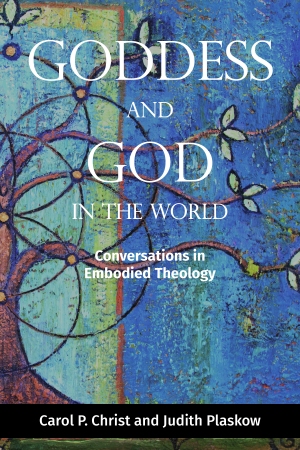
Goddess and God in the World final cover designThis blog is an excerpt from our new book Goddess and God in the World which will be published by Fortress Press in just one week — on August 1. As we look forward to its release, we remember the critical works that started us on a journey of discovery that continues to unfold. In a jointly written chapter, we describe the beginnings of feminist theology.

Feminism was welling up from under during [the late 1960s]. We became feminists early in graduate school but did not discover feminist theology until we were preparing for our comprehensive exams. As Judith was later to write, feminism placed a question mark over absolutely everything for us: the maleness of God, the male authorship of the Bible, and the male perspectives from which virtually all theologies had been written. Three key essays set the stage for future work in the field, including our own. We have already mentioned these essays, but it is important to address the challenges they posed to traditional theology, and our own responses to them, in more detail here. Continue reading “The Emergence of Feminist Theology: Remembering our Roots by Judith Plaskow and Carol P. Christ”

thea Gaia née Dorothy Ivy Wacker: Feminist Foremother and a Great “Ponderer” by Glenys Peacock

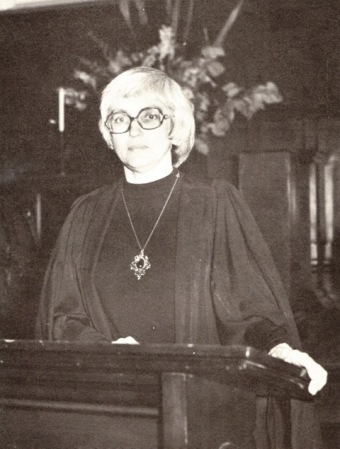
Rev. Dorothy Waker (thea Gaia)
Rev. Dorothy Wacker (thea Gaia)

On 15th May, 2016 thea Gaia left this earth which was her home for 85 years. thea was born
Dorothy Ivy Wacker in Gatton, Australia on 9th February, 1931, the eldest of four children.
Her family were descendants of German immigrants who came to Australia in the 1860s.
In primary school, Dorothy was a bright student, winning a bursary enabling her to continue
her studies at high school which she completed in 1947. She then studied primary teaching
at Queensland Teachers’ College and from 1950-52 she worked at School for the Deaf,
Dutton Park, Brisbane.

Dorothy joined South Brisbane Congregational Church and became President of Queensland
Congregational Youth Fellowship. At age 22, she decided to take theological training to
become a Congregational minister. Dorothy studied for Bachelor of Arts and Bachelor of Divinity at the University of Queensland. In 1959, she was awarded a Certificate of Ordination by the Queensland Congregational Union. Dorothy was ordained on 17th April, 1959 at Broadway, Woolloongabba, the first woman ordained as a Minister of Religion in Queensland. Over the next 10 years she was minister for Belmont, Broadway and Chermside Congregational Churches. Continue reading “thea Gaia née Dorothy Ivy Wacker: Feminist Foremother and a Great “Ponderer” by Glenys Peacock”

Reflections on Researching the Goddess Movement in Britain by Kavita Maya

KavitaMayaI’ve been asked by both academics and Pagans what inspired me to pursue doctoral research on the British Goddess movement: of the many ways that people first click with feminist politics, a story entwined with a ‘spiritual’ impulse might seem unusual, given the slow-to-change secular assumptions of mainstream feminism.

When I reflect on my history, two threads at the core of my early feminist identity leap out: one, the value of thinking and asking questions; the other, ‘feminist spirituality’, which for me describes a profound emotional, intellectual and creative investment in the struggle for a fairer, more inclusive world. Two early ‘click’ moments: as a child, asking persistent questions about the sexist gender roles modeled by those around me (and being told “You’ll understand when you’re older,” which I now recall with a grim irony), and—perhaps unusually—coming across the concepts of patriarchy, feminism and the Goddess by way of 1990s teen fiction about witches. Continue reading “Reflections on Researching the Goddess Movement in Britain by Kavita Maya”

A Tale of Two Sisters by Carol P. Christ

When I first returned from my ancestor quest in Germany, I fell ill with a bad cold and cough and had little physical energy. For two weeks I lived in the dreamtime, communicating with the ancestors and trying to make sense of the information about their lives I had discovered. After I got better, I had difficulty returning to daily life. The ancestors wanted to speak through me. Their stories, based on facts, come to me in waking trance.

A happy moment in the life of girl like Agnes
Feeding the ducks

Agnes Lattauer Sweitzer : I was born in Ober-Floerscheim (Hessen Darmstadt) on July 9, 1812. I was the first in a family of five children. Four years after me came Jakob, named after Father, and three years later, Rudolph. It was nice to have brothers, but my dream of a sister came true when Catherina was born a month and a day after my tenth birthday. My mother was busy with Jakob and Rudolph, so I became a second mother to Catherina. I could not nurse her, but I could sing to her and rock her to sleep. I changed her diapers and gave her a bath. It was so wonderful to have a baby to take care of. Three years later little Johanetta was born two days after my thirteenth birthday. Another baby for me and Mother bring up together.  I was in heaven. I was both mother and sister to the little girls. When they got older, I took my little sisters to play by the stream, where they giggled and cooed as we fed the ducks and the geese. In the summer, Mother and I brought them with us to the fields where we hoed and planted, weeded and harvested. They tried to pull weeds with their little fingers. It was my job to keep them from pulling up the plants too. Continue reading “A Tale of Two Sisters by Carol P. Christ”

Women First, Rivals Later by Vibha Shetiya

VibahSita, as many know, is the tragic heroine of the Ramayana who gets discarded by her husband Rama because he doubted she had remained chaste while in his arch enemy Ravana’s captivity. Moreover, she is the “ideal Indian woman” in popular imagination because she remains loyal to Rama no matter how unfair his treatment of her. But there is another female character in the epic who meets perhaps a far more violent fate.

Unlike Sita, however, Shurpanakha gets little sympathy from the readers because she does not stick to her socially assigned roles. I would like to talk about Shurpanakha and how she comes to symbolize all women who transgress societal boundaries, while also stressing the fact that although she is often presented as Sita’s opposite, the two share far more in common as women; both Sita and Shurpanakha deserve our compassion and empathy.

In the traditional Sanskrit text, Valmiki describes Shurpanakha as “maddened with desire” when she first beholds Rama’s beauty. The poet then goes into a rather lengthy description of what she is not by comparing her “unsightly” presence with Rama’s exemplary beauty, thereby affirming the fact that she does not deserve to be visible because of the physicality of her body. Upon his enquiring, Shurpanakha tells Rama that she, who roams the forest alone and according to her own will, is the sister of Ravana (who later kidnaps Sita), and she makes it a point to add that she is more powerful than all her brothers. She then declares her undying love for Rama and asks him to be her husband, after which the two of them could seek adventure amid the forest together. Continue reading “Women First, Rivals Later by Vibha Shetiya”

#HillYes by John Erickson

I’m going to do something I’d never thought I’d do: fill your newsfeed with yet another article pertaining to the 2016 United States Presidential election and yes, I’m going to talk about former Secretary of State Hillary Clinton (hint: I’m emphatically supporting her and I’m unapologetic about it.)

John Erickson, sports, coming out.I’m going to do something I’d never thought I’d do: fill your newsfeed with yet another article pertaining to the 2016 United States Presidential election and yes, I’m going to talk about former Secretary of State Hillary Clinton (hint: I’m emphatically supporting her and I’m unapologetic about it.)

Let me start off with my central point: a vote for Hillary is a vote to change history and the world. No, not because she’ll hail in some type of new economic stimulus (although I’m sure she’ll do just fine with our economy #ThanksObama) or because she’ll save us all from the evils of the GOP (looking at you Trump/Cruz/and the “moderate” Kasich) but because she’ll do one thing that’s never been done before: become the first female President of the United States, ever.

While I have tried not to get into “it” (read: online trysts with my friends on social networks who are #FeelingtheBern) the question I beg to ask is: what’s so wrong with wanting the right woman to be the President? This is one, but not my only reason, I will cast my vote for her both in the Democratic Primary in California in June as well as in November (and, if you haven’t guessed, I do not believe or promulgate the reasoning or rhetoric that Bernie Sanders will come from behind and win the Democratic Party’s nomination because I passed 5th grade level Math.)

Hillary Clinton

Continue reading “#HillYes by John Erickson”

“Light and Darkness” of the Goddess by Carol P. Christ

Carol Molivos by Andrea Sarris 2“Light and Darkness” is a song written and arranged to one of the oldest known European melodies by Ariadne Institute founding Co-Director Jana Ruble, following her first Goddess Pilgrimage to Crete. Every year since then, we have sung it in the caves of Crete during our rituals. A pilgrim told us that she learned it at the (Christian) Re-Imagining Conference. Last spring another pilgrim said that she knew it because her choral group sings it. You can listen to “Light and Darkness” and see pictures of an altar in a cave on a new video created by Goddess pilgrim PJ Livingstone after the 2015 spring tour.

In our culture we have been taught to fear the dark. We have been told that monsters come out in the dark, and that they will eat us. Such fears have not always been part of cultural memory. Continue reading ““Light and Darkness” of the Goddess by Carol P. Christ”