Kintsugi for the Soul – Part II – by Vanessa Rivera de la Fuente

IMG_20170723_113240

Continued from Part 1.

How do you start to put the pieces together? For me, it was imperative to keep a space to express emotions without self-censorship or self-prejudice, to identify exactly what was hurting me. It was not the What, but the How. A split is always sad, but part of life. I could have been the “ungrateful” partner.

What aches …

Well, just to mention some, it was not the obstacles of a relationship between two people used to singleness, with different cultural backgrounds and family styles, but the neglecting, insults, and public belittling, leading to my progressive invisibility and objectification in the daily life. It was not his one night stand a few years ago with an Islamic feminist I know. Every adult has a sexual past, that is not a problem, but discovering that past was quite current (thanks Whatssap) is the problem. Someone decided I was not smart enough to understand it, so triangulation and lies were employed, with the consequent mind games, an emotional roller coaster that included gaslighting and violation of trust.

Continue reading “Kintsugi for the Soul – Part II – by Vanessa Rivera de la Fuente”

How Do We Heal Rape Culture? Part 2: How to Help Men Become Safer by Trelawney Grenfell-Muir

In Part 1, I presented a spectrum of male behaviors and attitudes, from violently misogynistic to safe ally. Next it is time to think about how we – as women, male allies, and society – can help men move up that scale to become increasingly safer for women. The strategies will differ depending on where a man starts out. However, using current research about change theory, we can find some concrete strategies to help us start to make progress.

The Research

Social scientists have conducted many studies about persuasion and social change, and I encourage everyone to follow these research trends. For this piece, I will focus on a few simple ideas about what works. I’m gearing this advice mainly toward men who want to become safer and to help other men become safer, but some of it applies to women as well. It also applies to religious communities – if they prioritize this issue, the men who attend will learn to be safer.

Continue reading “How Do We Heal Rape Culture? Part 2: How to Help Men Become Safer by Trelawney Grenfell-Muir”

Neither My Duty nor My Honor by Natalie Weaver

Just the other day, I realized that discussion of my housekeeping has been a fairly regular conversation throughout my life.  One of my earliest memories is being about four years old in my yellow bedroom on Ruth Avenue in North Canton, Ohio, sitting amidst what seemed like a mountain of stuff.  I was trying to organize and put it away at my mother’s behest.  I had a red bandana tied across the top of my hair, and I was pressed up against a large cardboard box decorated with Disney’s slapstick hero, Donald Duck.  I was young and apparently had not learned how to differentiate all my consonants, because, as the story goes, I complained that all I ever did was “cwean, cwean, cwean!”

As a teenager in my mauve bedroom on Demington Avenue in Canton, Ohio, my sister and I, who shared a bedroom, were under the constant scrutiny of our stepfather.  I don’t remember it being exceptionally messy in there; the space was probably maintained better than average for kids our age, but the house was managed like the army.  Once, the appearance of the room was sufficiently troubling as to result in the removal of our bedroom door from its hinges.  I am still not sure what the purpose of this weird punishment was (humiliation?), but I recall feeling this to be one of the lowest points in my whole housecleaning career. Continue reading “Neither My Duty nor My Honor by Natalie Weaver”

What I Believe (Post-2016) by John Erickson

Ever since the election of You-Know-Who, I have been doing a lot of creative writing.

Ever since the election of You-Know-Who, I have been doing a lot of creative writing. Unlike academic publications, policy reports, or my dissertation, creative writing, much like my mentor Dr. Marie Cartier has written about, provided me with a needed escape from a world that seems to grow darker with each passing day.  In college, I served as Poetry Editor for the Wisconsin Review, the oldest literary journal in Wisconsin. Continue reading “What I Believe (Post-2016) by John Erickson”

As We Bless the Source of Life in Midsummer by Carol P. Christ

August 1 is the Neo-pagan and Wiccan holiday known as Lammas. For many witches and pagans this is the time when the young male God identified with the harvest of the seasonal wheat crop is sacrificed in the interest of the larger cycles of birth, death, and renewal. Here in Greece August 15 is a major holiday celebrating the Dormition and Assumption (death and rebirth) of the Panagia, She Who Is All Holy.

In her ground-breaking book The Spiral Dance: A Rebirth of the Ancient Religion of the Goddess, Starhawk identified the ancient religion of the great Goddess with Wiccan tradition defined by the Englishman Gerald Gardner and transmitted to her through her initiation into the Faery (or Feri) tradition of the Americans Victor and Cora Anderson. In her vision, the ancient religion of the great Goddess is understood to be a magical tradition in which spells play a prominent role. Continue reading “As We Bless the Source of Life in Midsummer by Carol P. Christ”

Holy Women Icons Online Retreats by Angela Yarber

I’ve shared before that the non-profit my wife and I created, the Holy Women Icons Project, is in the process of creating a small intersectionally ecofeminist retreat center on Hawai’i Island. The Holy Women Icons Project seeks to empower marginalized women by telling the stories of revolutionary holy women through art, writing, and special events.

Both the art and writing side of the project have been a monthly part of Feminism and Religion since 2012 as I feature the story of one of my holy women icons, along with the icon I’ve painted depicting them. As I paint revolutionary holy women from history, scripture, and myth, I also write about their lives; in addition to painting and writing, the bold witness of these women has inspired and grounded many of the retreats I lead in churches, seminaries, women’s and LGBTQ centers. Now the time has come for us to try and fulfill our dream of creating a home for this work, a little off-grid retreat center where people can come on retreat to create, sustain, and empower (by paying to attend or receiving scholarships from grants, but more on that later).

We were thrilled to film the first step of this process—building our family’s “tiny house”—with the television show Tiny House Nation. Since then, we’ve been working tirelessly to get our acre of land ready to build more housing for those on retreat, and to find funding sources to make it possible. Anyone who runs a non-profit or works in sustainable construction knows this is no easy (or affordable) task. We’re realizing that this far-flung dream may take longer than we’d envisioned due to lack of funding. We have some fabulous monthly patrons through Patreon, and we’d surely welcome more tax-deductible patronage or donations! Other than this, though, it’s the scrappy work of my wife and I to try and make this whole intersectionally-ecofeminist-off-grid-Hawai’i-retreat-thing a reality. Continue reading “Holy Women Icons Online Retreats by Angela Yarber”

Woman and Nature: Our Bodies Are Ourselves by Carol P. Christ

This earth is my sister; I love her daily grace, her silent daring, and how loved I am how we admire the strength in each other, all that we have suffered, all that we have lost, all that we know. We are stunned by this beauty, and I do not forget: what she is to me, what I am to her.

These words are from Susan Griffin’s Woman and Nature which I often recommend as one of my favorite books. Over the years I have read this passage and others from Woman and Nature aloud with my students, and we have always been moved, most  of us to tears. More recently these words have become the center of the “Morning Blessing” on the Goddess Pilgrimage to Crete.

In the epigraph to the book Griffin writes,

These words are written for those of us whose language is not heard, whose words have been stolen or erased, those robbed of language, who are called voiceless or mute, even the earthworms, even the shellfish and the sponges, for those of us who speak our own language . . .

Continue reading “Woman and Nature: Our Bodies Are Ourselves by Carol P. Christ”

Resisting Shame and Choosing to Live through the Loving Eye by Stephanie N. Arel

This week, I finished reading The Politics of Reality: Essays in Feminist Theory by Marilyn Frye, a text I had not encountered in my studies of feminism (in literary theory, psychology, philosophy, or theology) until now. In some ways, I wish I would have read it sooner. In other ways, I am grateful for this more recent rendezvous. From my current position and perspective – theoretical and personal – I was, I think, more able to hear the core message Frye conveys than I would have been years ago. I have less to protect now, and my ego is less fragile. In the text, she names the mechanisms around which Western – and patriarchal – cultures are founded. Her argument is fluent and cogent, even as it threatens the stability this culture offers. Our lives are embedded in it, even if our personal ethics point to alternative, feminist ways of living. Frye pushes her readers to live alternatively, so that we can recognize the times that we conspire/feed into/comply with patriarchal messages and clean the residue of servitude off of our skin.


For the purposes of this post, I engage two opposing concepts Frye presents in the text: the arrogant eye and the loving eye. Located in the chapter entitled “In and out of Harm’s Way: Arrogance and Love,” Frye investigates how men in phallocentric culture exploit and enslave women. The opposing, contradictory eyes of arrogance and love directly relate to the experience of shame which effectively serves to subjugate women in patriarchal culture.


Shame functions within what I call a logic of exposure. Shame relates intimately to the concept of being seen.  Affectively, shame results from our interest/excitement being partially truncated. For instance, we are drawn to someone (real or imagined); we are interested in their response to us, and somehow something interferes with the desire to connect. Contact is cut off, and interest/excitement partially halted. Shame ensues. We experience that someone (real or imagined) seeing us as other, different, foreign, maligned, wrong, or worthless. We are seen wrongly. This misperception alleviates joy and relates to the gaze of the arrogant eye under which (as the default gaze of phallocentric culture) we often find ourselves seeking approval.

Continue reading “Resisting Shame and Choosing to Live through the Loving Eye by Stephanie N. Arel”

Springing Forward with the Wicked Witch by Barbara Ardinger

Barbara ArdingerEl Presidente was enlarging his war against his citizens. This meant the roads were more crowded than before with refugees fleeing the capital city for safety among the farmers on the plains and up in the hills. Some of these refugees arrived, of course, at the farm of the wicked witch.

Refugees

Whenever a family arrived, the witch would put on her wickedest face and voice (she’d been practicing) and tell the children she was going to roast them and eat them with mashed potatoes and baby gravy. The children believed her for about a minute and a half, whereas their parents just smiled as each family was taken in hand by the senior refugees and led to rooms where there were new beds. The tenured refugees had (with the witch’s permission) taken charge and somehow found enough lumber to build two new rooms (lean-tos) at the side of the house. They were also working the farm and doing whatever they could with other providers of shelter to make newcomers as comfortable as possible. All the farms across the plains and in the hills had nearly run out of food to feed their guests, but with the coming of spring and tiny green shoots already showing, many of the people were hopeful. Continue reading “Springing Forward with the Wicked Witch by Barbara Ardinger”

“Girl . . . You’re Gonna Make It” by Carol P. Christ

https://vimeo.com/82884853

Why did this song,* this program, this woman mean so much to Oprah and  Michelle, to you, to me?

Because Mary Tyler Moore was one of our first role models of cheerful independent womanhood.

Why does this song still bring tears to my eyes?

Because I had never learned that a girl could make it on her own.

Because I feared that I couldn’t and hoped that I would.

And guess what, I did.

Lots of us did.

With help from our friends.

Mary showed us that too.

The Mary Tyler Moore Show was broadcast on Saturday nights.

Many of us were home alone, watching faithfully.

We do not forget.

*The above version of the song is from the first season, the words “you’re gonna make it after all” were changed to “you’re gonna make it on your own” in season two.

***

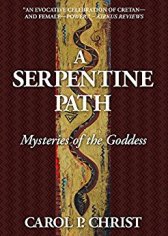
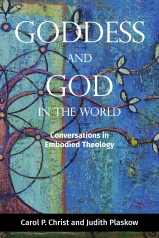
a-serpentine-path-amazon-coverGoddess and God in the World final cover designBe among the first to order A Serpentine Path, Carol P. Christ’s moving memoir of transformation. Carol’s other new book written with Judith Plaskow is Goddess and God in the World: Conversations in Embodied Theology.

Carol is a leading feminist theologian and historian of religion who wrote the first Goddess feminist theology, Rebirth of the Goddess as with Judith Plaskow co-edited the path-breaking Womanspirit Rising and Weaving the Visions.

Join Carol on a Goddess Pilgrimage to Crete in 2017. Save $200.