It was my twelfth birthday and I was in New York vacationing with my parents and brother. New York was a world away from the sleepy town of Luanshya, Zambia where I was from (and which I loved). The noise, the lights, the gigantic stores, and oh, the people. So many of them! My heart could barely contain the excitement.
It was one of these stores that had coaxed out my blossoming womanhood. I had spotted the perfect outfit at Macy’s. It was a red dress that fell slightly below my knees, delicate flower patterns adding that extra touch to the femininity I was ready to embrace. Although Luanshya couldn’t compete with the thrill of the Big Apple, I was now ready to embark upon my own exciting journey towards womanhood. And, I would take a little bit of New York back with me. Continue reading “The Red Dress by Vibha Shetiya”
For over ten years, I’ve been teaching a work of early Jewish mysticism known as Sefer Yetzirah, or the Book of Creation. There are widely differing opinions on the book’s origin and dating, but many scholars date it to the sixth century. Its core concept can be described simply: the Divine used the Hebrew letters as metaphysical channels to create the different aspects of reality: the directions, the elements, the planets, the months of the year, and so forth. Each letter is a channel by which God creates a unique form or entity, and meditating on the letters provides us with a connection to divine creative power. In its discussion of the letters, Sefer Yetzirah shows a strong connection to feminine imagery, and thus helps the later kabbalah develop its own link to the feminine.
Sefer Yetzirah shows influences from Aristotle to Gnosticism, and is often viewed as a work of Jewish philosophy. However, it is also a work of meditation, giving the reader instruction on how to focus and connect to the divine. Scholars such as Richard Hayman and Marla Segol have noted that the book’s structure and content connect it to magical literature: for example, the book has a deep concern with “sealing” the space of the world: letters of the Divine Name are used to seal the six directions of the universe. In a similar way, ceremonial magicians of the ancient world used sealing ritual, including the incantation bowls that were buried in the corners of a home to keep out evil forces. The book, like much ceremonial magic of the region, also discusses the elements. However, Sefer Yetzirah has a three-element system rather than a four or five-element system. The three formative elements are air, water, and fire.
We have been lost to each other for so long. My name means nothing to you. My memory is dust.
This is not your fault or mine. The chain connecting mother to daughter was broken and the word passed into the keeping of men, who had no way of knowing. That is why I became a footnote, my story a brief detour between the well-known history of my father and the celebrated chronicle of my brother.
Anita Diamant, The Red Tent
I am an expat author. My home is everywhere and nowhere. A wanderer, I have lived in many different places, from Minnesota, my birthplace, with its rustling marshes haunted by the cries of redwing blackbirds, to Bavaria with its dark forests and dazzling meadows and pure streams where otter still live, to my present home in the haunted moorlands of Pendle Witch country in Lancashire, England. My entire adult life has been a literal journey of finding myself in the great world.
For as long as I remember, I longed to be a writer. As a novelist I am on a mission to write women back into history. To tell the neglected, unwritten stories of women like my pioneering foremothers who emigrated from Bohemia (now the Czech Republic) in the 1860s to break the prairie soil of southern Minnesota.
To a large extent, women have been written out of history. Their lives and deeds have become lost to us. To uncover their buried truths, we must act as detectives, studying the sparse clues that have been handed down to us. We must learn to read between the lines and fill in the blanks. My heroine’s journey, in other words, is about reclaiming the lost heroines of history. My quest is to give voice to ancestral memory of that lost motherline.
My daughters came to me after Sunday School one day, concerned about a story they had heard in which God drowned almost everyone on Earth. So I sat down and thought about why a community might want to tell that story, and what valuable wisdom might be lifted from it for my children. Here is what I told them:
God/ess has many faces, which help us understand different things we need to know at different times. Sometimes we think of God/ess as Crone, an old, old woman crowned with silver hair as an emblem of her wisdom, who helps us learn to let go of anything that is holding back the wellness of our community and ourselves. Continue reading “A Feminist Retelling of Noah’s Ark by Trelawney Grenfell-Muir”
Aurora’s autobiographical narrative is a passionate paean to poets as the “only truth-tellers, now left to God”; she celebrates them as agents for personal and social transformation. As we come to the end of this National Poetry Month in the U.S., where truth is under siege, it’s worth recalling Aurora Leigh and its daring exploration of poetry, gender, divinity, and social justice.
I was in graduate school when I first read Aurora Leigh, Elizabeth Barrett Browning’s fiery 1856 epic about a young woman claiming her vocation as a poet despite Victorian society’s patriarchal strictures. The poem was not on any assigned reading-list; I’d simply stumbled across it while doing research for my dissertation. The opening lines brazenly assert the speaker’s authority and ambition:
OF writing many books there is no end;
And I who have written much in prose and verse
For others’ uses, will write now for mine,–
Will write my story for my better self . . .
Encountering those words, I was immediately possessed by Aurora’s voice and vision, a welcome change from all the male poets and critics I’d been reading. I devoured the verse novel’s nine books in one night. The poem became the centerpiece of my dissertation, and I studied and enthusiastically taught it for years.
I remember so vividly entering graduate school in my early forties and being told I was an “eco – feminist” by my professors. What does that phrase mean I asked having no relationship that I knew of to feminism. Feminists, I thought vaguely, naively, even stupidly, burned bras and hated men…
I was asked to read “Woman and Nature; The Roaring Inside Her” by Susan Griffin to help me see who I was, and after finishing this one book I submerged myself in feminist writings like a starved woman – child. My teachers were right. I was a feminist – an eco –feminist because I had already made the connection between what was happening to the Earth and what had happened to me. Every tree that was chopped down was a part of me, every stream that was polluted was a part of me, every animal that was slaughtered was a part of me because I was a part of Nature. I owed my life to Nature, the only mother I had ever had. I loved Her, honored her, became her fierce advocate and in the process She eventually taught me to love myself.
What do you get when you have two ladies, one a Baptist Minister living in KY and one an agnostic living in LA, making jokes and talking about the Bible? Don’t know? You get the new and exciting podcast Bible Bitches!
What do you get when you have two ladies, one a Baptist Minister living in KY and one an agnostic living in LA, making jokes and talking about the Bible? Don’t know? You get the new and exciting podcast Bible Bitches! We hope that you’ll take a moment to check out this new and exciting podcast that explores the F-word in Religion (among many other topics) and read the Q&A below with the creators Rev. Laura Barclay and Sara Hof! Click here to listen to the podcast (now on episode 5)!
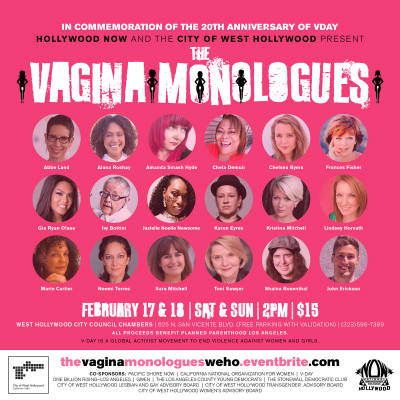
A month ago, the Hollywood Chapter of the National Organization for Women (NOW) and the City of West Hollywood presented the Vagina Monologues. The event was a complete success and we raised over $5,000 for Planned Parenthood Los Angeles! While the cast and crew worked together and formed a community in West Hollywood, communities were being ripped apart by senseless gun violence that took the lives of 17 beautiful souls at the Marjory Stoneman Douglas High School in Parkland, Florida
The cast and crew began to have discussions over a specific monologue and whether or not the audience, or cast members, would be triggered by its use of gun specific language in relation to the power of the vagina.
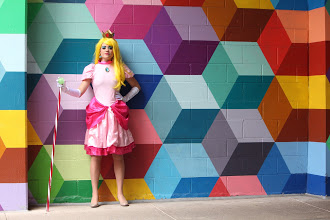
Toy stores and department store aisles are decked with pink and purple princess paraphernalia. Disney has provided an array of princesses for little girls to choose their birthday party or bedroom decor from. But as we all know, there’s a deeper secret hidden in the FAIRY TALES that high powered media execs have made their fortunes on: THE GODDESS.
Every hero’s tale, be it in video games or romantic movies sets out to do one thing: SAVE THE PRINCESS. When I was a child I saved Her myself on my little Nintendo system never knowing why She was in trouble in the first place. And was I the only one who ever wondered why NONE of the PRINCESSES HAD MOTHERS!?
In the early Centuries during the Christianization of Europe, Pagans (which means “people of the land”) hid truths right under the nose of the newly forming Christian Church in their folklore, games and children’s rhymes to avoid being burnt at the stake. These simple people tried to covertly keep the Wisdom of the Sacred Feminine that they’d been honoring since the beginning of time, ALIVE.


 It was my twelfth birthday and I was in New York vacationing with my parents and brother. New York was a world away from the sleepy town of Luanshya, Zambia where I was from (and which I loved). The noise, the lights, the gigantic stores, and oh, the people. So many of them! My heart could barely contain the excitement.


 I was in graduate school when I first read
 Feminism and Religion