Black and White Ball: A Poem to Honor Poodle Friends by Alla Bozarth

After Eucharist, the Sea of Galilee - alla
At the sea of Galilee


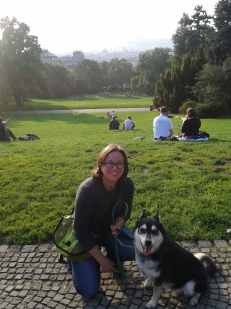
The following poem is in honor of Hank, the Rev. LouAnn and her wonderful husband Jim Pickering’s new puppy, a gorgeous black standard poodle, and his older brothers who are or were gorgeous and white.

All of them are or have been LouAnn’s pastoral assistants. I like to say they are the curates of her church of St. Gabriel the Archangel, because as therapy dogs whatever might be painful or lonesome in a person’s soul, the pups, at least for their visits, can cure it.


~~~~~~~~~~~~~~~~~~~~~~~~~~~~~~~~~~~~~~~~~~~~~

Black and White Ball

Give your dogs a black and white ball and tell them,
just to say it out loud, what it means.

Black is the color of mysterious things,
of the powerful regeneration and renewal
of Night in which Stars are born,
the universe delivering Beauty.

On Earth’s palette of color, black is all
the colors there are, blended variously
to the depth of Absolute Beauty. Continue reading “Black and White Ball: A Poem to Honor Poodle Friends by Alla Bozarth”

The Importance of Rituals (Part 2) by Elise M. Edwards

elise-edwards

In my previous post, I wrote about the importance of rituals. The rituals of the Easter season helped me process some difficult emotions. The way that rituals mark time and demonstrate consistency has been a comfort for me when facing new challenges and settings. But I am quite aware that rituals can become empty.   In one of the comments to that post, a woman named Barbara responded, “There came a time for me when familiar and meaningful ritual no longer made sense. I had changed in understanding of what the ritual symbolized and celebrated. And haven’t found new rituals that make sense for me now…or at least I’m not aware of any.” Barbara’s remarks capture not only the loss from no longer being able to relate to existing rituals after life changes, but also the difficulty in finding or creating new rituals to take their place. I thanked Barbara for her honesty and decided that this post would continue the discussion, focusing more on discovery and creation of new rituals.

As I was preparing that post, I watched an episode of Call the Midwife that prompted me to reflect on the need to create rituals when existing ones just don’t work. Call the Midwife is a BBC-PBS show about nurses and midwives living in a convent in London’s East End at the end of the 1950s and early 1960s. The show is based on the memoirs of Jennifer Worth, and it does a better job than most primetime dramas of showing female characters’ experiences the joys and challenges of their professional lives and personal lives. As it is set in a convent with several characters who are both nuns and midwives, the show also explores the theme of vocation. What does it mean to be called to the religious life? Called to nursing? What does motherhood demand? Continue reading “The Importance of Rituals (Part 2) by Elise M. Edwards”

Liberation Lessons for Pesach by Ivy Helman

Each year we read the story of our exodus from Egypt during the Pesach seder. The story is one of human liberation from oppression. Yet, most of the imagery we encounter, the drama of the story so to speak, involves nature: a river that saves a baby, a burning bush, the plagues, the re(e)d sea, the wilderness, lack of food and water and the promised land itself. What does this mean?

In general, it means that human liberation is intimately connected to the liberation of all of creation.  In particular, the exodus story can teach us many lessons about environmental justice.  I’m going to explore five of them here: do not manipulate nature, use water wisely, form a connection to the land, imagine G-d differently and treat humans, animals and the land well.

Continue reading “Liberation Lessons for Pesach by Ivy Helman”

The Importance of Rituals by Elise M. Edwards

elise-edwardsMy sister once said about me, “One thing you have to understand about Elise—she takes the ritual of whole thing very seriously.” My sister was right and her words helped me see this quality about myself. What ritual was she talking about me taking so seriously? Happy hour on Fridays.

It was a different season of my life when she said this. I don’t have Friday happy hours regularly anymore, although I did gather with my friends nearly every week for food and drinks for many years throughout my 20s and 30s. It was often on Fridays, but at one point it was Wednesdays and then, for about a year, it was Thursday nights after a late shift at work.

More recently, I would meet a friend for crepes at the farmers’ market on Saturday mornings. Although the day and the time and specifics of these gatherings would vary, the act of setting aside a weekly time to connect with people dear to me and relax as we indulged in good food or drink was a ritual to me.

Continue reading “The Importance of Rituals by Elise M. Edwards”

Role Play: In Search of the Authenticity of My Being by Elise Edwards

Elise Edwards“I stood in the authenticity of my being: Black, preacher, Baptist, woman. For the same God who made me a preacher made me a woman, and I am convinced that God was not confused on either account.”
– Reverend Dr. Prathia Hall

These words came across my Facebook feed on Sunday in celebration of International Women’s Day. Reconciling Ministries Network put the statement on its Facebook page, along with a picture of Prathia Hall preaching from the pulpit, in remembrance and honor of women leaders who contributed to the US Civil Rights Movement. This past Sunday, March 8, when the quote was displayed, marked the 50th anniversary of Selma’s Bloody Sunday. Prathia Hall was a leader in the Student Non-Violent Coordinating Committee (SNCC) and one of the activists on the Edmund Pettus Bridge who were attacked as they began to march from Selma to Montgomery, Alabama. Later in her life, she became an ordained minister, professor, and womanist theologian.

For me, this past weekend was about remembrance through many forms. While there were many events commemorating Selma and the important events that unfolded there 50 years ago, my family and I were focused on a more intimate form of remembrance. On Saturday, we held a dinner and informal memorial service for my godfather who passed away last month. I got the news of his death on a day when I’d been doing some deep soul-searching and reflecting about the image I present to the world and its correspondence with who I am and desire to be. Just a few days prior, I’d spoken to my godfather about his health and subsequently, I had been questioning how I might be more connected to him. We lived several states apart, and I wondered how I could be a good goddaughter to him despite the distance. Those questions are left unanswered in the wake of his death. Continue reading “Role Play: In Search of the Authenticity of My Being by Elise Edwards”

“Justice, Justice You Shall Pursue:” Finding Hope in Justice-Seeking Movements. by Ivy Helman

20140903_180423For the past few weeks, there has been a lot of discussion about racism in the United States and rightly so. It is clear from the lack of charges and the repetition of similar crimes across the United States by different members of various law force communities that some people because of the color of their skin are immune to the consequences of their actions and others, also because of the color of their skin, are often the victims of such actions. Criticism, here, in the forms of protests, federal inquiries and outrage are essential.

I am reminded of oft-quoted part of the Torah: Devarim (Deuteronomy) 16:20, one that I saw on some of the signs Rabbis carried with them in the protests. “Justice, justice shall you pursue, that you may thrive and occupy the land that the Lord your God is giving you,” (from the JPS translation). G-d tells those early Israelites that justice is a requirement not just for their survival in the Promised Land, but also if they want to have good, long lives. Later tradition, from the Talmud to Rashi and beyond, interpret this passage as a call for a just court system within Jewish society.  Likewise, all who use the system should have the principle of justice in mind.  There is also a lot of conjecture as to why justice is said twice. Many modern scholars call attention to the way in which religion and state were considered one in same for this time period and much of human history. Continue reading ““Justice, Justice You Shall Pursue:” Finding Hope in Justice-Seeking Movements. by Ivy Helman”

Awake! Awake! A Reflection on the Awakening of Conscience and Advent by Elise M. Edwards

Elise Edwards‘Tis the season to be…?

For me, this has not been a season to be jolly. I teach at a university, and again, I’m in the midst of the most hectic time of year of grading and exams and wrapping up projects due at the end of the calendar year. There have been moments of joy and rest. But I’ve been more reflective and sorrowful. This year, my heart and mind and soul have been opened up in new ways and I feel more urgency and need for social change. I’ve been experiencing “conscientization” during the time of year many Christians refer to as Advent.

I was introduced to the concept of conscientization in the work of Christian feminist and womanist ethicists like Beverly Wildung Harrison and Stacey Floyd-Thomas. Other feminist and liberationist thinkers had already convinced me of the vital role that critical thinking, consciousness-raising, and action occupy in ethical reflection and social change. In a chapter on “Feminist Liberative Ethics” in a textbook on liberative approaches to ethics, Michelle Tooley explains the meaning of conscientization:

“Activists speak of conscientization as waking up to the injustice in the world—or seeing it for the first time. It is not that the injustice is beginning; it is that you encounter oppression, injustice, violence yourself or you see it in a person or situation. You may have seen the same situation many times before, but for some reason you begin to connect the event with a deeper recognition that the injustice is wrong.”

(p. 185, Ethics: A Liberative Approach, Miguel A. De La Torre, Editor)

I was conscientized the night I heard that a grand jury did not indict Darren Wilson for killing Mike Brown, an unarmed black man. I was horrified to learn that this police officer doesn’t even have to stand trial for his violent and deadly act. Now it wasn’t like before grand jury’s decision I thought that black lives were given equal value in the US justice system. After all, for months I have been researching and preparing a paper called “When the Law does not Secure Justice or Peace” about artistic and religious responses to the dishonoring of black male personhood. I have been mourning the loss of Trayvon Martin and others as I write. But this decision left me sobbing in a hotel room as I watch the events unfold in Ferguson, Missouri. I gained a deeper social awareness about the depths to which the demonization and disregard of the lives of black women, men and children are entrenched in American life and the institutions within it.

I gained deeper self-awareness too. One reason the tragedy of the grand jury’s decision became so palpable to me is that just hours prior, I witnessed former president Jimmy Carter address the American Academy of Religion. He spoke passionately about the proliferation of violence, mistreatment of women, climate change, and other social concerns. To put it plainly, I was floored to see a white man in his 90s who was raised in Georgia and was a Southern Baptist until his 70s state without any qualms that people in power intentionally misinterpret religious texts to support the domination of women and nonwhites because those they do not want to lose their privilege. Yet he also called himself, like Archbishop Desmond Tutu, a “prisoner of hope.” He believes that things will change, and draws from his Christian convictions to sustain hope and motivate his work to fight injustice.

I was electrified by his words. I, too, had hope. In the days prior, I had gotten a break from my daily life, connected with friends, and conversed with like minds. I had been thinking about art and love. I had learned strategies for de-centering dominant narratives in the classroom and I was hopeful that I could use them to make a difference in my students’ lives. But mere hours later, while watching the news, the self-awareness I came to is that my hope is more fragile than I wish it to be. Futility consumed my hope.

A few weeks later, I can assert that my faith in God is not shaken, but my hope in humanity’s goodness has as much stability as a house of cards. In my present state of mind, I’m grateful that we are at a point in the church year that provides me with an opportunity to mourn the brokenness of our world. Christmas is approaching, but that doesn’t mean I have to sing merry carols. Advent is a season when Christians reflect on why the world needs God’s miraculous action and what it means to wait for light to emerge in the darkness. In the church calendar, it is a time when Christians re-enact and re-experience the anticipation of Jesus’ coming. Advent songs have a different character than Christmas carols. Many of them have a haunting tone or an eerie, sad, or mysterious sound. The lyrics of these songs place exhortations to “Rejoice!” next to pleas of “O come, o come, Emmanuel!” Emmanuel, also spelled Immanuel, means “God with us.” Christians draw this name from the Hebrew prophecies in Isaiah that are cited in the Gospel of Matthew’s account of Jesus’ birth. Matthew describes Jesus’ birth as the fulfillment of prophecy.

My conscientization allows me to hear these prophecies anew. They are familiar to me, as they are repeated often this time of year in Christian settings, but I hear them in new ways. I hear Isaiah 9:6 quite differently: For to us a child is born, to us a son is given, and the government will be on his shoulders. And he will be called Wonderful Counselor, Mighty God, Everlasting Father, Prince of Peace.

“The government will be upon his shoulders” likely means that this child will have authority. But as I hear those words this year, I imagine the Prince of Peace in the choke-hold of a law enforcement officer. I think of a little baby who are welcomed into the world with joy but who grows up only to be killed at a young age by threatened authorities and crowds of supporters. This is the story Christians tell about the God who is with us, the God who is also fully human. And this is the story we tell about Michael Brown, Eric Garner, Tamir Rice, Alesia Thomas, Aiyana Stanley-Jones and far too many others.

This Advent, I’m making a real effort to hold hope and despair together. I don’t want to become hopeless. I don’t want to think that my work in the classroom, in my church, in my community, on this site and in the printed page have no meaning. Hope is what sustains us to work for justice. I want to believe in that transformation of hearts and minds and souls is possible and immanent even when it emerges through sorrow and struggle. Suffering, sorrow, and killing without consequences must not be acceptable. With my new eyes, I see just how terrible they are.

Elise M. Edwards, PhD is a Lecturer in Christian Ethics at Baylor University and a graduate of Claremont Graduate University. She is also a registered architect in the State of Florida. Her interdisciplinary work examines issues of civic engagement and how beliefs and commitments are expressed publicly. As a black feminist, she primarily focuses on cultural expressions by, for, and about women and marginalized communities. Follow her on twitter, google+ or academia.edu.

Whose God is it, Anyway? by Esther Nelson

esther-nelsonI do not attend church (or any “house of worship”) regularly anymore.  However, one hot, humid, Sunday morning this past August, I wended my way to St. Mark’s Episcopal to hear my friend, Dale, preach.  He does “pulpit supply” there (his home church) occasionally.  Dale earned an MFA (Master of Fine Arts) in creative writing after finishing his seminary studies.  He’s written a one-man play titled “Jesus Phreak” and has performed it in churches and universities nationwide.  Dale and I have been friends for a decade or so.  He identifies as a Christian, but he’s not like any Christian I’ve ever known.
Church is familiar to me.  I was born to Protestant, missionary parents who “served the Lord” in Buenos Aires, Argentina, after graduating from Moody Bible Institute in Chicago, Illinois.  My parents had a “special burden” for Jews and worked to bring them to “the knowledge of Jesus Christ.”  In other words, they sought to convert Jews to Christianity–not just any Christianity, but the specific Christianity my parents believed in–a literal, “fundamental” understanding of Scripture made popular by Dwight L. Moody (1837-1899) and Cyrus I. Scofield (1843-1921).

I was raised on church and Sunday School, attending three services every Sunday for years.  Later on, as a young adult in the United States, I added Wednesday night prayer meeting, heeding a pastor’s adage: “Those who love the church come on Sunday morning, those who love the pastor come on Sunday evening, but those who love the Lord come on Wednesday night.”  I did not stop my regular church attendance (non-denominational, Baptist, Presbyterian, Reformed Episcopal, and just plain Episcopal–in that order) until well into my 40s.  By then, I could no longer contort myself to fit the mold “church” demanded from me. Continue reading “Whose God is it, Anyway? by Esther Nelson”

Painting Tiamat/Tehom by Angela Yarber

angelaToday I am honored to give a lecture on “Queering Iconography: Holy Women Icons from Sappho to Pauli Murray” at the North Star LGBT Center in Winston-Salem, NC. So, I want to continue the theme of featuring some of my queer Holy Women Icons. Joining Virginia Woolf , the Shulamite, Mary Daly, Baby Suggs, Pachamama and Gaia, Frida Kahlo, Salome, Guadalupe and Mary, Fatima, Sojourner Truth, Saraswati, Jarena Lee, Isadora Duncan, Miriam, Lilith, Georgia O’Keeffe, Guanyin, Dorothy Day, Sappho, Jephthah’s daughter, Anna Julia Cooper, the Holy Woman Icon archetype, Maya Angelou, Martha Graham, Pauli Murray, La Negrita, and all my other Holy Women Icons with a folk feminist twist is the often overlooked and misunderstood primordial goddess of creation: tehom.

In Genesis 1 we read, “In beginning, God created the heavens and the earth, the earth was a formless void and darkness covered the face of the deep, while a wind from God swept over the face of the waters.” It is the creation narrative held dear, formative, and meaningful for countless Jews and Christians. Interestingly, this word, deep, in Hebrew is tehom. Tehom translates as “deep or depths,” but it’s also a cognate for Tiamat, a Babylonian Goddess of creation. Out of the face of the deep, the world begins. Out of tehom, God creates. Out of Tiamat, the earth comes into being. This dancing Babylonian goddess syncretistically intermingles with the creation myth so pivotal to the faith of Christians and Jews in a way that could be terrifying, or beautiful, or—like the chaotic body of Tiamat that brings the world into being—both. Continue reading “Painting Tiamat/Tehom by Angela Yarber”

Putting Faith in Interfaith Dialogue by Esther Nelson

esther-nelsonWhy do it?  Sit around a table with people who profess a faith tradition different from our own, drink coffee, nibble on snacks, and talk.  What’s the point?  No doubt the reasons vary depending on the particular people getting together.  Nevertheless, there is the sense that if we “sit down together and talk together about our faiths,” we’ll “break down barriers,” and….then what?  Do we think (or hope) that those on the other side of the table will eventually “come around?”  Is conversion a goal?  Or, perhaps we just want to become more “tolerant” of other faiths.

So, for example, if Muslims share facts with Christians about the history of Prophet Muhammad, the Sunni/Shi’a division, and Shari’a law, will that help Christians tolerate Muslims?  Books on the history of religions abound.  Yet, religion-based violence flares around our globe.  Would learning about doctrinal beliefs–“truths” based on (usually male) interpretation of scriptural narrative–be helpful?  Christians understand Jesus to be God incarnate.  Muslims reject any doctrine that compromises the oneness of God.  Now what?  Are barriers broken down?  Are we more tolerant? Continue reading “Putting Faith in Interfaith Dialogue by Esther Nelson”