

May you allow yourself to 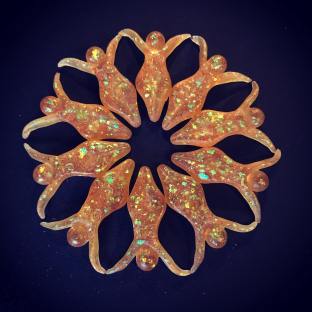
taste your longings
and to bravely honor them.
May you make wise sacrifices.
May you trust in abundance.
May you savor the many flavors
of this sweet life before your eyes,
beneath your feet,
below your skin,
within your soul,
around your heart.
I had imagined making beautiful loaves of herbed and flowered breads, but instead we hold scraps of plain white biscuits in our hands. Homemade, yes, but not as seasonally resplendent as I envisioned. It is Lammas, the festival of First Fruits, a celebration of sacrifice, gratitude, abundance, and renewal. I remind my four children of these themes as we stand in our small family circle on our back deck at sunset. There has been rain and the air is cool and beautiful, unseasonably delightful for August. The mulberry trees are broad leaved and heavy, leaning over the rails of the deck, where the last of the blackberries also hang, black and red beneath rusted red, gold, and green leaves, spotted with last month’s heat, brambles twined through the railings in a way that delights me—the wild’s insistence on creeping steadily closer and closer to enfold our home.
I have made four extra little biscuits, round and a bit lumpy, an offering for each of the four directions. I extend my hand into the center of our circle, cupping one small round biscuit at a time. My children and my husband extend 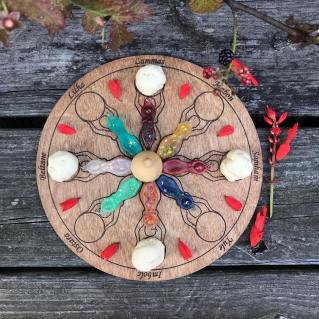 their hands over and under mine and we offer our gratitude into each morsel in turn, one for each direction and each element. For North, we speak of stability and strength, the health of our bodies, the safety and security of our foundation, the earth on which we live. For East, we speak of air, our mental states, how we will be mindful of how we speak and think and focus our energy and time. For the South, we speak of fire, of tending the flames of our inspiration, nourishing our passions, and watching for burnout. In the West, we speak of water, of being emotionally stable and loving. In the last seventeen years of parenting, if there is one thing I have learned is that rituals with children need to always involve action. The kids are eager to toss the biscuits into the air, in the directions we are honoring. In past years we have tossed pinches of cornmeal, at other times of the year grains of corn or flower seeds or dried herbs or petals, at the Winter Solstice we toss pieces of our annual golden “sun bread.” This bread, washed with egg and laden with butter is one we make together on solstice morning, shaping the smooth dough into a large sun face with a spiraled corona of rays. After it has baked, we offer scraps to the sun at noon, tossing them high into the air as we shout “Thank you! Thank you!” again and again into the crisp winter air. Last year, my garnet bracelet, a symbol of the path I walk with the goddess Persephone, flies off as I toss my sun bread and disappears into the waving stalks of wild grasses. We are never able to find it and the unexpected symbolism of Persephone becoming joined anew with the amber waves of Demeter’s grains delights me.
On the summer solstice this year, I made a cake in the shape of a honeycomb, decorating the hexagons with wild 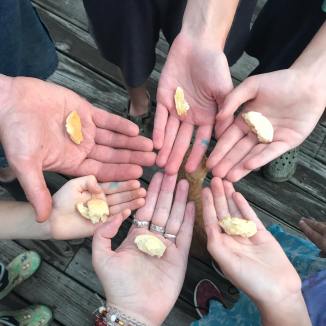 blackberries and rose petals. And, now on Lammas, there are these small white biscuits in our hands. My oldest son is almost seventeen. He is nearly as tall as his father, six feet. He has the biscuit for the south, which from where we stand on the deck is our house. He winds up his arm and lets the biscuit fly up, up and over the roof.
We offer our own small personal pieces of biscuit next, pinched as the first bite from each of our servings at dinner, as representative of a sacrifice we will make this season. And then, we cup our open hands close to our hearts and one by one we speak of what we are grateful for and what abundance we are welcoming, what we are making space to harvest in our open hands.
We join hands and sing, our six year old son requesting “We Are a Circle,” and following his lead, we sway from side to side as we sing, eventually all kicking our legs back and forth into the center of the circle and laughing. We say our closing prayer next, as we do each time we celebrate together: may goddess bless and keep us, may wisdom dwell within us, may we create peace* and then I extend my arms and gather them to me, for a large family hug. There is a sense of connection and renewal around us as we laugh and smile and I tell them thank you for participating.
This ritual was largely spontaneous, all I knew when I stepped outside was that we wanted to offer our gratitude symbolized by our four tiny loaves of biscuit-bread and that we wanted to acknowledge this next turn on the wheel of the year.
Several years ago, when I was still teaching at a local college, one of my students objected to the fact that material on working with LGBTQ clients was part of my class outline. She went through my personal Facebook page and those of my family members, where she noticed photos of the wedding ceremony I performed for my brother and his wife. A message arrived in my email: “by whose authority do you think you have the right to perform marriages?” she inquired. By my own authority, I thought, though in my reply I also cited that I am a legally ordained priestess and as such am recognized by the state of Missouri as capable of solemnizing legal marriages. Not much later, she dropped my class explaining in writing that to continue taking it would be to turn her back on Jesus Christ.
At mother blessing ceremonies, we often sing a song called “Call Down a Blessing.”** After one ceremony, I was asked, “but WHOSE doing the blessing?” and my answer was simple: We are. We are blessing one another.
These are radical acts. These are feminist acts. This is feminism and religion. To express gratitude for the earth, to name the elements as holy, to honor the cycles of the seasons and our lives, to design our own ceremonies, to hold our own circles, to be our own authorities, to bless one another and the spaces between us.
I have two teenage sons now, one seventeen and one fourteen. We have lifted our arms to the rising moon, tossed scraps of bread to the noontide solstice sun, and dabbed sweet spring water on one another’s faces in blessing since they were born. This is what they know.
And, even though they are now teenage boys, each night without fail they come to me and to their dad in turn to be kissed on the forehead in our nightly ritual, a benediction of love. Good night, sleep good, I love you, we each say. My seventeen year old usually drops his return kiss on the top of my head in my hair, speaking the familiar words back to me, good night, sleep good, I love you. Sometimes as I’m getting ready for bed, brushing my teeth in the bathroom, I look up to see him standing in the doorway, “mom,” he says, “did I forget to kiss you?” and I proffer my forehead, just in case we’ve forgotten. The boys each kiss their dad goodnight too and he them—on the forehead, a kiss, and the words, spoken and returned, good night, sleep good, I love you. Sometimes I think this is most potently feminist act of all, these two boys rapidly becoming men beneath our roof, going to bed each night with a kiss and the affirmation that they are loved.
Molly Remer’s newest book of poems, Sunlight on Cedar, was published in March. Molly has been gathering  the women to circle, sing, celebrate, and share since 2008. She plans and facilitates women’s circles, seasonal retreats and rituals, mother-daughter circles, family ceremonies, and red tent circles in rural Missouri. She is a priestess who holds MSW, M.Div, and D.Min degrees and wrote her dissertation about contemporary priestessing in the U.S. Molly and her husband Mark co-create Story Goddesses, original goddess sculptures, ceremony kits, mini goddesses, and more at Brigid’s Grove. Molly is the author of Womanrunes, Earthprayer, the Goddess Devotional, She Lives Her Poems, and The Red Tent Resource Kit and she writes about thealogy, nature, practical priestessing, and the goddess at Patreon, Brigid’s Grove, Feminism and Religion, and Sage Woman Magazine.
*Thanks, Carol Christ! We’ve used this family blessing to close our ceremonies for about ten years.
**Originally by Cathy Barton and Dave Para.
 Hello FAR friends,
 I was released from a national hospital in Crete on Friday afternoon after a seven day stay. During that time, I had over fifteen tests, including several ultrasounds, two CTs, a colonoscopy, a gastroscopy, and an excruciating forty-five minute MRI.
 I struggled with what to write about for my May post. Would I write about the ridiculous notion which has countless Americans buying into the idea that COVID19 is a hoax? I could write about how it is fool hearty for us to even consider lifting stay at home orders when the number of infected patients are still rising daily. The list goes on due to the rising pressures, frustrations, and anxieties that are surrounding each one of us.
 Last week a friend of mine started a post asking people to share something that they’ve enjoyed or appreciated since shelter-at-home orders began across the country and globe. This friend was in no way trying to minimize the very difficult situations that so many of us find ourselves facing during this pandemic. Rather, the list she elicited and generated helped to create, at least for me, a moment of hope or peace—a moment that I suspect many of us need right now.
 I’ve been thinking a lot about something my grandmother would always tell me: “When life hands you lemons, sometimes you have to make applesauce.” I know, it sounds crazy, but life right now appears to be more on the crazy than the sane side.
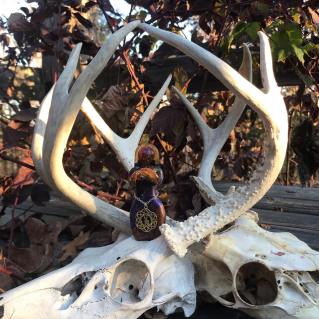 about a new account, feeling rushed and out of breath, there is a knock on the front door. I quickly dress and go out to the living room, my hair still wet and ragged, and find our other neighbor standing there. He is holding two white skulls in his hands, long antlers curving between his fingers. We talk about the buck, about the waste of his life, about the disrespect and senselessness of this action. He is a hunter too and he says he has been watching this deer for more than a year and that you get to know them when you live here, that you see the same ones, sometimes every day, that there are only so many in a given range, and you get to be a part of their lives. We ask him if he knows Limpy, the doe with the broken leg that healed crookedly, but that we see almost every day, sometimes twice a day, in the field across the road.
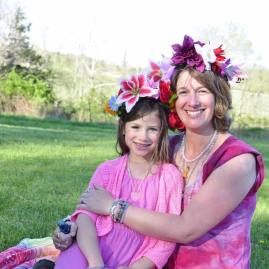 and share since 2008. She plans and facilitates women’s circles, seasonal retreats and rituals, mother-daughter circles, family ceremonies, and red tent circles in rural Missouri. She is a priestess who holds MSW, M.Div, and D.Min degrees and wrote her dissertation about contemporary priestessing in the U.S. Molly and her husband Mark co-create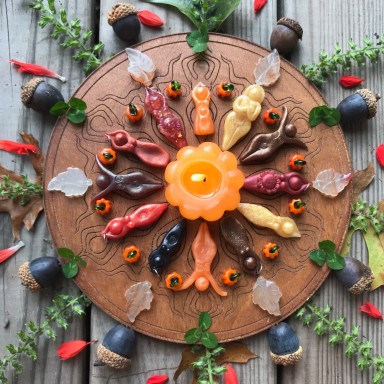
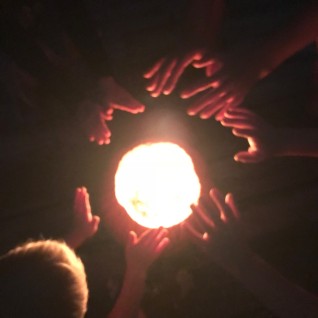 rituals like this” and my four year son offered his blessings for the “energy we feel together.” My seven year old daughter offered her gratitude for pandas and for toys.
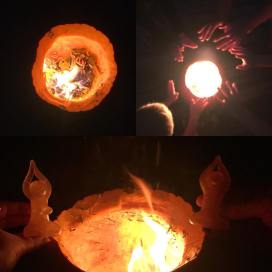 and hollow it out. Keep the seeds to plant with the remnants of your fire later. You may start the fire with paper and a lighter and then keep adding herbs to keep it burning, or you may stoke it by putting some alcohol in the bottom of the pumpkin to begin with. Alcohol burns cool and can create a longer lasting, less smoky flaming pumpkin. Offer your autumn bounty into the pumpkin with herbs sprinkles/handfuls—these can be spontaneous spoken aloud declarations of your harvest, your celebrations, your gratitude, etc. What are you thankful for?

