

 I’m deeply troubled by some of the anti-trans and anti-queer commentary that has been taking place on some of the comments on this blog in recent months. I’ll never forget when this project first began—talking with the founders about its original purpose: to bring the “F” word back into the mainstream religious discourse and more importantly, to be a place where scholars, young and old, senior or junior, could write, collaborate and eventually converse with across cyberspace.
However, in recent months, I’ve found myself being more of a watchdog rather than a frequent commentator on issues pertaining to feminist religious discourse. I’ve found myself reading comments about issues I may not frankly identify or agree with just to make sure that the cisgendering or anti-trans narratives do not become symbolic of what this blog is now rather than what was supposed to be at the beginning.
When I sat down to write my very first post I was scared. I was terrified that feminists from all communities would see me only as I appeared and not for whom I actually was. I was afraid that all I had worked for throughout my life would be moot with the first bad comment on one of my posts. While all of those fears were real and valid they quickly faded away as I was embraced by this community and many others for my passion rather than my gender; my life’s work rather than my privilege; and more importantly, the personal mission to make the world a safer and better place for women and girls everywhere.
To speak ones truth is oftentimes a difficult and nearly impossible act. However, to live one’s truth, on a day-to-day basis, is an aspect of life that has become so foreign to individuals who have become so comfortable in their own skin that I fear the activist and social justice roots that we all claim to hail from have fallen at the wayside and been replaced by complacency and reductionism.
Caitlyn Jenner’s story is one that many individuals, often not highlighted on this blog, know all too well. Caitlyn Jenner’s story and personal experiences are valid and for members of the feminist community to refer to her as not “feminist” or merely as a man “masquerading” as a woman while still utilizing his privilege from being biologically born as a man is troubling and the root of the problem facing many trans individuals today when they’re negotiating coming out as their true selves.
Trans individuals face a cadre of other horrible social, physical and mental statistics that oftentimes lead them to be more likely to self-harm. However, as feminists, isn’t it our job to make sure that all groups have access to the same freedoms rather than working towards denying it for certain groups while trolling the comments sections of posts?
Shakespeare said: “To thine own self be true” and for those of us who identify with the Golden Rule, if we no longer treat others as we would like to treat ourselves, then we really have failed as feminists; and if the comments on recent blogs are any indication, we still have a long way to go before all voices can feel welcomed not only on FAR but also in the world at-large.
John Erickson is a Ph.D. Candidate in American Religious History at Claremont Graduate University. He holds a MA in Women’s Studies in Religion; an MA in Applied Women’s Studies; and a BA in Women’s Literature and Women’s Studies. He is a Permanent Contributor to the blog Feminism and Religion, a Non-Fiction Reviewer for Lambda Literary, the leader in LGBT reviews, author interviews, opinions and news since 1989 and the Co-Chair of the Queer Studies in Religion section of the American Academy of Religion’s Western Region, the only regional section of the American Academy of Religion that is dedicated to the exploration of queer studies in religion and other relevant fields in the nation and the President of the University of Wisconsin Oshkosh’s LGBTQA+ Alumni Association. When he is not working on his dissertation, he can be found at West Hollywood City Hall where he is the Community Events Technician and works on policies and special events relating to women, gender, sexuality, and human rights issues that are sponsored or co-sponsored by the City of West Hollywood. He is the author of the blog From Wisconsin, with Love and can be followed on Twitter @JErickson85

 No matter what you call it abuse is abuse. This is highlighted in the popular book and now movie Fifty Shades of Grey. Because of the stir this book caused, I delved into the first book and my initial reaction was that of repulsion and wonderment. How could a woman let a man control her like that? Why would she let him do things like that to her and continue to come back to him? Why is this book so popular?
 When the wheel of the year turns towards fall, I always feel the call to retreat, to cocoon, to pull away. I also feel the urge for fall de-cluttering—my eyes cast about the house for things to unload, get rid of, to cast away. I also search my calendar for those things which can be eliminated, trimmed down, cut back on. I think it is the inexorable approach of the winter holiday season that prompts this desire to withdraw, as well as the natural rhythm of the earth which so clearly says: let things go, it is almost time to hibernate.
 It’s been almost two years since I lost someone I loved. The relationship was short, tortured, unhealthy (as all my romantic relationships have been, but that’s another story…) However, I fell particularly hard for this one. When we separated, the pain was unthinkable. I was surprised by how deep it ran. I didn’t know until he was gone how much I really cared about him. I became physically sick, and even now there are days when I only have to bring him to mind to conjure a familiar pressure behind my eyes and in my throat.
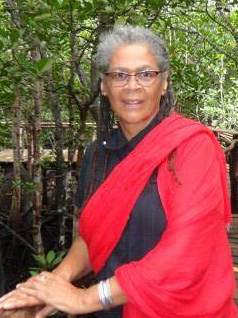 I am currently in Cape Town South Africa at a Queer Muslim International Retreat. Next month I will go to Jakarta Indonesia for a workshop focused on the same agenda: reform in Muslim communities towards the lives of dignity for lesbian, gay, bi-sexual, transgender, Queer and Intersex Muslims. It has been a long road and the end of the struggle is nowhere in sight. Still, there are important developments worth noting.
