What I Believe (Post-2016) by John Erickson

Ever since the election of You-Know-Who, I have been doing a lot of creative writing.

Ever since the election of You-Know-Who, I have been doing a lot of creative writing. Unlike academic publications, policy reports, or my dissertation, creative writing, much like my mentor Dr. Marie Cartier has written about, provided me with a needed escape from a world that seems to grow darker with each passing day.  In college, I served as Poetry Editor for the Wisconsin Review, the oldest literary journal in Wisconsin. Continue reading “What I Believe (Post-2016) by John Erickson”

Self-Care is a Feminist Issue: Holy Women Icons Project’s 7-Day Online Self-Care Retreat by Rev. Dr. Angela Yarber

Several years ago, I was pastor of a welcoming and affirming church. As a queer clergywoman, I thought that such a place would be the perfect place to flourish and thrive as a pastor. And yet, because of heterosexist and sexist microaggressions, I found myself anxious, depressed, and in need of physical, emotional, psychological, and spiritual care.

After a three-day retreat filled with self-care and soul-nourishment at a non-profit retreat center that catered to activists and artists , I felt as though a tremendous weight was lifted off my shoulders, that I could focus and find clarity in my vocation. Pausing to care for myself gave me the courage to leave my toxic job and live more fully into my calling. This experience taught me the vital importance of self-care.

Womanist Audre Lorde once proclaimed, “Caring for myself is not self-indulgence, it is self-preservation, and that is an act of political warfare.” Because caring for the self violates the patriarchal norms that traditionally dictate that you should be the one caring for everyone else. Yes, everyone needs to pause to care for the self. But oppressed minorities have a particular need for self-care, not simply as a way of refreshing oneself in order to do the work of justice, but as a vital part of the work of social justice. Because caring for yourself in a society—and a church—that wishes for you to do otherwise is an act of political warfare. When feminists care for themselves, it is a radical act of soul redemption, spirit rejuvenation, and a political and spiritual act of acknowledging your holy and innate self-worth. In case anyone has told you that you are not worthy, let me reassure you. You are worthy. And you deserve to care for yourself.

Continue reading “Self-Care is a Feminist Issue: Holy Women Icons Project’s 7-Day Online Self-Care Retreat by Rev. Dr. Angela Yarber”

Sacred Water by Molly Remer

“Drinking the water, I thought how earth and sky are generous with their gifts and how good it is to receive them. Most of us are taught, somehow, about giving and accepting human gifts, but not about opening ourselves and our bodies to welcome the sun, the land, the visions of sky and dreaming, not about standing in the rain ecstatic with what is offered.”

–Linda Hogan in Sisters of the Earth

The women have gathered in a large open living room, under high ceilings and banisters draped with goddess tapestries, their faces are turned towards me, waiting expectantly. We are here for our first overnight Red Tent Retreat, our women’s circle’s second only overnight ceremony in ten years. We are preparing to go on a pilgrimage. I tell them a synopsis version of Inanna’s descent into the underworld, her passage through seven gates and the requirement that at each gate she lie down something of herself, to give up or sacrifice something she holds dear, until she arrives naked and shaking in the depths of the underworld, with nothing left to offer, but her life.

In our own lives, I explain, we face Innana’s descents of our own. They may be as difficult as the death of an adult child, the loss of a baby, the diagnosis of significant illness, or a destroyed relationship. They may be as beautiful and yet soul-wrenchingly difficult as journeying through childbirth and walking through the underworld of postpartum with our newborns. They may be as seemingly every day as returning to school after a long absence. There is value in seeing our lives through this mythopoetic lens. When we story our realities, we find a connection to the experiences and courage of others, we find a pattern of our own lives, and we find a strength of purpose to go on. Continue reading “Sacred Water by Molly Remer”

A Healing Home of Dreams by Joyce Zonana

I had few expectations before my visit in the winter of 1999 to Cairo’s Rav Moshe Synagogue, also called the “Rambam.” I only knew it to be an obscure synagogue and yeshiva associated with the renowned twelfth-century theologian, sage, and physician, Moses Maimonides.

I left Egypt as an infant with my parents in 1951. Now I was finally back, hoping to experience the place that had shaped my family. Accompanied by a Muslim Egyptian friend, I walked the streets my parents had walked, attended services in the elegant downtown synagogue where they’d been married, tasted the familiar foods of my childhood, listened with delight to the melodious sounds of Egyptian Arabic. But seeking the Rambam was little more than a whim, sparked by a few lines in a Guide to Jewish Travel in Egypt. “Not on any tourist itinerary,” the brief blurb stated about the derelict synagogue in ‘Haret al Yahud, the city’s medieval Jewish quarter, far from where my parents had lived. Still, I had to go.

Continue reading “A Healing Home of Dreams by Joyce Zonana”

Honoring the Earth in our Rituals of Well-Being by Elisabeth Schilling

plantsMuch of our lives lack the rich culture of ritual that I think would help us repair the relationships we have with our own bodies and with the earth. The Rg Veda is one of the oldest collection of hymns from India. In them, I find a playful and introspective expression of desires and fears that, at first, did not seem to me to hold much wisdom for a modern contemplative. But lately, I have been noticing how the speakers communicate to or about the earth, and how their lives seem centered around trying to take a part in creation. Mostly, these hymns are stories and supplications for rain, cows, victory in battle, and a long life. But there is a deep understanding of the power and divinity in the universe that is the very earth-based wisdom that our humanity-in- crisis needs. If the Qur’an is God calling for humanity to be grateful, the Rg Veda is a model of a humanity that could be nothing else.

I love one incantation, for instance, found in the tenth mandala, that seems to be from a compounding physician, praying to the healing herbs that might make her client well again. I imagine her alone, in a greenhouse pharmacy, on a damp late afternoon, fingering stems and leaves before crushing them with her mortar and pestle to make a bespoke tincture that holds a cure. She knows the plants intimately, and works as if she is on holy ground: Continue reading “Honoring the Earth in our Rituals of Well-Being by Elisabeth Schilling”

Making Our Stand by Molly Remer

“You may not remember, may-2016-103
but let me tell you this,
someone in some future time

will think of us.”

Sappho

I put on my boots and jeans, grab my priestess robe, pack a basket of ritual supplies, and meet four close friends in a nearby cave. We feel a little nervous about holding ritual on unfamiliar land, but we decide to push our boundaries and do it anyway. The land needs us, says my friend. The other people who come here are meth-heads and vandals.

We take our drums and climb to the top of the cave, singing as we find our way up the steep hillside. On top, looking out across the country, we sing: cauldron of changes, feather on the bone, arc of eternity, ring around the stone. We laugh and practice some more songs, some hearty, some tentative and new. We tie up small bundles of our symbolic burdens with stones and let them down over the edge
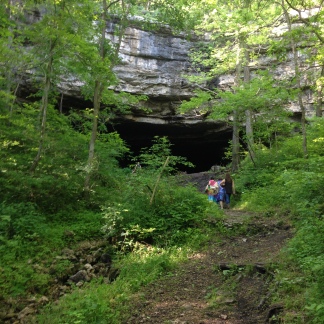
may-2016-051using handspun wool yarn until the yarn releases, taking our burdens with them. Suddenly, we hear the sound of tires on the gravel. Slamming doors. The sound of loud men’s voices. The smell of cigarette smoke. A ripple of uncertainty passes through us. We are once again tentative and we feel a current of unease. What should we do? we whisper to one another. The voices draw nearer, there are calls and hoots. My friend looks at me and says: this is where we make our standWe hold hands in a line at the edge of the cave roof, gazing out into the horizon. A hawk wheels overhead. We sing. The approaching voices quiet. We sing louder.

I am a strong woman, I am a story woman, I am a healer, my soul will never die.

We project our voices and yell: we are the witches, back from the dead!

The voices stop. We wait. We hear doors slamming. The sound of tires on gravel. We are alone once more.

We descend into the cave singing a song composed on the spot: Deeper, deeper. We’re going deeper. Deeper, deeper. Deeper still.

We strike a pose based on the carvings described in the classic book, When the Drummers were Women. Archaeologists described may-2016-099carvings of priestesses carrying drums as, “women carrying cakes to their husbands.”
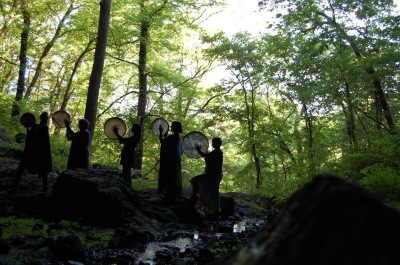
We shout: “we’re not carrying cakes!”

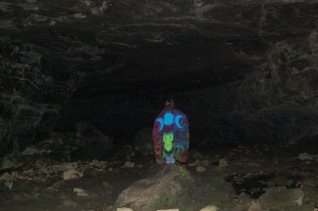
I stand on a rock in the center of the cave and sing: she’s been waiting, waiting, she’s been waiting so long, she’s been waiting for her children to remember to return. My friends join the song and we move deep into the darkness where we face the “birth canal” at the back of the cave, listening to the small stream within trickle, laugh, and bubble as it emerges from the dark spaces deep within the heart of the earth. We begin to sing:

Ancient mother we hear you calling. Ancient mother, we hear your song. Ancient mother, we hear your laughter…

Just as we sing the words, ancient mother, we taste your tears, droplets of cave water fall on our faces, splashing our eyelids.

It might seem simple on the surface, but gathering the women and calling the circle is a radical and subversive act. A revolutionary act. In my work with women’s circles and priestessing, I am repeatedly reminded that gathering with other women in a circle for ritual and ceremony is deeply important even though it might just look like people having fun or even being frivolous, it is actually a microcosm of the macrocosm—a miniature version of the world we’d like to see and that we want to make possible.

In the book, Casting the Circle, Diane Stein observes that women’s rituals, “…create a microcosm, a ‘little universe’ may-2016-062within which women try out what they want the macrocosm, the ‘big universe’ or real world to be. Within the safety and protected space of the cast circle, women create their idea of what the world would be like to live in under matriarchal/Goddess women’s values…The woman who in the safety of the cast circle designs the world as she would like it to be takes that memory of creation and success out into daily life…By empowering women through the microcosm of the ritual’s cast circle, change becomes possible in the macrocosm real world.” (p. 2-3)
It starts with these private ritual and personal connections and then, as Stein explains, “A group of five such like-minded women will then set out to clean up a stream bed or park in their neighborhood; a group of twenty-five will join a protest march for women’s reproductive rights; a group of a hundred will set up a peace encampment. The numbers grow, the women elect officials to government who speak for their values and concerns. Apartheid crumbles and totalitarian regimes in Eastern Europe end, disarmament begins, and laws to control polluters are enforced. Homes, foods, and jobs are opened to the world’s homeless, and often begins in the microcosm of the Women’s Spirituality ritual circle” (p. 3)

“Feminism catches fire when it draws upon its inherent spirituality. When it does not, it is just one more form of politics, and politics never fed our deepest hungers.”

–Carol Lee Flinders (in The Millionth Circle)
january-2017-038Molly has been “gathering the women” to circle, sing, celebrate, and share since 2008. She plans and facilitates
women’s circles, seasonal retreats and rituals, mother-daughter circles, family ceremonies, and red tent circles in rural Missouri and teaches online courses in
Red Tent facilitation and Practical Priestessing. She is a priestess who holds MSW, M.Div, and D.Min degrees and finished her dissertation about contemporary priestessing in the U.S. Molly and her husband Mark co-create Story Goddesses, original goddess sculptures, ceremony kits, and jewelry at Brigid’s Grove. Molly is the author of Womanrunes, Earthprayer, and The Red Tent Resource Kit and she writes about thealogy, nature, practical priestessing, and the goddess at Brigid’s Grove

Earth’s Mystery School by Molly Remer

“Earth is a mystery school complete with initiations and discoveries that you only experience by september-2015-123living with your feelings, touching the earth, and embracing the fullness of your humanity.”

–Queen Guenivere

(awakewoman)

On Samhain morning, I wake early and mist is rising out of the forest and dancing through the field and out of the trees. I have a moment of sheer awe to see it…the veil was literally thin.

Over the weekend, I visit the nearby river to connect in personal ceremony in appreciation before the park closes for the year and also symbolically to those at Standing Rock. This river eventually meets the Missouri River. I run my hands through the water. I anoint my brow, neck, and hands. I whisper my prayers into the ripples. I sing: “I am water. I am water…I am flowing like the water, like the water I am flowing, like the water.”october-2016-065

I am hurrying outside to get some work done. I feel tight and hurried with the length of my to-do list and my superhuman plans for the day. The bright red flame of a bloom on my pineapple sage plant catches my eye and then…the perfection of a bright yellow butterfly alighting on one slender stamen. My breath catches and I stop in wonder. I smell the flower and it smells of pineapple, just as the leaves do. I can hardly believe this treasure and the tightness melts into nothing. The rest of the day is full of joy.

I am once again healed by flowers.

About twenty feet outside my house, there is a small building with a little porch and a peaked roof. Inside, there is red carpet and a purple wall, goddess tapestries draped from floor to ceiling, and goddess sculptures in abundance. march-2016-002In this building I write, work, create, and hold small rituals with a circle of friends. I call it my Tiny Temple and it is the proverbial, “room of one’s own” described by Virginia Woolf in 1929. Having a dedicated work and ceremony space in the midst of a home-based life, which includes a home business shared with my husband, and four homeschooled children, has changed my life profoundly. In the tiny temple, I feel most wholly myself: connected, powerful, free, authentic, and completely alive.

One morning, as I walk to the temple, this beautiful rose makes me drop to my knees with delight. Yes. This right here. This is a beautiful moment. As I kneel beside the rose, the Body Prayer song* wells out of me until I have tears in my eyes.

september-2016-077  “We may need to be cured by flowers. 

We may need to strip naked and let the petals fall on our shoulders, down our bellies, against our thighs. We may need to lie naked in fields of wildflowers. We may need to walk naked through beauty. We may need to walk naked through color. We may need to walk naked through scent. We may need to walk naked through sex and death. We may need to feel beauty on our skin. We may need to walk the pollen path, among the flowers that are everywhere. 

We can still smell our grandmother’s garden. Our grandmother is still alive.”

–Sharman Apt Russell, in Sisters of the Earth

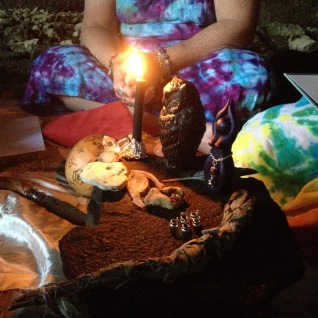
I create personal ritual almost every day in my tiny temple, sometimes simple, sometimes elaborate, sometimes tearful, sometimes joyful, sometimes hurried, sometimes leisurely, sometimes distracted, sometimes astonished at the wonder of it all. The week of my rose worship experience, I smudge the temple with sage I grew in the flowerboxes by my front porch. I ring my bell 13 times. I sing “I Am Fire.” I lay out cards and tiny goddesses and create a mandala out of fallen leaves. I leave an offering of flowers from the herbs and let rose petals drop from my fingers. Ritual captivates all the senses…in this sacred space, I invoke my own senses of smell, touch, sight, sound, and wonder and the result is magic.

“Through ceremony we learn how to give back. When we sing, we give energy through our voice; when we drum, we allow the earth’s heartbeat to join with our own; when we dance, we bring the energy of earth and sky together in our bodies and give it out; when we pray, we give energy through our hearts; when we look upon our relations, we give blessings through our eyes. When we put all these activities together, we have a ceremony, one of the most powerful forms of gift-giving we humans possess.”

–Sun Bear and Wabun Wind

May we each be healed by flowers, time to ourselves to sit on the earth and sing, and the simple, every day beauties and miracles that surround us each day.

october-2016-003

Notes:

august-2016-199

Molly has been “gathering the women” to circle, sing, celebrate, and share since 2008. She plans and facilitates women’s circles, seasonal retreats and rituals, mother-daughter circles, family ceremonies, and red tent circles in rural Missouri and teaches online courses in Red Tent facilitation and Practical Priestessing. She is a priestess who holds MSW, M.Div, and D.Min degrees and finished her dissertation about contemporary priestessing in the U.S. Molly and her husband Mark co-create Story Goddesses, original goddess sculptures, ceremony kits, and jewelry at Brigid’s Grove. Molly is the author of Womanrunes, Earthprayer, and The Red Tent Resource Kit and she writes about thealogy, nature, practical priestessing, and the goddess at Brigid’s Grove

Moving Forward and into a New Season by Elise M. Edwards

elise-edwardsIt’s only been a month and I am still reeling from the US presidential election.  I feel like I’m just beginning to emerge from the sense of loss and futility that has cloaked me.  But I am beginning to move forward.

I don’t feel better.  I’m still confused and discouraged about why people voted for Donald Trump.  I’m very concerned about his cabinet picks and his proposed policies.  But I am actively seeking a path forward and a path of resistance.  I’m finding support in my spiritual practices and communities.

In the Christian calendar, we are in the season of Advent.  Advent carries profound symbolism, and this year it is especially poignant for me.  The word advent bears meanings of arrival, birth, and emergence.  It’s the beginning of the Christian year, which is patterned on the life of Christ, but the year does not begin Jesus’ birth.  That celebration is observed at Christmas, four weeks into the church year.  The weeks preceding Christmas are a time of preparation and reflection on the need for the Incarnation.  The Incarnation of God in the Christ Child may be a distinctly Christian doctrine, but I believe the need for it–even the idea of it–is found in other spiritual and religious teachings.

Continue reading “Moving Forward and into a New Season by Elise M. Edwards”

A Midwinter Ritual by Barbara Ardinger

Midwinter, the winter solstice (December 21), is the shortest day and longest night of the year. I like to think of Yule, an old pagan name for the solstice season, as a time when we get to take a nice, long, peaceful nap between all those holiday parties. For this ritual, you need two candles (silver and gold), a blanket, and a small gift for yourself.

santaSanta Claus is really a shaman. He wears red and white and black (the three sacred colors of the so-called ancient triple goddess) and he’s fat because he’s well-fed. (A traditional shaman once told me never to trust a skinny shaman; if his people don’t provide for him, he’s not doing his job.) Santa flies from the frozen north, where the Saami (or Lapp) shamans still wield their full traditional powers. He’s drawn through the air by magical reindeer whose antlers symbolize the surging force of life. The Christmas tree is the world pole. From Mongolia to the American Southwest, shamans traditionally ascend the world pole to make their astral journeys. Santa knows everything, especially if we’ve been good or bad, and like karma itself, he brings us our just desserts. His gifts are the gifts of the spirit made material. His attendants, the toy-making elves, are the Old Ones who help the deserving and play tricks on the undeserving. Santa is not a god, but let’s honor him along with the solar gods and goddesses in our midwinter ritual. Continue reading “A Midwinter Ritual by Barbara Ardinger”

Rituals for Our Sons, by Molly Remer

“…There, he found a piece of glass and began to tell a story. He was telling one of his tribe’s men’s stories. It was a story for boys to become men, and it was not shared with women. The women had their own stories, not for men to know. I read that and thought, no one took me out into the desert; no one told me stories. That’s what I needed, a passing of history and the ways of living, from one man to another.”

–Christopher Penczak, Sons of the Goddess, p. 51

Our oldest son is rapidly sliding into manhood. Creaky voice. Height stretching on a near-daily basis. Fuzz on upper lip. I am finding it hard to hold august-2016-096-768x768
space for his transition as a teenager while still caring for a not-quite-two year old small boy as well, one who reminds me regularly of my first baby boy and what it was like to be a mother to only one, focused on each stage of development, each new word, each successful identification of a new color. Now that first baby boy swings that last baby boy onto one hip with practiced ease, washes dishes, helps to cook, pours milk for his sister.

Several years ago, I was asked to work on a coming of age/manhood ceremony for a friend’s son. It never quite came together—I didn’t feel like I could do it and I still feel regret about having let that boy down. At the time though, and still now, I felt that I’m not “qualified” for the job—I don’t know the men’s stories either. The council of men needs to prepare his ceremony. Where is the men’s council, the circle of men? I think we have them around us, but that there is much less cultural permission for them to gather in groups to honor transitions in sacred ways. Much as women’s circle work feels radical and transformative and even threatening to patriarchal culture, men gathering in circle to honor and guide one another, that is perhaps even more so. I see Red Tents around the world. I see women’s circles springing up with a glorious passion and far flung expression. I am guiding other priestesses in circle work, and Red Tents and Pink Tents, and holding ceremoniesjuly-2016-822-1080x675 for our daughters coming of age. What about our sons? Where are their ceremonies and welcomes into manhood? Where are their stories in the desert? Is it a mother’s job to provide the container for those stories? Can I call the circle for my son and then step back? I know what it means to be a girl reaching into womanhood. I know what it means to circle with other women. Does it have to be different for boys and men?

When I was reading books, looking for ideas for my friend’s son, I noticed that most pagan rituals described for boys include the element of the son being “kidnapped” from the mother, women, and girls and being taken away by the men and left alone. I hate these rituals. Every time I read one like it, my heart screams, “NO, we want more than that for our sons.” Despite being promoted as part of an alternative spiritual framework, how does this type of ceremony support and honor the type of world we wish our children to grow up in? Why do boys need to be kidnapped from their mothers and left alone in order to be men? Isn’t that the very root of patriarchy on this earth? No thank you.

I bought another book specifically because it mentioned including a rite of passage ceremony for boys. I read it with eagerness and was dismayed at august-2016-073-300x300what I found. The circle was called, held at dusk, and each person was instructed to bring a rock for the newly fledgling boy. They were to go around the circle and share what they learned, what they were imbuing into the stone…so far, so good, right?…and then, throw it into the darkness and say, “find it for yourself.” When I read this, I had an epiphany. If this was a ceremony for girls, we each would have handed her the stone and welcomed her into the circle with our wisdom, we would have made sure she knew that she was strong, powerful, and capable, but also that part of that power meant that we were standing with her and offering our wisdom in support. She would not have to crawl in the darkness alone looking for rocks, because we’re there. And, that is the core message of most women’s circles and ceremonies for girls. We’re there. You are not alone. So, then I knew…a ceremony for a boy need look no different. Maybe I do not know the stories from the men’s desert, but I do know what it is like to celebrate someone for their unique gifts and strengths, look them in the eye and affirm their power, and sing to them with love of my support of their dreams. This is not a gendered thing, this is humanity. How do we want to welcome boys into the world of adults? By casting away our wisdom and telling them to search in the darkness for themselves? Or by standing next to them, shoulder to shoulder, hand in hand, and offering all that we have, all that we are, in support, and trust, and honor of their evolving selves?

july-2016-829-768x512

This summer, we gathered in sacred circle for a chanting workshop and a summer ceremony. The men at the chanting workshop sang just as wonderfully together as the women do in the Red Tent. The boys in the summer circle joined hands just like anyone else.

We do know how to do this.

This song below was recorded during the chanting workshop and feels appropriate for this occasion…

picture1

Molly has been “gathering the women” to circle, sing, celebrate, and share since 2008. She plans and facilitates women’s circles, seasonal retreats and rituals, mother-daughter circles, family ceremonies, and red tent circles in rural Missouri and teaches online courses in Red Tent facilitation and Practical Priestessing. She is a priestess who holds MSW, M.Div, and D.Min degrees and finished her dissertation about contemporary priestessing in the U.S. Molly and her husband Mark co-create original goddess sculptures, ceremony kits, and jewelry at Brigid’s Grove. Molly is the author of Womanrunes, Earthprayer, and The Red Tent Resource Kit and she writes about thealogy, nature, practical priestessing, and the goddess at Brigid’s Grove