Letter to Allah by Jameelah X. Medina

Would we eat without the pangs of hunger? Would we drink without feeling thirst? Would we sleep without feeling fatigue or drowsiness? Would we cry without feeling sorrow? These are some questions I’ve asked myself when I wonder why so many people tend to find God, religion, or spirituality in times of great dis-ease and despair. Suddenly, I felt inspired to write a letter to God thanking Her for all that She is and for all that I am. In labyrinthical terms, this is my letter to the God in me that resides within me in God.

Letter to Allah Continue reading “Letter to Allah by Jameelah X. Medina”

Cultural conditions and Spiritual Subtleties by Oxana Poberejnaia

oxanaI am very grateful to Carol P. Christ and other contributors for their insightful comments and thoughtful questions to my post “Blindness of the Gals”. As I promised to Carol, here is my post that starts answering some of the issues raised in the comments.

I cannot say that it was giving birth to my daughter that first made me question my blindness to patriarchy in religion and culture. Rather, it was a gradual process of educating myself by reading works by feminist thinkers, and learning about the brave women and men who have been fighting and are still fighting for women’s rights.

Continue reading “Cultural conditions and Spiritual Subtleties by Oxana Poberejnaia”

In Dreams I Trust by Annette Allen

AnnetteGrowing up in an agnostic family in 1950’s Britain, I did not hear religion discussed.  So it seemed odd that my parents sent my brothers and me to Sunday school.  At home, as I was battling my father’s constant criticism and jealousy towards Eric, my younger brother, learning about Jesus thrilled me.   Jesus seemed to love and value young children – what a hero!

Moving to Addis Ababa, Ethiopia, in 1962, deepened my faith.   At Nazareth School for Girls, I practised Catholicism, recited the rosary, and devoured books about female Catholic saints. But the American sisters taught that our bodies were impure, not healthy; lustful thoughts about boys were wrong, and husbands were masters.  Worst of all, heaven didn’t have any animals.  To an innocent girl, God was now judging and condemning.  I was very confused. Continue reading “In Dreams I Trust by Annette Allen”

THE LABRYS: A RIVER OF BIRDS IN MIGRATION by Carol P. Christ

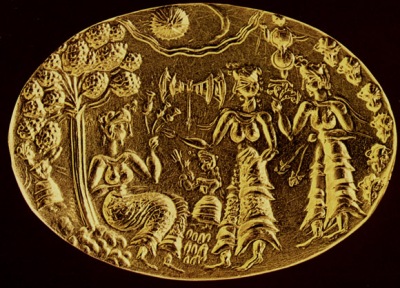
carol-christ“There’s a river of birds in migration, a nation of women with wings.” Goddess chant, Libanalabrys seal ring

On the Goddess Pilgrimage to Crete, I explain that many of the names given to “Minoan” (c. 3000-1450 BCE) Cretan artifacts and architecture are products of patriarchal and Eurocentric imaginations, and as such, are misleading.  For example the name “Minoan” was given to the culture of Bronze Age Crete in honor of “King Minos,” who was said to have ruled in Crete a few generations before the Trojan War–several hundred years after the end of the culture to which his name was attached.  In fact, despite his eagerness to find evidence that King Minos ruled at Knossos, the excavator Sir Arthur Evans finally had to concede that the best he could do was to produce a fresco of a “Prince of the Lilies” which he identifed as the image of the male ruler of the culture he called “Minoan.”  Evans’ Prince had white skin, a fact that Evans conveniently overlooked–because according to his own interpretation of “Minoan” iconography, white skin would mark the figure as female.  Mark Cameron, who reviewed Evans’ reconstruction of the fresco, suggested that the Prince is more likely to be a young woman who is perhaps leading a bull to take part in the bull-leaping games.  He also stated that the “crown” belonged to another fresco altogether.

Evans’ failure to find evidence of a King or for that matter a Queen at the complex of buildings he called “The Palace of Knossos” calls into question his idea that these structures were palaces.  Nanno Marinatos argued that the “palace” was instead a ritual center for the surrounding village, as well as a community gathering place, a place for storing grain, wine, and oil in a sacred way, and a place where ritual objects were fashioned of clay, bronze, stone, and gold.  Following her lead, I renamed the “Palaces” “Sacred Centers.” In this blog I will experiment with renaming the “Minoan” culture “Ariadnian,” after the pre-Greek name Ariadne, which may be one of the names of the Goddess of Bronze Age Crete.

One of the most pervasive–and many would say–most enigmatic symbols of the Ariadnian culture is the labrys.  Continue reading “THE LABRYS: A RIVER OF BIRDS IN MIGRATION by Carol P. Christ”

To Have and to Hold: Gay Marriage and the Religion Question

If a conservative religious traditions can’t give their mothers or sisters full equality, how can we expect them to give a GLBT individual the time of day?

John Erickson, sports, coming out.Outrage.  Anger.  Fear.  Hatred.  These are just a few of the words that flashed across my Twitter feed as I woke up on that fateful Wednesday, June 26 morning when the Supreme Court of the United States ruled that the Defense of Marriage Act (or DOMA) was unconstitutional and that supporters of Proposition 8, the hotly contested voter initiative in California that banned same-sex marriage, had no standing.   People were mad.  However, it wasn’t just the typical kind of mad that is associated with hatred, it was a type gay_marriage_81102178_620x350of mad that was met with impossible anguish because what I was reading and feeling was a result of one thing: there was nothing more they could do.

What does all this mean?  Questions from friends and family were filling up my inbox and although I wanted to take a moment to just hit “Reply All,” and input the words: Equality, I had to hold back and start to examine the notion that although equality may now be firmly on the proverbial table, there is still a lot of work to be done, specifically for gay marriage and those wanting to marrying inside the traditional church spaces they grew up in and not just the ones that have come out as open and affirming in recent years towards LGBT individuals. Continue reading “To Have and to Hold: Gay Marriage and the Religion Question”

Ancient Spirit Wisdom by Jassy Watson

For the Love of Gaia Jassy WatsonOn a recent journey within, guided by drumming and visualisation I encountered my Muse. Her Native American Indian appearance surprised, even bewildered me, as I know so little about North America’s indigenous cultures.

As I painted her into being I listened closely to what she told me, stating clearly “I am Ancient Spirit Wisdom,” the wisdom of our ancestors passed on through story, image, sculpture, word, song, dance, ritual, prayer and ceremony. The closer I listened, the more my Mysterious Muse reminded me that I had a story within, one of my very own, yet one shared by women everywhere. I too am a container of Ancient Spirit Wisdom, more precisely, Ancient Women’s Wisdom.

Ancient Women’s Wisdom, Jassy Watson,  ‘Ancient Spirit Wisdom’
Closeup, ‘Ancient Spirit Wisdom’ Jassy Watson 2013

Continue reading “Ancient Spirit Wisdom by Jassy Watson”

Birth as a Shamanic Experience by Molly

editMollyNov 083Childbirth is a rite of passage so intense physically, psychologically, emotionally, spiritually, that most other events in a woman’s life pale next to it. In our modern lives, there are few remaining rituals of initiation, few events that challenge a person’s mettle down to the very core. Childbirth remains a primary initiatory rite for a woman.” –Maren Hansen (MotherMysteries)

When I was pregnant with my first baby, I read an article with the theme of “Birth as a Shamanic Experience.” I can no longer find the exact article (online or printed), but I distinctly remember my feeling upon reading it: I was entering into a mystery. Giving birth was big. Bigger than anything I’d ever done before and it went beyond the realm of a purely biological process and into something else. Like shamanic experiences, giving birth is often described as involving a sense of connection to the larger forces of the world as well as being in an altered state of consciousness or even a trance state. While shamanic experiences may involve “journeying” to other realms of reality, giving birth requires the most thoroughly embodied rootedness of being that I’ve ever experienced. It, too, is a journey, but it is a journey into one’s own deepest resources and strongest places. The sensation of being in a totally focused, state of trance and on a soul work mission is intense, defining, and pivotal.

Shamanic journeys may be embarked upon for the purpose of soul retrieval and I can’t help but think that this is the purpose of giving birth as well—the birthing woman travels into herself to bring forth the soul of her child.  Continue reading “Birth as a Shamanic Experience by Molly”

God Doesn’t Live Here Anymore: Gay Bars and the Growing Divide Between Sexuality and Spirituality by John Erickson

oes God exist within the LGBTQ community anymore or has the community itself abandoned God for all-night raves, dance clubs, alcohol, and hypersexualized and over commoditized fetishized forms of femininity and masculinity? Oftentimes, I find myself answering yes to the above questions. After surviving hate crime after hate crime and endless batches of newly elected conservative politicians hell bent on ignoring medical and social epidemic plaguing the very country they were elected to serve and protect, why would a community, oftentimes linked to sin itself, believe in a holy entity?

John Erickson, sports, coming out.My good friend and fellow Feminism and Religion Contributor Marie Cartier’s forthcoming book, Baby You Are My Religion: Women, Gay Bars, and Theology Before Stonewall argues that American butch-femme bar culture of the mid-20th Century should be interpreted as a sacred space.  Specifically, gay bars served as both communal and spiritual gathering spaces where butch-femme women were able to discover and explore not only their sexuality but also their spirituality.  An opus of an academic accomplishment based off of the amount of in-depth interviews she conducted, Professor Cartier explores lived religion in an area that has become all too common within the LGBTQ community: the bar

The Palms, the last local and only lesbian bar to be found in city of West Hollywood, CA is closing its doors and I can’t help but wonder where its patrons or parishioners will now go? Continue reading “God Doesn’t Live Here Anymore: Gay Bars and the Growing Divide Between Sexuality and Spirituality by John Erickson”

Coming out as a Cosmic Cowgirl by Jassy Watson

For the Love of Gaia Jassy WatsonFor the past two months I have been participating in a teacher training called the Colour of Woman (COW) method, an intensive healing and transformational program of sacred painting and intentional creativity founded by visionary artist, teacher, author, and publisher, Shiloh Sophia McCloud. The course is designed for women who want to infuse their lives and work with the mysterious and ancient powers of the creative principles of the Sacred Feminine; she who is known by many names and forms; She who is the mysterious source of life that births both the feminine and masculine; She who has been honoured and deified by many ancient cultures as the bringer of life, growth, decline, death and re-birth; She who is the wellspring of creativity. Continue reading “Coming out as a Cosmic Cowgirl by Jassy Watson”

Unblocking Abundance: A Ritual by Sara Frykenberg

Sara Frykenberg

Rather than release the sadness, heartache and struggle we put into the bowl out into the world, we meditated …to transform what we could of this energy, re-membering the parts of ourselves that had helped to create these blocks and are responsible for transforming them.  We took the transformed energy back into ourselves.

As I have written about many times before, I believe that contemporary Western society operates within a largely abusive paradigm.  I often think of oppression in terms of an abusive cycle.  Theologians like Cater Heyward and Rita Nakashima Brock describe the impact of the theologies that generate such abusiveness, noting how we become smaller to ourselves and smaller to one another.  We do not believe that we are enough, nor are the people or the planet around us ‘enough’ to fill the vacuous alienation that substitutes itself for real relational need in an abusive context.  Judith Shaw wrote eloquently about the environmental impact of conflating need with greed in her Friday post, “Can We Honor Inanna and Her Gifts?”

Shaw writes, “At first glance we appear to be abundant with things, energy, experiences.  But in our mad desire for more and more and always more we neglect the balance of the very earth who provides us with all.”  Many people, particularly in industrialized nations, have been taught to fill the need for a sense of abundance, connection and ‘enough-ness’ with more stuff: more things, more money, more food, more land, etc.  And yet, ironically, this quest for ‘more’ can also prevent us from experiencing the very abundance we seek.  We can create blocks to abundance by trying to fill the vacuum instead of our actual needs: and difficultly, abusive patterns and cycles can prevent us from seeing the difference between the two.  Continue reading “Unblocking Abundance: A Ritual by Sara Frykenberg”