#YesAllWomen, the Darwin Debate, and the God Complex by John Erickson

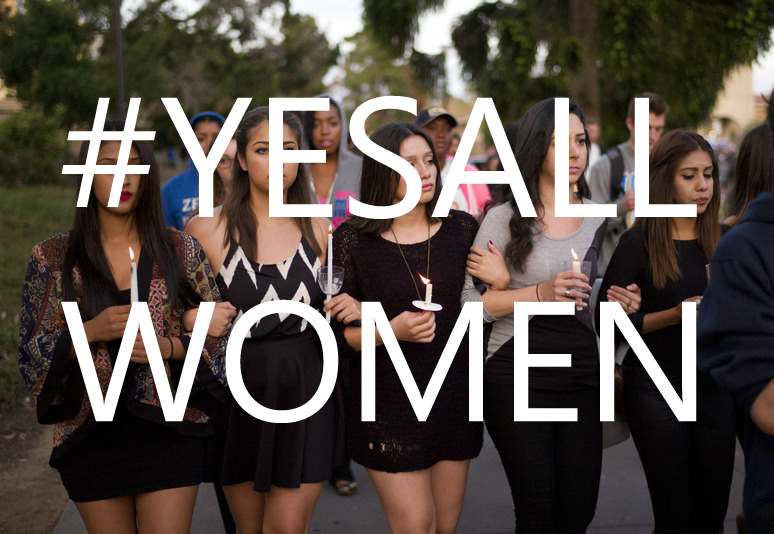
#YesAllWomen proved that although not all men commit horrible crimes against women, the men that often get the headlines and create the most controversy are the ones that need to be watched out for.

John EricksonThe one thing I typically will choose to do on the rare occasion that I’m able to sit down and relax is to watch a documentary.  While some people may go to the gym, read a book, or hang with friends, I typically choose to stay in, nestle up on my couch, and learn.  While on my last bout of relaxation, I chose to watch the HBO documentary Questioning Darwin. Although it offers very little new insight into the evolution vs. creationism debate, it does offer an interesting new way to look at the recent social media hashtag war feminists, allies, and supporters found themselves in over the #YesAllWomen movement that took the world by storm.

yesallwomen

Now, before I discuss #YesAllWomen, I have to admit that I did not enter into the safe space women created for themselves to tell tales of the horrible things they have and have had to face on a daily basis.  I firmly believe that men should not have entered into the digital space Continue reading “#YesAllWomen, the Darwin Debate, and the God Complex by John Erickson”

The Outraged Ancestral Mother by Molly


crop027During the fifth week of the Rise Up and Call Her Name curriculum by Elizabeth Fisher, “We honor the Outraged Ancestral Mother and the belief that the sacred and secular are one.” When I priestessed this session for my women’s circle, I was caught by the idea of the Outraged Ancestral Mother and we spent some time discussing her and the degree to which humanity has hurt our planet. The next morning while I was practicing yoga, snippets of a poem came floating to my mind. I had the distinct feeling that the Outraged Ancestral Mother was ready to speak to me. I went down to the woods to listen to what she had to say.

Continue reading “The Outraged Ancestral Mother by Molly”

Redefining Spirituality, One Church for All by Andreea Nica

Andreea Nica, pentecostalismAs a former lover of Christ and ex-Pentecostalist, I had countless visions and dreams that one day I would be a spiritual leader. While growing up in the charismatic church, it was even prophesied that one day I would become one.

Nearly ten years after leaving the church, I carried a distrust in religion’s relationship with women and its barrier to free thought. My work as a freelance journalist led me to discover a spiritual women’s retreat held in North Bend, Washington. Inspired to experience a non-religious, spiritual gathering, I registered for the retreat held by Center for Spiritual Living (CSL) in Seattle.

CSL is described as a:

“Trans-denominational, inter-generational, not-your-usual church, that was started in 1921. A safe place for ‘the rest of us’ who are looking to connect with God/Higher Power/Universal Presence, but don’t really fit in with any one religion.”

The spiritual center’s core teaching philosophy derives from “Science of Mind” or Religious Science, a New Thought spiritual, philosophical, and metaphysical movement founded by practical mystic Ernest Holmes. The spiritual principles rely on the laws of physical science in establishing its core beliefs. Continue reading “Redefining Spirituality, One Church for All by Andreea Nica”

Monkey See…by amina wadud

amina 2014 - cropped

When I was a little girl the Washington D.C. Zoo did not have that extra security fence between gawking spectators and the cages of certain animals.  My mother used to climb up onto the cage and hand peanuts to the monkeys.  I don’t know, maybe that was the beginning of my lifelong love of monkeys.  When I moved to Malaysia as Assistant Professor at the International Islamic University I was driving down a main roadway and along the side of the road I saw a monkey scurrying along much like we see squirrels in the US.  A new phase in my life began.  How many ways to repeat my mother’s antics?  Could I possibly top that? This introduction might seem silly but I just have to share one of the most sublime experiences of my life and for that I need to give you a feeling for just how much I love monkeys.

When monkeys are in the wild they are not always amenable to such antics as we humans can do or imagine.  I think that’s probably part of survival, don’t you?  Anyway, in Malaysia, even though they were as plentiful as squirrels and just as accessible, like squirrels they are not at our beck and call either.  We were pretty much limited to the evenings at a local park when they would come down from the trees and let us feed them. Like children do with Canadian geese at Merritt Lake Park here in Oakland, or any where they roam.  Once we climbed up more than 1000 stair-steps to the top of the Batu Caves a Hindu temple and tourist spot, to see the sights and feed the monkeys.  That time one wily monkey snatched the whole bag of food from my daughter’s hand while she wasn’t looking and that was the end of it.  No way to go back to the car and run back with more!  Continue reading “Monkey See…by amina wadud”

A Tiny Life by Barbara Ardinger

Barbara Ardinger

The news is getting me down. Nearly three hundred Nigerian schoolgirls kidnapped by Boku Haram. The capsized South Korean ferry and more than 300 drowned students. Kids taking guns to school and the governor of Georgia signing a law that says anyone can carry a gun almost anywhere in the state. The ever-continuing feminization of poverty. A couple Saturdays ago, I heard an enormous noise of cawing and shrieking and wings flapping outside my window. It went on for several minutes, so I finally set my book aside (I was trying to ignore Eyewitless News), got up, and looked out into the courtyard. Two huge, noisy crows were chasing a smaller bird. I think it might have been a scrub jay. I have no idea what the jay’s crime had been in the crows’ eyes, but they were chasing it back and forth, up and down, and one of them finally speared it with its beak. The jay fell. The crows landed on the roof of the building across the courtyard and strutted back and forth for several minutes. One of them went down for a closer look at the fallen jay. Then they flew away.

I’ve seen crows attacking other birds before. They’re extremely intelligent birds, but they also get aggressive. Some years ago, I sat at a desk in an office, gazing out the window, and saw a crow destroy a hummingbird’s nest and eat the babies. Sad, yes, but this is how crows around the world find food. My coworkers wanted to storm outside immediately and (I guess) shoot the crow and maybe tear the little tree out of the ground. “No,” I said. “Leave it alone. Tennyson was right when he wrote that nature is bloody.” Continue reading “A Tiny Life by Barbara Ardinger”

Reincarnation – A Belief Found Worldwide by Judith Shaw

judith Shaw photo

Reincarnation is a spiritual belief that our souls are reborn many times to this physical Earth plane. These many lives give us the opportunity to experience a variety of circumstances and create karma, the law of cause and effect. Through these experiences one grows, until ultimately one’s soul reaches a level in which it transcends to another dimension. Once in these other dimensions our souls continue their evolution toward oneness with Source.

I have always believed in reincarnation myself and have explored the idea in various paintings. This painting, Many Lives, illustrates that belief. The far left figure is my present self and the other figures represent selves I might have been in past lives. But the concept of reincarnation is not as ancient as I thought it was.

Many Lives, painting by Judith Shaw

It is difficult to known exact beliefs of peoples who lived before written history began but some scholars feel that ancient cultures who practiced shamanistic Earth-based religions had a concept of reincarnation. But other scholars believe that these tribes taught only of the preexistence of the soul before birth or its independent survival after death in an Otherworld. Continue reading “Reincarnation – A Belief Found Worldwide by Judith Shaw”

Jesus, Mary and Joseph: Who Are Our Saints? by Marie Cartier

Tomorrow I will be going to a friend’s 7th grade classroom presentation of “famous people in history.” She has 120 students who will be dressing up as someone in history and doing a presentation board about this person—as well as dressing in costume. She asked me to come in costume as Frida Kahlo. As many of you know, I admire/adore Frida Kahlo and wrote a blog last year extolling her praises; actually it was a “valentine towards an ethics of loving women and art.” (And every year I dress as Frida and help a friend do a lively lotería game at an LGBT celebration of Cinco de Mayo at our Church.)

My friend told me that while there would not be a Diego Rivera in her crowd of costumed living historians—there would be Frida’s lover Josephine Baker (someone saw the movie Frida and knew Josephine and Frida were “friends”), and there would be several Guadalupes.

This got me thinking that for children/teens – especially children brought up in religious households (and especially Catholic households, of which I was such a child) – saints and real people are often conflated. And famous real people one admires often are given “sainthood” in one’s imaginary church. Continue reading “Jesus, Mary and Joseph: Who Are Our Saints? by Marie Cartier”

Danu, Celtic Mother Goddess by Judith Shaw

judith Shaw

Danu, of the flowing waters, Queen of the fertile land – Danu, the Great Mother Goddess of the Irish Celts, known as Don by the Welsh Celts, is the Creator Goddess of the Tuatha De Danann, the first wave of Celtic tribes to invade Ireland.   She is also known as Danann, Ana, and Anann.  She gave birth to all life in the land of the Celts.

No stories of Her survive but Her power remains strong. She is the most ancient of all the Celtic deities. In a silver flash of iridescence she appears in my mind’s eye.

As the “Flowing One” She is associated with the seas, wells, springs and the Danube River, gifting Her children the magic of transformation, inspiration, and wisdom. As an Earth Goddess, She bestows abundance and earth mysteries. She embodies the wisdom of living in balance with the Earth. She is sometimes associated with Flidais of the cattle and deer. She is also connected with Brigid, Goddess of Healing, Poetry and Smithcraft, who the original Neolithic people of Ireland worshiped long before the Celts arrived. Continue reading “Danu, Celtic Mother Goddess by Judith Shaw”

The Bee Goddess Calls by Judith Shaw

judith ShawSpring arrived in the Northern Hemisphere and all of Goddess’s children are waking up from our winter slumbers.  Birds are singing, fruit trees are blossoming, bees are buzzing, and early spring bulb flowers are in full bloom.  Signs of spring fever are evident as we find ourselves full of energy and vitality for new projects and relationships.

As new life emerges from the Earth we can more easily reflect on our place in the greater scheme of life.  It’s a good time to question the values of our consumer society and ask if there is another way.

In contrast to these values of domination, separation, and consumption, ancient wisdom traditions teach that we are all connected – to each other, to all life, to the whole natural world and to the spiritual cosmos. Continue reading “The Bee Goddess Calls by Judith Shaw”

The Soul is Symphonic: Reclaiming Sacred Music

https://i0.wp.com/media.tumblr.com/55c2821e2413450d48ec03b96e4cd426/tumblr_inline_mqcp4y6ZwN1qz4rgp.jpg

Here is a hymn of praise, a beautiful and intimate piece meant to be sung.

Hail, O greenest branch,

sprung forth on the breeze of prayers.

. . . . a beautiful flower sprang from you

which gave all parched perfumes their aroma.

And they have flourished anew  in full abundance.

The heavens bestowed dew upon the meadows,

and the entire earth rejoiced,

because her flesh brought forth grain,

and because the birds of heaven built their nests in her.

Behold, a rich harvest for the people

and great rejoicing at the banquet.

O sweet Maiden,  no joy is lacking in you . . . .

Now again be praised in the highest.

When I posted this sacred text on my blog back in 2008, I asked my friends who come from a diverse range of spiritual backgrounds to guess the author and the divine figure to whom the text is addressed. Some thought it might be an ancient hymn to Persephone. In fact, it is one of Hildegard von Bingen’s ecstatic odes to the Virgin Mary. This song, O viridissima virga, can be found on a number of CDs of Hildegard’s music.

Born in the rich green hills of the German Rhineland, Hildegard von Bingen (1098-1179) entered the religious life at the age of eight. A Benedictine abbess, she composed an entire body of sacred music, including seventy-seven songs and a musical morality play which can be regarded as our first surviving opera. A polymath well versed in science and the healing arts, she developed her own form of natural medicine that is still practiced in Germany today. During her own lifetime, she was most famous for her prophecies which earned her the title Sybil of the Rhine.

Since earliest childhood, Hildegard experienced profound visions which directly influenced her music, theology, and healing practices. Her visions revealed the feminine face of the divine, which is mirrored in her music. Many of her songs are addressed to Mary or female saints, such as Ursula. Even the Godhead itself appeared to her in feminine form. In Scivias, her first book of visionary theology, she writes, “She is with everyone and in everyone, and so beautiful is her secret that no person can know the sweetness with which she sustains people, and spares them with inscrutable mercy.”

Hildegard’s sacred songs are filled with a deep sensuality and reverence for the natural world. In her hymn O viridissima virga, she transforms the Latin word virgo, or virgin, into virga, or branch, addressing Mary as the most verdant and lushly abundant branch on Jesse’s tree. Hildegard was Christian, yet her music and visions have profound resonance for people from all spiritual backgrounds. The more I study mystics and visionaries, the more I am convinced that they draw on the true heart of divinity. They tap into the ineffable.

Sacred music was the bedrock of Hildegard’s spirituality. For her, song was the highest form of prayer, sacred harmonies rising like incense in a perfect offering to heaven. Hildegard believed that the soul is symphonic. Such is the sweetness of music that it banishes human weakness and fear, and draws us back into our original state of grace, reuniting humans to their divine Source.

Benedictine monastic life was structured around the Divine Office: eight times a day, from the dawn office of Lauds to the night vigil of Matins, the choir nuns gathered to sing the Psalms of David and other sacred songs. Near the end of her long life, Hildegard and her nuns at Rupertsberg Abbey were subject to an interdict, or collective excommunication. A supposed apostate lay buried in their churchyard and they refused to allow the ecclesiastical authorities to exhume this man and desecrate his grave. As a result of the interdict, Hildegard and her nuns were denied the Mass and the sacraments—a very old woman, Hildegard herself might have died without the final sacraments or Christian burial. Yet what infuriated her most was that she and her sisters were forbidden to sing the Divine Office. Sacred song was absolutely central to her identity as a religious woman. The interdict was lifted only shortly before her death. I imagine her singing until her dying day.

What relevance does this have for us today? When I listen to recordings of Hildegard’s music, I am struck by its ethereal beauty. Nowadays, for people across the spiritual spectrum, there seems to be a dearth of good music. Much of what is sold as meditation music or inspirational music seems shallow and insipid to me. A regular church-going Catholic is more likely to experience the guitar mass than the mysterious beauty of Hildegard’s music.

As contemporary spiritual people, are we to live our lives severed from the kind of music that can truly feed our souls?

What can we do to reclaim the power of sacred song? Few of us are gifted composers. Many of us cringe to even hear ourselves sing. How do we integrate sacred music into our spiritual practice? Most of us lead busy lives and the stillness of a monastic lifestyle remains an impossible dream. Yet we might find sung devotions at morning and twilight to be deeply enriching. We might start by listening to recorded music that inspires us. From my own practice, I’ve discovered that Hildegard’s music definitely works as a backdrop to meditation and contemplation. It soothes the soul and draws the heart and mind to a higher place. Over time we might gain the courage and will to take the leap to sing for ourselves. It’s not necessary to play an instrument. The voice  God gave us is enough. The next logical step is creating our own new music.

If we can’t find the music to nourish our soul, we must create it. Hildegard took the established tradition of plainchant and wedded it to her own vision to create hymns of incomparable beauty that still move us today. Most of us aren’t visionaries like Hildegard, but we can write our own heartfelt lyrics in praise of the Divine as we see Her. We can write songs to celebrate the sacred cycles of the year and the days we hold sacred. We can take ancient sacred texts and find a melody to carry the words. Medieval plainchant is beautiful in its simplicity. Or perhaps a haunting old folk air will inspire you.

When you offer your songs as prayers, sing like you mean it. It’s not a performance to impress other humans but a pure act of devotion. Meet together with friends in an informal devotional gathering. Share your songs. Inspire each other. Our modern sacred music will inevitably keep evolving as people compose new songs and add to the canon. We each have the opportunity to be part of this evolution.

Mary Sharratt is the author of Illuminations: A Novel of Hildegard von Bingen (Houghton Mifflin 2012, Mariner 2013), winner of the Nautilus Gold Award: Better Books for a Better World. Visit her website.


Sacred Music Discography:

Hildegard von Bingen:
11,000 Virgins: Chants for the Feast of St. Ursula, Anonymous Four, Harmonia Mundi, USA.
The Dendermonde Codex, Dous Mal/Katelijne Van Laethem, Etcetera.
A Feather on the Breath of God, Gothic Voices, Hyperion.
Canticles of Ecstasy, Sequentia, Deutsche Harmonia Mundi.
Voice of the Blood, Sequentia, Deutsche Harmonia Mundi.