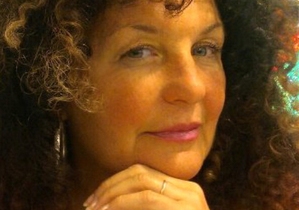
Earlier this week I went to hear Sr. Helen Prejean speak about the death penalty. You will remember, if the name does not immediately ring a bell, that the amazing movie Dead Man Walking (dir. Tim Robbins, 1995) was about her and her ministry to provide solace and closure with God to those inmates on Death Row. In the film, Sr. Prejean was played by Susan Sarandon. Dead Man Walking, a phenomenal hit, chronicled her first attempt at this ministry—her trials and limited success—in helping Matthew Poncelet come to grips with what he had done, ask forgiveness of the victims’ parents (because he was complicit in the murder of two teenagers) and face his death with dignity.
In addition to teaching Gender and Women’s Studies, I have also been the screenwriting professor at University of California Irvine since 1992. I have used the screenplay for this movie (adapted from Prejean’s book and direct interviews) almost since it was published. It’s a great example of how research, interview, and authenticity can make a movie work—rather than “making it up.” Even the title was new to most of America- “Dead man walking!” refers to the last walk an inmate makes as he (or she) walks to his (or her) death.
So, I was enthusiastic when I heard that Sr. Helen was speaking at a local church very close to my house. Although I’ve used the screenplay for well over a decade, I had never met her or read the actual memoir she wrote. It seemed the perfect opportunity to meet her and get a signed copy—and also something my students would love to hear about when we discuss the film in the winter. Continue reading “Right to Life vs Right to A Life: Abortion & The Death Penalty by Marie Cartier”
I had an entire blog ready to go for posting this week, but as news broke of Jennifer Lawrence’s stolen pictures, I couldn’t bring myself not to speak up.
If you have not heard yet, hackers broke into Jennifer Lawrence’s personal accounts and uploaded quite a stash of private photos on to the internet. They are currently threatening to upload stolen videos as well. You can find the story chronicled here. I’ve decided to link to a feminist website that is withholding the photos because, trust me, you do NOT want to wade the waters of what is out there in regards to this story. It is rage inducing. Continue reading “We Are All Jennifer Lawrence by Martha Cecilia Ovadia”
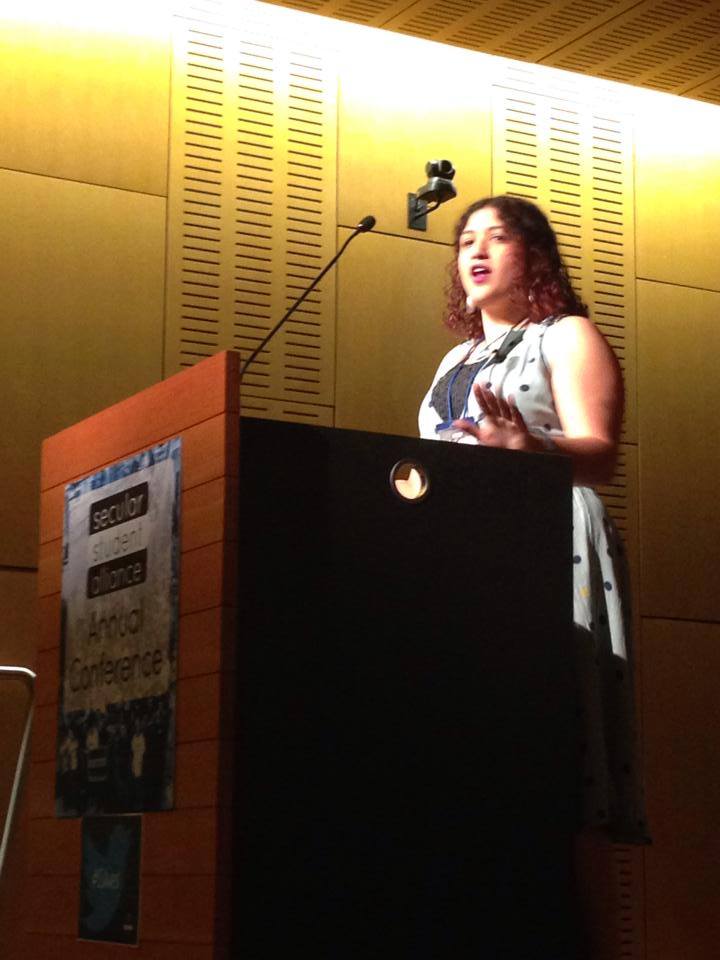
A few days ago I had the pleasure of giving a talk at the Secular Student Alliance Conference on how non-believing persons can work with Churches. Amidst the chaos of conferences–managing your time, deciding which talks to attend, and making sure you have enough water (it was a Burning Ring of Fire outside in Tempe, AZ)–I got to meet some pretty incredible secular women.
One of them was Heina Dadabhoy.
Heina speaking at SSA.
Former Muslim, blogger at Freethought Blogs, and overall bad-ass, Heina spoke about ways in which secular groups can create a more welcoming environment for ex-Muslims and Muslims beginning to doubt. Her talk, “Of Murtids and Muslims,” (a “murtid” is a public apostate) was not only about her experiences coming out as a secular humanist, but considered some of the absurd questions people ask her (and other ex-Muslims) about leaving Islam. “So did your parents try to honor kill you?” “Have you gone through FGM?” It was disturbingly humorous.
What I considered to be Heina’s main point, was that we should respect each others’ individual differences and not generalize and caricature all Muslims with the depictions of some. “Just because you read Ayaan Hirsi Ali’s book,” Heina notes, “does not make you an expert on Islam.” Heina made sure to emphasize the radical diversity that exists in Islam. She also spoke of the some of the issues that people go through when they leave Islam: How do I create a new identity when my old one was intricately tied up in my Muslim community, family, and culture? How do I navigate popular culture when I have missed a bunch of it? How do I find myself in this new secular world? Heina’s answers were refreshingly honest and insightful.
P.S. Aisha (one of Muhammed’s wives) should not simply be reduced to the young person Muhammed married; she was also a war leader, influential Muslim thinker, and someone who contributed greatly to early Islam. This is, of course, Heina’s insight.
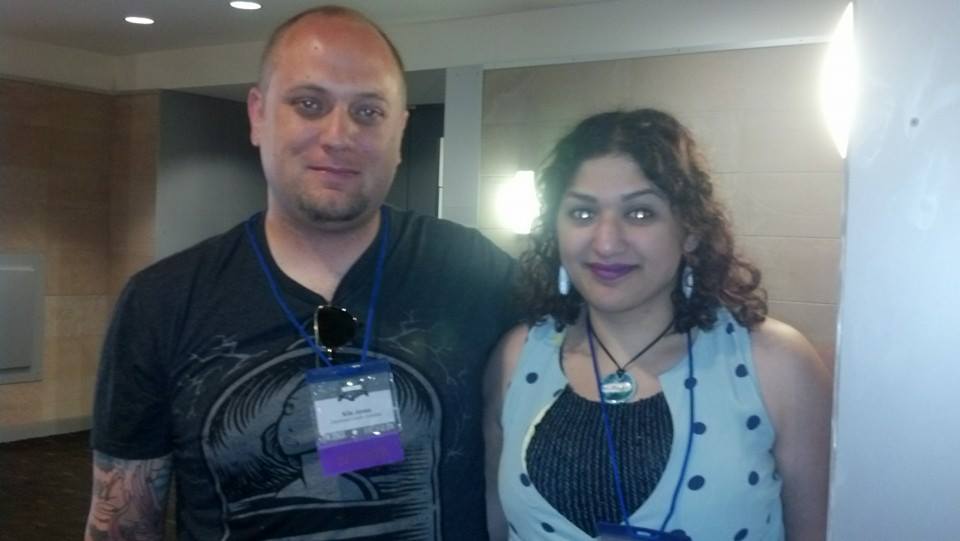
Me and Heina at SSA
Another awesome secular woman I met, was Sarah Morehead.
Sarah. Photo from Apostacon.
Sarah is a former evangelical Southern Baptist, Executive Director of the “Recovering From Religion” project, and another overall bad-ass. She spoke on how to start up a Recovering From Religion group on your campus. Here is a blurb about Recovering From Religion,
“If you are one of the many people who have determined that religion no longer has a place in their life, but are still dealing with the after-effects in some way or another, Recovering From Religion (RR) may be just the right spot for you. Many people come to a point that they no longer accept the supernatural explanations for the world around them, or they realize just how much conflict religious belief creates. It can be difficult to leave religion because family and culture put so much pressure on us to stay and pretend to believe the unbelievable. If this is you, we want to help you find your way out. Don’t let people convince you that you just didn’t have ‘enough’ faith, or that you just haven’t found the “right” religion.”
Sarah and I chatted (and often laughed) about our old experiences as conservative Christians. We discussed some of the funny language (Christian-eze) we used to use, the various levels of guilt and shame that were cast upon us, and how science helps explain some of the interesting displays of piety often seen at Pentecostal services. Sarah’s jovial and welcoming demeanor was calming, and as an Executive Director for a project aimed at helping people “recover” from religion, I cannot think of a better person for the job.
Lyz. Photo by SSA.
The last woman I have in mind is Lyz Liddell.
Lyz is the Director of Campus Organizing for the Secular Student Alliance. I have an interview I did with her a while back, on this very blog! Besides running around with her headset on, standing on chairs for announcements, and generally keeping the world of SSA from not crumbling into oblivion, Lyz is a great motivation and example. If you are ever interested in starting a SSA group on your campus, talk to her.
To all those who attended this years SSA West, or who are involved with helping secular students: Unite!
Kile Jones holds a Bachelors of Theology (B.Th.) from Faith Seminary, a Masters of Theological Studies (M.T.S.) and a Masters of Sacred Theology (S.T.M.) from Boston University, and is a current Ph.D. in Religion student at Claremont Lincoln University. He also holds a Certificate in Science and Religion from the Boston Theological Institute. Mr. Jones has been published in Zygon: Journal of Religion and Science, Philosophy Now, Free Inquiry, World Futures, Human Affairs, and the Secular Web. He is the Founder/Editor-in-Chief of Claremont Journal of Religion (www.claremontjournal.com), and is the Founder/Director of Interview an Atheist at Church Day (interviewatheists.wordpress.com).
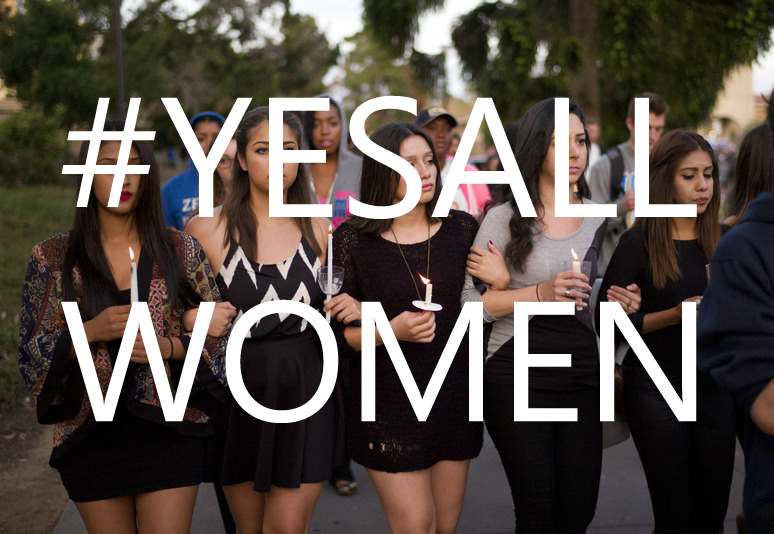
#YesAllWomen proved that although not all men commit horrible crimes against women, the men that often get the headlines and create the most controversy are the ones that need to be watched out for.
The one thing I typically will choose to do on the rare occasion that I’m able to sit down and relax is to watch a documentary. While some people may go to the gym, read a book, or hang with friends, I typically choose to stay in, nestle up on my couch, and learn. While on my last bout of relaxation, I chose to watch the HBO documentary Questioning Darwin. Although it offers very little new insight into the evolution vs. creationism debate, it does offer an interesting new way to look at the recent social media hashtag war feminists, allies, and supporters found themselves in over the #YesAllWomen movement that took the world by storm.
Now, before I discuss #YesAllWomen, I have to admit that I did not enter into the safe space women created for themselves to tell tales of the horrible things they have and have had to face on a daily basis. I firmly believe that men should not have entered into the digital space Continue reading “#YesAllWomen, the Darwin Debate, and the God Complex by John Erickson”
One of my academic joys is interviewing people I find particularly interesting (see most of my posts here). This time I am honored to present a recent interview I did with Judith Butler.
It may come as a surprise to those who identify as both feminists and religious practitioners that I don’t believe women should be pastors of any dominant religious congregation. This includes most religions which, I assert, are rooted in and structured by the tenets of patriarchy. Does that mean I think women should be congregants of a patriarchal-originated religious system? You guessed it – no. While this may seem like a radical notion to some, it took me quite some time to come to terms with my own conflict in being both feminist and a believer.
My transition from the Pentecostal sect was a long, intricate process that involved life-altering decisions. The notion of leaving the church was driven by my immersion in women’s studies during my undergraduate degree. There were many difficult questions I simply didn’t have an answer for, as the church didn’t provide me with them.
One of them being: Can women instruct an entire congregation of believers?
For those who are female pastors, I’m sure you’ve heard this one a million times, but somehow it never fades from religious and secular discourse. Whether it’s the Islamic, Jewish, Christian, or Mormon faith, women have had to constantly fight for their right to preach religious doctrine. In the beginning of my transition, I was on the side of: Preach it ladies! Continue reading “Why I Don’t Believe in Female Pastors by Andreea Nica”
For several weeks I have been reflecting on the idea of authority and how that word impacts us. I am always struck by the use of the word in Mark’s Gospel passage because I find it offensive and counterintuitive as a term used for Jesus, yes, especially when in my favorite image of him he is holding a lamb, a person of deep compassion, of stalwart forgiveness, and of deep understanding of the cosmos as interdependent, not lording over anything, not asking for a hierarchical word such as ‘authority.’ I cringe when I hear it, and when I see it in print; my physical reaction mirrors my interior twisting and turning as anxiety builds against the myriad meanings and interpretations of this word and what it represents in its broadest oppressive, dominant context. Questions arise as the physicality of it enters my brain and the sound permeates me, such as, – ‘He spoke with authority’, or ‘Listen as I am the authority’, or I have the authority to make that decision’. How do we respond to those who presumably ‘have authority’? What does it mean to ‘have authority’ to those who have it and those who do not? What is our own sense of authority? DO we have it or do we not? If not, how do we get it? Do we want it, even? What does it really mean to have it anyway? Is it given to us by others or do we grasp at it for ourselves? Continue reading ““And one spoke with authority” Mt. 7:29 by Janice Poss”
October 11th was International Day of the Girl – a movement that empowers girls around the world to see themselves as powerful change agents. This year’s theme is “Innovation for girls’ education.” Certainly, this makes sense given that education is one of our most powerful resources – just ask Malala. During her recent interview on The Daily Show,Malala reminded the world that it is education that can solve global problems – not war.
The youngest person in history to be nominated for a Nobel Peace Prize, Malala is clear in her message; the only way to make change is through peace, dialogue, and education. When asked about her reaction to the threat to her life by the Taliban, Malala responded saying that she thought quite a bit about what she would say if she came face to face with a Talib. “I would tell him how important education is and that I would even want education for your children as well. That’s what I want to tell you, now do what you want.”
Although the Taliban has continued to threatened her life, Malala says striking back is not the right approach. “If you hit a Talib, then there would be no difference between you and the Talib. You must not treat others with cruelty. … You must fight others through peace and through dialogue and through education.” Such words of wisdom from a child. Continue reading “What Would Malala Do? by Gina Messina-Dysert”
In this post I interview Lyz Liddell, Director of Campus Organizing at the Secular Student Alliance. I first got in contact with Lyz about the idea of building a Humanist Center at my school, Claremont Lincoln University. She was very helpful and inspiring. I then had the pleasure of meeting her face-to-face when I gave a presentation on “Atheism and Interfaith” at the Secular Student Alliance’s Annual Conference in Las Vegas. So once again, I give you an interview with a strong female non-believer:
Lyz Liddell of the SSA
Can you give us a little background to how you became interested in secular activism and how you became the Director of Campus Organizing for the Secular Student Alliance?
I first became interested in secular activism via our Executive Director August Brunsman, close to ten years ago. The editor of our newsletter had recently acquired some fame (that was Hemant Mehta, with the fame from his experience of selling his soul on eBay) and was no longer able to commit to the regular editorial schedule; I was asked to step up, and since I had some editing experience, I took it on. Up until that point, I had been a “layman,” if you will – secular for sure, but not really an activist. Through several years of editing that newsletter, I learned what secular student groups were doing, and what was happening in the secular movement at large. The more I encountered, the more enthusiastic about it I was. I started going to conferences to get more information and news for the newsletter, and got more involved with the organization’s staff and volunteers and affiliates. When the campus organizer position opened up in late 2008, I stepped up into that position, and we’ve grown it from there (2 full time staff and some volunteers, a board of mostly college students) to the professional organization we are today (9 full time staff, 4 part-timers, a professionalized board and dozens of dedicated volunteers; we’ve grown from ~100 affiliates in 2008 to over 400 today).
I never gave much credence to religion but through my mother, I met G-d, and through her I understood that I’m not a feminist because of the books I’ve read but rather because of the woman I call mom.
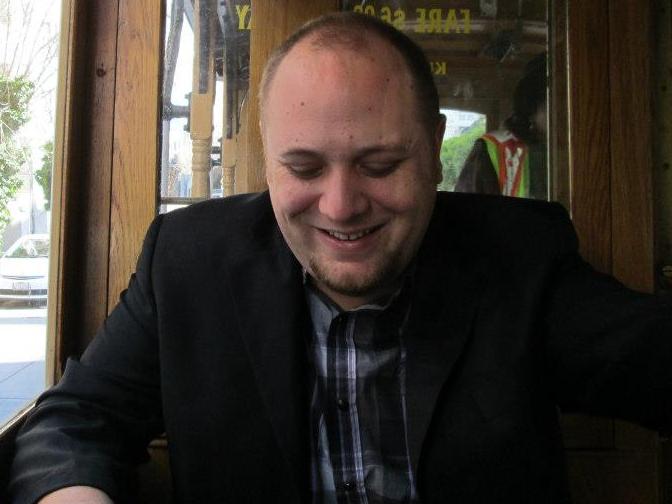
The first question I always get asked when I’m in feminist spaces is: “What inspired you to become a feminist?” Although I could go into the various histories revolving around men’s involvement in the early stages of the women’s movement to the similarities between the LGBTQ and women’s movements, my simple answer has always relied on one person: my mother.
I’ll be the first to admit (as well as many other people who will join me in the same chorus) that my mother deserves Sainthood for having put up with all the shenanigans I have, and still continue to, put her through. From running away from our local Catholic church the moment she dropped me off at Sunday School, to swearing like a sailor on leave at a very early age in front of Father Schmidt (who still fondly remembers me and the list I brought in with me to the confessional booth). Continue reading “Truths My Mother Taught Me by John Erickson”


 Earlier this week I went to hear Sr. Helen Prejean speak about the death penalty. You will remember, if the name does not immediately ring a bell, that the amazing movie Dead Man Walking (dir. Tim Robbins, 1995) was about her and her ministry to provide solace and closure with God to those inmates on Death Row. In the film, Sr. Prejean was played by Susan Sarandon. Dead Man Walking, a phenomenal hit, chronicled her first attempt at this ministry—her trials and limited success—in helping Matthew Poncelet come to grips with what he had done, ask forgiveness of the victims’ parents (because he was complicit in the murder of two teenagers) and face his death with dignity.
 In addition to teaching Gender and Women’s Studies, I have also been the screenwriting professor at University of California Irvine since 1992. I have used the screenplay for this movie (adapted from Prejean’s book and direct interviews) almost since it was published. It’s a great example of how research, interview, and authenticity can make a movie work—rather than “making it up.” Even the title was new to most of America- “Dead man walking!” refers to the last walk an inmate makes as he (or she) walks to his (or her) death.



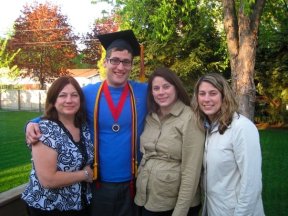 The first question I always get asked when I’m in feminist spaces is: “What inspired you to become a feminist?” Although I could go into the various histories revolving around men’s involvement in the early stages of the women’s movement to the similarities between the LGBTQ and women’s movements, my simple answer has always relied on one person: my mother.
