

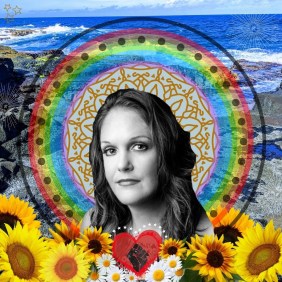
As the American Embassy was bombed in 1999, I was hunkered in a Russian Orthodox Church, gazing at the brooding, whitewashed faces of icons, hands raised in endlessly frightening benediction. Hundreds of men met my eye, as I found myself asking, “Where are all the women?” In 2005, the sun peaked over the horizon on Mount Sanai as I entered the chapel at Saint Catherine’s Monastery, which houses the oldest collection of Christian orthodox icons in the world. As a sensory overload accosted my eyes, ears, and nose, I scanned the scene to find only two women crammed among all the icons; one was a nameless daughter sacrificed by her own father. Where were all the women? A few years later, I knelt at the Temple of 1,000 Buddhas in Thailand. Not a woman could be found. Where are all the women?
For over a decade, I’ve painted folk-feminist icons of revolutionary women from history and mythology, a subversively artistic attempt to answer my own question by painting the women who have been ignored, excluded, or strategically erased. From Pauli Murray to Sarasvati, Gloria Anzaldua to Papahanoumoku, this work continues to be a gift, joy, and a tremendous part of the mission of my non-profit, the Tehom Center, which empowers marginalized women by teaching about revolutionary women through art, writing, retreats, and academic courses. Continue reading “Subversive Sister Saints by Angela Yarber”
 On the eve of the Jewish Sabbath and the start of Rosh Hashanah, Supreme Court Justice Ruth Bader Ginsburg breathed her last breath. She was 87. She fought so hard for so long. She is an American patriot, hero, champion for women’s rights, and for many she was the stalwart bastion of justice and ‘liberal’ rulings. She was a Supreme Court Justice for 27 years. Her life has been put into books, a movie, and the most notorious memes around. She became known for elaborate collars over her Justice robes. We mourn the lost of her, we celebrate her memory, and we must pull up our boots and continue the fight.
 My sense of direction is, at best, poor. In spite of that, I love a road trip. With the advent of affordable GPS (Global Positioning System) devices, driving long distances has become easier. Unfortunately, that tool (GPS) is not always reliable. Sometimes I get lost. I have a hard time figuring out how to get back on track. Like Blanche DuBois in “A Streetcar Named Desire,” I’m forced at times to depend on the “kindness of strangers.” Getting lost, though, becomes part of my road trip adventure.
 Friends, it has been a few months since I’ve posted in this community. I’m amazed at how much our world has changed since then. Here in the northern hemisphere, spring came and went. It felt like a tide of turmoil rolled in, leaving debris all along the shore and now we are trying to clean it up while keeping our eyes on the sea for more dangerous waves that are coming.

 As I write this in late June, the news is still pretty depressing. Pandemic. Politics. Corruption. No no no. I can’t write anything current and cheery, so here’s another bit of distracting nonsense from my so-called archive.
 About six months ago I was hired to write a curriculum for a Jewish organization on biblical women in ancient and contemporary midrash. Midrash—the ancient process of creative interpretation of sacred text that began two thousand years ago and continues to this day—has been one of my fields of expertise, and women in midrash is a particular specialty. I knew the first lesson I wrote would be on Eve (Chava in Hebrew), the first woman of Genesis. Yet as I began to write lessons, I started with Sarah and Hagar, then proceeded to Rebekah and Lot’s wife, Rachel and Leah, even Asnat (Joseph’s wife) and Naamah (Noah’s wife). It became clear over the months that I was avoiding Eve. Whenever I began to think about beginning “her” lesson, I grew anxious and immediately began to think of something else. Only when I had already written six of my ten lessons did I finally, reluctantly, begin to research ancient legends and modern feminist poems on the first foremother of the Bible.
