


Life is full of color, and nothing is ever black and white. Mourning teaches us that no color remains alone and that every shade has its season under heaven. People often associate grief with black clothing and dreary weather, but grief isn’t simply black and white. It is greige. Not because grief is dull, but because grief is transitional. Greige is not the absence of color, but the space in which we learn to see color differently. Like mourning itself, we often dismiss neutral colors because they are not eye-catching and feel indecisive. Instead, we gravitate towards vibrant colors and complementary color combinations. Yet greige has become a staple in design because it softens its surrounding colors. Perhaps this is why greige can be associated with the season of mourning, as it does not ask sorrow to replace joy, or memory to replace hope. Instead, it simply creates space for them to exist until another season under heaven arrives.
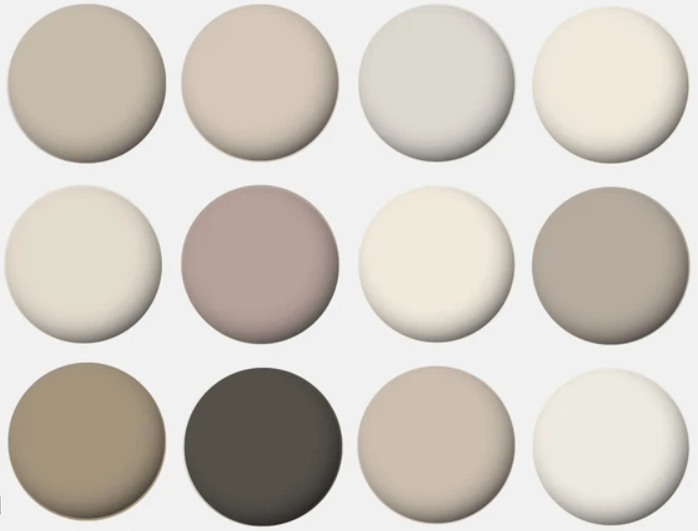
Mourning often functions in this manner. Like greige, mourning occupies the space between what was and what will be. It is the season in which the colors that once filled our lives begin to soften as we learn to live with absence rather than presence. As the ninth day of the Jewish month Av passes, this day of observance marks a series of catastrophic events that occurred over the centuries on what is now known as Tisha B’av. Tisha b’Av commemorates some of the greatest collective losses in Jewish history, beginning with the destruction of the First and Second Temples and expanding to include other tragedies that occurred on the ninth of Av throughout Jewish history. This day of mourning holds space to reflect and mourn, without rushing toward hope. In doing so, the Jewish calendar makes space for grief as a season in its own right, rather than rushing past this time of discomfort. In this way, the day introduces greige.
This fifteen-day movement from Tisha B’Av to Tu B’Av reflects this rhythm of mourning and renewal, and is not accidental. The Jewish calendar follows the sun and moon, reinforcing the transition between darkness and light, which is what helps shape Jewish holidays. Just as color cannot exist without light, mourning cannot exist without love. This lunisolar calendar does not rush from one to the other but allows grief to move gradually toward renewal. Like greige, the movement between these two reminds us that memory does not disappear as light returns. Instead, the colors of love and loss remain, softening one another until absence becomes another shade through which we continue to see the world.
Ecclesiastes understands this kind of in-between existence remarkably well. Just as the Jewish calendar teaches one how to reside in each season, Ecclesiastes teaches us that there is a season for every emotion, rather than presenting life as a series of fixed, isolated emotional states. Solomon’s pairings in Ecclesiastes 3:1-8 remind us that the only constant in our physical existence on Earth is the life we experience under heaven. There is a time to weep and a time to laugh, a time to mourn and a time to dance, and yet there is never a time Solomon suggests any of these feelings occur in isolation. In fact, Ecclesiastes highlights the duality of these mixed emotions. Instead, they are written in pairs, representing the understandings of human life through relationship rather than separation. We identify joy because we have experienced sorrow. We can value peace because we have experienced conflict. In this way, Ecclesiastes resists reducing human experience down to a single emotional state and instead demonstrates the beauty in our intertwined emotions.
The poetic structure of Ecclesiastes presents a full spectrum of human experience, ranging from “a time to be born and a time to die” (3:1). Solomon never uses a single color, and another accompanies every experience. Weeping beside laughter, mourning beside dancing, and so on. red and green, or yellow and purple, the same can be said of emotions. Just as complementary colors enrich one another (red complements green and yellow complements purple), opposing emotions deepen, and laughter gains deeper meaning as weeping has been experienced. The same can be said for recognizing peace and treasuring it, after war has been witnessed.
Solomon’s writings suggest that enduring, isolated emotions do not mark life under heaven at a given time, but by a combination of them. We can deduce, then, from the reading that human existence is composed of contrasting colors that blend, creating depth in much the same way an artist layers pigment on a canvas. Greige is no exception. Like the emotional pairings in Ecclesiastes, it is created through combination rather than occurring in isolation.
Ecclesiastes reminds us that there is a time for every emotion, but the season of light, marking Tu B’Av, does not erase the past and the darkness encountered on Tisha B’Av. Rather, the remembered darkness of this latter holiday reminds us that grief has a place, but with Tu B’Av, we learn that grief is never the only color on the palette. Instead, variations of the colors we experienced before form and enter our lives; we are reminded that human beings are capable of carrying more than one color at a time. Thus, joy does not erase mourning any more than purple erases its components, blue and red, after forming. Mourning is sorrow mixed with gratitude, absence mixed with memory, and love mixed with longing.
Each season creates a variant in the shades of color we have experienced before. Just as an artist cannot recreate the exact shade twice, we can never experience love, loss, or hope in the same way twice. Every season under heaven leaves its own color behind. Ecclesiastes echoes that life under heaven is never black-and-white, and the Jewish calendar calls us to envision every shade. As Tisha B’Av comes to an end, or the next time mourning enters your life, perhaps imagining greige offers a different way to encounter grief. Mourning is one season under heaven, but never the only color on the palette. It is the season when the colors of our lives soften, making way for the new colors the next season will bring.
Bio
Madison Jackson recently graduated from Fordham University in New York City with a Bachelors of Science in Psychology. She is currently living and working in Boston, Massachusetts as a Marketing specialist at Skyeburst Wealth Management. Madison came to FAR to expand upon scripture she studied during her senior year at Fordham. She has a captivating TikTok account that you can follow @citylifefashion.
Discover more from Feminism and Religion
Subscribe to get the latest posts sent to your email.
 Feminism and Religion
I am glad to know the name of this color (which I never heard before) and how it can connect and reflect mourning. Thank you!
LikeLike
Thank you for “mourning occupies the space between what was and what will be. It is the season in which the colors that once filled our lives begin to soften as we learn to live with absence rather than presence. And for “Mourning is sorrow mixed with gratitude, absence mixed with memory, and love mixed with longing.”
I will think more about this way of approaching the month of Av.
LikeLike