The Black Wings of Spring by Sara Wright

Spring on the Wing

Red Willow River’s
waters are rising.
Sea green waves
wash whittled
beaver sticks
against pebble strewn shores.
I bend.
filling a
miniature vessel
with river water
to hold her song:
Water Is Life.

Spring is on the wing.
Bird migrations,
wild winds,
leave – taking,
these are the
elements of seasonal change.
Prayers for rain
may be answered.
Pale green desert rosettes,
toothed scorpion rounds,
purple filigreed ferns,
swelling Cottonwood buds,
all create a chorus of rain chants
sweetening the night.
Blackbirds trill from
tallest branches,
flash crimson
in morning flight. Continue reading “The Black Wings of Spring by Sara Wright”

Magical Women by Elisabeth Schilling

Are Women’s Bodies too Magical for Professionalism?

I feel I’m at times strategizing ways to hide my magic. I contemplate, for instance, whether that college in [conservative state] is going to like that I had a poem published in a lit mag called Pussy Magic (they call their staff a “coven,” which I adore – I’m quite proud to be in this magazine – I think I have a crush on the entire staff). Sometimes, I’m so used to asking questions such as this, that I find myself surprised and unprepared for when other people manage to, admirably, give fewer fucks.

For instance, I was watching an old YouTube clip the other day of Alexandria-Ocasio Cortez on Stephen Colbert’s Late Show about her preparation for being sworn in.

Colbert was asking her about her experience, and she was asked to explain the story behind her nails (good question because it is a good story). She told him that when Sonia Sotomayor was being sworn in, she was advised to choose a neutral color of nail polish because something like red would bring in too much scrutiny and comments. Continue reading “Magical Women by Elisabeth Schilling”

Exercising Women’s Religious Voice and Authority – Why is this Still an Issue? by Elise M. Edwards

elise-edwardsOver the past few days, I’ve been spending time at a church in Alexandria, Virginia conducting oral history interviews.  I’m doing research for a project about the arts and the church that has me diving deep into the church’s congregants’ and leaders’ experiences. Yesterday’s conversations offered insight about many theological topics that interest me, but what was particularly encouraging was what I witnessed concerning women in ministry.  That’s not what I was looking for, but it is what I needed to see.

Before beginning these interviews, I had already been thinking about the ways women’s authority and voice are often challenged.  This past weekend, I attended a regional religion conference where I assumed a leadership position and my voice was sought out for advice and insight.  I had great conversations with other women in academia about wellness and success while I was there.  Attending the conference provoked fond memories of a similar conference many years ago, when I connected with many colleagues in this FAR community and we discussed the theme of “Women and Authority.” Those were positive experiences.  But I had an unpleasant encounter, too, when I was on the receiving end of a male colleague’s condescending remarks.  I was also made aware of a disturbing incident in which a woman of color was publicly disrespected while speaking at a university event and subsequently trolled.  Those experiences triggered anger and deep sadness. To be honest, I also felt a sense of resignation and defeat.  Patriarchy is just so persistent.

Continue reading “Exercising Women’s Religious Voice and Authority – Why is this Still an Issue? by Elise M. Edwards”

“What Could be Sadder?” I’ll tell you…by Esther Nelson

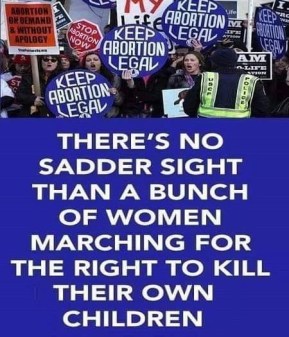
You’ve probably seen the following meme circulating on social media:

This meme is designed to be evocative.  Specifically, it plays into the concept of the sanctity of motherhood that so often oozes into a popular sentimentality about children.  In Christian-majority countries, we read and hear the story of the Virgin Mary acquiescing humbly and readily to her pregnancy when the angel of the Lord tells her she is with child, something done to her by the Holy Spirit.  “And Mary said, Behold the handmaid of the Lord; be it unto me according to thy word.  And the angel departed from her” (Luke 1:38).  Mary is often elevated in Christian circles as a role model for women.

Putting aside the question (for now) that asks when life begins, let’s consider this “sad sight” the meme talks about—“women marching for the right to kill their own children.”  Abortion aside (for now), there are many examples—both in literature and history—of women having killed their children.  I offer the following two:

The novelist Toni Morrison (b. 1931) won the Pulitzer Prize for Fiction (1988) for her book, BELOVED.  Morrison tells Sethe’s story, a mother who knows firsthand the horrors of slavery, who kills her child rather than seeing her enslavedContinue reading ““What Could be Sadder?” I’ll tell you…by Esther Nelson”

Ariel, just fighting to get above water…by Yara González-Justiniano

I am all for the critical deconstruction of Disney Princesses, especially since now I see more of a commercial push for them as a collection than when I was growing up in the late 80’s. However, I too had a favorite princess growing up, Ariel from The Little Mermaid. I lived next to the ocean and it made sense that she would be the most relatable Disney character to a Puerto Rican 5-year-old at that time; a character like Moana was not yet in site to appeal to this isleña.[1] I remember going to the beach every week and hoping to find a fish or a seagull that could talk. What drew me into the film was her story and the whimsical animal characters, not particularly the “finding prince charming” fairytale.

Recently, as more modern and independent female characters continue to make their Disney debut, I hear people refer to Ariel as the worst princess of them all. ¡Ay bendito![2] Poor Ariel is always critiqued and looked down on for giving up her voice for a man. But in reality she was infatuated with humans and wanted to be “part of [that] world” long before she met Eric. She was an explorer, a questioner and as naïve as we all can be sometimes when we set our hearts to follow a dream. Regardless, she wanted more! Continue reading “Ariel, just fighting to get above water…by Yara González-Justiniano”

Tree-Hugging Is About Trees and So Much More Than Trees by Carol P. Christ

Not too long ago I heard someone deride members of a seminar who were building labyrinths in the olive groves of Greece as “a bunch of tree-huggers.”  I bristled! I probably first heard of the Chipko tree-hugging movement which is led by women in the 1970s and 1980s. Because I love nature, I naturally assumed hugging trees is a good thing. Originally, I had no idea that the tree-hugging movement was about much more than saving trees from being felled in the interests of short-term profit.

I did not know that the deeper purpose of the movement is to save a way of life based on forest-culture that is being threatened by the imposition of western ideas and practices promoted by colonialism and its successor, the green revolution. Nor did I know that the traditional forest-culture of India is the provenance of women: more than 4000 years of observing and experimenting created a “women’s knowledge” passed down from mother to daughter. Continue reading “Tree-Hugging Is About Trees and So Much More Than Trees by Carol P. Christ”

Vayikra: No Temple Required by Ivy Helman

29662350_10155723099993089_8391051315166448776_oThis week’s Torah portion is Vayikra (Leviticus 1:1 – 5:26).  Vayikra is essentially one long discourse on animal sacrifice with an occasional grain or oil offering included.  This killing of animals, their subsequent burning and the shared eating of their flesh was the predominate way deities were worshipped in ancient Canaan.  It was believed that the smell of cooking meat appeased the gods and most importantly stifled their anger. It is no wonder then that the ancient Israelites so integrated within the surrounding culture adopted similar methods of worship.

Yet, there was always present within Israelite society a minority opinion that the deity didn’t desire sacrifice.  The prophets, who strived to create the most just society possible, often said that sacrifice had little effect.  Sometimes they even suggested that the divine has never requested sacrifices, such as in Jeremiah 7:22 which says, For neither did I speak with your forefathers nor did I command them on the day I brought them out of the land of Egypt, concerning a burnt offering or a sacrifice.”  Yet, most of the time, the prophets argue that what is most important is how one behaves and the type of society the Israelites create more so than the offering of sacrifices.  Prime examples of this line of thinking are the prophet Amos (5:14-15 and 21-24), Isaiah (1:11-17 and 27), Hosea (6:6), Micah (6:6-8) and Jeremiah (6:20).   Continue reading “Vayikra: No Temple Required by Ivy Helman”

Integrity of the Self by Natalie Weaver

I sat in a frigid moot court room at a conference on the morning of March 8, trying to concentrate. Within an hour of the program’s opening keynote, my underarms had become damp with that weird cold sweat that happens when you are at once freezing and yet decidedly overwarm in your wool overcoat. I was distracted, trying to decide whether I was sick, menstruant, nervous, or inappropriately dressed.  My coat was long and fitted over my suit coat, and I was vaguely worried about bleeding through or around what had become a misaligned feminine product.  Sitting straight in all those stiff layers for several hours felt, I imagined, something like the confinement of a full body corset.

The collar was taut around my neck, which made me feel sort of protected, but my presently over-long hair was caught up in a bun that kept bumping against the back of that same collar.  My glasses were smudged, and I can barely see out of them anyway at present, so I pushed them on top of my head.  However, my piled up, giant-feeling hair kept rocking them off center, so they sat at a precarious tilt on their perch.  Every time I leaned to get something from my purse, they would clumsily tumble forward off my head and onto the floor.  My pulled-back hair was giving me hair headache (which is just hard to explain if you’ve never had it – maybe something like a toothache in your hair follicles), and my left eye was working a sty that made my left eyelid twice the size of the right one.  My eyes are naturally a little unevenly sized, and it is especially apparent when I am tired, so with the sty, I was rocking a sort of partial Peter Lori look. Continue reading “Integrity of the Self by Natalie Weaver”

Recognizing Abuse by Karen Tate

I’ve been thinking a lot about abuse.  Of course, most of us know about the domination, exploitation and  need for control meted out by patriarchy, but I wonder if we have actually normalized many abuses?  Abuse in the home, in the workplace, in our culture.   Perhaps  we accepted it unconsciously because so many of us are conditioned by religions that tell us to make noble sacrifice and tolerate suffering silently. I wonder if we’re calling it out when we see it – often and loudly – or if we’ve become conditioned to quietly accept the abuse with little push back.

My intent is not to offend anyone with this.  I want to find common ground and defeat the polarization we find around us, but our President is the poster child for abusive behavior.  Do we recognize his lies and fear-mongering and so many of the ideas he gives credence and license to as abuse?  Not only is he eroding our democratic institutions but he poisons the political, social and cultural arena with negativity, fear and hate, rather than uplifting us and encouraging us to evolve and be the best version of ourselves.  I equate him to poison in a well from which we must all drink. Continue reading “Recognizing Abuse by Karen Tate”

Gendered Only In Expression by Chris Ash

“I want you to see this new piece I wrote for our newsletter,” said Sister Ann.

We were safe inside the dining room of the Episcopal convent where she lived and I was an extended guest, and yet she spoke in hushed tones that suggested she realized the controversial nature of what she was about to say.

“This whole piece – it’s about the idea that being ‘born again’ clearly indicates the concept of God as mother.” She laid out her argument about wombs and motherhood and the feminine divine. It was a fairly essentialist argument (being the mid-nineties), but it was the first time I’d heard any modern Christian reference God as anything other than father, son, male. Before finding the Episcopal cathedral where I regularly attended services, I’d had two general experiences of the divine: the evangelical, conservative, patriarchal God of my father’s church, and the gender-creative spirit found in practices that were fairly alternative for my small, South Carolina town. Continue reading “Gendered Only In Expression by Chris Ash”