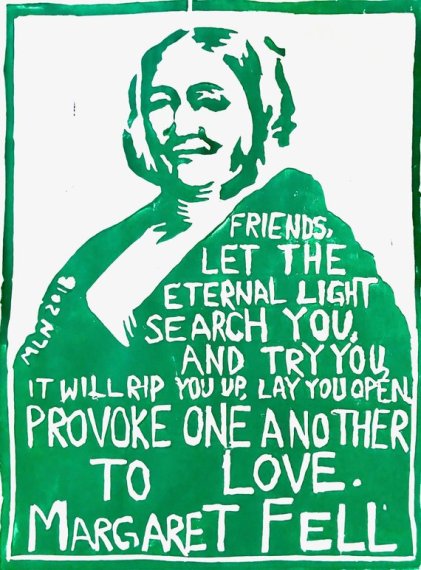
I am in Peace: The Ministry of Margaret Fell by Mary Sharratt

margaret fell

This linoprint of Margaret Fell can be ordered here.

Pendle Hill will forever be associated to the Pendle Witches of 1612 who live on in the undying soul of the landscape and its folklore and who inspired my 2010 novel, Daughters of the Witching Hill. Pendle Hill also gave birth to the Quaker movement.

In 1652, George Fox, a simple weaver’s son and cobbler’s apprentice turned dissenting preacher, wandered across England on a spiritual quest. When he climbed Pendle Hill, his revelation came to him—an event that would change both Fox and the world forever. He envisioned a “great multitude waiting to be gathered.”

As we travelled, we came near a very great hill, called Pendle Hill, and I was moved of the Lord to go up to the top of it; which I did with difficulty, it was so very steep and high. When I was come to the top, I saw the sea bordering upon Lancashire. From the top of this hill the Lord let me see in what places he had a great people to be gathered.

George Fox: An Autobiography, Chapter 6 Continue reading “I am in Peace: The Ministry of Margaret Fell by Mary Sharratt”

Eve by Any Other Name… by Janet Maika’i Rudolph

This title isn’t entirely true. Eve would need an exceptionally well thought out replacement for Her name to be as sweet as it already it. That is because Eve’s name is unique, multi-dimensional and integral to the Bible’s mysteries. The Hebrew word for Eve translated to English means “life.”

And Adam called his wife’s name Eve;
because she was the mother of all living.
Genesis 3:20

Barbara Walker wrote about variations of Eve’s name as they appeared in neighboring cultures. Eve in Hebrew is pronounced variously as hawah or chavah. Walker wrote that in many middle-eastern cultures, Her name was the hallmark of “superior feminine power. To the Hittites, she was Hawwah, Life.’ To the Persians, she was Hvov, ‘the Earth.’ Aramaeans called her Hawah ‘Mother of All Living.” (The Women’s Encyclopedia of Myths and Secrets, p 289.) In other words, She was a Great Goddess in Her own right. Her name was and is still is reminiscent of the awesome power that She has held in our lives. Continue reading “Eve by Any Other Name… by Janet Maika’i Rudolph”

Meeting the Windigo by Carol P. Christ

Towards the end of Braiding Sweetgrass, mother, biologist, and member of the Citizen Potawami Nation Robin Wall Kimmerer sets out at the end of winter to visit a forest area near her home that she considers hers not in name but in virtue of her love and care for it. On arriving, she discovers that the forest is no more, having been clear-cut by the owner. The wildflowers and the plants she has harvested over the years have sprouted up, but Kimmerer knows that without the forest cover they will be burned by the sun and their places taken by brambles. Continue reading “Meeting the Windigo by Carol P. Christ”

Practical Lessons in Kindness from the Grasshopper and the Ant (With apologies to Jean de La Fontaine for significant changes to his fable) by Barbara Ardinger

Note: This story was originally posted early in 2016. I’m posting it again because, thanks to the state of UNkindness the Abuser-in-chief has pasted all over the semi-civilized Semi-United States, we need lessons in kindness more than ever before. I bet you agree with me!

“Curses on that grasshopper!” exclaimed the ever-busy Madame Fourmi. “All he ever does is play. He’ll be sorry when winter comes.”

And so it went. Every day, Mme. Fourmi spent the morning scrubbing her front steps. And Monsieur Cigale?

“Partaaaaayyyyy!” Every day, he sped by on his skateboard. “Hey, Auntie Ant, stop cleaning the concrete and come and play with us. We’re gonna start a band!”

“Not on your life,” muttered this grandmother, most of whose conversations with her many daughters and granddaughters consisted of instructions on how to properly clean their homes and hills and how to prepare and store food for the winter. “Life is serious business, it is, it is. We need to plan ahead.”

Continue reading “Practical Lessons in Kindness from the Grasshopper and the Ant (With apologies to Jean de La Fontaine for significant changes to his fable) by Barbara Ardinger”

New Beginnings: Re-Birthing Myself a Million Times and One by Elisabeth Schilling

Photo 2I think being a mother must be an amazing experience. I don’t really know the glimmers and shadows of any life but mine, even though I would be more than happy to listen. Recently, I’ve been reading the poems of Carol Ann Duffy, Scottish poet, U.K. Laureate, and once partner to poet Jackie Kay, and she writes something in one of her poems (“A Clear Note”) that I resonate with: “Never have kids. Give birth to yourself.” It is not Duffy, the narrator, who says this, but a character named Moll.
In the triptych poem, three women—Agatha, Moll, and Bernadette, three generations of women, speak to and about each other through time and space. The quote is just something Moll recalls saying to her daughter, Bernadette one night when she is drunk. I of course do not think a woman cannot give birth to herself if she has children. But it is certainly a good (in my opinion, for I wish it so) excuse for myself, revising this line of verse in my own voice: I will never have kids; I need the entirety of life to birth myself.

Continue reading “New Beginnings: Re-Birthing Myself a Million Times and One by Elisabeth Schilling”

Celtic Awen, Spiritual Homecoming, and Singing with Trees by Trelawney Grenfell-Muir

Does your name have a special meaning? Mine does. In fact, in one corner of the world, you would be very hard pressed to find anyone who did not know the significance of the name Trelawney and its history. They could probably even sing you a rousing song about it:

And shall Trelawny live? Or shall Trelawny die?

There’s twenty thousand Cornish here, will know the reason why![1]

But growing up in New England, no one had ever heard the name Trelawney before, or the name “Cornwall,” the land of Trelawney. If I said “Celtic,” they would finally nod.

Then with the internet came affordable communication “across the pond” to Britain, and my earliest internet explorations connected me with Cornwall, where my grandfather came from. I taught myself Cornish folk songs, I found folktales, recipes, and a more richly detailed cultural nourishment than my Cornish grandfather had managed to pass along to us. A lifelong mystic and Methodist minister, but if you ever asked my grandfather his religion, he would reply, “Druid,” with just that hint of mysterious twinkle in his eye.

Continue reading “Celtic Awen, Spiritual Homecoming, and Singing with Trees by Trelawney Grenfell-Muir”

Re-reading Mary Shelley’s FRANKENSTEIN by Joyce Zonana

And so is born the “monster” most people associate with the name Frankenstein–a lone and lonely terrorist who lashes out against a world that has no place for him. One by one, he strangles all the people his “maker” holds dear: his brother William, his best friend Clerval, and his cousin/bride Elizabeth. Yet the novel invites us to have compassion for the creature, even while it condemns the society that makes him as he is. Victor, raised by a devoted mother and tenderly loved by a doting cousin, should have known better. As should we.

jz-headshotA few weeks ago, a former colleague invited me to visit one of his classes, to discuss Mary Wollstonecraft Shelley’s 1818 novel Frankenstein; or, The Modern Prometheus and the essay I’d published about it almost thirty years ago, “‘They Will Prove the Truth of My Tale: Safie’s Letters as the Feminist Core of Mary Shelley’s Frankenstein.”  To prepare for that visit, I’ve spent the past few days re-reading the book, and I’m overwhelmed anew by the beauty of Shelley’s language, the brilliance of her plot, and the profoundness of her themes. The book moves me even more today than when I first read it.

Continue reading “Re-reading Mary Shelley’s FRANKENSTEIN by Joyce Zonana”

Logic and Intuition – Antithetical or Cooperative? by Judith Shaw

judith shaw photo

“Art does not reproduce the visible; rather, it makes visible.”-Klee

An artist is continually making decisions – decisions about subject matter, themes, materials, size. Does one do pre-planning with preliminary drawings are just dive right in? Once those decisions are made then one gets into the nitty-gritty of all the decisions needed to bring a particular piece to completion. But what is the best approach to use in making those decisions – logic or intuition?

Continue reading “Logic and Intuition – Antithetical or Cooperative? by Judith Shaw”

Time to Dismantle the Myth of the Nation State? by Carol P. Christ

I am a citizen of two countries currently being torn apart by popular nationalism. In Greece, the cry is “Macedonia is only Greek,” while in the United States a nation of immigrants is being told that it must fear being invaded by immigrants. The truth is that the idea of a nation state is a fiction created in the nineteenth century. It is high time to dismantle it.
Here is the Greek case. Phillip of Macedon invaded from the north and created a federation of Greek states in 338 BCE. His son Alexander the (so-called) Great conquered territories extending as far as India before his death in 323 BCE, establishing the seat of his empire in the newly founded city of Alexandria in Egypt. Phillip and Alexander are claimed as Greek, but in fact Phillip forced independent Greek-speaking city states into union under his rule.

Although the Greek language became the lingua franca of the Alexandrian Empire, the people who spoke forms of Greek did not become an ethnically pure free Greek nation under Alexander. Rather they became subjects in an empire ruled by a king that united people of different cultural traditions under a newly imposed Greek language. It is probable that Phillip and Alexander originally spoke a form of Greek, but even this is debated by experts. Continue reading “Time to Dismantle the Myth of the Nation State? by Carol P. Christ”

Part One: The God Ayyappan and The Sabarimala Temple by Anjeanette LeBoeuf

AnjeanetteThe Sabarimala Temple in Kerala, India has been recently thrown into the news. It has made world news due to the two centuries long tradition of denying females from the age of 10-50 entrance into the Temple. As of September 2018, the Indian Supreme Court ruled in favor of allowing women entrance into the Temple. Needless to say, this ruling was met by both large numbers of supporters and protestors.  But what makes the Sabarimala Temple so controversial?

Continue reading “Part One: The God Ayyappan and The Sabarimala Temple by Anjeanette LeBoeuf”