

 Last week I was finally able to see “Spotlight“, the recent movie depicting the true story of the Pulitzer Prize-winning Boston Globe investigation into the priest pedophilia abuses. What makes “Spotlight” so compelling is the shared burden of culpability by those outside the organized Catholic Church. While hunting down the priestly offenders, including Cardinal Bernard Law, “Spotlight” also takes calculated aim at those official offices and individuals that turned a blind eye from the sexual abuse of children. In his NCR review, film critic Steven D. Greydanus praises the film for its ability to include such collaborators as “Lawyers, law enforcement, family members and friends, and pointedly and repeatedly, the fourth estate itself—the press and specifically the Globe – are all implicated.” Which is to say, the sin of silence through a misguided sense of protection of the institution is as damaging as the act itself.
In the Globe’s investigative work, a team of four reporters begins the difficult work of interviewing survivors of sexual abuse. What moved me deeply was the recurrent syllogism expressed by each in their retelling of the abuse at the hands of their parish priest. In the first statement of a syllogism, the major premise is the articulating of the moral principle. Step two, the minor premise, is the particular act to be judged. Step three is the logical conclusion inferred between the major and minor statements. With regard to the Catholic Church’s doctrine of the priesthood and views expressed by survivors, the syllogism looks like this:
Step 1: “By ordination one is enabled to act as a representative of Christ, Head of the Church in his triple office of priest, prophet, and king” (Catechism of the Catholic Church, # 1581)
Step 2: All priest (as males) reflect Jesus Christ in word and deed.
Step 3: When a priest abuses children it is as if Jesus Christ is also the abuser.
For those survivors interviewed by the Globe, their early religious teaching of the priest as Jesus made Jesus as God a participant in the abuse. Cries of anger over the abuse at the hands of priest who stood in the place of God turned to lament at the losing of ones faith and belief in a benevolent God. Continue reading ““Spotlight” and the Recovery of a Lost Faith by Cynthia Garrity-Bond”

 In medieval Europe, religious devotion provided an alternate narrative for women’s lives in a male-dominated culture. Defiant women who stood up for themselves in the face of rape, incest, and murder were hailed as virgin martyrs. Religious vocations, such as becoming a nun or a beguine, provided a viable and esteemed alternative to forced marriage.
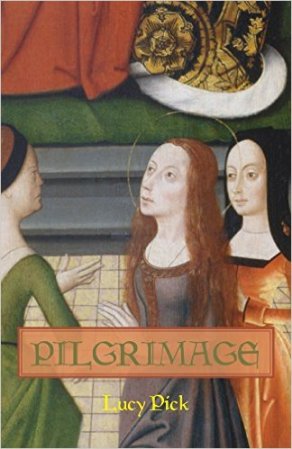 The cover of academic historian Lucy Pick’s novel
 is story, my Word program froze several times, and I lost what I had written. This has never happened before. The fifth time, it occurred to me that Artemis was not happy with the way I was telling the story of her life and death. I lit a candle and prayed for her spirit to fly free like the gulls over the sea that I could see out my window and began again. The words in italic are the ones she added.
 Coloring is a fast growing trend

 Sci-fi fan that I am, I would feel remiss if I failed to discuss
 Feminism and Religion