 In contrast to the linearity of our time concept in the West, Indians view life as infinite and cyclical. Although Hindus, like ancient Greeks, believe in four ages of humanity (the so-called yugas), these occur not just once, but repeat cyclically every several million years. Similarly, the creator god Brahma is said to have a daily cycle which has recurring effects on the existence of the world. When Brahma awakes the world is created anew, and when he falls asleep it dissolves once again into the primal waters of eternity. Fortunately for us, Brahma’s day lasts 4,320,000,000 human years.
Holland Cotter, in reflecting on Eastern art, once brought these temporal differences into sharp focus when he contrasted two of the major icons of East and West — Christ on the cross and the dancing Shiva. He said, “The Christ figure embodies the Judeo-Christian concept of divine history as a straight, purposeful line from the Fall of Man (sic.) to redemption, but with a tragic human story of self-sacrifice, loss and atonement at its heart. The dancing Shiva is, by contrast, a dynamic, joyous cyclical image: a poised, uplifted foot and hands form a circle echoing the nimbus of flames surrounding the figure. The image represents a culture which…views both humans and gods as participants in a cosmic game that periodically grinds to a catastrophic halt only to begin again.”[i]
Like Shiva, Kali has been depicted surrounded by a halo of flames. But unlike Shiva, her portrait is far from a joyous image. In one example, a 17th or 18th century North Indian sculpture, Kali is personified as a voracious, old hag squatting on a victim whose entrails she eats. Slicing open the belly of the anonymous corpse, Kali scoops out its intestines with her bony fingers and gobbles them with her protruding teeth. The anonymity of the victim brings home to the viewer the fact that ultimately we are all Kali’s prey. And the flames burning around her head reemphasize this point, for as the aureole of the Dancing Shiva, they are the fires of the final conflagration at the end of each world period. But in this image we realize that such flames flicker constantly, since time erodes all that has ever existed and Kali swallows all she has ever birthed.[ii] Continue reading “Kali Ma (Part 3 of 3) by Nancy Vedder-Shults”


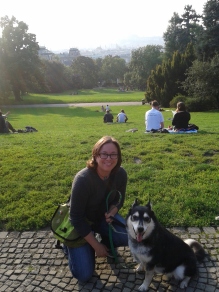 According to the United States Holocaust Memorial Museum, the Jewish population of Czechoslovakia numbered some 357,000 in 1933. By 1950, it was recorded to be 17,000. To be sure, some escaped to Israel or the United States. Yet, within the modern boundaries of the Czech Republic, some 77,000+ perished. You can find the names of the dead inscribed on the walls of Prague’s Pinkas Synagogue. The Jewish community here remains extremely affected by the effects of WWII and the lingering legacy of communism.
 Each month on Feminism and Religion, I feature a
 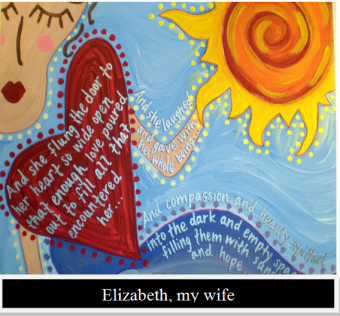 I would like to dedicate this post to all the holy women who fill our lives, yet whose stories we never hear. Because it is not only these seemingly famous women—these heroines of feminism—who are holy and whose stories matter.
 In my last post, I shared with you my wonderment at the power of music to speak for us when we lack speech and to touch us when we are beyond reach. Now, I experience wonderment at the power of silence. For, it was silence that in the end helped my father-in-law, who was truly my father, to shed his mortal coil. After the noise of caregivers and nurses, of talking and encouraging, of wailing and whispering, there was a window of silence when I sat alone with him, stroking his forehead lightly. I knew he would be free in that quiet to exhale, and with that final breath, he too became silent.
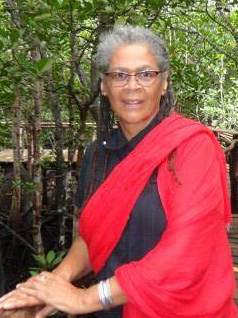 It’s not so easy any more to control the parameters of Islam and the way it is practiced by those who wish to stuff their opinion down the throats of other Muslim citizens, be they minorities or majorities across the globe.
 Can we think of the voting place as an altar where we hole-punch a prayer to the honored dead?
 November, which begins with All Saints Day (yesterday) and All Souls Day (today), gives us a quiet, welcome break between the loud make-believe of Halloween and the incessant caroling of the winter solstice season with its popular holidays. In the Northern Hemisphere, the days are noticeably shorter and darker now. Where I grew up, it’s gray, cloudy, and often rainy. It has always seemed to me that people are turning inward and the month is closing in on itself. Even today in southern California, I feel a delicious melancholy composed of silence and rest from hard work.
 Originally, in ancient Greek, ‘sphere’ simply meant ‘ball.’ Though its grammatical gender varied, it was primarily a feminine noun. It is in that sense and with that gender that it bounces into Western literature in the episode of the Odyssey where Nausicaa and her companions are playing catch on a beach (
