What’s Your Feminism I.Q.? by Barbara Ardinger

Let’s begin a new year by finding out what we know about feminist history and goddess scholarship. Take this little quiz and find out where you stand as a Feminism/Goddess Scholar. (It’s okay to laugh at some of the choices. Laughing shows you’re paying attention.)

1. Who wrote When God Was a Woman?

            a. Ernest Hemingway                         b. Merlin Stone

            c. Sharyn McCrumb                           d. Isabel Allende

Continue reading “What’s Your Feminism I.Q.? by Barbara Ardinger”

My Encounter with the Venus of Dolní Věstonice by Ivy Helman.

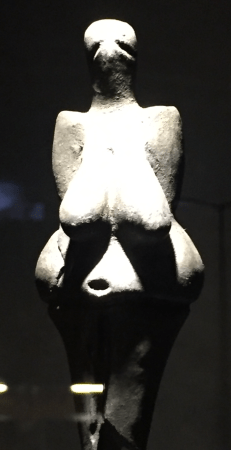
Marija Gimbutas, in her book Language of the Goddess, mentions only one goddess figurine from what was, at the time of her writing, Czechoslovakia (pages 31-32).  That figurine comes from Předmosti, in the very eastern part of what is now the Czech Republic.  However, there are more, and I would like to introduce you to the one that I encountered during a visit to another part of the Czech Republic several weeks ago.

Meet what Czechs refer to as the Venus of Dolní Věstonice.  There is not a lot of information about her, so I have pieced together what I can find.  Said to be the oldest known fired terracotta figurine (some 29,000 years old), she was first unearthed in 1925.  She was found broken into two pieces at the site of the Stone Age settlement known as Dolní Věstonice, in the southeastern part of the Czech Republic.  This settlement, according to Archeo Park Pavlov, was part of the Pavlovian culture, a Stone Age culture local to the area.  

Author’s photograph of a replica of the Venus on display at Archeo Park Pavlov.
Continue reading “My Encounter with the Venus of Dolní Věstonice by Ivy Helman.”

Avian Friendship by Sara Wright

The other night I had a dream about a strange green hooded figure that was guarding a green gate underground. She wasn’t  human; she had a hooked bird’s beak (like many of Marija Gimbutas’s goddess figures). Something about the strange face reminded me of an American Indian. This creature was not friendly but she was not hostile either. Just really intent upon making it clear that you did not pass through the gate without her permission. The word Root kept reverberating out loud in this place… Root Woman? Strange that she was also a bird.  Anyway, thinking about bird women prompted the following poem and brief reflection on my relationship with one kind of bird…

Continue reading “Avian Friendship by Sara Wright”

Toadwise: A Tale for a Life Lover – Part II by Sara Wright

Read Part I here…

In the Americas I found more recent Indigenous mythology on the Toad as Goddess. Tlaltecuhtli is a Pre–Columbian (1200–1519) goddess belonging to the Mexica. Although Tlaltecuhtli’s name is masculine modern scholars interpret this toad figure as female because she is squatting giving birth. Some see her as crouching under the earth, mouth open waiting to devour the dead. Since the Aztec culture was a warring male dominated Patriarchal one I think it’s perfectly reasonable to assume that the Earth Goddess/Toad was seen as masculine to the Mexica.

In Mesoamerica we find Toad widely represented in art, often with feline or other non-naturalistic attributes, including jaguar claws and fangs. These images can be regarded as versions of Tlaltecuhtli. In contemporary Mexico, as in Guatemala, and throughout South America toads play a role in myth, sorcery, shamanism, and in curing/healing. Continue reading “Toadwise: A Tale for a Life Lover – Part II by Sara Wright”

Toadwise: A Tale for a Life Lover – Part I by Sara Wright


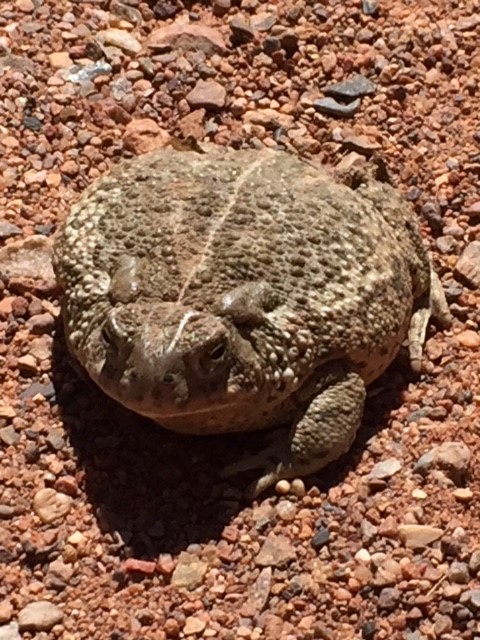
Last night I was thinking about the giant western toad that is living in my garden when I had a peculiar thought: Write a story about the Toad and an Old Woman and call it A Tale for a Life Lover. At this very moment I heard my toad’s rasping guttural cry outside my window. I was so shocked I got up and went out on the porch, hoping to hear the call again, but the toad only spoke once. Afterwards, I wondered if I had imagined it.

When the giant western toad appeared in my yard last week I had been in a state bordering on despair over baffling health issues and the ravages of Climate Change. Maybe it is no longer possible for me to separate the two? After the visitation I sensed that the toad’s abrupt appearance meant something beyond the amazing fact that I had met a giant toad who apparently had been living here all along. Continue reading “Toadwise: A Tale for a Life Lover – Part I by Sara Wright”

“Fertility” and the Regeneration of Life by Carol P. Christ

Prehistoric and indigenous religious traditions are often disparagingly mischaracterized as primitive fertility religions, concerned not with higher morality, but rather with the processes of reproduction of humans, animals, and plants. When these religions feature a Great Mother Goddess, it may be assumed that these religions are primarily focused on birthing human babies. Nothing could be farther from the truth.

Indeed, archaeologist Marija Gimbutas discovered that in the symbol systems of Old Europe, the Goddess is only rarely imaged as pregnant or giving birth. Nor is She portrayed solely in human form. Rather, She is portrayed with a bird head, wings, and a plethora of other animal and plant features. If She is a Great Mother Goddess, She is revered as the Source of Life, not simply as a mother of human babies. Gimbutas states that in Old Europe the Goddess was worshiped in as a symbol of the powers of birth, death, and regeneration in all of life. Gimbutas said these societies were matrilineal and probably matrilocal. Continue reading ““Fertility” and the Regeneration of Life by Carol P. Christ”

Women, like Goddesses, Come in All Colors, Shapes, and Sizes…by Vanessa Soriano


I wish I could have gotten this phrase tattooed on my arm when I started the serpentine journey into womanhood.  Like most of us, growing up, all I ever saw in media were thin female bodies with impossible proportions.  As one article put it:

Although body size and weight perception differ across race and ethnicity, women in western society are subject to images of women as not only thin, but also athletic and toned, with small waists, large buttocks, and large breasts, a body type that is largely unattainable.  Because of this ideal, all girls and women typically have weight concerns that ultimately shape body image, satisfaction, and appreciation. Continue reading “Women, like Goddesses, Come in All Colors, Shapes, and Sizes…by Vanessa Soriano”

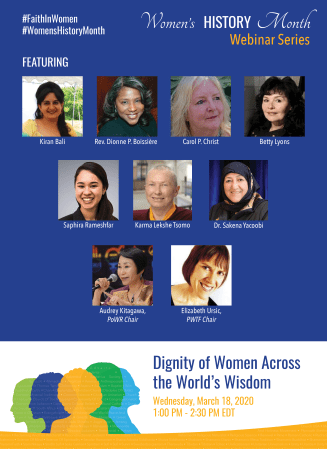
Dignity of Women Across the World’s Wisdom: Parliament of World Religions Webinar by Carol P. Christ

I have been asked to post my contribution to the Parliament of World Religions Webinar: Dignity of Women Across World’s Wisdom. 

I am participating in this discussion as a representative of women who are on a Goddess path. I do not represent any established or newly formed religious or spiritual tradition. Rather I speak for an increasingly large number of women who are seeking alternatives to established traditions that celebrate and legitimate male power as power over or domination. We do not follow leaders or gurus and we place no trust in any sacred texts.

Most of us have grown up in cultures where the most prominent religious traditions feature male Gods, male teachers, and male religious leaders. We agree with Mary Daly who said that when God is male the male is God. In traditions where God is male, male teachers and religious leaders are viewed as reflecting or being in the image of the male divinity. We do not assume that images of God as male are never valid, but we do assert the need for images of God as female.

As I said in my often re-published essay, “Why Women Need the Goddess,” the most important meaning conveyed by the symbol of Goddess as the ultimate creative power in the universe is that female power is legitimate and good. This does not mean that female power is always good, but it clearly undermines the widely held view that female power exercised apart from male control is always evil or bad. This view is reinforced by images of women as evil in religious traditions, for example, Eve seduced by the snake. Continue reading “Dignity of Women Across the World’s Wisdom: Parliament of World Religions Webinar by Carol P. Christ”

Ancient Mothers, I Hear You Calling Me to Crete by Carol P. Christ

On a cold and rainy morning in Lesbos, I ponder the advice of my intuitive friend Cristina to reflect on the spiritual dimensions of my decision to move to Crete. When asked why I am moving from Lesbos to Crete, I tend focus on the negative: I am lonely in my small village; and I am disheartened by my neighbors’ lack of compassion for the refugees who come to our island from Syria, Iraq, Iran, and Afghanistan.

As I begin to think again, I recall the many wonderful things I have experienced in Lesbos. This is the island where Sappho sang, and I too have been inspired by the muses who arise from the land. It is here that I first felt Greece calling me to leave my home. It is here that I learned to speak Greek. It is here that I listened to the stories of the old people who remembered a time when everyone lived closer to each other and the land. It is here that I learned to dance the traditional dances of Greece. It is here that I learned to identify over 300 species of birds that visit the wetlands on spring migration or are year-around or summer and winter residents. It is here that I dedicated a decade of my life to the effort to protect the wetland home of the birds I came to love. It is here that I was asked to run for regional and national office by the Green Party Greece. It is here that I met green friends I will always hold in my heart. It is here that I became an amateur geologist, learning the volcanic history of an island that has been declared a UNESCO Geopark. It is here that I imagined the time before 1922 when Turks, Armenians, and Greeks lived together in my village. It is here that I renovated a small Turkish house in a neighborhood that once had a mosque and later, a Neoclassical “mansion” (not particularly large by American standards) built by a Greek shipowner who transported goods brought by camels along the silk road from China. It is here that I learned to drink retsina and to relish food drenched in olive oil. I will carry all of this with me, for it is in my blood and in my bones.

But now, Crete is calling me. Continue reading “Ancient Mothers, I Hear You Calling Me to Crete by Carol P. Christ”

Harriet Boyd Hawes, Marija Gimbutas, and the Religion of Ancient Crete by Carol P. Christ

One of the projects I am working on these days is an essay on the religion of ancient Crete for a series of books on various aspects of the Minoan site of Gournia.

Harriet Boyd excavated the Minoan town of Gournia in 1901-1904. She was one of the first woman archaeologists and the first woman to run her own excavation in Crete, to be followed by Edith H. Hall whom she trained. She was also the first to excavate a Minoan town as opposed to a “palace,” providing the first evidence of daily life in Minoan Crete. Harriet Boyd might have continued to excavate in Crete, but her marriage in 1906, followed by the birth of her son soon thereafter, caused her to lose interest in a career as an excavator. Nonetheless, she published the results of her excavations in her book Gournia in 1908 and taught at Wellesley College until she reached retirement age.* Continue reading “Harriet Boyd Hawes, Marija Gimbutas, and the Religion of Ancient Crete by Carol P. Christ”