

The fortune teller stood at a square park table, her hair wrapped in a gold scarf, stacking perfectly formed human fingernails. Across from her, I watched as she methodically piled and unpiled the fingernails according to some obscure but precise calculation known only to her. She measured them against a line carved into the wood marked with tiny incremental notches.
Reading the messages she found there, she spoke.
“Your mother and father are not one, but All.”
My friend Jacqueline, standing between us, immediately blurted out, “What the fuck does that mean? That doesn’t make any sense!”
But I answered with unexpected certainty.
“No. She’s right. They are the archetypal Mother and Father. They are not mine alone.”
The fortune teller waved us closer.
“Come on. I have to finish these visions so I can go to heaven.”
This was the dream I had the night I arrived on the Isle of Mull in western Scotland for a two-week Goddess Pilgrimage. I believed I was traveling to my fatherland, the home of Clan MacBean, to heal old wounds and unbind myself from contracts unknowingly inherited through my patrilineal line.
Instead, the dream revealed what I was truly preparing to release: not merely personal trauma, but something collective. I was beginning to loosen my attachment to a primordial feeling I had carried for as long as I could remember—the feeling of wanting and not receiving.
The fortune teller feels like an ancient mythic force. She sits at the boundary between worlds, calculating the physical remnants of human life. Later, I learned that Scottish folk medicine regarded fingernails as an extension of a person’s living essence. Hair, fingernails, and blood were believed to retain an invisible connection to the body from which they came. Healers tied nail clippings to a bird’s leg and released it, buried them beneath trees, or incorporated them into remedies intended to draw illness from the body.
Like the fortune teller at her square table, measuring the genetic remnants of my ancestors, Ariadne’s mother, Pasiphae—whose name translates as “All-Shining”—was a renowned practitioner of ancient pharmakeia, a blend of herbal medicine, pharmacology, and sacred magic. Both women operate at the exact same boundary: they look at the physical matter of existence—whether it is roots dug from the earth or nail clippings cut from a hand—and use it to decode a deeper, inherited truth.
Pasiphae’s sanctuary at Thalamae was a place of dream incubation, a physical space designed for the exact kind of vision I had just received on Mull. Centuries apart, the fortune teller and the ancient Queen were working the same magic.
Though later male poets recast such gifts as witchcraft, women who understood the medicinal and spiritual powers of nature were once revered as healers, guardians, and ritual leaders. Pasiphae’s importance endured long after the Minoan era. At her sanctuary, political leaders and common people alike traveled to practice dream incubation. Through fasting, prayer, and sleeping within the temple precinct, they sought visions that could diagnose illness, prescribe remedies, or reveal the future.
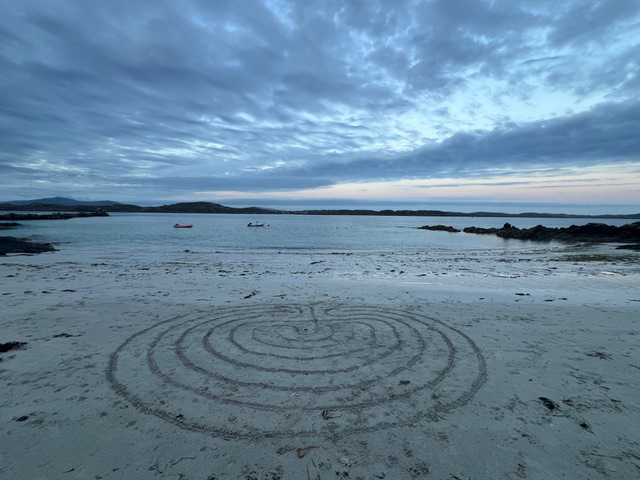
Before Ariadne became a supporting character in a hero’s tale, Minoan Crete was a sophisticated civilization centered on the worship of the Great Mother Goddess. The Queen of Crete likely served as both ruler and High Priestess, embodying the living presence of the Earth Mother during sacred rites. Pasiphae would have presided over ecstatic ceremonies, spiral dances, and seasonal rituals intended to channel the generative forces of nature into the world. Ariadne, her daughter, stood poised to inherit that role. Yet history remembers her primarily for providing the crimson thread that enabled Theseus to navigate the labyrinth and kill the Minotaur.
My fortune teller examined the fossils of human history to fuel her visions. The fingernails held the biological and psychological blueprint of every ancestor who came before me: the generational imprint of those who gripped, scratched, clawed, and struggled through the universal ache of longing. Even her urgency to “go to heaven” suggested a deeper truth. Energy moves. Things grow, decay, are measured, and return to their source.
When I shared the dream with the women in my pilgrimage group, our local guide on Mull remarked that the fingernail imagery reminded her of the North Berwick witch trials of 1591. Under torture, the young healer Geillis Duncan implicated respected midwife Agnes Sampson and noblewoman Euphemia MacCalzean in accusations of witchcraft.
Among the charges were folk healing practices used to ease childbirth. In an era when labor pain was considered divinely ordained, attempts to relieve a woman’s suffering could be interpreted as rebellion against God’s will. Sampson reportedly provided Euphemia with remedies that included ground fingernails intended to make the birth of her twins safer and less painful. To the authorities, these acts became evidence of sorcery. To the women involved, they were simply care.
The tragedy of the witch trials lies in the transformation of healing into heresy and compassion into crime. Their story reveals the same patriarchal anxiety that recast Pasiphae’s sacred medicine as dangerous witchcraft.
My pilgrimage continued, bringing vivid dreams that unfolded like an epic heroine’s journey. Though I am an only child in waking life, I dreamed of having fiercely loyal siblings. In one dream, my sister washed my hair at a public spigot in a busy town square. My brother stood beside me, agreeing to help me write a letter of protest to a school that required students to wear absurdly transparent yellow biker shorts as part of the uniform. Together, we set out to find our lost parents. Along the journey, I searched for a pendant that could serve as a protective talisman. Nothing fit.
I eventually realized I did not need a talisman.
I was already prepared.
As the days passed, the purpose of my unbinding ceremony became increasingly clear. It was not simply about disentangling myself from inherited patterns within my own family system. It was about releasing my identification with a much older wound: the collective grief of children throughout history searching for absent parents—a timeless yearning to be held in perfect attunement.
Longing is part of our shared human inheritance.
True Mother Magic—whether embodied by Pasiphae within the labyrinthine halls of the Palace of Knossos or by the fortune teller patiently counting remnants of human life—is fluid, cyclical, and inseparable from nature’s rhythms. It embraces birth and decay, creation and dissolution.
To a rigid mind, such power appears dangerous because it cannot be controlled.
Those who fear it often attempt to suppress it. Yet history repeatedly demonstrates the futility of that effort. Nature endures. Cycles continue. The intuitive, medicinal, and protective wisdom associated with women survives every attempt at erasure.
Whether my dream tapped into ancient traditions surrounding nails, healing, and divination, I don’t know. But I recognize the pattern. The fortune teller sorting the blueprints of my ancestors was simply Pasiphae by another name—sorting the roots of the world to heal an inherited poison. The ancient world and my modern psyche became a single, continuous labyrinthian line. What I do know is that both Ariadne and I stand with the same powerful Mother Magic at our backs.
No epic poet can fully rewrite the personal or collective unconscious.
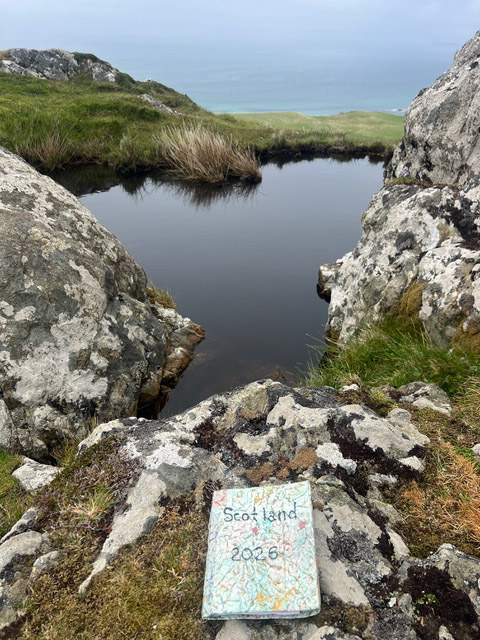
On the final day of the pilgrimage, I climbed to the highest point on the Isle of Iona and found the hidden nook of Brigid’s Well. Protected by craggy rock formations, soft grass, and a 360-degree view of the surrounding sea, I felt suspended between worlds. There, I unbound myself from longing. I spoke my words into the wind, swam naked in the cool spring, and lay upon the earth. Then I heard:
Ahhh… Welcome, Sister.
Feel the blanket of love below you, on top of you, at your feet, above your head.
Sister.
Not daughter.
Not mother.
Sister.
Equal.
Unbound, indeed.
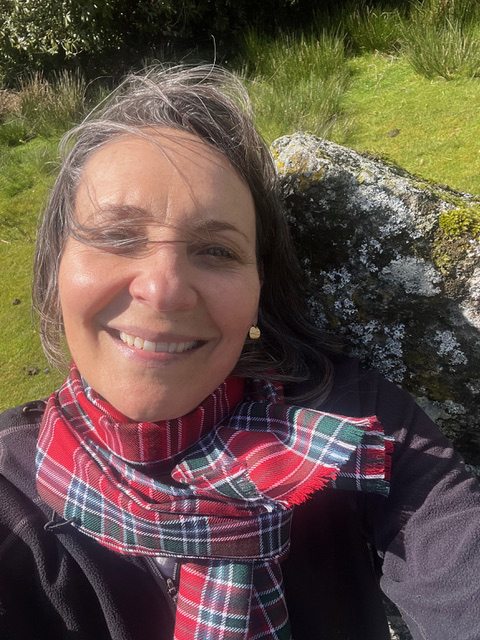
Lochbuie, Isle of Mull, Photo by Author
BIO: Arianne MacBean a licensed marriage and family therapist with a certificate in somatic psychotherapies and practices at Synergy Somatic Psychotherapy in Pasadena, CA. She holds a BA in Dance from UCLA, a Double MFA in Dance and Writing from CalArts, and an MA in Counseling Psychology from Pacifica Graduate Institute. Her first book, Tough Shit – the angry woman’s guide to embodying change was published by Tehom Center Publishing. Read her essays at Mutha Magazine, Nasty Women Writers Project, and Dance Chronicle. She will be presenting a roundtable discussion, Ariadne & Me: Re-Scripting our Goddess Guides, at the Goddess-Makers Conference hosted by Pacifica Graduate Institute Aug 28 – 30, 2026.
Discover more from Feminism and Religion
Subscribe to get the latest posts sent to your email.


Wonderful, wise essay…every personal wound carries a collective charge and it’ s important to recognize that the two are intricately connected – in my own life I can sometimes feel this knowing in day life – sometimes in dreams -or visions. no matter how we receive this information it is important to HONOR it as a gift – even if it’s something we don’t want to know. I say this because there are always two sides and both must be acknowledged as part of one whole. “Nature endures. Cycles continue. The intuitive, medicinal, and protective wisdom associated with women survives every attempt at erasure”. I would add that what we call intuition demonstrates this ability women have – we are closer to the workings of earth and cosmos – like it or not.
LikeLike
“Closer to the workings of earth and cosmos – like it or not!” ❣️
LikeLike