


With the trees burning around the world, in Canada and the US as well as in Europe and Africa, Asia, South America and more, it seems to be an especially important time to be with the trees, to recognize our kinship, and to celebrate them.
To see just how bad the fires are around the world, below are the links to two maps that are kept in real time.
NASA Greenpeace
I don’t know when and where the initial hatred of trees began, but I would tag the Bible as an early and influential proponent of destroying trees.
The viciousness against trees appears to have grown out of a desire to erase Goddess worship in Biblical lands. The terms for Goddess groves were Asherot and Ashereem named after the Goddess Ashera. An individual tree was called an Ashera. The charge given to the people was to cut down everyone.
And ye shall overthrow their altars, and break their pillars, and burn their groves (Ashereem) with fire; and ye shall hew down the graven images of their gods, and destroy the names of them out of that place.
Deuteronomy 12:3 KJV
But ye shall destroy their altars, break their images, and cut down their groves:
Exodus 34:13 KJV
There were other messages in the Bible (some of which are below) but the messages like those above are the most thundering and the ones that have echoed the loudest through time. Most of the passages that respect trees have faded to become eclipsed. Others have been translated out of easy reach.
The following are excerpts from my most recent book, The Music of Creation. I have two chapters in the book dedicated to trees, one is “Trees and Seeds” and the other is “The Celebration of Trees.”
For the biblical passages following, KJV means King James Version and MPV means Mystic Pagan Version. The MPV’s are my own translations based on the original meaning of the words.
TREE COMMENTARY
We, as humanity.beings, have a deep connection to trees. So much so that it is reflected in our language. Even today, we speak about our own ancestors as “the roots” of our “family tree” of which there are many “branches.” Our descendants are “offshoots.” Our children are the “fruit” of our loins.
Anthropologist and religious scholar Mircea Eliade writes extensively about the associations of trees and their ancestral connection to humans. He calls them both mystical and mythical.[1] His examples include the Miao groups of Southern China and Southeast Asia who “worship the bamboo as their ancestor.” He also notes Australian tribes who view the mimosa as their progenitor. And there is a tribe from Madagascar called Antaivandrika which means “people of the tree.” They consider themselves descended from the banana tree.
The Hebrew language provides further evidence of our relationship to trees. In Hebrew the word for tree is ets. If you add the universal breath syllable, ah (or ha) you get ets-ah which means spine (or sacrum). Ets-eem[2] in Hebrew means bones. We all carry our own trees of life within our human bodies. Our bones are likened to the bones of trees. Our spines are our personal trees of life. In this way they are deeply connected to the trunk/spines of the trees.
Eve is chavah or hawwah depending on the transliteration. In Hebrew, the “Tree of Life” is the tree of ha-hay-yim or Her name in plural.
The Tree of Life, literally translated, means the Tree of Eve (transcendent of gender) in its grandest, most powerful aspect. The Hebrew ha-hay-yim[3]is life in plural, LIFE/EVE writ large in the fullness of all mystery.
Below are some of the passages that even in the traditional translations honor trees.
Deut 20:19
…thou shalt not cut them down (for the tree of the field is man’s life) . . .
KJV
. . .thou shalt cherish them (for the trees of the field are the brother/sister journeyers of our lives) . . .
MPV
Psalm 1:3
And he shall be like a tree planted by the rivers of water,
that bringeth forth his fruit in his season;
his leaf also shall not wither; and whatsoever he doeth shall prosper.
KJV
And we shall be likened to trees, planted by the flowing rivers
Bringing forth fruits in the fullness of time
So that our seeds may flourish.
MPV
Proverbs 3:18
She is a tree of life to them that lay hold upon her:
and happy is every one that retaineth her.
KJV
She is a tree of life to those who acclaim Her,
and blessed are all who embrace Her.
MPV
COMMENTARY
This section celebrates and honors trees as an element of our relationship to them. Trees all over the world are hurting. Between hurricanes, fires, infestations, indiscriminate logging, and climate change our trees need extra amounts of care and love. Celebrating trees helps us to raise our own consciousness, as well as those around us. When we become more aware of the trees and what they need to be healthy, our connection grows ever stronger. And the trees do respond.
I believe that many of the passages about trees are very old ones that were incorporated into the Biblical library of books. Their original messages were probably too popular for the emerging priesthood to ignore or remove entirely, so they sought to hide them either by verbiage or through translations.
Deut 20:19 is one such passage that was likely inserted into a wartime tale. The discussion surrounding the passage is what to do (or not) in the case of a “siege of war.” The people are admonished not to cut down the trees . . . “for the tree of the field is man’s life.” It’s odd that the Bible should suddenly be so concerned with “man’s life” when two passages before in Deut 20:17 the discussion is about the “complete destruction” of other cultures in the area; the Hittites, Amorites, Canaanites, Perizzites, Hivites, and Jebusites.
The passage itself is three words: Ha-adam ets hassadeh. Ets, as we have seen, means tree. Adam is obvious because it’s also a familiar name, and hassadeh is the land or fields. We’ve seen Adam in relation to trees and food before in the Bible and that, of course, didn’t turn out so well. It is ironic that the grand deity, who had once punished Adam for eating the fruit of the trees is now advocating for that very thing. There is some confusion of message which is why I consider this passage to be a blend of older and newer stories.
This is all really old knowledge, pagan knowledge if you will.
I can’t stop thinking about the Deuteronomy command to burn down the trees.
burn their groves (Ashereem) with fire;
Deuteronomy 12:3 KJV
Aren’t we living today with the culmination of that mandate? Let us instead live with this command also from Deuteronomy
. . .thou shalt cherish them (for the trees of the field are the brother/sister journeyers of our lives)
Deuteronomy 20:19 MPV
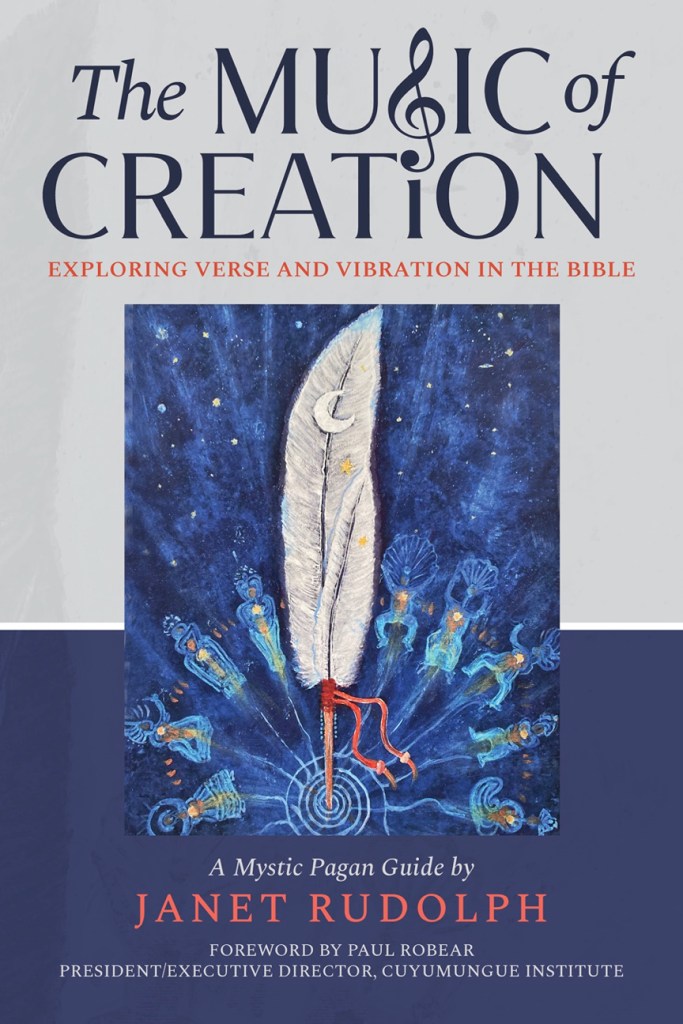
The Music of Creation is available on Amazon and at Barnes and Noble.
Details of Judith’s Olive Tree print sale here. The special runs from Aug 19 through the 24th- special $90, retail price $175 – limited edition of 25, signed and numbered. To access the special price, use the code TREESPECIAL.
[1] Mircea Eliade, Patterns of Comparative Religion, translated by Rosemary Sheed, University of Nebraska Press, 1996, 300-301.
[2] Or ets-eem, a plural form of the word tree.
[3] The “w” and “y” are interchangeable. The “eem” or “yim” sound at the end is the plural suffix.
Discover more from Feminism and Religion
Subscribe to get the latest posts sent to your email.


I have such a fondness for Asherah and trees. I believe it started when I read your book Janet!! I am going to schedule this for a #Goddess101Texts . When I moved to Alabama, my first ‘welcome’ here was from a grove of trees Monte Sano State Park. I regularly am in the woods with trees, and I have had the thought many a time that I could die there, that is how wonderful the trees make me feel. Thank you Janet for your work.
LikeLiked by 1 person
I want to be buried under an old tree.. all trees are my friends…
LikeLiked by 1 person
ashes to ashes, tree bones to tree bones . . .
LikeLike
Thank you Caryn. And the next time you are in Monte Sano State Park (or other grove of trees) please give them hugs from me.
LikeLike
Asherah was the first goddess I ever sculpted though I had no idea that I had done so – some 45 years ago…I think you are right. This is the time to celebrate each tree – we share 50 percent of our DNA with trees so they are literally our relatives – but of course, some of us have always known this – felt it in out bones. It is no accident that the Tree of Life shows up in every religion! Fred Pearce and Environmental Journalist of some 40 years has written a book called “A Trillion Trees ‘ that addresses the idea that trees are both feared nd loved in passing. I was struck by this sentence because I do not see trees in a negative light. I see in my dreams that they are cut down -and my grief for trees is ongoing. You offer some fascinating quotes that support this idea that trees are to be fired and I think/ feel that it is a given that tres and the goddess are One…. Wonderful post Janet. Will be reading it again – thank you. Your scholarship matters.
LikeLiked by 1 person
not fired – but FEARED -normally don;’t care about AI generated mistakes but this one I do. Anyone interested in tree survival should read this book – it offers hope long term –
LikeLiked by 1 person
Totally agree about the Tree of Life and the grief of what is happening. I am not familiar with Fred Pearce, I am noting him on my “to read” list. Thank you.
LikeLike
I have loved trees my whole life and felt that deep connection your words so beautifully describe. In fact the first painting I ever did when I was young was of a tree.
I feel and understand the hatred the patriarchy holds onto toward women – the true original sin- but I never connected that to a specific hatred of trees until reading your post. That ancient patriarchal hatred of woman, who contains the miracle of human life within her body, is most surely the source of the hatred of nature, Mother Earth. That I always knew, but trees specifically— it is truly unfathomable how they can hold such hatred in their hearts for so many millennia.
For years, riding my bike through the cottonwood forest that runs along the banks of the Rio Grande gave me such joy. But this year it is different. This year the trees are dying due to the ongoing and extreme drought and my ride has turned into a song of sadness and a farewell to my friends.
Thank you Janet for reminding us all of our deep connection to trees. Without trees, humans would not have emerged.
LikeLiked by 1 person
Judith I can see that you love trees because no one could paint them as beautifully as you do without that strong feeling in your heart.
And oh my re: the Rio Grande, what a sadness. I wonder how much longer Mama Earth will put up with we humans.
LikeLike
I love this! I love the way you bring in the Biblical passages, both for the destruction and for the celebration of trees; as well as the connections you draw to the human body and our roots and branches. One of the most effective exercises we did in my indigenous trauma training was to get a sense of what tree we would be in this moment. We have such an affinity and they can teach us so much about ourselves.
LikeLiked by 1 person
Trees as healing elements. Love it! Thank you for that gem.
LikeLike
Such a wise, beautiful, timely, well-researched post, Janet. And Judith, you see the soul of trees. Your painting reminds me of trees I visit I call the granny trees.
I offer an excerpt from a poem I wrote in the previous century. “Our Other Selves”
We breathe together
in and out, in and out
back and forth between us
in a rhythm so perfect
we forget it’s there ….
And we need to remember now. We need to love the trees, our friends, our neighbors, our other selves,
as ourselves.
LikeLiked by 1 person
Fabulous poetry as always Elizabeth. I love your sense of connection and breath between us and trees. I was thinking about that today how we have that breath relationship and here you are putting into such poignant words! It is a strong relationship that we forget at our own peril for sure.
And like I said to Caryn, please give those granny trees a hug from me.
LikeLike
Your article made me think of “She is a tree of life for them” by photographer Consuelo Kanaga. I think I first saw it in the anthology, “Family of Man.” I don’t think I can post the photo here though.
LikeLiked by 1 person
Thank you Annelinde for making the connection. It is always so great to expand our connections. Here is a link to the photograph: https://collections.lacma.org/object/133706
LikeLike