

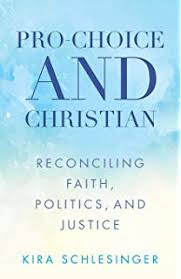
In 2015 Kira Schlesinger wrote piece for Ministry Matters about how her own pro-choice stance on abortion had become more complicated the more she explored the issue of abortion. The article was widely read and shared, as well as hotly debated by many. You can read this article and the many comments here. Out of the response to this article grew Schlesinger’s Pro-Choice and Christian: Reconciling Faith, Politics, and Justice.
The book does a great job of walking the fine line of being both academically engaging and an easy enough read to engage a book or Bible study group as well. Schlesinger uses the first couple of chapters to dig into the history of abortion, listing recorded examples of the process as early as 1300 BCE. From there she briefly walks the reader through the roughly 100 years (Comstock Act in 1873 until Roe v. Wade in 1973) during which abortion was illegal in the United States. Finally, she wraps up this beginning historical section with details about the generations after Roe v. Wade up to our current reality.



 Storytelling is as old as humanity. We tell ourselves stories – about who we are as individuals, about our families, and about our people – to understand who we are. A lot of narratives are told by a dominant segment of society at the expense of others. I am drawn to stories that flip the script. What stories about real people help us envision a world where all human beings can fulfill our God-given potential?

 This past term I had the opportunity to teach courses on the Christian doctrines of Christology and Trinity. My first inclination was to approach these doctrines from the perspective of their historical development. For, I find the historical study of doctrinal development to be a fascinating and liberating approach to theology because it delivers the searcher from the illusions of ubiquity and universality, even in matters of the most central tenets of faith. When people can see doctrine in its political, polemical, and posited guises, we can be free from absolutization of belief in past expressions as well as in present permutations.
 Feminism and Religion