 I spent 2015 teaching an Intentional Creativity program ‘Wisdom of the Goddess” to an intimate tribe of women creatives from our local community. In December we held an end of Year Art Gala displaying a portion of the work which saw over 100 paintings of Goddesses created over a 10-moon period.
The program was divided into the cycles of Creation, Transformation and Celebration, as inspired by Hallie Inglehard’s book “The Heart of the Goddess”. Each month, through ritual, visioning and painting, we explored a Goddess that represented these cycles; Eve, Anjea, Demeter, Cerridwen, Kali, Persephone, Aphrodite, Ochun and finally, our Inner Goddess.
It took great courage for the artists to display their paintings in public. It is often hard to explain this work because it requires such deep and thoughtful exploration of one’s inner world along with a commitment to a creative practice that favours personal growth and discovery over outcome. It can be difficult finding the language to elucidate on this process that is not just about the act of painting.
It is painting to grow and heal.
It is sacred.
It honours and empowers women.
It inspires authentic creative expression.
It unites one with self.
It connects one back to the earth.
It transforms.
It reveals.
The show was a great success. A gallery full of Goddesses was surely a sight to behold! It was a humbling experience to be out and proud about our creative work in our regional, agricultural, largely conservative community. I feel it is imperative for the restoration of female empowerment to be remembering and re-imagining the Goddess by way of image and it was through Her that these astounding women artists found the courage to put their heart and soul on the wall for all to see.
The influence that image has is far-reaching and cannot be under-estimated. Image is a universal language that evokes emotion and can go as far as mobilising the masses and even change the course of history. The famous photo of ‘Phan Thi Kim Phuc’ running naked down a road after a napalm attack during the Vietnam War is but one outstanding example.
As I reflected on the years work however, I was reminded that while these paintings carry with them incredible insights and powerful messages of change, growth, discovery and transformation, the Goddess is so much more than just an image; and certainly more than just an image to mass-produce and sell. While “the strength and independence of female power can be intuited by contemplating ancient and modern images of the Goddess” (Carol P. Christ in ‘Why Women Need the Goddess’), it cannot be forgotten that She is the sacred made immanent in the natural world, expressed in the diversity of all forms of life and death. We seek Her, sometimes even travelling to the ends of the earth to find Her, forgetting that She is everywhere. She is you and me and Her sacred sites are found in our own backyards.
With this in mind I recently returned to some creative investigations I had begun a few years ago exploring woman in nature and the Goddess as the body of the earth through paint. The earth speaks and I am listening to Her stories and bringing them to the canvas to re-affirm my sense of wonder and respect for nature. My aim is to awaken an ancient memory of the sacred relationship between human and nature, for now, more than ever, it is critical that this relationship be restored. In doing so, the earth may once again be seen and valued as a living, breathing body that sustains and nourishes all life rather than being merely a commodity to be devastated and destroyed in the name of capitalism and greed. Further, these images are reminders of the interconnectedness of all life; we are not separate from the earth, but part of its’ intricate web.
The following image was inspired in part by Terry Tempest Williams ‘When Women Were Birds’ but is also an image born from a revelation I had many, many years ago when I first starting seeing woman in nature, especially in the body of trees.
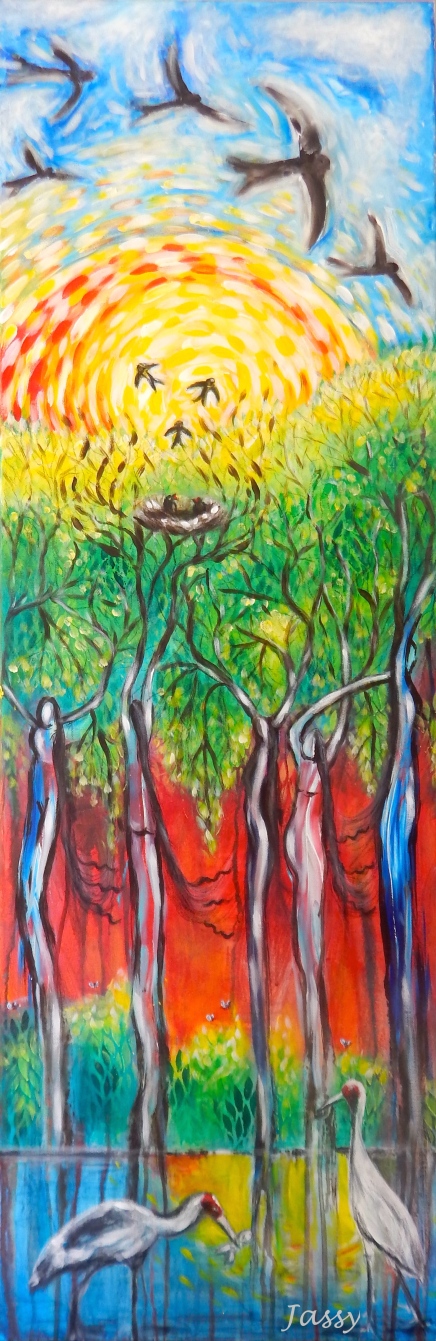
“We are the birds eggs. Birds eggs, flowers, butterflies, rabbits, cows, sheep; we are caterpillars; we are leaves of ivy and sprigs of wallflower. We are women. We rise from the wave. We are gazelle and doe, elephant and whale, lilies and roses and peach, we are air, we are flame, we are oyster and pearl, we are girls. We are woman and nature. And he says he cannot hear us speak.
But we hear.”
― Susan Griffin, Woman and Nature: The Roaring Inside Her
Jassy Watson, who lives on the sub-tropical coast of Queensland Australia, is a Mother of four, passionate organic gardener, Intuitive/Visionary Artist, Intentional Creativity Coach and a student of Ancient History and Religion at Macquarie University, Sydney. She is the Creatress of Goddesses Garden Studio & Gallery; a small school for the Sacred Creative Arts. Jassy teaches regular painting workshops in person, nationally, internationally, and online based around themes that explore myth, history, earth connection and the Goddess. Her latest SOULSCAPES (TM) exploring woman in nature will be on show at ‘Dreaming Into Being’, Percolator Gallery, Paddington, Brisbane April 5th-11th. You can see her work at http://www.goddessesgardenandstudio.co


 In the first blog in this series, I argued that one of the hallmarks of a good theology is recognizing that the source of authority must be located in individuals and communities who interpret texts and traditions as they encounter divinity anew in the present. In our new book Goddess and God World, Judith Plaskow and I suggest that a second hallmark of good theology is the “turn to the world.” What we mean by this is not only that divinity is immanent in the world, but also that the purpose of human life is to be found in this world—not the next.
 Thus through an enormous network of mythological narrative, every aspect of culture is cloaked in the relationship of ruler and ruled, creator and created. . . . [Sumerian] legend endows the Sumerian ruler-gods with creative power; their subjects are recreated as servants. . . . [This new narrative was] deployed with the purpose of conditioning the mind anew.(20, italics added)
 At the time of climate change and crises of capitalism we need to drop our sense of entitlement to comfortable life or even to life at all. Nature will not spare us just because we are humans. When the meltdown of economic and environmental systems occurs, we are all going down: humans and non-humans, women and men, spiritual or not. We have
 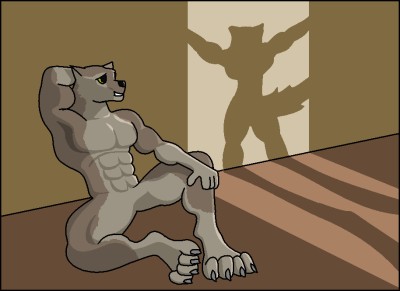 It starts with the main character, a Chinese Buddhist Were Fox who lives in present-day Moscow, consoling herself: “What else (or What the fuck) did you expect from life, A Huli?” A Huli is her name, supposedly meaning Fox A in Chinese. It is also a swear phrase in Russian, meaning “What the fuck?”
 When Flint, Michigan’s water supply was poisoned by lead through a policy decision— as has been widely reported, especially by