God is Too Big by amina wadud

amina 2014 - cropped

In my current casual reading, a novel, the answer to the question “and where is God for you?” was expressed this way:

“Definitely in the car with us as we talk and exchange things, and change each other in the process…People have things they want to give away, or they want things they don’t know where to look for, and they need containers to pool their information. This night is far too large for us to rattle around in on our own. It’s a perfect fit for God, but we need our container. We need one another for God to work through us: that’s something I experience every day. The concept of God is way too big for me to get my mind around, but despite that, maybe even because of it, the relationship keeps growing and changing.  Sometimes it grows so slowly it seems it’s stopped. Or gone in reverse. Then when I least expect it, it takes a big leap forward.”

I was struck by this first because of the concept of God being “way too big.”  I struggle with this and yet would have it no other way. I have gone out my way to kill off the childhood concepts of God, referred to in that book Your God is Too Small. It explains that for many people, their concept of God has not advanced far from the one they had as a child – from the Big Bad Punisher to the tooth fairy God of requisition. As a strict monotheist, I constantly fight to smash the idols of my own imagination or preoccupation. To get God out of any box.

Continue reading “God is Too Big by amina wadud”

My Afternoon with Amina Wadud: Some Pearls of Wisdom for a Warm Autumn in Santiago by Vanessa Rivera de la Fuente

Vanessa Rivera de la Fuente. Amina WadudAlbert Einstein said that there are two ways for understanding life: One, to believe nothing is a miracle; the other, to believe everything is a miracle. I think life is a bit of both. There are experiences that result from a chain of events we can easily recognize. Others are just a gift. My meeting with Amina Wadud was of the second kind – a beautiful gift from life in the beginning of the autumn in Santiago of Chile.

Meeting The Lady

Since I converted to Islam, around 5 years ago, and started my path now as a feminist Muslim, it is not possible to explain one without the other in my life history- the presence, words and activities of Amina Wadud have been a source of inspiration for me.

Her book, Quran and Woman, was the first approach to and basis for an Islamic Feminism that stands with strong feet against misogyny and fundamentalism in the name of religion. Her courage when she dared to preach a jutba (sermon) and lead a mix prayer – something still forbidden officially for women in Islam – led us to question our  physical place and its symbolic meaning in the mosque. Her vocation as a globetrotter, talking, meeting, and encouraging people in the world to build new meanings and communities based in freedom of spirit, made me understand that the message of Islam and its different reading on gender, is not only on behalf of Muslim women or Muslims in general, but is on behalf of all humankind, like a whole family looking for social justice and freedom, passengers in this big mosque and madrassa that is Allah’s creation.

Continue reading “My Afternoon with Amina Wadud: Some Pearls of Wisdom for a Warm Autumn in Santiago by Vanessa Rivera de la Fuente”

Dr. Debbie Downer Discourses on the Lives of Early Pious and Sufi Women by Laury Silvers

Silvers, Bio Pic FRBlogI’ve been called a downer because I take what seems like a jaundiced perspective on the early history of pious and Sufi women. There is a tendency in some scholarship, and nearly all contemporary popular treatments of these women’s lives, to over-focus on the positive. They fasten to aspects of their lives that we (post) moderns regard as “positive” or even “liberating,” while ignoring what we find less attractive or troubling. For them, these treatments tell a story of a lost tradition of feminine and egalitarian spirituality representing a golden period that we only need to reclaim to overcome the present state of sexist affairs in our religion. I know these kinds of stories work for women, or they would not keep retelling them. But they don’t work for me. Continue reading “Dr. Debbie Downer Discourses on the Lives of Early Pious and Sufi Women by Laury Silvers”

We Rose for the One Billion on V-Day by Jameelah X. Medina

Jameelah Medina

Every February I gear up to participate in local V-Day 1 Billion Rising events where activists rise up to end violence against women and girls. This year’s theme was the journey to justice, and there were two local events. I delivered a speech at the second event. This is so meaningful to me because it testifies to how far I have come in my journey. Just a few years ago, I would never have spoken what I considered the unspeakable. I have found that with each utterance, I gain more freedom and encourage others to do the same in their own way.

One in every three women/girls will be sexually assaulted in her lifetime, and someone is sexually assaulted every two minutes in the USA. Knowing this and being one of these women, I dedicate this month’s post to my fellow survivors in hopes that you find some healing in it. Below is what the crowd heard from me on V-Day:

Justice is one of those tricky concepts that has many faces. For some survivors, justice is restorative where they are willing to engage in a dialogue with the perpetrator, community, and other stakeholders to attempt to repair the harm that has been done to them. For others, justice is poetic. It comes in the form of retribution and punishment whether it involves incarceration, physical harm or illness, or death by homicide or suicide. Yet other survivors feel that there is no such thing as justice any way you look at it. They feel that there is nothing that can ever be said or done to erase or minimize the life-long effects of the violence perpetuated against them. Continue reading “We Rose for the One Billion on V-Day by Jameelah X. Medina”

A Not So Ideal Deal: Perspectives On Sexism In “Islamic Marriage” by Vanessa Rivera de la Fuente

Vanessa Rivera de la Fuente. Marriage in IslamOne topic that emerges from the discussions I have with other Muslims and people in general relates to marriage. Starting with, I don’t agree with marriage. Not because I think married life is negative but because, under the prevailing patriarchal logic, marriage is not conducive to full relationships. Patriarchy has also polluted Islam and, therefore, the way in which gender relations are understood as part of a Muslim’s life including the concept of marriage.

Since I converted to Islam, I have received 11 marriage proposals. I have refused them all. Many people have seen in my attitude a sign of pride and rebellion. They are wrong. I do not rebel against married life, but against the terms in which it is presented to me and the role I am supposed to have because I am a woman in it. Manly-man-male ideas about women, prejudices related to the fact that I am not “pure Muslim, but converted,” “not Arab,” and stereotypes about Hispanic-Latina women, have all played a major role in the deep indignation and disgust with which I have rejected each prospect. Continue reading “A Not So Ideal Deal: Perspectives On Sexism In “Islamic Marriage” by Vanessa Rivera de la Fuente”

Why I Don’t Believe in Female Pastors by Andreea Nica

Andreea Nica, pentecostalismIt may come as a surprise to those who identify as both feminists and religious practitioners that I don’t believe women should be pastors of any dominant religious congregation. This includes most religions which, I assert, are rooted in and structured by the tenets of patriarchy. Does that mean I think women should be congregants of a patriarchal-originated religious system? You guessed it – no. While this may seem like a radical notion to some, it took me quite some time to come to terms with my own conflict in being both feminist and a believer.

My transition from the Pentecostal sect was a long, intricate process that involved life-altering decisions. The notion of leaving the church was driven by my immersion in women’s studies during my undergraduate degree. There were many difficult questions I simply didn’t have an answer for, as the church didn’t provide me with them.

One of them being: Can women instruct an entire congregation of believers?

For those who are female pastors, I’m sure you’ve heard this one a million times, but somehow it never fades from religious and secular discourse. Whether it’s the Islamic, Jewish, Christian, or Mormon faith, women have had to constantly fight for their right to preach religious doctrine. In the beginning of my transition, I was on the side of: Preach it ladies! Continue reading “Why I Don’t Believe in Female Pastors by Andreea Nica”

Moving In by amina wadud

amina 2014 - cropped

After 52 days of homelessness—or more precisely as I heard it called “sofa surfing”—sleeping between the sofa and air mattress in my children’s homes, not eating their food unless invited, contributing to their upkeep, including cleaning bath tubs and dishes – I finally found a place that fits the basic requirement and income bracket for me, my daughter, her son and her former roommate (plus two cats).  It was promised on the 11th, but up until the 14th nothing even remotely resembling a kitchen was in place.  No appliances, no cabinets, not even a kitchen sink.  But my daughter had already twice extended her lease at her previous address and we were up against a new deadline. 

“We’re okay without a kitchen,” we said, so long as we can move in now.  It was promised on the 11th. I’m not going to fudge on the dates, because almost every day we were told about one thing or another that would take ‘one more’ day.  Two weeks later, I wake for morning prayer and meditation only to find water flooding beneath the refrigerator. And there is still a gaping hole where a dishwasher will one day be.  Continue reading “Moving In by amina wadud”

Slavery and God/dess by amina wadud

amina 2014 - croppedWell the Golden Globe awards have been handed out.  I don’t have a television, so I didn’t actually watch, but a quick google search gives the results.  Highest honors go to a movie about blacks as slaves and whites as criminals.  That’s appropriate. 

But this is feminism and religion, so let me get to the point.  It’s about a chance discussion on social media about the “merciful god” and historical institutions like slavery (holocaust, or oppressions like misogyny, homophobia, Islamaphobia and others…).

My view of the divine, the cosmos and of the world is shaped by my slave ancestry.  Recent area studies about Islam in America estimate that one third of the Africans forced to the Americas were Muslim.   My first African relative on US soil identified as Moor (another term used for “Muslim”).  But Islam did not survive slavery. Continue reading “Slavery and God/dess by amina wadud”

The Winding Road of Life by Jameelah X. Medina

Jameelah MedinaA while back my family and I went up to the mountains to Lake Arrowhead Village. My metaphorical thinking took me on a fantastic mental voyage replicating our way up the mountain. I give thanks to Allah for the power of thought and imagery.

As we ascended the mountain getting closer and closer to Lake Arrowhead Village, that winding road mirrored the road of life, the life of a Muslim, my life.

Our lives are like winding roads, bending left and right, vacillating between high and low levels of faith , right and wrong, sin and repentance, over-consumption and charity, animalistic and angelic, ignorance and knowledge, pride and humility, blessings and trials, and the small and large defeats and victories in battles with our nafs [ego].

Yes, yes, I know; that road we took was just a road, but the symbolism cannot be denied. That road is like the road of belief, the road of knowledge, the road of love, the road of sabr [patient perseverance], the road of success, essentially, the sirat al-mustaqim, the straight path, though there is nothing physically straight about it. Continue reading “The Winding Road of Life by Jameelah X. Medina”

Vipassana 3 by amina wadud

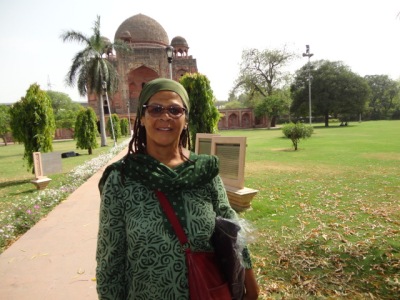
Amina Wadud 2 I am Muslim, by choice, practice and vocationI really learned a lot from my Vipassana experience.  I embraced the challenge to meditate for 10 hours a day and to keep noble silence in between.  These were par for the course.  However, in this last blog, I will bring attention to some of the negative consequences of choosing my Vipassana in India at a small, out of the way place in the state of Rajastan.

You should know I make no bones about my American (of African descent) baby boomer status.  I am a child of the universe.  Yep, the 70’s marked my character and all of my life pursuits from then on.  I still wear blue jeans at 60 and over weight.  I still decorate my hair (in dreadlocks!) People who know me appreciate the hippy-gypsy personality.  I appreciate it.

So let me be honest, I went to find enlightenment in India.  That I also went to find it in Indonesia between 2008 and 2010 or Malaysia in 1989 is no less so than my efforts to find it also in my own America for the days in between traveling the world over.  I want to KNOW the meaning of life and to SEE the purpose of my existence.

Let me also make no bones about this: I hated India; some days actively so. Meanwhile, some days were experiences of sheer awe and wonder in being there.  Thus, most days were a kind of love-hate emotional roller coaster. India was the dirtiest place I have ever been (and that is approximately 55 countries).  Most importantly India has the worst gender dynamics I have ever experienced (and YES, I have been to Saudi Arabia; I’ve been to Afghanistan; I have lived in parts of the Middle East and Africa).  So my conclusions are based on extensive personal experience.

There are also many, many good things about India, hence my love-hate relationship.  In this blog it is my hate of India that feeds into my let down at Vipassana.  What I describe here is NOT an intentional part of the Vipassana experience as organized by its founder and his students.  Mr. Goenka never said anything even subtly misogynistic in our daily lessons—and trust me, I listen as intently as I observe other dimensions of gender inequality.

One of the features of the ten day retreat was gender separation.  No problem. I have lived and traveled extensively in Muslim circles where this is par for the course. Nothing new, nothing exceptional and nothing I could not abide with.  What I could not handle was the ways in which the conditions FOR the women, as separate from the men, also slipped into that under-stated gender disparity with no means to alleviate it.  None of these are gross or abusive, but they had an impact on my experience which is why I mention them.

Our dormitory did not have a hot water heater (and the temperatures were cool to cold, as opposed to hot summers when tepid water is more than comfortable, it is preferred.) The rooms were cold too.   To remedy this problem (supposedly) they gave us access to an empty room in the dormitory across from us that had a hardly-working hot water heater.  By “hardly” I mean of 11 days I bathed there, for only one of them was the water actually hot.  Hot enough that when we hauled it to our own bathrooms we had to add cold water to take a warm ladle-bath. Otherwise, we would haul tepid water daily, because it was slightly better than the cold water that ran from our own taps.  Every day we would line up to “test” if the water was more than tepid.  This meant that we had to communicate to the other women.  By far the most frequent occasion for breaking noble silence was in our indications about the water temperature in that spare room.

The women’s dining hall could only be accessed by walking off the pavement into the dirt, dog-do and cow dung around over-grown bushes to get to the back of the main building.  Once we arrived at the door, we had to climb stairs with no first step but rather two flat bricks precariously laid out.  Then we came through a door that was sometimes locked from the inside.  We were like beggars seeking permission to do what the men walked up freely to do in the same building through a broad lighted stairway and double doors.  On one occasion a few additional women joined our ranks but no effort was made to add to the number of eating utensils causing the need for someone(me) to walk up to the kitchen door (through the men’s section) and solicit, silently, for additional plates so everyone could eat.

The men entered the meditation hall through an outer room in which they left their shoes.  The women entered from the other side and were told to put our shoes on the porch.  From there, the dogs hauled off the shoes.  My sandals happened to be leather, so they were chewed on and bitten.  In the end, I left them in the trash in India.  I am NOT a shoe person. I wear only flat practical shoes.  I only own a few pair at time, which I keep for years.

Now, here’s the thing.  I’ve worked my entire adult life to distinguish between gender oppressions that are manifest because of patriarchal perspectives and practices and the fundamentals and values or principles of my faith system.  I also note that religions often use the double talk of “piety” to condition women’s acquiescence to their own oppressions.  As the days of Vipassana unfolded, I became more aware of my own anger regarding a life time of working to end gender inequities.  Meanwhile, I was continually bombarded with them at this center.  In the end, I felt that if I let my guard down, by fully buying into the discourse about love, compassion, peace and liberation I would also have to ignore these violations.  I didn’t wish anyone harm, but I was so leery that a request for benevolence would camouflage my need for resilience against gender oppressions that were being condoned under the guise of religious transcendence.

In the end resistance to manifest forms of oppression interfered with my ability to surrender to the demands for benevolence.  A simple sharing of both benevolent and adverse conditions by both women and men could have gone a long way to change what was so inequitable about a practice that demanded equanimity.

amina wadud is Professor Emerita of Islamic Studies, now traveling the world over seeking  answers to the questions that move many of us through our lives.  Author of Qur’an and Woman: Rereading the Sacred Text from a Woman’s Perspective and Inside the Gender Jihad, she will blog on her life journey and anything that moves her about Islam, gender and justice, especially as these intersect with the rest of the universe.