Entering The Cave: Jewish Women and the Art of Feminist Dreaming (Part 1) by Jill Hammer

Jill HammerDreams are my window on my wildest self. They are also a way to observe the conflicts within, and therefore they are a feminist practice, teaching me about my relationship to power, gentleness, love, and brokenness. Claiming my dreams is a way of claiming all the parts of myself. I am inspired in my dream practice by my own Jewish tradition, which has many dream practices, as well as by contemporary knowledge about dreams. Frequently in my dreams, I am able to observe my own longing for the company of women and for the presence of Goddess—deity in a female mode—in my life. Frequently, I learn about my experience as a woman by watching my dreams.

In one recent dream, I found myself in a town called Ursula, visiting a cave. Inside the cave were statues of holy women. After my visit, I expressed a desire to move to this town, Ursula. When I woke up, I remembered a painting I had seen in London when I was young: a depiction of St. Ursula, a fourth-century Catholic saint said to have led eleven thousand women on pilgrimage. Ursula is also the she-bear, an archetype of the sacred feminine. The desire to live in the town of Ursula could be read as a desire to live in the realm of the she-bear: in the company of women. The town of Ursula is also a town of the ancestors: the priestesses, prophetesses and wise women of old, represented by the statues in the cave. Though the imagery in my dream comes from a variety of cultures, the dream reminds me of my desire to connect to the women my tradition through dreams.

I teach Jewish dreamwork (based on biblical, Talmudic, kabbalistic and contemporary texts) to rabbinical and cantorial students at the Academy for Jewish Religion. I have seen how deeply it adds to my students’ spiritual lives. And, as one of the co-founders of the Kohenet Hebrew Priestess Institute, I have seen dreamwork transform the lives of women who are becoming ritual leaders and healers. Kohenet’s dream practice includes dream circles in which each participant offers a different reading of each dream, beginning with “In my dream of this dream.” We begin this way because each of us has a different understanding, influenced by who we are.

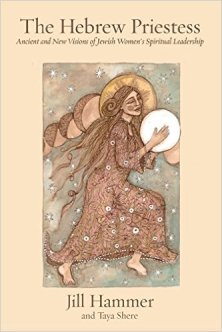
At Kohenet retreats, we often find that the dream of one person provides powerful healing for the whole community. For example, one woman dreamed of finding a bearded father-figure in a house. When she went into the basement, she found her mother working and writing next to a goddess shrine (Jill Hammer and Taya Shere, The Hebrew Priestess: Ancient and New Visions of Jewish Women’s Spiritual Leadership, p. 70). The dream expressed an experience many of us shared: the process of unearthing the power of women and the mythic feminine in our own lives.

Continue reading “Entering The Cave: Jewish Women and the Art of Feminist Dreaming (Part 1) by Jill Hammer”

I Missed a Day Again: Reflections on Hanukkah by Ivy Helman

20151004_161012When I first started back on my journey to reclaim Judaism, I distinctly remember the first Hanukkah I lit candles. Not only was I bringing light into the literal darkness of night, I was also kindling the divine spark within myself. Each night I walked through a meditation I had created using the letters of the word Hanukkah, since there were eight letters and eight nights. I remember some of the words I had assigned to the nights: Holiness, Attentiveness, Night, Understand, Knowledge and Keep. I can’t remember the rest, but I do remember feeling the calm of the candlelight and the deepness of the meditation. I also remember that at some point, either I missed a night of lighting or I repeated one night twice because the days were officially over, and I still hadn’t lit all eight candles.

That has happened to me twice since I returned to Judaism. Yes, twice. Maybe three times. Oh, I don’t know. Now every time the festival approaches I worry that I’m going to do it again. I’m constantly rechecking the calendar so that I am certain I know which night we are on and so that I don’t miss one. I know it sounds like a mundane worry. Yet, in many ways Judaism works on turning the mundane into the holy. This was clearly a lesson on the ways in which the routine of life had too much control over me. Continue reading “I Missed a Day Again: Reflections on Hanukkah by Ivy Helman”

Thoughts on Race and Being Jewish by Ivy Helman

20151004_161012When studying the Shoah, it is extremely important for teachers to introduce students to the 1800s concept of race “science,” which is what I have been doing in my classes over the past few weeks.  An American and European development, this “science” was deeply connected to the development of racism.  Through a “scientific” method, humans were classified based on certain characteristics (i.e. head size, posture, gait, etc.) and traits (i.e. aggression, passivity, even temperament, etc.). Physicality was linked to personalities that were “typical” as well as desirable or undesirable.

Race “science” supported the slave trade, colonialism and the exhibition and exotification of non-European peoples. In the case of the Shoah, race “science” was heavily relied upon by the Nazi Regime in their propaganda, law and ideology. For the Nazis and all nations under their purview, “Jewish” was a racial identity, “scientifically-proven” through measurements and observations and set out by the Nuremberg Laws of 1935, previous and subsequent anti-Semitic decrees and the systematically-planned extermination of 6 million of us.

Continue reading “Thoughts on Race and Being Jewish by Ivy Helman”

Shomer Shabbos: Finding Meaning in the Observance of Shabbat by Ivy Helman

20151004_161012One of my first posts on feminismandreligion.com was about ways to re-soul on Shabbat. Since I haven’t yet revisited any topic in the years I’ve been writing for this blog, I thought now is the perfect time and Shabbat is the perfect subject matter. Why is now the perfect time? Why is Shabbat the perfect subject matter? These two questions share the same answer. I’ve been grappling with discovering a meaningful observance in the midst of my new teaching endeavors.

I teach, study and read about Judaism every day of the working week (and often Sundays) for 8 to 10 hours a day (sometimes more). Don’t get me wrong, I love it! I also practice Judaism every day and know there is a difference between the two. However, while I hesitate to admit it, the last thing I want to do on Shabbat is immerse in Jewish prayer, song and feasting. Why? Because in so many ways, my study and preparation for class brings me closer to my identity, helps me strengthen my faith and commits me more to its observance. However, when it comes to Shabbat, traditional observance feels like work and does not re-soul me the way it should. Continue reading “Shomer Shabbos: Finding Meaning in the Observance of Shabbat by Ivy Helman”

Embracing the Hebrew Priestess by Jill Hammer

Jill HammerEven after I was ordained as a rabbi, I longed to be a priestess. The spiritual leadership I wanted most was less about leading traditional Torah study and prayer (though I’d done plenty of that) and more about immersing in the ocean, creating new rituals, reading kabbalistic sources on Shekhinah (the divine feminine mentioned in Talmud and kabbalah), or interpreting legends about women. My deepest desire was for there to be a school for Jewish women on a priestess path.
Ten years ago, my dream came true. In 2005, Taya Shere and I founded the Kohenet Hebrew Priestess Institute to bring to life the traces of the priestesshood we were finding in the Bible, in Near Eastern archaeology, and in Jewish lore and history. In Kohenet sacred space, we explore the women of spirit among our ancestors, resist their erasure, and bring forward the practices that were sacred to them. We discover in these forgotten teachings the mysticism of the material: the understanding that in our lived experience on the earth we are closest to divinity. At Kohenet, we meet the submerged version of deity called Shekhinah, Imma Ilaah, Elat, Goddess, Divine Mother, and understand why she has been so feared and rejected, yet also has been a deep and lasting part of our tradition as Jews.

The Kohenet Institute has ordained four classes of women and now meets twice a year for training weeks at the Isabella Jewish Retreat Center in Falls Village, Connecticut, and at Ananda Meditation Retreat in Nevada City, CA. We and our students run workshops and services in venues like Limmud UK and the Parliament of World Religions, as well as classes at retreat centers, local synagogues and women’s centers. Days at Kohenet are filled with spiritual exploration: prayer in the feminine in Hebrew and English; ceremony to grant new names or celebrate elders or heal the sick; making incantation bowls in the style of ancient Babylonia; slideshows of ancient priestess and Goddess art from the lands of the Bible; drum circles and labyrinths; stories of witches dueling with Talmudic sages, immersing in the lake before the Sabbath. At Kohenet, we celebrate and embody the sacred feminine, and prepare our students to lead ritual in an earth-based, embodied, feminist way that is rooted in Jewish tradition. Continue reading “Embracing the Hebrew Priestess by Jill Hammer”

Drawing the Four Together: Rosh Hashanah, Yom Kippur, Sukkot and Immigration.

10953174_10152933322533089_8073456879508513260_oLast Sunday, the Czech Republic’s Narodní Divadlo (National Theater) had its opening celebrations. The National Theater is a big thing here sort of like America’s Hollywood where actors, actresses and directors are household names. The opening celebration is even broadcast on television by Česká Televize (Czech TV, the national television company).

This year, Narodní Divadlo and Česká Televize have decided to dedicate all of the profits of the day’s long events to one organization: Organizace pro Pomoc Uprchlíkům (Organization for Aid to Refugees). It is the longest running and the most well-known NGO in the Czech Republic helping refugees, immigrants and asylum seekers. In addition, it also happens to be where my partner is a lawyer and Head of the Legal Department. So I have a personal connection.

As the High Holy Days begin tomorrow evening, I’ve been thinking a lot about their connection to immigration and Sukkot. My reflection starts with the fact that we too were once refugees. We too were once persecuted and forced into slavery. We too escaped and wandered in a foreign land even though sometimes we yearned for the comfort of the familiar. The sukkah is supposed to remind us of this history. At the same time, we have also been unwelcomed by many, been seen as suspicious and have even been expelled from the many lands we once called home. We have been murdered in mass numbers too many times to count. All of this is to say, that we know the situation of the down-and-out, because we have been there. Likewise, we have in many places overcome it and have a mission to help others in similar situations.

Continue reading “Drawing the Four Together: Rosh Hashanah, Yom Kippur, Sukkot and Immigration.”

You Deserve It: Punishment and Reward in a Patriarchal Society by Ivy Helman

10953174_10152933322533089_8073456879508513260_oA friend recently told me that I deserve a vacation. I brushed it off and replied that I haven’t been working that hard. Ever since, I’ve been troubled by that comment and have been reflecting on why it bothers me so much. Today I am sharing with you why I’m uneasy about the idea of deserving reward.

Most of the time, in Western society, deserving something centers around actions: either done or not done. For example, a firefighter pulling a colleague out of a burning building is a heroic act that many people think deserves recognition. We would be wrong not to honor that act. At the same time, a drunk driver dies in an automobile accident, and most people think the person got what s/he deserved. A non-smoker is diagnosed with terminal lung cancer, and people struggle with explaining the actions she or he has done to deserve that fate. Whereas when a smoker is diagnosed, people often jump quickly to blaming the victim. Continue reading “You Deserve It: Punishment and Reward in a Patriarchal Society by Ivy Helman”

Feminism and Faith by Judith Plaskow, Rosemary Radford Ruether, and amina wadud

Foreword Image.001 (1)“Feminism saved my faith” is the concluding phrase of one of the writers in Faithfully Feminist, and though not everyone would say it that way, most of these women have found feminism and faith vibrantly interrelated. The contributors to this anthology articulate a range of reasons that feminists might choose to remain within a patriarchal religious tradition. They also remind us that women reconcile their faith and feminist identities in diverse ways. This volume testifies to the dynamism within the religious communities of Judaism, Christianity, and Islam in the United States, and to their internal diversity. This diversity allows for the contributors to engage in a process of their own development as feminists of faith that interacts with similar processes of development going on in their religious communities.

The overriding common bond for these women of faith is the shared conviction that the conflict between religion and feminism is real— even when it is generated by other people’s expectations that those two identities are separate and irreconcilable. Once each woman arrived at a place where she no longer felt an imperative to abide by an either/or dichotomy, she was able to define the terms of her religion and feminism for herself and to own both identities as significant.

Multiply the individual accounts in this volume by tens of thousands, and the effect of these women’s decisions and the concerted actions for change that have flowed from them has been enormous. For example, feminism has profoundly altered American Judaism in the last forty-plus years. Women are ordained in all branches of liberal Judaism and, in all but name, in modern Orthodoxy. New denominational prayer books written in English use inclusive language and incorporate writings by women. Feminists have written Torah commentaries, designed rituals for important turning points in women’s lives, and created new scholarship on women that contributes to a fuller history of the Jewish people.

Likewise, Christianity has been significantly impacted by the work of feminist theology. While some branches continue to refuse leadership roles to women, many others have acknowledged that every person embodies the spirit of Christ and have embraced the ordination of women. In 2006 the Episcopalian Church ordained its first woman bishop, the highest office in the church. Inclusive language has found its way into the prayers and rituals of many churches and feminist commentaries have shifted thinking on scriptural interpretations. Dialogue within and across branches of Christianity are expanding borders, and movements like Woman Church and online feminist spaces have created opportunities for women to claim agency and participate in roles that have been traditionally withheld.

In the long road to Islamic feminism, women have sometimes lacked agency to define either Islam or feminism. Traditional definitions of these words which operate as a constraint on work within Islam towards justice, equality and dignity; feminism was connected to Western imperialism and invasion into Muslim-majority nation states, and centuries of patriarchal control and interpretation stifled women’s efforts to claim Islam for themselves. This is changing, aided by campaigns such as the 2009 launching of the Musawah movement for equality and justice in Muslim family law. A new freedom is emerging that allows Muslim women the dignity and honor of defining Islam and feminism for themselves—no matter how little they might know of global discourses and historical traditions. All that was necessary was to, identify as a believer and expect a life of justice within that belief. Islam has also witnessed women-led prayers and a move toward inclusive prayer spaces.

The profound changes feminists have inspired and worked for do not mean that all problems have been solved and that women’s subordination is a thing of the past; there is plenty of work for a new generation. The difficulties with overcoming the glass ceiling and balancing work and life that women within the larger society face also bedevil women in all three religious communities. Panels, boards, and publications often exclude women’s voices completely or have only token female participation. Ordained women in Judaism are paid less than their male counterparts and rarely become senior rabbis in large or prestigious congregations. If women “choose” to serve smaller synagogues —the explanation often tendered to explain these gaps—that is partly because the expectations surrounding the rabbinate have not kept pace with its changing demographic, and women who want to combine rabbinic work with raising a family face considerable obstacles. Christian ordained women face similar obstacles within the priesthood and continue to be denied leadership roles in some branches, including Catholicism and Mormonism. Similarly, Muslim women are often excluded from panels at religious conferences and are underrepresented on the boards of religious institutions. The idea of women leading Muslim prayers remains controversial. And too often, discussions about women’s role in Islam still revolve around the issue of hijab, or covering.

The challenge for feminists today is passing on feminist insights and gains to the next generation. Is women’s history being incorporated into elementary and high school texts, or are students being taught the same parade of male names and faces? More particularly for Jews, Christians, and Muslims, when a girl or woman wants to mark some nontraditional ritual occasion, is it clear where to turn for resources? Do most Jews, Christians, and Muslims even know that it is possible to create new rituals that feel deeply meaningful and religiously authentic?

Finally, when teachers—and parents—talk about God, how is God imagined? Are children still growing up thinking about God as a distant male figure, or are they offered a range of images, and emboldened to create their own? Are children being encouraged to talk about and challenge passages in and interpretations of the Torah, Bible, and Qur’an that are misogynist or otherwise unethical? Are they developing critical tools that will allow them to engage with and transform difficult parts of tradition?

The next generation of feminists should consider a move beyond rhetoric and terminology towards substance and personal affirmation. Identifying as feminists of faith helps forge global alliances towards meaningful dialogue across difference—even the differences within. It is only when these deeper levels of change are addressed that the question, “Why stay?” will cease to be relevant.

FF_front-cover_FINALThis essay is the Foreword for Faithfully Feminist: Jewish, Christian, and Muslim Feminists on Why We Stay edited by Gina Messina-Dysert, Jennifer Zobair, and Amy Levin.  

For more on Faithfully Feministclick here.

Join the conversation on Twitter using the hashtags #FaithfullyFeminist and #WhyIStay.

Related Articles:

9 Badass Feminists of Faith You Should Know

Mayim Bialik Endorses Faithfully Feminist

Why We Stay

Judith Plaskow is Professor Emerita of Religious Studies at Manhattan College and a Jewish feminist theologian. Co-founder and co-editor of the Journal of Feminist Studies in Religionshe is co-editor of Womanspirit Rising and Weaving the Visions and author of Standing Again at Sinai: Judaism from a Feminist Perspective and The Coming of Lilith: Essays on Feminism, Judaism, and Sexual Ethics 1972-2003.

Rosemary Radford Ruether, Ph.D. is Professor of Feminist Theology at Claremont Graduate University and Claremont School of Theology.  She is also the Carpenter Emerita Professor of Feminist Theology at Pacific School of Religion and the GTU, as well as the Georgia Harkness Emerita Professor of Applied Theology at Garrett Evangelical Theological Seminary. Rosemary has enjoyed a long and distinguished career as a scholar, teacher, and activist in the Roman Catholic Church, and is well known as a groundbreaking figure in Christian feminist theology.  Ruether is the author of multiple articles and books including Sexism and God-TalkGaia and GodWomen Healing Earth and The Wrath of Jonah: The Crisis of Religious Nationalism in the Israeli-Palestinian Conflict. Her most recent books include Catholic Does Not Equal the Vatican: A Vision for Progressive Catholicism(2008), Many Forms of Madness: A Family’s Struggle with Mental Illness(2010), and Women and Redemption: A Theological History, 2nd ed.(2011).

amina wadud is Professor Emerita of Islamic Studies, now traveling the world over seeking answers to the questions that move many of us through our lives.  Author of Qur’an and Woman: Rereading the Sacred Text from a Woman’s Perspective and Inside the Gender Jihad, she will blog on her life journey and anything that moves her about Islam, gender, and justice, especially as these intersect with the rest of the universe.

Where are the Jewish Feminists? by Ivy Helman

10953174_10152933322533089_8073456879508513260_oLast month in my regular post, I suggested that a lesbian who passes as an Orthodox man subverts Jewish traditional gender roles and understandings of sexuality at the same time she is conveying something true about her own relationship to the Holy One.  Not a single comment challenged me on that proposition.  Not one.  Why?  I think I know the answer.

While I absolutely love this site and have been a regular blogger now for three and a half years, I must say there are whole worlds of ideas, insights and conversations that we are missing. Whenever I write a blog on this site related to Judaism, it is rare that I receive a comment from someone Jewish (at least recognizably so).  And, as the above example illustrates (especially if you were to read the comments of said post), no one even recognized the problematic nature of such a suggestion or challenged me as to how I think it would accomplish subverting gender roles and traditional views on sexuality.

The fact that I am the only regular Jewish contributor writing about Judaism in this blog doesn’t help. The last one left over two years ago. Also as far as I can tell from regular reading and a few searches, the last guest blogger who was both Jewish and wrote about something related to Judaism was about this time last year.  Where are the Jewish feminists?  Not here. Continue reading “Where are the Jewish Feminists? by Ivy Helman”

Sappho, Frankincense, and Female Spirituality by Stuart Dean

Frankincense

White Howjary Frankincense (photo: Trygve Harris (www.enfleurage.com))

Sappho is the first Greek author to attest to the usage of frankincense.  The word she uses to refer to it (libanos) is what comparative linguists call a ‘loan word,’ in this case from ancient South Arabic (the root meaning of which is ‘white’), the language spoken in the only region in the world still now, as then, where the trees grow that produce the resin that is frankincense (the finest being White Howjary from near Salalah Oman).

This was long before Amazon Same-Day Prime: that frankincense even made it to where Sappho was is astonishing given the thousands of miles of desert terrain that had to be covered.  That fact plus the fact that Sappho chose to use the Arabic word for frankincense suggests it must have been of special importance to her.  How important can be seen in the power she attributes to it.  In one prayer poem (S.2, composite translation and very brief notes here) she completes a stanza by referring to frankincense burning from Aphrodite’s altars; she completes the very next stanza with a reference to ‘sleep falling.’  The parallelism implies a reciprocity: the smoke goes up, the sleep comes down and a stanza later, there is Aphrodite. Continue reading “Sappho, Frankincense, and Female Spirituality by Stuart Dean”