When you read this FAR family, it will be the one month anniversary of us losing our dog Malibu due to we believe complications from diabetes. It was unexpected, her illness, and we are still reeling from it.
It was my intention this month to do a meditation again on the sacredness of animal companions in our lives, and especially of the loss of their presence and what it means to have had them bless us for the brief time they are able to.
LGBTQ+ people in biblical religions often turn to the story of Jonathan’s love for David as an example of biblical affirmation of same-sex love. The biblical narrative in 1 and 2 Samuel stresses Jonathan’s love for David from the moment David and Jonathan meet to Jonathan’s death after which David utters the famous words, “your love to me was wonderful, passing the love of women.” Nevertheless, “love” can indicate many different kinds of relationship, both sexual and non-sexual, and one finds much resistance among biblical scholars to reading Jonathan and David as a model of sexually-expressed love between men. While some passages in the text are sexually suggestive, nothing in the Bible explicitly states, “David and Jonathan had sex.” Thus, the strategy of holding up Jonathan and David as a biblical vindication of same-sex love and desire only throws LGBTQ+ people back into the exhausting state of being endlessly debated.
My new book, David’s Loves, Jonathan’s Laments: Gay Theology, Musical Desires, and Historical Differencespeaks from the pain of the experience of being caught in the crosshairs of that debate. Inspired in large part by Mary Daly, it also speaks from an impatience with the state of being stuck in a debate that endlessly repeats itself. This inspiration from Daly is only one way in which feminist thought deeply informs my project of rethinking the relationship of Jonathan and David.
Technically I was employed as a lab assistant at our community hospital. This position entailed multiple responsibilities, from receptionist to actual bench work within the laboratory. The task I dreaded most was my assistance at autopsies. Beyond a strong constitution, it required no measurable skill set. This job was not the high-tech, immaculate setting of any of the CSI programs of today; instead the morgue was a stark, condensed room with two pullout refrigerators for the deceased, a stainless steel table the autopsy was performed on, and the necessary instruments and accouterments, some suspended from what appeared thin air. These tools of the trade ranged from the expected scalpels and retractors to saws and garden-like shears.
Fast-forward fifteen years. It is the morning of July 11, 1991. Prisoner number 74799 has just been transferred from the Department of Corrections, Arizona State Prison in Florence to Tucson County General Hospital in critical condition. Eight months prior to his admittance to the prison hospital, Prisoner 74799 was diagnosed with metastatic lung cancer. While considered inoperable, he was administered the customary chemotherapy treatments until four months later when the cancer spread to his brain, taking most if not all of his cognitive abilities away. Within one hour of his transport, Prisoner 74799, my brother, Michael Paul, died at the age of thirty-nine.
My partner and I are getting married in a little over a month. She, a lawyer, and I, a professor, live in the Czech Republic. Technically, we aren’t getting married because the Czech Republic doesn’t have marriage equality. Our relationship will not be recognized in the U.S. For that, we need to be married in a state or nation that has marriage equality. Germany might soon. Other options would be a number of EU countries or the United States, but that doesn’t affect our status in the Czech Republic. Finally, our marriage will also not be recognized by some in Jewish circles as well since the ketubah, the Jewish marriage document which possesses legal status in Jewish courts, is between two women.
There is nothing legal about our Jewish wedding except one could argue its Jewishness. So, the day after our wedding our relationship will have the same recognition as it had the day before and the day before that. This would not be the case if we were a heterosexual couple. It reminds me of the countless commitment ceremonies that took place before marriage equality in the United States. They were not prohibited (like the marriages that slaves had because slaves weren’t considered people under the law or eligible to enter into legal contracts while in bondage (see pages 301-302). Yet, similar to the “contubernal relationships” of slaves performed by their masters or other slaves (page 302), they weren’t particularly legal either. Despite the ceremony, there was no change in status of the couple within society. Yet, recognition was and still is an important component of both struggles for rights. In fact, according to Darlene Goring in “The History of Slave Marriage in the United States,” (345-346), the process of gaining legal recognition was very similar for both ex-slaves and the marriage equality community in the United States. Continue reading “Reflections on Marriage by Ivy Helman”
This week, I finished reading The Politics of Reality: Essays in Feminist Theory by Marilyn Frye, a text I had not encountered in my studies of feminism (in literary theory, psychology, philosophy, or theology) until now. In some ways, I wish I would have read it sooner. In other ways, I am grateful for this more recent rendezvous. From my current position and perspective – theoretical and personal – I was, I think, more able to hear the core message Frye conveys than I would have been years ago. I have less to protect now, and my ego is less fragile. In the text, she names the mechanisms around which Western – and patriarchal – cultures are founded. Her argument is fluent and cogent, even as it threatens the stability this culture offers. Our lives are embedded in it, even if our personal ethics point to alternative, feminist ways of living. Frye pushes her readers to live alternatively, so that we can recognize the times that we conspire/feed into/comply with patriarchal messages and clean the residue of servitude off of our skin.
For the purposes of this post, I engage two opposing concepts Frye presents in the text: the arrogant eye and the loving eye. Located in the chapter entitled “In and out of Harm’s Way: Arrogance and Love,” Frye investigates how men in phallocentric culture exploit and enslave women. The opposing, contradictory eyes of arrogance and love directly relate to the experience of shame which effectively serves to subjugate women in patriarchal culture.
Shame functions within what I call a logic of exposure. Shame relates intimately to the concept of being seen. Affectively, shame results from our interest/excitement being partially truncated. For instance, we are drawn to someone (real or imagined); we are interested in their response to us, and somehow something interferes with the desire to connect. Contact is cut off, and interest/excitement partially halted. Shame ensues. We experience that someone (real or imagined) seeing us as other, different, foreign, maligned, wrong, or worthless. We are seen wrongly. This misperception alleviates joy and relates to the gaze of the arrogant eye under which (as the default gaze of phallocentric culture) we often find ourselves seeking approval.
The warrior spirit is not only the coherent ability to resist circumstances outside of one’s making; but the ability to fight the war within all of us thus managing discomfort and chaos with the force of authenticity.
Recently an enlightened friend on social media reminded me of the importance of not only portraying an awakened consciousness in the fight towards enlightened morays in an age of fascist’s dictatorships but actually waking up to unresolved veracities.
Hurriedly, I searched for a working definition of enlightenment consistent with my Christian beliefs. I finally found several however, none exactly measured up to the values that are interlaced within scriptures and thus are founding principles of Christianity and religious fundamentals.
breathe me
compel my flesh to stir.
will new landscapes through
your pores.
dine upon my potent supplication.
peel the lonely longing from
your swelling desire.
partake of flaming majesty, while
speaking: yes, over and over and
over again, rising and falling in
love’s newly remembered caress.
breathe me in.
breathe me out. Continue reading “Agape: Inspiration and Word Made Flesh by Margot Van Sluytman”
When I was 19, I fell hard into the kind of deep depression that hits college kids whose unstable upbringings, rife with inconsistency and trauma, left them ill-prepared to face the self-direction and responsibility of independence. I didn’t grow up religious despite my father’s attempts to turn visitation weeks into conversions, but had started attending the local Episcopal cathedral months earlier after seeing its stunningly beautiful windows on a historic tour. Having taken basic stained glass courses when I was 18, I’d been mesmerized by the artistry and would sit in a different pew each week, drifting into and out of awareness of the service, eyes trained on the nearest window, lost in contemplation, love pouring in.
When the darkness became too much and I sought more of that love through spiritual care and reflection, I walked into the church library and thumbed through the directory looking for resources, and was hopeful to discover that the Episcopal Church had convents. That afternoon, I dialed the number for the nearest convent, and in that especially dramatic way of depressed 19-year-old artist types with backgrounds in theater, I declared that I couldn’t handle life in the world anymore and that I might want to become a nun. Sister Ann told me that their order was less an escape from the world than a new way of being fully present in it, but invited me to spend Christmas at the convent.
Decorating the tree in the guest house
What started out as a holiday visit became several months of me spending every day that I wasn’t in class or at work at the convent, living in the guest house, attending five services a day, helping with maintaining the grounds, and spending as many waking hours as I could in the library, face buried in the works of medieval women mystics. Over the coming years, I’d spend many long weekends in retreat at the convent, and the sisters became my second family. I visited with women I was dating and later with a Muslim boyfriend, and everyone was always welcomed with love. When my first child almost died as a newborn and I called to ask for prayer, two sisters drove to be with me in the hospital. I still cry now, twenty years later, when I tell people the story of a parish priest leading the small group gathered in my hospital room in prayer after my son’s first surgery, and how my heart swelled when halfway through the Lord’s Prayer, teary eyes closed, I began to hear the familiar lilt of women’s chanting over our soft-speaking voices. Continue reading “On Being an Occasion of Joy by Chris Ash”
When we got into the car to go, I asked my twelve-year-old daughter, “Do you know why we are marching today?”
“To protest Donald Trump?” she replied.
I explained that some people may be going for that reason, but that was not the reason I was going.
“Are there any positive reasons you can think of for why we are marching?” I asked her.
She went on to name several things Donald Trump had said about women. “I guess those are all still anti-Trump things,” she said.
“I am marching because I am a mother, I am a sister, I am a daughter, I am a wife, and I am a survivor. That’s what I am saying if anyone asks me,” I told her.
I had already thought through this question. As a pastor of a church with people who have diverse political affiliations I am committed to being able to minister to everyone in my congregation. I have served churches in which my political views are in the minority and I have served churches in which my political views are in the majority. Both have challenging aspects, but nothing that I have experienced previously in terms of partisanship feels like it relates to what is happening in the United States right now. Those old partisan dynamics were difficult to navigate—it took discipline, but not one ounce of moral compromise.
The decision to march was not a partisan one, it was a moral one, and it was a spiritual one. If I didn’t march it I would be listening to a frightening interlocutor—and his name is despair.
Party affiliations are not creating the alienation at the root of what is happening. The challenges are much more painful—and if I stay silent or still in the face of this situation I would not be doing my job as a pastor or a mother. Continue reading “Do You Know Why We Are Marching? by Marcia Mount Shoop”
It’s only been a month and I am still reeling from the US presidential election. I feel like I’m just beginning to emerge from the sense of loss and futility that has cloaked me. But I am beginning to move forward.
I don’t feel better. I’m still confused and discouraged about why people voted for Donald Trump. I’m very concerned about his cabinet picks and his proposed policies. But I am actively seeking a path forward and a path of resistance. I’m finding support in my spiritual practices and communities.
In the Christian calendar, we are in the season of Advent. Advent carries profound symbolism, and this year it is especially poignant for me. The word advent bears meanings of arrival, birth, and emergence. It’s the beginning of the Christian year, which is patterned on the life of Christ, but the year does not begin Jesus’ birth. That celebration is observed at Christmas, four weeks into the church year. The weeks preceding Christmas are a time of preparation and reflection on the need for the Incarnation. The Incarnation of God in the Christ Child may be a distinctly Christian doctrine, but I believe the need for it–even the idea of it–is found in other spiritual and religious teachings.


 When you read this FAR family, it will be the one month anniversary of us losing our dog Malibu due to we believe complications from diabetes. It was unexpected, her illness, and we are still reeling from it.

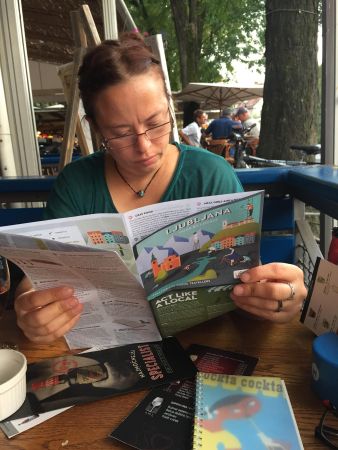 My partner and I are getting married in a little over a month. She, a lawyer, and I, a professor, live in the Czech Republic. Technically, we aren’t getting married because the Czech Republic doesn’t have marriage equality. Our relationship will not be recognized in the U.S. For that, we need to be married in a state or nation that has marriage equality. Germany might soon. Other options would be a number of EU countries or the United States, but that doesn’t affect our status in the Czech Republic. Finally, our marriage will also not be recognized by some in Jewish circles as well since the


 When I was 19, I fell hard into the kind of deep depression that hits college kids whose unstable upbringings, rife with inconsistency and trauma, left them ill-prepared to face the self-direction and responsibility of independence. I didn’t grow up religious despite my father’s attempts to turn visitation weeks into conversions, but had started attending the local Episcopal cathedral months earlier after seeing its