Tonight Is Guy Fawkes Night by Barbara Ardinger

Mark Twain is reported to have said that while history does not repeat itself, it often rhymes. Let’s see what rhymes we can find in Tudor and Jacobean England and Trumpean America. Here’s the history lesson. What has changed in 400 years?

After about a thousand years of Roman Catholicism in the British Isles (with a few thrusts toward reform, like the 14th century theologian John Wycliffe, who translated the Bible into medieval English), it is Henry VIII who is usually given credit for “reforming” the English church, i.e., declaring his independence from the Roman church and the pope in 1534. While Henry still called himself a good Catholic (and even condemned Martin Luther), it was the Tudors and their advisors that thrust a militant and puritanical Protestantism on the people.

The Tudor dynasty, which lasted just over a century, began with the victory of Henry Tudor (who became Henry VII) over Richard III at Bosworth Field in 1485. (Shakespeare turned Richard’s story into a Tudor propaganda play. In real life, Richard was a good king.) Henry’s second son, Henry VIII, was a tyrant who is best known today for his six wives. He was also more interested in luxury (in his day synonymous with vice) and self-aggrandizement than anything else.

Continue reading “Tonight Is Guy Fawkes Night by Barbara Ardinger”

An Algorithm for Capturing White Heteropatriarchy: The Woman Caught in Adultery and the Failure of the Civil Rights and Feminist Movements to Embrace Intersectionality by Blanche Cook


The church occasioned one of my first conscious experiences with inequality — Sunday school to be exact. I was nine and bedecked in black platform shoes and a bright pink polyester suit.  It was the 70s, a moment in fashion history never to be revisited.  My Sunday school teacher, a spiritually angelic woman, was explaining the demise of the Woman Caught in Adultery. According to the story, the leaders of law and religion wanted to stone the woman to death for having intercourse with a man that was not her husband.  Although she was vulnerable to the death penalty, the man was not exposed to any punishment.  This lopsided sanctioning plagued my young mind.  Little did I know, I would spend my legal career, as a federal sex trafficking prosecutor and as a legal scholar, trying to vindicate the Woman Caught in Adultery.

Continue reading “An Algorithm for Capturing White Heteropatriarchy: The Woman Caught in Adultery and the Failure of the Civil Rights and Feminist Movements to Embrace Intersectionality by Blanche Cook”

Traveling Sexism by Anjeanette LeBoeuf

This summer I traveled quite a lot domestically. While I was in airports, on trains, waiting in lines, and going about my summer I kept coming across certain patterns and experiences which were becoming all too common and too significant to ignore; a mixture of overt and subtle sexism.

First it started out with one of my airport shuttle drivers wondering why I was traveling alone. While there is always room for small talk, I was struck with how – if I was male – that question would not have been asked. It reached the pinnacle when I was told by an older man to give up my seat for an elderly woman so he didn’t have to give up his seat – this was after he had stared at me for over 10 minutes when I first sat down using his eyes to voice his displeasure over me taking up two seats. Regardless of the fact that he, himself, was taking up 3.

Continue reading “Traveling Sexism by Anjeanette LeBoeuf”

A Middle: Understanding the Relationship between Violence and Power by Katie M. Deaver

In my last post here on Feminism and Religion I unpacked the three primary understandings of atonement theology as well as some of the feminist critiques of those understandings.  In this post I’d like to focus a bit more on how the relationship between power and violence influences how Christian women view the atonement.

In her book, On Violence, Hannah Arendt puts forth a new analysis of the relationship between power and violence.  Arendt’s analysis, though primarily focused around concepts of the potential for worldwide destruction and war following major global occurrences such as the Second World War and the struggles for civil and women’s rights within the United States context, supplies an interesting framework with which to consider this relationship as it relates to domestic violence.    Continue reading “A Middle: Understanding the Relationship between Violence and Power by Katie M. Deaver”

Rape, Community and Healing by Vanessa Rivera de la Fuente

During my last months in Cape Town I have been facilitating a series of workshops on Rape, Gender Justice and Culture of Consent. I am blissful for the opportunity to teach and learn with a group of people with whom we have navigated in the approach of Rape and Sexual Assault in their different perspectives, from the socio-political to the intimate tenets.

This has been an exciting journey of healing and soul blooming. I have realized the critical role that Cape Town has played in pushing me towards empowerment and thriving, enhancing my taking back ownership of my body and all the experiences happening through it.

This journey started few years ago when I decided to come out of the closet as a rape survivor. I wrote about it on Feminism and Religion. This was the first step of my breakthrough. Little by little I became confident and shameless about saying: “Yes, I was raped”.

Continue reading “Rape, Community and Healing by Vanessa Rivera de la Fuente”

The Intersections of Faith and Reproductive Justice by Katey Zeh

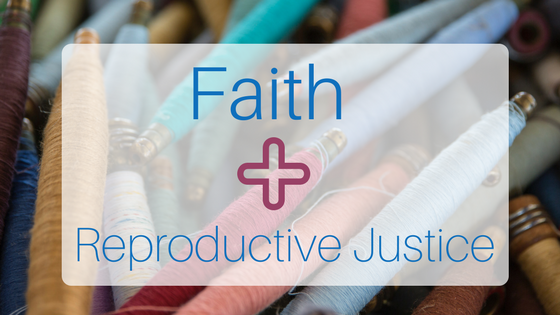
The Intersections of Faith & Reproductive Justice

Last week I participated in a panel discussion hosted by the Center for American Progress (CAP) on the intersections of faith and reproductive justice. These conversations are critically important, particularly in these political times when threats to our bodily autonomy and right of conscience are sanctioned by our current administration, Congress, and many state legislatures.

The framing of these public discussions is always interesting and somewhat troubling to me. Often progressive spaces like these do recognize that many people of faith support reproductive health care, but with that understanding is the assumption that supporting the full spectrum of reproductive healthcare, including access to safe abortion care, necessitates some kind of moral reckoning for religious people.

Continue reading “The Intersections of Faith and Reproductive Justice by Katey Zeh”

A Gift Offered in Faith and Love by Elise M. Edwards

elise-edwards“The day begins with the sun and ends with the moon and stars; what you do in between is your gift to the world.” – Reyna Craig

The new year has begun, and many of us take this marking of time as an occasion to set intentions, goals, plans, or resolutions for the year ahead.  For us feminists, the year ahead holds clear challenges.  We know that the bodies, spirits, minds, hearts, and souls of women, racial and ethnic “minorities,” and all sorts of vulnerable people will be attacked.  We know that the protections secured under the law for these bodies, spirits, minds, hearts, and souls have been eroded and continue to be dismantled in the name of… well, what exactly? Justice? Life? Religion?

We’ve seen voting rights eroded in the name of democratic ideals.  We’ve seen challenges to bodily autonomy in the name of life.  We’ve seen state-sanctioned murder in the name of law and order.  We’ve seen a rise in religious intolerance in the name of religious liberty.  Our work in this age must be to continue to expand our collective understandings of these ideals.  This is the gift we offer to the world.

Continue reading “A Gift Offered in Faith and Love by Elise M. Edwards”

A Letter to Those I’ve Lost by John Erickson

Out of all of these things, the one thing that has kept coming to my mind is G-d. What is he (or she) thinking? I feel like I’m back in one of my Old Testament classes discussing the harsh and cruel G-d that thrust so many horrible things onto their believers. Maybe, the worst part about the election isn’t Donald Trump, but it is the realization that G-d may be dead after all.

Dear [Insert Name Here],

Something died on November 8, 2016, and I do not think I’ll ever be able to get it back. I sat there, walking back to my house, in disbelief and utter shock and scared about the next 4 years of my life.

For weeks leading up to the election, I had found myself praying in the copy room at my work almost daily. I would sit there, silent and alone, having just read some misleading article or alt-right post from a family member that called Hillary Clinton the devil, and wonder: when did everything go so off the rails?

Although we’ll spend years trying to figure the answer to my above question out, for me, it is a question I have been asking myself ever since election night and specifically knowing how certain members of my family would, and ultimately did, vote. Continue reading “A Letter to Those I’ve Lost by John Erickson”

My Reaction to the Election Results by Elise M. Edwards

elise-edwardsI wanted to stay in bed yesterday morning.  I wanted to stay in bed for the whole day.  When I heard that Trump won the US Presidential election, I didn’t know how to deal with it.  How can I accept this reality?  I still don’t have an adequate answer.

Turn to prayer? Yes.  Do some writing? Ok. I’ll also take every hug and kind word that’s offered to me.  And still, my emotions will be raw for a long time.  I cry at random moments.  My voice catches unexpectedly.  I feel that so many Americans embraced a vision of the country that is intensely hostile to people like me (women, African-Americans, Black Lives Matter sympathizers, liberals, intellectuals). How can I not take that personally? Dismissing the harm of Trump’s open hostility or accepting it in deference to some supposedly higher goal feels like rejection too.  It justifies and legitimizes his contempt and denies the seriousness of it.  Do we really accept a man who speaks so openly of sexual assault because he promises to bring jobs back?  That denigrates women and all assault victims. The hatred directed at immigrants, Muslims, and LGBTQA persons is even more unrestrained and horrifying!

Continue reading “My Reaction to the Election Results by Elise M. Edwards”

Debating a “Winning” Personality by Sara Frykenberg

Sara FrykenbergI wasn’t sure I wanted to watch the debate between presidential candidates last Tuesday. As John Erikson discussed in his post “The End is Nigh,” one could easily predict Trump’s sexism and misogyny, it was just a question of how his hatred would surface and whether or not he would tip his hat to “how truly dangerous he really is.” So, I compromised: I watched some of the debate, able to shirk part of what I felt was my responsibility to history for a more pressing responsibility, the need to put my daughter to bed. And, of course, Donald Trump delivered what his ‘brand’ promises… (poor) mis/re-direction, lies, bullying and incompetency.

Continue reading “Debating a “Winning” Personality by Sara Frykenberg”