Confession by Darlena Cunha

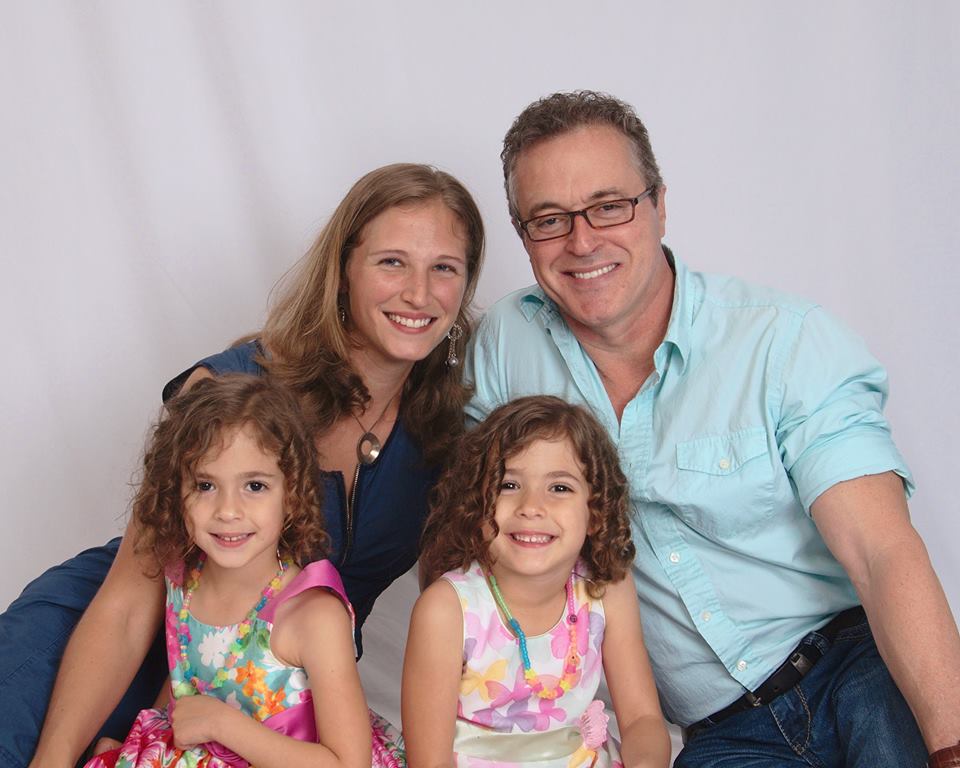
Darlena family portraitGood afternoon, Fr. John. I’m here for confession. No, I’d like the curtain back, please. I want you to see my face. I really need to talk to you, get my bearings. But this confession will not be solely about my sins, for, unfortunately, I am not sure I will ever change my ways.

Does that exclude me? Is Catholicism a club? Should my twin daughters, five years old, be subjected to scorn and pity that their mother is a sinner? That they were born in sin? They don’t look like sin, to me. They are light, and love, and happiness. They have shaped me, taught me, brought me into the woman I was meant to be. Is it wrong of me to want to do the same for them? Is it better to turn me out and lose two potentially pure beings who will make their own choices in their religion and could be devout Catholics, or put up with me in the hopes that my children will be more worthy?

I’m here because I like you, you know. I like Catholicism. It’s in my blood, my heritage, my family. And where I’m from, everyone belongs.

I was baptized, received communion, was confirmed, attended youth group. I went to an all-girls Catholic college my freshman year. Full-ride because I’m fairly smart, and I work hard. That’s where I lost Him, you see. I don’t know how, or why, but one early fall day when the leaves were crisp and bright but not yet falling, I looked up at the chapel on campus, and He was gone. Or He seemed gone. Continue reading “Confession by Darlena Cunha”

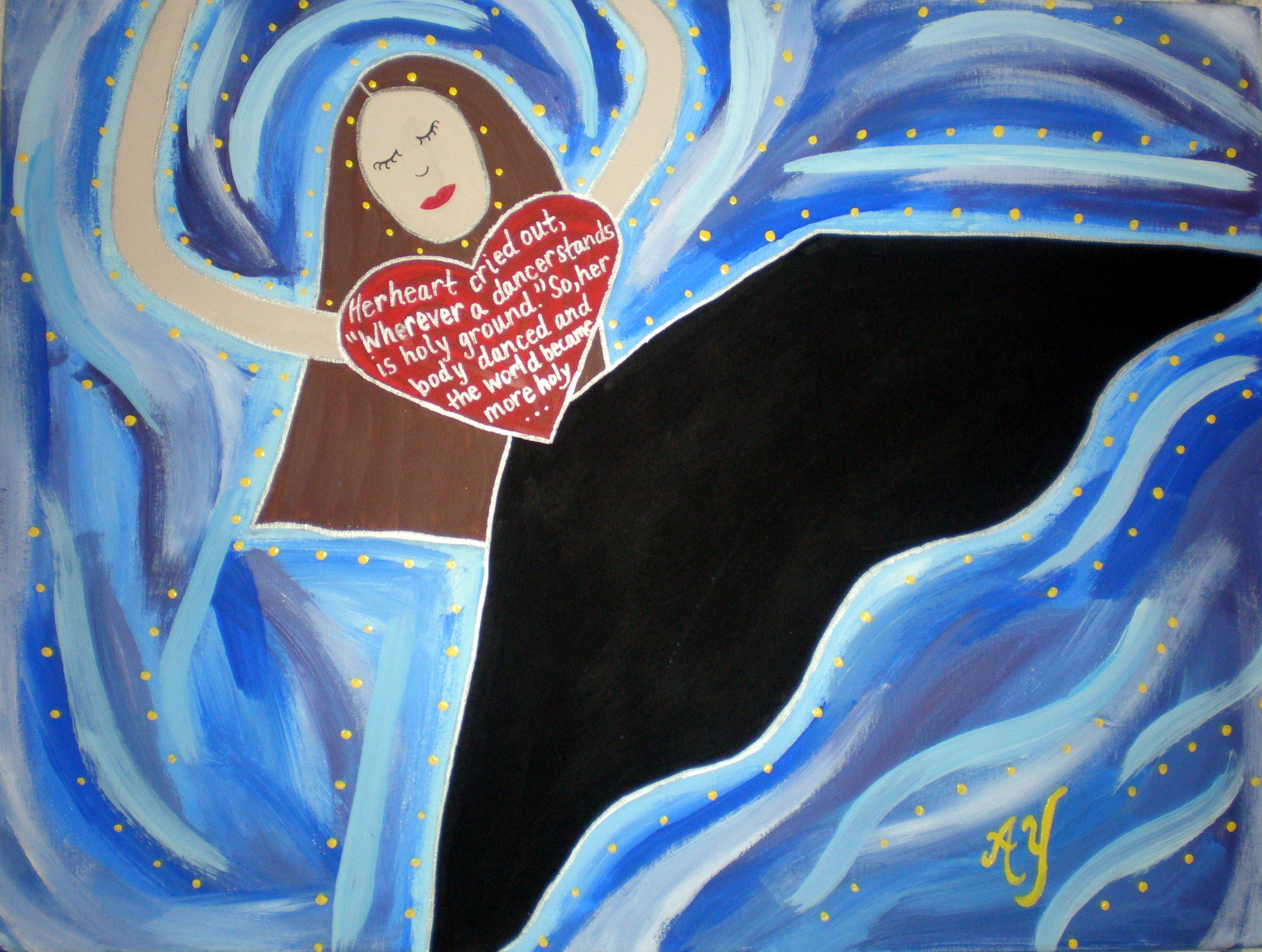
Painting Martha Graham by Angela Yarber

angela

Joining Virginia Woolf , the Shulamite, Mary Daly, Baby Suggs, Pachamama and Gaia, Frida Kahlo, Salome, Guadalupe and Mary, Fatima, Sojourner Truth, Saraswati, Jarena Lee, Isadora Duncan, Miriam, Lilith, Georgia O’Keeffe, Guanyin, Dorothy Day, Sappho, Jephthah’s daughter, Anna Julia Cooper, the Holy Woman Icon archetype, Maya Angelou, and all my other Holy Women Icons with a folk feminist twist  is the dancing revolutionary Martha Graham. So, as the contemporary and modern dancers on So You Think You Can Dance continue to amaze us this summer, let us remember from whence they came.

Martha Graham’s contribution to the world of dance cannot be overestimated. She is regaled as the Picasso of the dance world, revolutionizing it by introducing an entirely new quality of movement known as modern dance. Not only did Graham revolutionize the dance world, like Isadora Duncan before her, she also made great contributions to feminist spirituality. One of her most famous statements may well have been “wherever a dancer stands is holy ground.” Like most dancers who are so in tune with their bodies, Graham new the holiness therein, the ways in which the body can express the ineffable when words alone simply cannot. “The body never lies,” she famously reminds us.

Martha Graham Continue reading “Painting Martha Graham by Angela Yarber”

Redefining Spirituality, One Church for All by Andreea Nica

Andreea Nica, pentecostalismAs a former lover of Christ and ex-Pentecostalist, I had countless visions and dreams that one day I would be a spiritual leader. While growing up in the charismatic church, it was even prophesied that one day I would become one.

Nearly ten years after leaving the church, I carried a distrust in religion’s relationship with women and its barrier to free thought. My work as a freelance journalist led me to discover a spiritual women’s retreat held in North Bend, Washington. Inspired to experience a non-religious, spiritual gathering, I registered for the retreat held by Center for Spiritual Living (CSL) in Seattle.

CSL is described as a:

“Trans-denominational, inter-generational, not-your-usual church, that was started in 1921. A safe place for ‘the rest of us’ who are looking to connect with God/Higher Power/Universal Presence, but don’t really fit in with any one religion.”

The spiritual center’s core teaching philosophy derives from “Science of Mind” or Religious Science, a New Thought spiritual, philosophical, and metaphysical movement founded by practical mystic Ernest Holmes. The spiritual principles rely on the laws of physical science in establishing its core beliefs. Continue reading “Redefining Spirituality, One Church for All by Andreea Nica”

Five Years of Untamed Spirituality and Challenging Feminism by Vanessa Rivera de la Fuente

Vanessa Rivera de la Fuente. Path to IslamIn Chilean tradition, the number five has an important meaning regarding the understanding of life. At 5, a person starts school and  life in society. At 15, we celebrate the entrance into the young adulthood. At 25, it is expected you have finished college. Age 30 is a good age to get married and by age 35 you’ve probably bought your first house. At 40, it is the perfect time to make an evaluation of your life … At 65, you leave behind all duties and enjoy the rest of the path. Each one of this milestones comes with a celebration or ritual that gathers your family and/or closest friends.

A few days ago, I entered my 5th year of Islam as my spiritual path. Following the tradition, I want to make an honest assessment of my first period as a Muslim- naming the Good, the Bad and the Ugly- but also expressing my Hopes, in the sincere feeling that the best is yet to come. Continue reading “Five Years of Untamed Spirituality and Challenging Feminism by Vanessa Rivera de la Fuente”

Writing Holy Women Icons by Angela Yarber

angelaFor two years I have had the great privilege of writing a monthly article about one of my Holy Women Icons with a folk feminist twist for Feminism and Religion. Virginia Woolf , the Shulamite, Mary Daly, Baby Suggs, Pachamama and Gaia, Frida Kahlo, Salome, Guadalupe and Mary, Fatima, Sojourner Truth, Saraswati, Jarena Lee, Isadora Duncan, Miriam, Lilith, Georgia O’Keeffe, Guanyin, Dorothy Day, Sappho, Jephthah’s daughter, Anna Julia Cooper, the Holy Woman Icon archetype, Maya Angelou, and many others that will follow in the months and years ahead have guided, empowered, and inspired me as an artist, activist, feminist, scholar, and preacher.

I knew from that outset that writing about them would deepen my relationship with each of these amazing women. I also knew that their power and efficacy monumentally increases when they join together. This colorful cloud of witnesses has filled myriad galleries, reminding viewers of the powerful women who have paved the way for us today. Many have left the group, finding a resting place in the homes, offices, and galleries of friends, colleagues, and strangers who have purchased or commissioned an icon along the way. And those that remain erupt the hallways of my home with a cavalcade of color, daily reminders of who I am called to be and become.

Between researching their stories, painting them, hanging them in galleries, and selling them, I knew that one day I would bind their stories together in a book. So, it is with tremendous joy that this dream has become a reality. Parson’s Porch Publishing, a non-profit publishing house whose mission is to “turn books to bread” by giving their profits to feed the poor, has lifted up the stories and images of nearly fifty of my beloved Holy Women Icons in a book. So, along with originals, commissions, and prints, Holy Women Icons are now available as a book and as individual greeting cards. It is my sincere hope that by binding the stories of these holy women together, they may provide inspiration and empowerment for all readers, binding all our diverse stories together in a collective cry for beautiful, unabashed, prophetic justice for all. Continue reading “Writing Holy Women Icons by Angela Yarber”

BOOK REVIEW: Amy Wright Glenn’s Birth, Breath, & Death by Natalie Weaver

Natalie WeaverAmy Wright Glenn’s Birth, Breath, & Death: Meditations on Motherhood, Chaplaincy, and Life as a Doula is a mid-life memoir of the author’s personal encounters and professional insights drawn from her work in the spaces of birth and death.  Glenn gleans from her formative experiences as a daughter and sister, her trained experiences as a teacher and doula, and her wisdom experiences as a mother, chaplain, and friend.  In an accessible voice, Glenn reflects compassionately on her early life in a Mormon family.  She considers critically the nature of religious worldviews that are doctrinally dualistic and apocalyptic.  Glenn further describes the therapeutic and illuminating value she found in the scholarly study of religions as an anthropological phenomenon.  Glenn explores how religious discourse both expresses human joy and grief and also aids us in our encounters with life and death.  Glenn intertwines her academic study with personal narrative and achieves a professionally-informed and experientially-based “thinking out loud” about the bookends of human life.   Her writing is tender, and her vision is thought-provoking.
Continue reading “BOOK REVIEW: Amy Wright Glenn’s Birth, Breath, & Death by Natalie Weaver”

God is Too Big by amina wadud

amina 2014 - cropped

In my current casual reading, a novel, the answer to the question “and where is God for you?” was expressed this way:

“Definitely in the car with us as we talk and exchange things, and change each other in the process…People have things they want to give away, or they want things they don’t know where to look for, and they need containers to pool their information. This night is far too large for us to rattle around in on our own. It’s a perfect fit for God, but we need our container. We need one another for God to work through us: that’s something I experience every day. The concept of God is way too big for me to get my mind around, but despite that, maybe even because of it, the relationship keeps growing and changing.  Sometimes it grows so slowly it seems it’s stopped. Or gone in reverse. Then when I least expect it, it takes a big leap forward.”

I was struck by this first because of the concept of God being “way too big.”  I struggle with this and yet would have it no other way. I have gone out my way to kill off the childhood concepts of God, referred to in that book Your God is Too Small. It explains that for many people, their concept of God has not advanced far from the one they had as a child – from the Big Bad Punisher to the tooth fairy God of requisition. As a strict monotheist, I constantly fight to smash the idols of my own imagination or preoccupation. To get God out of any box.

Continue reading “God is Too Big by amina wadud”

Meditating on Oneness by Amy Wright Glenn

Utah native Amy Wright Glenn will talk about her book: "Birth, Breath, & Death: Meditations on Motherhood, Chaplaincy, and Life as a Doula." Courtesy Amy Wright GlennAt the age of fourteen, I began to question the Mormon faith of my family. I embarked on a life long personal and scholarly quest for truth. While teaching comparative religion and philosophy, I was drawn to the work of supporting women through labor and holding compassionate space for the dying.

In my book, “Birth, Breath, and Death,” I share moving tales of birth and death while drawing on my work as a doula, hospital chaplain, and mother. I weave together these stories with philosophical reflections on truth, meaning, and Spirit.

This is an excerpt taken from the first chapter entitled “Search.”

I spent much of my early twenties traveling throughout The Middle East and India. I lost track of time gazing at an ancient copy of Homer’s Iliad at a museum in Cairo. I remember sleeping through a freezing cold night on Mt. Sinai and awakening to a brilliant sunrise over the Arabian Peninsula. I climbed the pyramids in Egypt and protested the Israeli occupation of the West Bank with Arab and Jewish women peace activists. For a year, I studied in Jerusalem. Later, I dedicated myself to the practice of meditation at an ashram in the Himalayas.

A lively mix of debate and discussion characterized my Hebrew University days. In the evenings, I worked illegally as a waitress in the Jewish Quarter of the Old City. Adorned in Roman attire, I served fantastic platters of Middle Eastern cuisine and performed folk songs and dance routines for photo-snapping tourists. I was nineteen and living in Jerusalem, a place saturated in religious symbolism. Known as Al-Quds in Arabic and Yerushalim in Hebrew, Jerusalem is a city renewed and ravaged due to contested paradigms of poetry and politics. Continue reading “Meditating on Oneness by Amy Wright Glenn”

Religion: Trapped in Love Through Shame by Andreea Nica

Andreea Nica, pentecostalismI was first introduced to shame in the church. Shame paradoxically drew me closer to God, prevented me from committing sins, and helped me repress certain natural urges. The church I grew up in indoctrinated its congregation to believe that shame would transform us into true and wholehearted believers – that as carnal beings, we needed to feel both guilt and shame in order to be saved and transformed into spiritual entities.

One question that permeated my mind growing up, but I’d never dare to publicly ask:

Why would Jesus die for me when I never asked Him to? Continue reading “Religion: Trapped in Love Through Shame by Andreea Nica”

Freedom and Faith by amina wadud

amina 2014 - cropped

 In September past I travelled to Zanzibar with a long time friend from Singapore. I intentionally planned to visit the places where other Africans, like my ancestors, were bought, sold, and held in waiting like fish in the fish market.  The slave trade in east Africa is linked to this historical island, which was like a Fed Ex hub: a central location to facilitate the transfer of slaves—stolen, captured in war, kidnapped, or bought elsewhere to be traded, from there to parts of Persia and Arabia.

I explained to my friend, EVERY African-American identifies intimately with slavery.  We talk as if it were only yesterday.  We say “we,” as though speaking of relatives in another city or town. We also say “they” about slave masters and traders, about the over seers who beat us, the men who raped our foremothers and sold off their children, the few who taught us to read in secret, or turned a blind eye at our efforts to escape. Yet, I know of NO WHITE person who identifies with their history as slave masters.

My intention was to perform some simple ritual interface at the markets and holding cells. I had not planned any details, I had only reflected on the value of sacred expiation and the reality of living blood still flowing because my ancestors gave their blood, sweat, and tears. Perhaps my blood would mingle with the spirit of the blood of my ancestors.  At least I hoped I could, through some selected prayers or liturgy, release anger, pain, and humiliation in exchange for a life of freedom. I owe my life to them and I wanted to consciously renew the bond and then, like Nelson Mandela’s walk to freedom, to LET it go. To honor my ancestors I must live fully and in freedom. Continue reading “Freedom and Faith by amina wadud”