The Wonder that is Being Born: How to Live Out Loud? Sacrilegious or Evolution? by Karen Moon

Karen 2006Yesterday, I went to a Women’s Circle, the description follows:

Our next circle will honor this journey of Venus or Innana as she was known by the ancient Sumerians. We will gather on Sunday, July 26th at 3 PM at my house. We will celebrate the divine feminine energy of Innana/Venus through meditation, song and dance. I encourage you to dress as your inner goddess, embracing your personal divine feminine energy. We will have our usual potluck munchies afterward.

I had spoken to the host on the phone previously and know her via Social Media.  My husband gave his helpful advice to be sure that it was not a “cult,” and yes, I do think any time you find things via social media, a big dose of common sense is needed.  Continue reading “The Wonder that is Being Born: How to Live Out Loud? Sacrilegious or Evolution? by Karen Moon”

Rosmerta, the Great Provider – a Celtic Goddess of Abundance by Judith Shaw

judith Shaw photoAs we near August 2, known to the ancient Celts as Lughnasadh or Lammas, examples of abundance are everywhere.  Gardens and farms are in full bloom with some crops ready for harvest and others very near.  Lambs born in spring are now reaching maturity. Days are still long and we are full of energy. It is a perfect time to remember the Celtic Goddess, Rosmerta.

Rosmerta,  a goddess loved by both Celtic and Roman Gauls was known as ”The Great Provider”. She is a goddess of fertility and wealth. She was worshipped in South-western Britain, Gaul, and along the Rhone and the Rhine rivers.

Continue reading “Rosmerta, the Great Provider – a Celtic Goddess of Abundance by Judith Shaw”

Sappho, Frankincense, and Female Spirituality by Stuart Dean

Frankincense

White Howjary Frankincense (photo: Trygve Harris (www.enfleurage.com))

Sappho is the first Greek author to attest to the usage of frankincense.  The word she uses to refer to it (libanos) is what comparative linguists call a ‘loan word,’ in this case from ancient South Arabic (the root meaning of which is ‘white’), the language spoken in the only region in the world still now, as then, where the trees grow that produce the resin that is frankincense (the finest being White Howjary from near Salalah Oman).

This was long before Amazon Same-Day Prime: that frankincense even made it to where Sappho was is astonishing given the thousands of miles of desert terrain that had to be covered.  That fact plus the fact that Sappho chose to use the Arabic word for frankincense suggests it must have been of special importance to her.  How important can be seen in the power she attributes to it.  In one prayer poem (S.2, composite translation and very brief notes here) she completes a stanza by referring to frankincense burning from Aphrodite’s altars; she completes the very next stanza with a reference to ‘sleep falling.’  The parallelism implies a reciprocity: the smoke goes up, the sleep comes down and a stanza later, there is Aphrodite. Continue reading “Sappho, Frankincense, and Female Spirituality by Stuart Dean”

Aine and the Giant Leap by Deanne Quarrie

Deanne Quarrie, D.Min.For our full moon rites coming up on the first of July we will be honoring Aine, Goddess of Love, Light, and Fertility who is also Queen of the Faeries. Aine’s name means “Bright” and She is typically honored at the Summer Solstice when the sun is at its peak of power.  The next full moon falls just after the Summer Solstice. The Solstice is associated with abundance, beauty and bounty.  It is not necessarily about the harvest season, as that is yet to come.  However, everywhere we look we can see the abundance of the Mother and so it is when we first acknowledge, with joy, what is before us.

In my Tradition, the Summer Solstice falls within the Oak Moon, the Moon in which we “court the lightning bolt.”  What that means to us is that with our roots planted firmly in the ground, as does the Oak tree, now is the time to take all of our plans and put them into action.  “Go for it” is what we are saying to ourselves and to the world. Continue reading “Aine and the Giant Leap by Deanne Quarrie”

Caitlyn Jenner is a Friend of Mine

To speak ones truth is oftentimes a difficult and nearly impossible act. However, to live one’s truth, on a day-to-day basis, is an aspect of life that has become so foreign to individuals who have become so comfortable in their own skin that I fear the activist and social justice roots that we all claim to hail from have fallen at the wayside and been replaced by complacency and reductionism.
caitlyn-jenner-transformation-high-cost-surgery-clothes-house-5I’m deeply troubled by some of the anti-trans and anti-queer commentary that has been taking place on some of the comments on this blog in recent months. I’ll never forget when this project first began—talking with the founders about its original purpose: to bring the “F” word back into the mainstream religious discourse and more importantly, to be a place where scholars, young and old, senior or junior, could write, collaborate and eventually converse with across cyberspace.

However, in recent months, I’ve found myself being more of a watchdog rather than a frequent commentator on issues pertaining to feminist religious discourse. I’ve found myself reading comments about issues I may not frankly identify or agree with just to make sure that the cisgendering or anti-trans narratives do not become symbolic of what this blog is now rather than what was supposed to be at the beginning.

When I sat down to write my very first post I was scared. I was terrified that feminists from all communities would see me only as I appeared and not for whom I actually was. I was afraid that all I had worked for throughout my life would be moot with the first bad comment on one of my posts. While all of those fears were real and valid they quickly faded away as I was embraced by this community and many others for my passion rather than my gender; my life’s work rather than my privilege; and more importantly, the personal mission to make the world a safer and better place for women and girls everywhere.

To speak ones truth is oftentimes a difficult and nearly impossible act. However, to live one’s truth, on a day-to-day basis, is an aspect of life that has become so foreign to individuals who have become so comfortable in their own skin that I fear the activist and social justice roots that we all claim to hail from have fallen at the wayside and been replaced by complacency and reductionism.

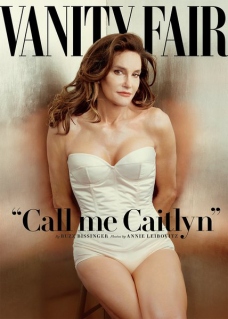
Caitlyn Jenner’s story is one that many individuals, often not highlighted on this blog, know all too well. Caitlyn Jenner’s story and personal experiences are valid and for members of the feminist community to refer to her as not “feminist” or merely as a man “masquerading” as a woman while still utilizing his privilege from being biologically born as a man is troubling and the root of the problem facing many trans individuals today when they’re negotiating coming out as their true selves.

Trans individuals face a cadre of other horrible social, physical and mental statistics that oftentimes lead them to be more likely to self-harm.   However, as feminists, isn’t it our job to make sure that all groups have access to the same freedoms rather than working towards denying it for certain groups while trolling the comments sections of posts?

Shakespeare said: “To thine own self be true” and for those of us who identify with the Golden Rule, if we no longer treat others as we would like to treat ourselves, then we really have failed as feminists; and if the comments on recent blogs are any indication, we still have a long way to go before all voices can feel welcomed not only on FAR but also in the world at-large.

John Erickson is a Ph.D. Candidate in American Religious History at Claremont Graduate University. He holds a MA in Women’s Studies in Religion; an MA in Applied Women’s Studies; and a BA in Women’s Literature and Women’s Studies. He is a Permanent Contributor to the blog Feminism and Religion, a Non-Fiction Reviewer for Lambda Literary, the leader in LGBT reviews, author interviews, opinions and news since 1989 and the Co-Chair of the Queer Studies in Religion section of the American Academy of Religion’s Western Region, the only regional section of the American Academy of Religion that is dedicated to the exploration of queer studies in religion and other relevant fields in the nation and the President of the University of Wisconsin Oshkosh’s LGBTQA+ Alumni Association. When he is not working on his dissertation, he can be found at West Hollywood City Hall where he is the Community Events Technician and works on policies and special events relating to women, gender, sexuality, and human rights issues that are sponsored or co-sponsored by the City of West Hollywood. He is the author of the blog From Wisconsin, with Love and can be followed on Twitter @JErickson85

Stoneflower by Molly

Molly 180

Like flower growing from rock
the world is full of tiny, perfect mysteries.
Secrets of heart and soul and landscape
guarded tenderly
taking root in hard crevices
stretching forth
in impossible silence.

Sleeping
resting
waiting
watching
knowing
that all one needs
is a crack in stone
and a seed of possibility…

One spring evening during my year-long woodspriestess experiment , I went for a walk through the woods with my husband and daughter and we discovered something that delighted and thrilled me. It was rock with a small, perfect flower growing out of it and it was a powerful symbol of what I learned from my time in the woods. Continue reading “Stoneflower by Molly”

Aphrodite in Bagram Afghanistan & The ‘Friend of the World’ of the Flower Ornament Scripture by Stuart Dean

Stuart WordPress photo

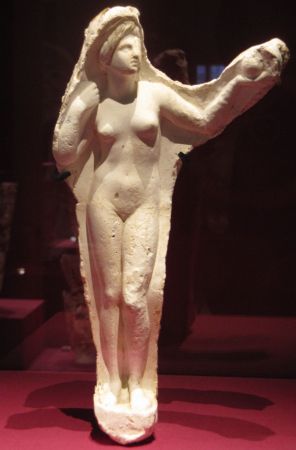
 In the 1930s two ancient storerooms in Afghanistan near what is now the Bagram US Air Base were discovered by French archaeologists and unsealed for the first time in about two thousand years.  They contained artifacts from all over the ancient world, evidencing just how active trade then was along the complex network of routes known collectively as the Silk Road.  Among the artifacts in one of the storerooms was a plaster statuette of Aphrodite (‘Bagram Aphrodite’).

BagramAphroditeThough it is not known what the motivation originally was for acquiring the Bagram Aphrodite, its presence in Afghanistan arguably evinces an interest in female spirituality–if not in the owner of the storerooms then among some of the people in the market for which she may have been destined.  Evidence of such interest among Buddhists is to be found in the Flower Ornament Scripture (FOS), a compendium of sutras dated to approximately the same time (and possibly the same region) as the storeroom containing the Bagram Aphrodite.  Female spiritual figures, both mortal and immortal, some portrayed as having official positions, others without any, are prominent in the final chapter of the FOS, so prominent that one scholar suggests Buddhist women of the time in some way influenced its composition (see Douglas Osto, Power, Women and Wealth in Indian Mahayana Buddhism).
Continue reading “Aphrodite in Bagram Afghanistan & The ‘Friend of the World’ of the Flower Ornament Scripture by Stuart Dean”

Is it possible that we each have our own personal Divine Twin? by Susan Gifford

Susan by GaryEI recently re-read several books written by Jeffrey Raff, a Jungian analyst with a deep interest in spiritual alchemy.  Raff has a Ph.D. in Psychology from Union Graduate School and a diploma from the C.G. Jung Institute in Zurich.  While studying in Zurich, he was most influenced by Marie-Louise von Franz.  Raff, von Franz and many others feel that Jung was most importantly a spiritual teacher and that Jungian psychology follows in the path of other western esoteric traditions such as Gnosticism, Kabbalah, Sufism and Alchemy.
The Divinity in these traditions is very far from the patriarchal god of current organized religions and that is attractive to me.   It is a “God” with both masculine and feminine energy – who relates to all humans – as partners.  Equality and partnership are feminine/feminist qualities.  Surely such a “God” would not be in favor of patriarchal religions that view women as second-class and give men all the religious leadership power.  Continue reading “Is it possible that we each have our own personal Divine Twin? by Susan Gifford”

The Importance of Rituals (Part 2) by Elise M. Edwards

elise-edwards

In my previous post, I wrote about the importance of rituals. The rituals of the Easter season helped me process some difficult emotions. The way that rituals mark time and demonstrate consistency has been a comfort for me when facing new challenges and settings. But I am quite aware that rituals can become empty.   In one of the comments to that post, a woman named Barbara responded, “There came a time for me when familiar and meaningful ritual no longer made sense. I had changed in understanding of what the ritual symbolized and celebrated. And haven’t found new rituals that make sense for me now…or at least I’m not aware of any.” Barbara’s remarks capture not only the loss from no longer being able to relate to existing rituals after life changes, but also the difficulty in finding or creating new rituals to take their place. I thanked Barbara for her honesty and decided that this post would continue the discussion, focusing more on discovery and creation of new rituals.

As I was preparing that post, I watched an episode of Call the Midwife that prompted me to reflect on the need to create rituals when existing ones just don’t work. Call the Midwife is a BBC-PBS show about nurses and midwives living in a convent in London’s East End at the end of the 1950s and early 1960s. The show is based on the memoirs of Jennifer Worth, and it does a better job than most primetime dramas of showing female characters’ experiences the joys and challenges of their professional lives and personal lives. As it is set in a convent with several characters who are both nuns and midwives, the show also explores the theme of vocation. What does it mean to be called to the religious life? Called to nursing? What does motherhood demand? Continue reading “The Importance of Rituals (Part 2) by Elise M. Edwards”

Guanyin Revisited: Queer, Pacifist, Vegan Icon by Angela Yarber

Each month, I delight in writing about a revolutionary woman. Whether she is from history or mythology, sharing the stories of my Holy Women Icons with a folk feminist twist is one of my favorite things to do as a feminist, artist, scholar, and clergywoman. Yet, no matter how much research I’ve done, or how many times I’ve taught about an icon, new discoveries are made, revelations within my own heart and mind cracked open, so that there is sometimes the need to revisit a particular holy woman afresh. Such is the case this month with Guanyin. Though I wrote about her nearly two years ago, published a book including her story, and have taught a course with one session focused on her compassion and mercy, I realized that much about her has gone unsaid. Namely, she is an icon for queers, pacifists, and vegans. Before explaining why, let’s have a quick review…

Guanyin is the Buddhist Goddess of Mercy and Compassion. In the Lotus Sutras, she originates from a bodhisattva named Avalokitesyara. Avalokitesyara is identified as male in the Lotus Sutras. Overtime, however, Avalokitesyara transitions from being identified as a male to becoming Guanyin, most often portrayed in feminine terms and referred to as “she.” Many scholars assert that Guanyin is androgynous and can take on the form of any sentient being. And this is how I’ve always written about Guanyin, as the divinely androgynous one who is most often portrayed in feminine form. Continue reading “Guanyin Revisited: Queer, Pacifist, Vegan Icon by Angela Yarber”