

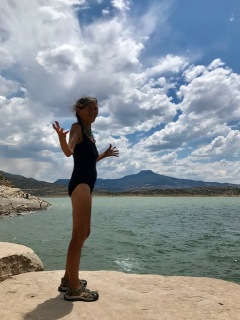
 I entered the Silent Tomb;
the Mosque felt
devoid of Presence.
We wandered through
a myriad of glorious arched rooms,
ornately carved woodwork –
soft carpeted floors.
Removing our shoes
we spoke softly
in deference to
Something ineffable?
Each tiled courtyard,
Mute, yet
starred in
cobalt blue.
Opaque light streamed
through precisely cut
geometric shapes,
domed ceilings
cracked the heavenly stream
into patterned shards.
Outside,
unattended,
High mud walls
kept Creation
at bay.
Fruit trees
twisted by bitter west winds
ragged junipers
sagging in sorrow
rendered invisible
by those who choose
not to see…
I wept for the casually discarded
living breathing
Beings –
Pulsing with Light.
Beyond white sand walls
the stark white capped
Mountains cried out in torment
“Here we are!”
“Sangre de Christos” –
it is our body, our blood
that has been shed
not just his.
Stretching north –
Ridged, ribbed serpents
split the continent in two,
valley gorges meandered far below
arroyos flooded Rio Grande
and all the colors of
the rainbow streamed
out of mud and stone. Continue reading “Our Lady is on Fire by Sara Wright”
Category: Women’s Spirituality
Lise Weil – Requiem by Sara Wright
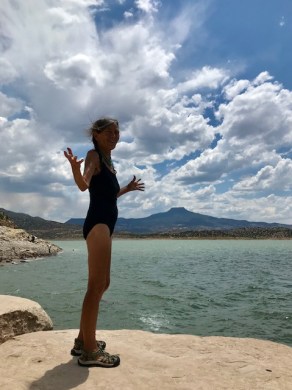 For the Visionaries of the Women’s Movement and Beyond.
“I glimpse lines crazing my face in the windowglass,
crone’s bones emerging. My eyes are growing larger;
soon they will perch on stalks and swivel, crustacean.
The better to see how others do it:
this last chance at living…The message is we’re too fatigued to change the myths
of ourselves at this stage, preferring to die, unmake
the world, in the familiar. Understandable. Yet I persist
in lusting to be seamless with the universe while still aware
of it—so I suspect a future darkly bright, kaleidoscopic
as symmetries glittering beneath eyelids rubbed dry of tears.”Italics are my own.
Robin Morgan “Reading the Bones,” from her latest book of poems, Dark Matter: New Poems, published by Spinifex Press.
Yesterday I attended a reading for the memoir In Search of Pure Lust written by my friend and former professor Lise Weil, a woman who has dedicated her life to visionary thinking and teaching by inviting anyone to enter who has ears to listen and an open heart.
When I first encountered Lise’s radical feminist ideas my hair caught fire; and the flames between us continued to rise higher and higher. Our friendship remains as tempestuous as the fire that binds us still – fire and air are the two mediums of communication that flow between us – one a lover of women, a lesbian, internationally known translator, editor, writer, lifetime visionary activist and teacher, the other, a dedicated Earth centered heterosexual woman, a naturalist and mystic whose lifetime of writing had been confined to her journals up until that point, a woman who returned to school only after her children were grown. Continue reading “Lise Weil – Requiem by Sara Wright”
The Sanctuary of One Another by Molly Remer
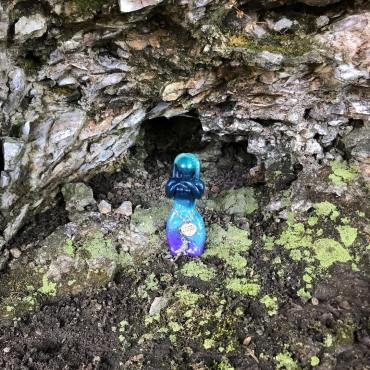 “Please prepare me
to be a sanctuary.
Pure and holy
tried and true.
With thanksgiving
I’ll be a living
sanctuary
for you.”*
—Beautiful Chorus (Hymns of Spirit)
In March, my husband drove our daughter into town to work at her Girl Scout cookie booth and released me to prepare for an all-day Red Tent retreat for my local women’s circle. After I packed my supplies for ritual, I set off on a walk in the deepening, rain-dark twilight. As I walked, I sang a song of sanctuary over and over, until I felt transported into a different type of consciousness, my feet steady on muddy gravel, the leafless branches stark against grey sky, moss and stones gleaming with sharp color against the roadside. A fallen tree absolutely carpeted with enchanting mushrooms caught my eye and invited me off the road and into its arms. As I stood there, feeling as if I had stepped out of ordinary reality and into a “backyard journey,” the spring peepers in the ephemeral pool in our field began their evening chorus. It has been so cold out with below freezing temperatures, snow, and ice for days since first hearing them in early March that I actually wondered if they would survive to continue their song.
Mercifully, though, it is not a silent spring. Continue reading “The Sanctuary of One Another by Molly Remer”
The Healing Feminine Energy of Food by Elisabeth Schilling
 In our society, relationships with food are complicated. Sometimes we might be anxious that our food is not safe, that we are not told the whole story, that we have to educate ourselves on what we can and guess the rest. Sometimes there are emotions connected with food such as ecstasy, joy, guilt, remorse, anxiety, or disgust. Sometimes thinking about food can be stressful, that we don’t have enough money to feed ourselves and others in the ways we would like or at all. Other times, we might wish food away because it is boring or we have limited skills or vision. I cannot say that my relationship with food is the healthiest. I have used food as a punishment and way to self-harm, I’ve been restrictive with food or scared of certain foods. I’m a little or a lot OCD and neurotic with how I handle food.
Ultimately, though, I love good food, and I rather enjoy cooking, especially when I have time to myself and am alone in the kitchen. There is something soothing in cleaning the preparation space and items, chopping the vegetables, combining the green, orange, purple together, letting my intuition guide me for spices. I know that food can be a ritual. It is a time where I listen to the water spill from the spout, the crackle of garlic in oils, the silence in the gaps where I pause before completing another step. Sometimes I go renegade, experimental or familiar, and other times the recipe is liturgy as it requires my faith to be guided by another’s wisdom. Continue reading “The Healing Feminine Energy of Food by Elisabeth Schilling”
The Mud and the Lotus: What India Is Teaching Me by Vanessa Soriano
 About 5 years ago, I began a consistent yoga practice. Right around the same time, I started a PhD program in Women’s Spirituality at the California Institute of Integral Studies where I eventually wrote my dissertation on Women’s Spiritual Leadership. Throughout my studies, I realized that the path of the Divine Feminine is an intricate journey that accentuates the mind, body, soul connection. The yogic path does the same. In late 2018, I enrolled in an intensive 5-week 300-hour yoga teacher training in India where I continued my spiritual explorations. Hindu culture reveres the Divine Feminine and Divine Masculine and yoga is viewed as a pathway into God/dess through the body. Here’s the first part of the story…
I’m in India and it’s 5:30 a.m. and an hour of pranayama awaits me. The yogis define prana as the life force that animates the entire body and yama relates to discipline. The practice of pranayama consists of breathing techniques that aim to control the breath in order to connect to the life force that resides within. Accessing this life force can invoke feelings of bliss and a connection to the Divine.
Class starts, I’m officially starving, and I haven’t had enough coffee. Continue reading “The Mud and the Lotus: What India Is Teaching Me by Vanessa Soriano”
Longing to Heal Family in our Differences and Distances by Elisabeth Schilling
I can’t even save myself. I make bad decisions just like the ones in the world – bombs and wars and the industrial revolution with chains of greed. But then I go on and, without even knowing any part of the story, want to save others. Carol Christ’s post yesterday on family brought me to tears and I instantly had to write a poem. First, it made me think of the memory of my own mother telling me to wait for my dad to get a belt and him saying it will hurt him more than it does me.
Except when I told my mom this, she said it never happened, so I don’t understand the vivid visions in my head that I have being little and hearing the words and being afraid, and why the sight of men’s work belts make me nauseous. I believe my mother. It doesn’t matter either way, I guess, now, in my opinion about my own experience. What I mean by that is I don’t want to do the work of being suspicious or thinking about what is at stake at the moment. I’m okay with shelving it. Let’s just say I believe and don’t feel like trying to explain those visions. I suppose everyone will have an opinion about my decision and perspective on this. Feel free to voice it if it makes you feel better. Continue reading “Longing to Heal Family in our Differences and Distances by Elisabeth Schilling”
Priestesses at the Parliament by Rae Abileah, Bekah Starr & Chaplain Elizabeth Berger

During the first week of November 2018, 12 graduates and current students of the Kohenet Hebrew Priestess Institute attended the Parliament of the World’s Religions in Toronto, Canada. The Parliament is a conference with a 125-year-old history that has grown to an estimated 10,000 participants representing more than 200 spiritual traditions. To share a Jewish feminist perspective with the Parliament’s attendees, we sought to create moving experiences and intimate spaces through a variety of invited and informal initiatives.
Priestessing Panels
Many of us were slated to speak at the Parliament, and rather than just show up and give an academic presentation on a panel, we brought the feminist spirit of Kohenet into our sessions, moving rows of chairs to create a circle, guiding participants through embodied practices rather than giving speeches, and crafting ritual. Continue reading “Priestesses at the Parliament by Rae Abileah, Bekah Starr & Chaplain Elizabeth Berger”
The Personal Book of Shadows: Compendium of Sacred and Scientific Knowledge, Wisdom, and Evolving Experimentation by Elisabeth Schilling
 I’m the type of insecure wallflower who has deleted social media accounts, blogs, photos, poems, and journals because 1. I am not good at commitment or planning, 2. I shame myself for being eclectic and lacking consistency, and 3. a sentiment I have either created or exists in some form externally prods me to brand myself, something I cannot do well (see no.1 and no.2). Oh, that doesn’t mean I don’t find the brand smart, and maybe calling it a “brand” condemns it to consumerism and commodities, when really it is being focused where I am distracted and a frivolous sensationalist.
On the whole, currently, I suppose I’m experimenting with accepting this all-over-the place eclecticism that has seemed to follow me my entire non-linear life and trying to commit to embracing whatever mess I create, even if it feels disjointed and that I can never have a nice, clean, mono-personality. Who am I? About 8 different people. Can anyone relate? Okay, maybe I just need to grow up. I have a feeling it will just have to happen in my next life. Continue reading “The Personal Book of Shadows: Compendium of Sacred and Scientific Knowledge, Wisdom, and Evolving Experimentation by Elisabeth Schilling”
“The Burning Lava of a Song” by Joyce Zonana
Aurora’s autobiographical narrative is a passionate paean to poets as the “only truth-tellers, now left to God”; she celebrates them as agents for personal and social transformation. As we come to the end of this National Poetry Month in the U.S., where truth is under siege, it’s worth recalling Aurora Leigh and its daring exploration of poetry, gender, divinity, and social justice.
 I was in graduate school when I first read Aurora Leigh, Elizabeth Barrett Browning’s fiery 1856 epic about a young woman claiming her vocation as a poet despite Victorian society’s patriarchal strictures. The poem was not on any assigned reading-list; I’d simply stumbled across it while doing research for my dissertation. The opening lines brazenly assert the speaker’s authority and ambition:
OF writing many books there is no end;
And I who have written much in prose and verse
For others’ uses, will write now for mine,–
Will write my story for my better self . . .
Encountering those words, I was immediately possessed by Aurora’s voice and vision, a welcome change from all the male poets and critics I’d been reading. I devoured the verse novel’s nine books in one night. The poem became the centerpiece of my dissertation, and I studied and enthusiastically taught it for years.
Continue reading ““The Burning Lava of a Song” by Joyce Zonana”
Ritual Theory: Sharing Stories by Molly Remer
“Ritual that is alive encourages each person to touch what is sacred in their own way, in their own time, through their own unique experience. So there evolves a dynamic dance between guiding and shaping the group’s experience and encouraging and supporting the individual’s experience, so there is a smooth and cohesive flow to the ritual.” –Suzanne Reitz and Sandy Hoyt (Celebrating, Honoring, Healing)
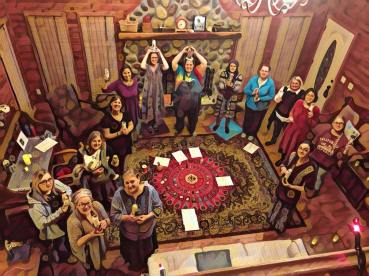 As a practicing priestess, one of the dynamic dances that I engage in is with the power of story. I both find that women’s stories are the vital lifeblood of conscious engagement and power-building with one another and that they can be one of the elements that bogs down a ritual and makes it lose power and magic. This is partially because the dominant culture may teach us to bond using stories in a way that actually drain our energy through “venting,” swapping complaints, trading to-do lists, and through describing behavior, motives, and character of other people. In women’s ritual space, I encourage people to dig deep, but also to share a here-and-now connection of shared experience rather than a there-and-then rendition of past experiences.
Chameli Ardagh in her Create Your Own Women’s Temple manual from Awakening Women explains:
To hold the group and space as sacred is one of the most important guidelines, and the guideline that may bring up the most questions or protests. It goes against our habits as women and against our identification with the small self; we are quite used to creating intimacy through sharing our wounds and problems. The Temple Group is not a place for processing wounds, analyzing ourselves, solving problems, complaining about our lovers, healing our addictions or sharing the stories of the personality. Many women’s circles (and support groups or sharing circles) are focused mostly on the personality. The Temple Group is, in a way, impersonal because it focuses on the larger vast nature of our true self. In the Temple Group we focus not so much on our identity as separate women, but on the whole group as one feminine divine body and expression. The impersonal guideline may sound uncaring at first, but as you explore new ways of being intimate and nourish each other as women, beyond the words, you discover that those are infinitely more fulfilling and caring than the personality talking and processing (p. 61).
I believe that we live in a storied reality and that we are constantly in the process of 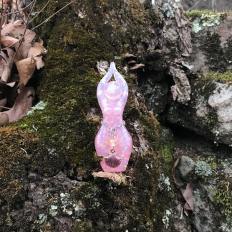 storying and re-storying our lives and that seeing our lives, and the lives of others, through a mythopoetic lens, can have a radically transformative impact on our experiences and our relationships. I have written about this for FAR in the past and noted that my personal lived experience is that stories have had more power in my own life as a woman than most other single influences. The sharing of story in an appropriate way is, indeed, intimately intertwined with good listening and warm connection. As the authors of the book Sacred Circles remind us “…in listening you become an opening for that other person…Indeed, nothing comes close to an evening spent spellbound by the stories of women’s inner lives.”
So, what is special about story as a medium and what can it offer to women that traditional forms of education cannot?
Stories are validating. They can communicate that you are not alone, not crazy, and not 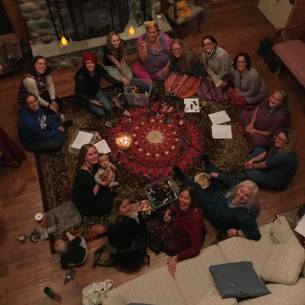 weird. Stories are instructive without being directive or prescriptive. It is very easy to take what works from stories and leave the rest because stories communicate personal experiences and lessons learned, rather than expert direction, recommendations, or advice. Stories can also provide a point of identification and clarification as a way of sharing information that is open to possibility, rather than advice-giving.
Cautions in sharing stories while also listening to another’s experience include:
- Are you so busy in your own story that you can’t see the person in front of you?
- Does the story contain bad, inaccurate, or misleading information?
- Is the story so long and involved that it is distracting from the other person’s point?
- Does the story communicate that you are the only right person and that everyone else should do things exactly like you?
- Is the story really advice or a “to do” disguised as a story?
- Does the story redirect attention to you and away from the person in need of help/listening?
- Does the story keep the focus in the past rather than the here and now present moment?
- Is there a subtext of “you should…”?
Several of these self-awareness questions are much bigger concerns during a person-to-person direct dialogue such as at a women’s retreat rather than in written form such as blog. In reading stories, the reader has the power to engage or disengage with the story, while in person there is a possibility of becoming stuck in an unwelcome story. Some things to keep in mind while sharing stories in person are:
- Sensitivity to whether your story is welcome, helpful, or contributing to the other person’s process.
- Being mindful of personal motives—are you telling a story to bolster your own self-image, as a means of pointing out others’ flaws and failings, or to secretly give advice?
- Asking yourself whether the story is one that will move us forward (returning to the here and now question above).
This work is beautiful. It is complex. It is multilayered. It is simple. It is hard. It is easy. It is rich and rewarding. It is dynamic and evolving and flowing. It is never the same.
May you be blessed with many stories together.
 Note: there is a detailed audio exploration of the themes of this post available here.
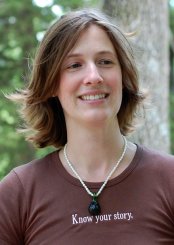
Molly has been “gathering the women” to circle, sing, celebrate, and share since 2008. She plans and facilitates women’s circles, seasonal retreats and rituals, mother-daughter circles, family ceremonies, and red tent circles in rural Missouri and teaches online courses in Red Tent facilitation and Practical Priestessing. She is a priestess who holds MSW, M.Div, and D.Min degrees and wrote her dissertation about contemporary priestessing in the U.S. Molly and her husband Mark co-create Story Goddesses, original goddess sculptures, ceremony kits, and jewelry at Brigid’s Grove. Molly is the author of Womanrunes, Earthprayer, and The Red Tent Resource Kit and she writes about thealogy, nature, practical priestessing, and the goddess at Patreon and at Brigid’s Grove.

