I spend a lot of time thinking about gardens. I think there might be something to them.
It seems strange to talk about gardens during such an intense time. The crucible of injustice, laid so bare during the pandemic, is overflowing all around us in a volcanic eruption of protests and retaliation. And more and more, we understand how it’s all connected – poverty, violence, choking black men, choking women, a choking planet. All connected in a huge, toxic river of greed, fear, destruction, and death.
Following the murders of Trayvon Martin and Tamir Rice, Kelly Brown Douglas released her book, Stand Your Ground: Black Bodies and the Justice of God. In this critical work, she details the embedding of structural violence within the doctrine of American Exceptionalism and the deep rooted racial injustice that our nation was founded upon.
Over the last several months, our world has changed. We’ve witnessed great tragedy and there is so much to grieve. COVID-19 intruded upon our lives abruptly forcing the realization of our misplaced priorities. However, systemic racism has always been here, tightly woven into the fabric of our society; yet privileged voices have failed to answer the call for justice.
As so many risk their health and safety to march for racial justice; to exclaim that Black Lives Matter and that George Floyd’s life was indeed sacred (as was Raychard Brooks, Breonna Taylor, Freddie Gray, Sandra Bland, Philandro Castile, Alton Sterling, Eric Garner…#SayTheirNames), we must consider our own responsibility in perpetuating oppressive structures that condone the trend of public lynchings.
Following the murders of Trayvon Martin and Tamir Rice, Kelly Brown Douglas released her book, Stand Your Ground: Black Bodies and the Justice of God. In this critical work, she details the embedding of structural violence within the doctrine of American Exceptionalism and the deep rooted racial injustice that our nation was founded upon. She explains it was not a book that she wanted to write; rather, as a mother of an African American son, it is a book she was compelled to write. In doing so, Kelly has laid bare the sin of our nation. Five years later, her witness continues to demand our attention.
I reached out to Kelly and asked if she would be willing to talk with me about her book and she graciously agreed. Thus, for this post, I am sharing the wisdom of Kelly Brown Douglas, vlog style, knowing that, in this moment, it is her words that we all need to hear.
Gina Messina, Ph.D. is an American feminist scholar, Catholic theologian, activist, and mom. She serves as Associate Professor and Department Chair of Religious Studies at Ursuline College and is co-founder of FeminismAndReligion.com. She has written for the Huffington Post and is author or editor of five books including Women Religion Revolution. Messina is a widely sought after speaker and has presented across the US at universities, organizations, conferences and on national platforms including appearances on MSNBC, Tavis Smiley, NPR and the TEDx stage. She has also spoken at the Commission on the Status of Women at the United Nations to discuss matters impacting the lives of women around the globe. Messina is active in movements to end violence against women and explores opportunities for spiritual healing. Connect with her on Twitter @GMessinaPhD, Instagram: @GinaMessinaPhD, Facebook, and her website ginamessina.com.
Sing to the LORD, all you godly ones! Praise his holy name.
Psalm 30:4 (New Living Translation)
Therefore I will give thanks unto thee, O LORD, among the heathen, and I will sing praises unto thy name. 2 Sam 22:50
Let them praise the name of the LORD: for this name alone is excellent. Psalm 148:13
The wording of these passages is very odd. After all, why is God’s name always being praised? It’s like saying to someone, “you must be a wonderful person because you have a lovely name,” or “the LORD must be great because ‘he’ {sigh} has such a great name.” Actually though, as I began to go deeper into my own personal practices of spirit work and chanting, I found that there is a profound truth to this use of praise. Most, if not all, of the ancient names of deities are made up of power syllables. By this I mean certain sounds that have a vibrational essence which not only resonate within our bodies but connect us with all the vibrations that surround us. Sounds made by these syllables are a bridge between worlds created by our breath.
Mystically speaking we could say that the breath of creation and our own breath interfuse. We can experience this through the vibration of power syllables. The most common syllables in the west are familiar ones – AL LA HA AH YA LO WAH and the mighty HU. Think of all the names of divinity that can be created by experimenting with these syllables. Continue reading “The Sacred HU by Janet Maika’i Rudolph”
Two recent posts, Community Immunity by Natalie Weaver on May 6, and Carol Christ’s May 11 essay, Women Invented Agriculture, Potter, and Weaving…, have spurred me to focus and finally share something that I’ve meant to for a long time. For 30 years I helped my husband realize his dream of a small farm, while I continued working as an artist. We both came from urban backgrounds and both (separately) charged out into the wild world at age 17, inventing as we went along. That fearless approach continued with the farming many years later.
We started with sheep and cows but soon turned to focussing on goats. We wanted to farm organically from the start (1988) and that, combined with a lack of childhood indoctrination into Big Ag Culture had us devouring all the information we could while carefully observing the animals and applying our shared humanistic approach to daily life to the care of goats. I say this last part so no one imagines a slavelike situation as is often seen in images of dairy farms. Continue reading “Caprine Community by Laurie Goodhart”
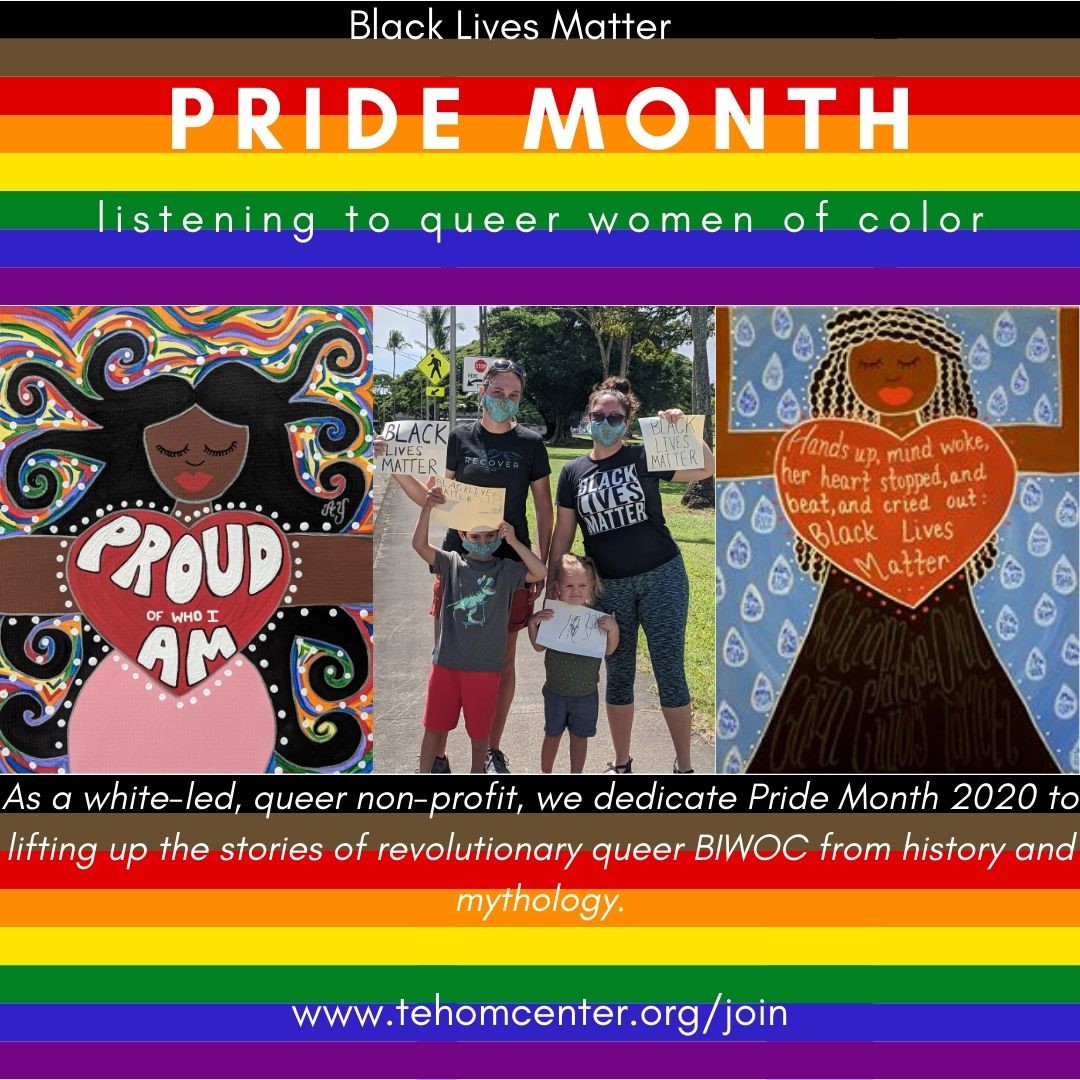
As Pride Month and Black Lives Matter protests co-exist, the spirituality of queer women of color teaches white allies how to listen.
After nearly eighty days of sheltering in place, I feel like I’ve stepped out and found the world on fire. June isn’t supposed to be this way. It’s Pride Month, after all, and I’m queer, eager to dance alongside my favorite drag queens, albeit reticent to embrace capitalism’s commodification of our beloved rainbows.
Most of our annual Pride events have been cancelled due to concerns of social distancing amid a global pandemic. I support these cancellations, though my first family outing since quarantine was a Black Lives Matter protest in Hilo, Hawai’i; we all stood six-plus feet apart, wore masks, and waved our signs beneath the King Kamehameha statue. As my six-year-old was complimented on how he wrote his own sign, I adjusted my three-year-old daughter’s face mask and thought about how queer BIPOC started the Stonewall riots only 51 years ago. I thought about how we queers would have every right to demand our Pride celebrations, storming capitals with glitter bombs, and demanding our civil liberties, not completely dissimilar to the myriad gun clad white dudes demanding haircuts only weeks ago. But we don’t. Continue reading “Coming Out of Quarantine by Angela Yarber”
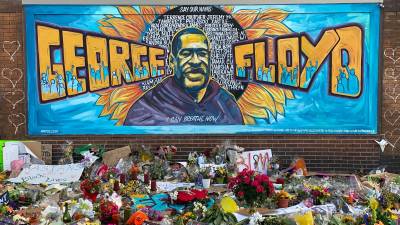
This month I had originally intended to blog on the injustice of UK landowners using Covid19 as a ruse to illegally block public footpaths during lockdown when country walks are one of the few pleasures remaining to many people. However, recent events have completely blown that essay out of the water. In my hometown of Minneapolis, police officer Derek Chauvin suffocated beneath his knee George Floyd, an unarmed black man accused of a minor offense, while three other Minneapolis police officers stood by and did nothing. Outrage for this brutal and senseless killing literally ignited protests across the Twin Cities and across the globe. Thus, it would seem a travesty not to devote my monthly blog to George Floyd and the protesters around the world who are calling for an end to systemic police brutality against black communities. Continue reading “This is a Wake Up Call by Mary Sharratt”
Rescue tadpoles from the evaporating puddle
in the driveway.
Look for pink roses in the field.
Look for wild strawberries
along the road.
Listen to the crows in
the compost pile
and try to identify them
by their different voices.
Plant basil and calendula
and a few more rows of lettuce.
Examine the buds beginning
on the elderberries
and check blackberry canes
to see if the berries have set.
Watch the yellow swallowtail butterflies dance.
Wonder about action and apathy
and what bridges gaps.
Refuse to surrender belief in joy.
Listen for faint echoes of hope.
Feel the tender beat of humanity
pulsing in the world.
Feel the sun on your face
and water seeping
into your jeans.
Remember that even if you have to
move one tadpole at a time,
change is always possible.
It is easy to become exhausted and overwhelmed by the volume of things there are to say, the things there are to think about, to care about, to put energy into, to love, to be outraged about. I want to invite you, at the moment of this reading, to breathe it out, to let yourself come into your body right where you are this second, and put one hand on your heart and one hand on your belly. Remind yourself that you’re whole right here, right now. There is suffering and there is fear and there is pain and there is joy and there is beauty and there is life, and we can hold it all. Let yourself settle and feel, present in this moment, in this unfolding. And, with whatever you feel, whether you feel hopeless or joyful or angry or happy or thrilled or enthusiastic or creative or drained, whatever it is, with your hand on your heart, accept those feelings as okay right now: how you feel, is how you feel; where you are, is where you are; who you are, is who you are. Continue reading “Nourishing Wholeness in a Fractured World, by Molly Remer”
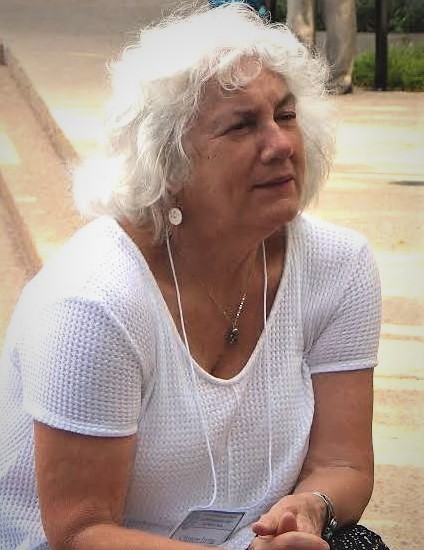
Today, I bring you an old old story from Scotland. It explains how and why winter became spring. Cailleach is another name for the Hag – the archetypal Crone. She represents winter. Brigit is the forever Maiden and stands for spring. There are many ways to spell her name, all of them correct. Ben Nevis is a mountain in Scotland and the word bairns means “babies”.
It’s always important to remember that myths come to us through retellings by countless bards and storytellers. They are layered one on top of the other like palimpsests and sometimes appear contradictory. I think of stories- particularly the ones who have existed for millennia as three-dimensional puzzles to be slowly played with and unlocked in increments. Furthermore, what we see and hear in a story means different things to us at different times and circumstances. There is always something new to be gleaned. Continue reading “Brigit and the Cailleach by Christine Irving”


 I spend a lot of time thinking about gardens. I think there might be something to them.

 Sing to the LORD, all you godly ones! Praise his holy name.
 Two recent posts,
  As Pride Month and Black Lives Matter protests co-exist, the spirituality of queer women of color teaches white allies how to listen.
 George Floyd Memorial, Minneapolis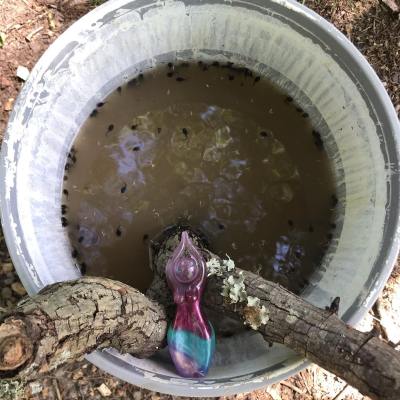
 Today, I bring you an old old story from Scotland. It explains how and why winter became spring.
  Feminism and Religion