

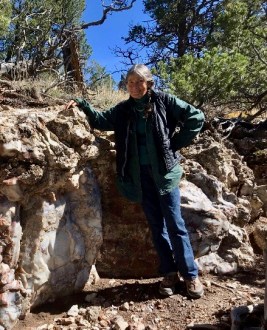
 Scientist Diana Beresford Kroeger proved that the biochemistry of humans and that of plants and trees are the same – i.e. the hormones (including serotonin) that regulate human and plant life are identical. What this means practically is that trees possess all the elements they need to develop a mind and consciousness. If mind and awareness are possibilities/probabilities then my next question isn’t absurd: Do trees have a heartbeat?
According to studies done in Hungary and Denmark in 2017 (Zlinszky/Molnar/Barfod) trees do in fact have a special type of pulse within them which resembles that of a heartbeat.
To find this hidden heartbeat, these researchers used advanced monitoring techniques known as terrestrial laser scanning to survey the movement of twenty-two different types of trees to see how the shape of their canopies changed.
The measurements were taken in greenhouses at night to rule out sun and wind as factors in the trees’ movements.
In several of the trees, branches moved up and down by about a centimeter or so every couple of hours. Continue reading “The Forest has a Heart?** by Sara Wright”
 As the results from America’s Super Tuesday election primaries came in, I found myself feeling disoriented. I could not focus on any task and found myself obsessively reading the news and checking my Facebook timeline. Many of my friends who had supported Elizabeth Warren were embracing Biden as the next best hope to defeat Donald Trump. Sometime on Thursday, I came across Starhawk’s
  The Tanakh, Jewish scriptures, predominately call the deity king and lord and use the masculine pronoun. These images evoke a certain level of power. Just how powerful the deity is in then multiplied when “he” is addressed as “G-d of Gods,” “Lord of Lords,” judge, almighty, all-powerful, and warrior-like with vengeance, fury and flaring nostrils. Events like war, army invasion, disease, drought, and famine are often described as divine punishments for wrongs done throughout the Tanakh.

 Every morning I walk to the river in the velveteen hour between the vanishing blue night and the coming of the first scarlet, pink, lavender, purple or golden ribbons that stretch across the horizon. Sometimes clouds with heavy gray eyelids mute first light. Either way all my senses except that of sight are on high alert; a deep peace embraces me in the dark. My body knows the way. I murmur to the willows as I pass through the veil and under their bowed bridge. Their response is muted, a song beneath words.
 Today’s blog is a sequel to:
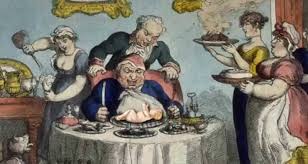
  In 1729, the Anglo-Irish author Jonathan Swift (1667-1745), who was already widely known for his political polemics and satirical pamphlets and highly ironic letters to and about the literati of Georgian England, published “A Modest Proposal for preventing the Children of Poor People from being a Burden to their Parents or the Country.” Having observed how the English conquerors and (mostly absentee) landlords of Ireland had for close to five centuries been bleeding the island dry by confiscating its crops and taxing the Irish people unto starvation, Swift suggested in “A Modest Proposal” that the poor people (nearly everyone) sell their children to the rich to be used as food. Yes, the pamphlet is outrageous. (But students of English literature generally enjoy it. I know I did. It’s lots less boring than the poetry written during the reigns of the first three Georges.) It was widely discussed (an understatement) in London.

 Just a few months ago, not long after turning seventy, I was diagnosed with mild osteoporosis. I had thought that all my yoga, my occasional forays to the gym, my daily walking, my frequently consumed leafy greens and yogurt , my calcium supplements would protect me. I had thought I was different from most other women my age, that I could avoid taking the medication that I knew was sometimes problematic. But the bone density scan revealed what I had feared, and because both of my parents declined and died shortly after hip fractures, because I had once broken an ankle, I decided to accept my doctor’s sober recommendation: that I begin a weekly dose of alendronate. It would be the first chronic medication I would ever be prescribed.
