The Mountain and the Goddess by Judith Shaw

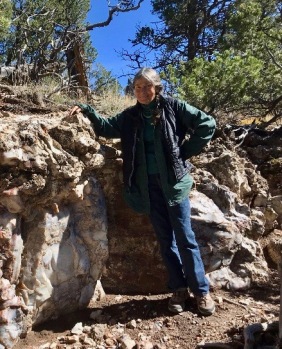
judith shaw photoMother Earth does not discriminate. She cares for all her children in all their varied forms. Our ancient ancestors considered Earth and its many geological elements to be feminine and/or associated with goddesses – from caves, to rivers, lakes and seas, to forests, to agricultural fields, to mountains.

Continue reading “The Mountain and the Goddess by Judith Shaw”

Elder – Berry Musings by Sara Wright

I first became interested in herbalism as a young mother who kept a small herbal garden outside her back door. There is nothing better than fresh herbs to spice up any dish (as any good cook knows well) and baking my own bread, making homemade granola, etc., like gardening, was simply part of what I did. In retrospect, I see that cooking served as a highly creative endeavor that helped me to create some balance between the millions of mundane jobs associated with single motherhood and my need for creativity…

It seemed quite natural to begin to explore herbs for medicinal purposes. I first experimented with plants that grew wild near my house on the island on which I lived. I sensed that developing a personal relationship with the plants I was using mattered, an intuition that continues to inform my growing and preparation of herbal remedies to this day. If I don’t have the right growing conditions for an herb I need, I wild craft responsibly. Until recently I have never used store bought preparations.

When I studied with medicine folk in the Amazon thirty years after first using herbs for culinary and then medicinal purposes, I learned that each healer only used his/her own garden grown herbs and preparations differed based on the knowledge that each medicine person received directly from the plants, so perhaps the importance of having a personal reciprocal relationship with individual plants is tied to their efficacy – my sense/experience is that it is. The ways of the natural world are not well understood by most westernized people. Continue reading “Elder – Berry Musings by Sara Wright”

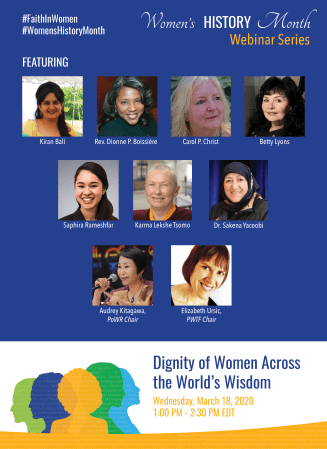
Dignity of Women Across the World’s Wisdom: Parliament of World Religions Webinar by Carol P. Christ

I have been asked to post my contribution to the Parliament of World Religions Webinar: Dignity of Women Across World’s Wisdom. 
I am participating in this discussion as a representative of women who are on a Goddess path. I do not represent any established or newly formed religious or spiritual tradition. Rather I speak for an increasingly large number of women who are seeking alternatives to established traditions that celebrate and legitimate male power as power over or domination. We do not follow leaders or gurus and we place no trust in any sacred texts.

Most of us have grown up in cultures where the most prominent religious traditions feature male Gods, male teachers, and male religious leaders. We agree with Mary Daly who said that when God is male the male is God. In traditions where God is male, male teachers and religious leaders are viewed as reflecting or being in the image of the male divinity. We do not assume that images of God as male are never valid, but we do assert the need for images of God as female.

As I said in my often re-published essay, “Why Women Need the Goddess,” the most important meaning conveyed by the symbol of Goddess as the ultimate creative power in the universe is that female power is legitimate and good. This does not mean that female power is always good, but it clearly undermines the widely held view that female power exercised apart from male control is always evil or bad. This view is reinforced by images of women as evil in religious traditions, for example, Eve seduced by the snake. Continue reading “Dignity of Women Across the World’s Wisdom: Parliament of World Religions Webinar by Carol P. Christ”

Reviewing Current Holocaust Popular Culture Materials By: Anjeanette LeBoeuf

AnjeanetteI contemplated doing a post on the current rising issues of the Coronavirus but as so much of life has been stopped, altered, and/or rearranged, that I figured I would embody the proverbial statement of “Just Keep Calm and Carry On.” So, this month’s post is a mixture of observation/product review on recent Holocaust narratives, especially found in movies, TV shows, and books.

Continue reading “Reviewing Current Holocaust Popular Culture Materials By: Anjeanette LeBoeuf”

The Serpent and The Seed by Janet Maika’i Rudolph

I was so inspired by Judith Shaw’s blog post, “The Serpent and the Goddess” (Feb 26th) that I began to dust off my old notes on serpent imagery. I was reminded a concept that kept jumping out at me. In discussing the Kabbalah, Rabbi David A Cooper, writes that mystics describe the universe as the “the skin of the serpent.”[1] What a beautiful yet puzzling concept! I wanted to dig deeper.
The serpent’s connection to the Great Goddess has been an excellent place to begin this quest. Barbara Walker notes the etymological connection between the serpent, and the Great Goddess from the Bible whose name is Eve. Walker writes, “The names of Eve, the Serpent, and ‘Life’ are still derived from the same root in Arabic.”[2] But the Goddess connection is not the totality of the serpent’s magic. Continue reading “The Serpent and The Seed by Janet Maika’i Rudolph”

A Lovely Self-Imposed Isolation by Deanne Quarrie

Deanne QuarrieWith everyone talking about it – I won’t.  Let’s just say that I am in the “at risk” population and have decided that staying home is my best protection against “it.”

Staying home is what I do most of the time. I am perfectly happy with that.  I live on my computer and in the evenings, I take a break as a “couch potato” and indulge in serial watching! I only have one neighbor who comes over and I am keeping him outside and at a 6-foot distance, as he has no sense and is exposing himself in many ways, even though he too, is high risk.

I have been working for a few years on the creation of a group practice that honors Hekate and occasionally Her companions, in ritual.  In my seminary, I have developed a Master of Divinity degree program with studies based on Her.  All throughout this active work, most has been in researching but also a great deal in writing. I seem to be even more productive in this isolated state. As I am not isolated online, I have been communicating with others and we seem to be “triggering” each other’s creativity. The term “falling down a rabbit hole” has taken on new meaning.  Not only am I falling down my own rabbit holes, I am falling down rabbit holes started by other people! Continue reading “A Lovely Self-Imposed Isolation by Deanne Quarrie”

The Truth Revealed by Coronavirus – It’s All Connected by Judith Shaw

judith shaw photoCoronavirus is revealing many truths to this world – a world grounded in the patriarchal consciousness of domination and separation for millennia. Though still on the fringes of social awareness, the ancient wisdom of community and connection remains alive and growing.

Continue reading “The Truth Revealed by Coronavirus – It’s All Connected by Judith Shaw”

Community and Social Distancing by Gina Messina

Our commitment should be to the wellbeing of all; our own wellbeing is dependent upon it. This virus does not recognize borders or walls, nor racial or religious divides. Oppressive structures have caused our communities to crumble; and yet, it is only through a collaborative community effort that we can hope to “flatten the curve.” 

We are in the midst of a global crisis unlike anything we’ve seen during our lifetime. Admittedly, I gave the situation little attention, even when relatives were under forced quarantine in Italy and cases were piling up in California where many of my family and friends live. It’s typical; we often don’t realize the seriousness of a particular issue until it is one we experience ourselves — we can empathize, but can’t fully understand something that hasn’t hit home.

I wasn’t afraid when the NBA suspended its season, or when March Madness was canceled. When I received an email that a child at my daughter’s school had been quarantined, I told myself it was precautionary. Still, when a neighbor who is a nurse in an ER had provided care to a patient who tested positive for COVID-19, I thought how scary it must be for her — but assumed that nurses of all people know how to protect themselves from getting sick. 

Once school was suspended in my state and people started to panic, buying up every last roll of toilet paper and hand sanitizer pump, my concern was not COVID-19, but instead what I deemed overreaction. Nonetheless, I jumped on the bandwagon and stocked my pantry just in case…although I was too late for the toilet paper. Continue reading “Community and Social Distancing by Gina Messina”

Trees Sleep? by Sara Wright

This post follows last week’s post: The Forest Has a Heart?

In 2016, Zlinszky (Zlinszky/Molnar/Barfod) and his team released another study demonstrating that birch trees go to sleep at night (now we know that all trees – at least all the trees that have been studied so far – do sleep at night).

Trees follow circadian cycles responding primarily to light and darkness on a daily cycle. The researchers believe the dropping of birch branches before dawn is caused by a decrease in the tree’s internal water pressure while the trees rest. With no photosynthesis at night to drive the conversion of sunlight into simple sugars, trees are  conserving energy by relaxing branches that would otherwise be angled towards the sun. Trees increase their transpiration during the morning, decreasing it during the afternoon and into the night. There is a change in the diameter of the trunk or stem that produces a slow pulse. During the evening and the night tree water use is declining, while at the same time, the stem begins to expand again as it refills with water.

When trees drop their branches and leaves its because they’re sleeping. They enter their own type of circadian rhythm known as circadian leaf movement, following their own internal tree clock. Continue reading “Trees Sleep? by Sara Wright”

Women’s Circles Need Well-Established Structures to Ensure that Everyone’s Voice Is Heard by Carol P. Christ

In a recent blog on Feminism and Religion, “Insights on Sisterhood,” Eirini Delaki opened a dialogue about problems that arise in women’s circles. According to her, many of us are reacting against the poisonous pedagogy of control which is all too familiar in patriarchal families and patriarchal cultural, religious, and economic institutions. Desiring to be free of hierarchical structures that inhibit our growth and happiness, we often react against all structures.

We imagine that groups without structure will provide a space where we can learn and grow together. We begin with a vision of sisterhood in which everyone’s voice will be heard. In practice, however, groups without structure usually end up being dominated by those with the loudest voices and the biggest egos. The quieter and less sure members of the group find themselves dominated again. When the vision of sisterhood is not realized, the group is likely to dissolve. Continue reading “Women’s Circles Need Well-Established Structures to Ensure that Everyone’s Voice Is Heard by Carol P. Christ”