

 My father was a very intelligent man who tested “genius” in the army. Drafted into the army at a young age, he decided not to take advantage of the “GI Bill” that would have paid for his college education after the war, because he already had a family to support. My father was lucky not to have served in combat. Scheduled for the invasion of Japan, he served in its occupation. I once asked him if he saw the devastating effects of the atomic bombs that the United States dropped on Japan. Instead of answering directly, he said dismissively, “I suppose you think I was traumatized.” I imagine that on some level he was, because unlike many WW II veterans he never spoke about his time in the army, and most tellingly, he was the only member of his unit not to sign up for the “extra pay” to be earned in the reserves, and thus the only one not to be called up to serve in Korea. Although he never questioned the US government’s right to wage war, he always told me, “war is hell.” Though he was not at all pleased when I became active in the anti-war movement, I found some of the roots of my opposition to war in my father’s refusal to glorify it. Continue reading “Gifts from My Father by Carol P. Christ”
Hooray! The Holiday Season Is At Hand! by Barbara Ardinger
December seems to have more holidays than the rest of the year put together. Days to honor Ix Chel, the Virgin of Guadalupe, St. Lucy (aka Santa Lucia), the Declaration of Human Rights, and the publication of the Rider-Waite Tarot. Saturnalia. Hanukkah. Christmas. Kwanza. Yule. Innumerable reasons to go shopping for gifts and banquets. Here, to help you survive the holiday season, are two Found Goddesses.
Who, you may ask, is a Found Goddess? The term comes from Found Goddesses, published in 1988 by Morgan Grey and Julia Penelope. Found Goddesses are modern ones that we invent to deal with modern issues that the classical pantheons can probably not cope with. Like going to the mall and cleaning our houses before our guests arrive. (Note that I’ve rewritten these pieces a bit to bring them more or less up to date.)
Continue reading “Hooray! The Holiday Season Is At Hand! by Barbara Ardinger”
Gas-lighting on Al Franken(stein)’s Street by Elisabeth Schilling

I will add my #metoo, but don’t feel like going into details. I will just say that in light of my past experience and Al Franken’s statement of apology, I’m realizing why some of us don’t tell at an even deeper level.
This is Al Franken’s statement:
Summary: It’s super hard to be a guy in this society.
Continue reading “Gas-lighting on Al Franken(stein)’s Street by Elisabeth Schilling”
Kintsugi for the Soul – Part II – by Vanessa Rivera de la Fuente

How do you start to put the pieces together? For me, it was imperative to keep a space to express emotions without self-censorship or self-prejudice, to identify exactly what was hurting me. It was not the What, but the How. A split is always sad, but part of life. I could have been the “ungrateful” partner.
What aches …
Well, just to mention some, it was not the obstacles of a relationship between two people used to singleness, with different cultural backgrounds and family styles, but the neglecting, insults, and public belittling, leading to my progressive invisibility and objectification in the daily life. It was not his one night stand a few years ago with an Islamic feminist I know. Every adult has a sexual past, that is not a problem, but discovering that past was quite current (thanks Whatssap) is the problem. Someone decided I was not smart enough to understand it, so triangulation and lies were employed, with the consequent mind games, an emotional roller coaster that included gaslighting and violation of trust.
Continue reading “Kintsugi for the Soul – Part II – by Vanessa Rivera de la Fuente”
In the footprints of Machig Lapdron by Mary Sharratt

Machig Lapdron, female Tantric Buddhist mystic and lineage founder
I’ve just returned from an illuminating trip to Bhutan, high in the Himalayas. Bhutan is a Buddhist kingdom and the world’s youngest democracy.
On our last full day in this enchanting land, my husband and I drove with our guide over the nearly 4000 meter pass of Chelela and into the Haa Valley which doesn’t see that many tourists. Our goal was the Hermitage of Juneydrak, where Machig Lapdron (1055-1145 CE), the famous female Tantric mystic, master, and lineage founder, once meditated.
Continue reading “In the footprints of Machig Lapdron by Mary Sharratt”
Jewish Folklore and Women’s Clothing: When Things are the Text by Jill Hammer

Two weekends ago, I had the pleasure of visiting the Jewish Museum on Fifth Avenue in Manhattan. The Jewish Museum has long been a favorite museum for me. My wife and I took our daughter to this particular exhibit because we knew she’d like it. The exhibit is entitled “Veiled Meanings: Fashioning Jewish Dress from the Collection of the Israel Museum, Jerusalem.” It consists of many, many garments created and worn by Jews, from Moroccan wedding clothes to German prayer shawls to Yemenite amuletic (meant to protect the wearer) dresses. Accompanying the garments were placards explaining the folk traditions giving rise to the various garments. What I realized (again) after viewing the exhibition was how much I could learn about the culture of Jewish women, and Jewish culture in general, by looking at things, not texts.
The sacred texts and laws central to Jewish life, while they certainly discuss Jewish women, tend not to be created by or for Jewish women. This means many aspects of how Jewish women thought or acted (before the present day) are obscured. However, these garments were created by and often for Jewish women, and their shapes and symbols tell a great deal. For example, the Moroccan Jewish wedding clothes I mentioned were embroidered with spirals, representing (according to the accompanying written material) the spiral of life. These spirals were also found on Jewish tombstones. The spirals resembled, to me, the spirals I’d seen carved on stone at Newgrange and Knowth in Ireland—the ancient symbols of life and journey. I was amazed to see them in a Jewish context. Another dress that mixed Sephardic and Moroccan style also had spirals featured prominently.
Continue reading “Jewish Folklore and Women’s Clothing: When Things are the Text by Jill Hammer”
My Mother’s Appearance in a Healing Dream by Carol P. Christ
 My mother spent a good deal of her life defending my father to me and my brother. “Your father didn’t mean it,” she would say. “Your father loves you—he just doesn’t know how to show it.” “Your father never cried when his mother died—that is why he is so angry now.”
Shortly after my mother died, my brother said to me: “I finally realized that the only way I could get along with Dad was if he decided on that particular day that he was going to get along with me.” My brother’s words hit me like a ton of bricks. At the age of forty-six, I was still trying to get along with my father. I had years of therapy to help me understand our relationship. My brother saw the truth without the benefit of therapy.
About six months after my mother’s death, I had the most amazing dream. Though I have alluded to it in my writing, I promised myself not to speak of it directly it while my father was still alive.
I had accompanied friends to the Greek Saturday night Easter service in their village. At the stroke of midnight we lit candles saying “Christ is risen, he truly is,” before embracing and kissing each other on the cheeks. I was sleeping in a guest room in my friends’ house. The dream occurred shortly before dawn. Though I rarely remember my dreams, I awoke with a clear memory of this one.
In it my mother spoke to me in Greek. She told me that now that she was no longer living, she had a clearer perspective on the way our father treated me and my brother. She explained that she had loved my father so much that she had not wanted to see that he had been cruel to us and to recognize the ways he had harmed us. She said she was very sorry that she had not protected us. Her final words before the dream ended were: “Don’t ever love anyone so much that you become blind.”
To this day I do not know why my mother spoke to me in Greek–perhaps it was a way of distancing herself from my father and indicating that she was on my side now. It seemed deeply appropriate that she appeared to me at the time when the Greeks were celebrating the resurrection of “life from the grave.” My mother’s words were a healing balm: healing the breach that her siding with my father a crucial junctures in our relationship had created in my relationship with her, and healing an even deeper would in my psyche.
About that time I was reading Alice Miller’s discussion of the poisonous pedagogy of control. Miller says that the most important words abused children need to hear are: What happened to you was wrong. This should not happen to you or to any child. In the dream my mother spoke the words she had been unable to speak while she was alive. She told me that she finally understood that there was no excuse for the way my father treated me and my brother.
I came to realize that the words my mother spoke when she was living, words intended to absolve my father and assuage my pain, had confused me about the nature of love. From my mother, I learned to imagine that people–especially men–who treated me badly loved me deep down but could not show it. No wonder I always ended up feeling hurt and abandoned.
My mother’s ability to acknowledge the truth about my father when she came to me in my dream was a revelation. The blinders that had clouded all my relationships fell away. I could now begin to see all of my relationships more clearly and to recognize which relationships were healing me and which were harming me. Before the dream I literally did not have a clue, because my mother had taught me love is a magical feeling that has no relationship to actual behavior. After the dream I learned that love manifests in both word and deed. My life has been different from that day to this.
Though I never doubted the healing power of this dream, I had some difficulty in squaring it with my belief that death is the end of individual life. If my mother was not living heaven or somewhere else, then how could she speak to me after she had died? In the ensuing years I have come to understand that the ancestors live in us. The words my mother spoke to me when she was alive became part of my cellular memory. The mother-daughter relationship is so profound that there are times when the mother-daughter boundary is blurred. As I recognize how deeply this is true, it no longer seems important to know if “my mother” appeared to me in my dream or if “my mother as she lives in my me” appeared in my dream. Her appearance transformed my relationship with her and my relationship with my self. And that is what matters.
In memory of Janet Claire Bergman Christ, August 11, 1919-December 7, 1991.
* * *
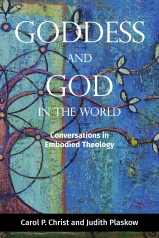 Carol’s new book written with Judith Plaskow, is Goddess and God in the World: Conversations in Embodied Theology.
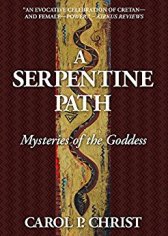
FAR Press recently released A Serpentine Path: Mysteries of the Goddess.
Join Carol on the life-transforming and mind-blowing Goddess Pilgrimage to Crete. Sign up now for 2018! It could change your life!
Carol’s photo by Michael Honegger
The Act of Gun Control by Anjeanette LeBoeuf
 This month’s post is brought on by dealing with another aftermath of a mass shooting and the responses in the wake of devastation. I write this in ardent hope that this will start a discussion that will hopefully lead to change. That waking up to another massacre will not continue to become the norm. So, upcoming generations will not have gun violence and mass shooting a standard, another headline, another milestone of the highest causality in history. Continue reading “The Act of Gun Control by Anjeanette LeBoeuf”
Small Business Saturday: Feminist Gift Guide for the Holidays by Angela Yarber

Wondering what to give the revolutionaries in your life for the holidays? Want to support feminist small businesses as you shop? Need some creative ideas with powerful feminist history and theory embedded in each purchase? Would it help if the gifts fused together feminism and religion? The Holy Women Icons Project, Lagusta Luscious, and Bloodroot Feminist Vegetarian Restaurant has plenty of ways for you to celebrate the holidays with empowering gifts to please feminist in your life.
The feminist non-profit Holy Women Icons Project seeks to empower marginalized women by telling the stories of revolutionary holy women through art, writing, and special events. For over five years, a different holy woman has been featured each month on Feminism and Religion; we became an official non-profit earlier this year; and we have some beautiful, creative, and empowering offerings suitable for the holidays.
Continue reading “Small Business Saturday: Feminist Gift Guide for the Holidays by Angela Yarber”
Thanksgiving, Pies and Remaking Tradition by Marie Cartier
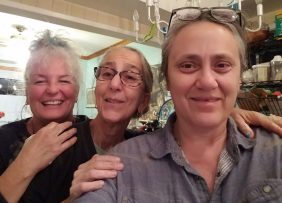 Dear FAR readers—you will be reading this blog the day after Thanksgiving, which is one of my favorite holidays. It didn’t used to be—but it is now.
Over twenty years ago, I remade this holiday for myself. At that time I was in my late thirties and was just coming out of almost a decade of healing from a very rough childhood. I spent a lot of time in those early recovery years yearning for some kind of magical “family” I thought “everyone” had. Once I really opened up about my story, however, I realized everyone doesn’t have any one thing. We all have something different—and everyone has a story.
I decided to create a ritual—I didn’t intend for it to turn into a tradition, but it did. Continue reading “Thanksgiving, Pies and Remaking Tradition by Marie Cartier”
 Feminism and Religion