The Spirit and Jarena Lee: Inspiration to Break Boundaries by Elise M. Edwards

elise-edwardsI am so frustrated that we are still fighting to affirm women’s place in leadership.  I’ve been thinking about this struggle in the context of church ministries (especially preaching) and social activism, seeing a stark contrast between the way institutional churches and universities promote and subvert women’s authority and the ways movements like Black Lives Matter do.

Particularly, I’ve been struck by the ways that more radical movements employ language and practices that are based in spirit more than hierarchical authority.  I have found a theme emphasizing equality in humanity’s access to spirit in both historical and contemporary movements and writings about religious experience.  I’m certainly not the first one to notice or discuss how appeals to Spirit have empowered those excluded from dominant systems of power to challenge constrictive social structures, but I would like to share how this dynamic has become more visible to me so that, together, we might find encouragement, inspiration, and food for thought.

Continue reading “The Spirit and Jarena Lee: Inspiration to Break Boundaries by Elise M. Edwards”

Fostering Conversation and Connection in Community by Katie M. Deaver

I recently began a new job as the Associate Director of Admissions for the Lutheran School of Theology at Chicago, one of the seminaries of the Evangelical Lutheran Church in America.   This week was orientation for our new and returning students and much of the time has been focused on getting to know one another as well as getting to know the corner of Chicago in which we are located.  There have been so many life giving conversations as well as so many questions!

Our mornings featured speakers who helped us to engage one another in conversation as well as to start thinking about the unique reality of our place within not only the LSTC community but also within the rest of the Chicago community and the larger world.  Throughout these presentations  and getting to know you activities my thoughts continued to be pulled back to the question of how to have life-giving conversations in a time when so many of us feel emotionally and spiritually drained by the world around us.

Continue reading “Fostering Conversation and Connection in Community by Katie M. Deaver”

Missing a Teachable Moment: The Purple Dress by Marilyn R. Freedman

Intelligent and impish eyes took in my approach, and the little girl moved away from the post office doors. But not before I saw her sweet face with round cheeks still full of baby fat squished against the glass. With slightly messy, curly blond hair and wearing a shiny, deep purple, ruffled dress-up dress, she looked pretty, happy, and confident. This was her world, wherever she was. When I smiled, though, she turned away, shy of a stranger.

I got into the long line with my kid and listened to the little girl’s dad discuss gift card values with her older brother. The boy named an amount, and the dad commented about how expensive it was. “What a great way to teach a little economics and finance,” I thought.

Continue reading “Missing a Teachable Moment: The Purple Dress by Marilyn R. Freedman”

When Community Eclipses Polarity by Kay Bee

I recently accepted a new position at my local public library and yesterday the duties of that position happened to include staffing our library’s Eclipse Viewing Party. From about 10am to 1pm, I answered countless questions about the eclipse, helped people of all ages make pinhole projection viewers out of everything from cardstock to saltine crackers, loaded & reloaded NASA’s footage that we live streamed on the big screen, & handed out moon pies. And, of course, encouraged the couple hundred folks who had descended on our little library to be good neighbors and share the fifty pairs of NASA-approved eclipse glasses we’d managed to get our hands on the week prior.

The eclipse was stunning. We were able to experience the temperature drop, the change in the quality of light, and a safe view of the peak of the eclipse, which was at about 80% here in the Four Corners area. But what really struck me about the experience was the spirit of community I witnessed.

Image courtesy of NASA/GSFC/CI Lab

Folks shared eclipse glasses with each other freely, passing them around beyond the friends or family they had come with to people they didn’t necessarily even know. “Did you get to take a look?” was a phrase I heard everywhere I went as I wove through the crowd, helping wherever I was needed. “Here, use these and then pass them on.” Kids broke moon pies together, splitting them into pieces to share with those who hadn’t snagged one before we ran out of those as well. People spotted shadows of the eclipse naturally projected onto the ground or on one gentleman’s white cowboy hat by the sun’s light as it passed between tree leaves and happily showed each other. Elders taught children they didn’t know how to use their pinhole projectors just like they did when they were young. Everyone cheerfully & excitedly helped each other get a different perspective on this moment in time in order to better appreciate the ever-shifting relationship between our Earth, Moon, & Sun.   Continue reading “When Community Eclipses Polarity by Kay Bee”

Self-Care is a Feminist Issue: Holy Women Icons Project’s 7-Day Online Self-Care Retreat by Rev. Dr. Angela Yarber

Several years ago, I was pastor of a welcoming and affirming church. As a queer clergywoman, I thought that such a place would be the perfect place to flourish and thrive as a pastor. And yet, because of heterosexist and sexist microaggressions, I found myself anxious, depressed, and in need of physical, emotional, psychological, and spiritual care.

After a three-day retreat filled with self-care and soul-nourishment at a non-profit retreat center that catered to activists and artists , I felt as though a tremendous weight was lifted off my shoulders, that I could focus and find clarity in my vocation. Pausing to care for myself gave me the courage to leave my toxic job and live more fully into my calling. This experience taught me the vital importance of self-care.

Womanist Audre Lorde once proclaimed, “Caring for myself is not self-indulgence, it is self-preservation, and that is an act of political warfare.” Because caring for the self violates the patriarchal norms that traditionally dictate that you should be the one caring for everyone else. Yes, everyone needs to pause to care for the self. But oppressed minorities have a particular need for self-care, not simply as a way of refreshing oneself in order to do the work of justice, but as a vital part of the work of social justice. Because caring for yourself in a society—and a church—that wishes for you to do otherwise is an act of political warfare. When feminists care for themselves, it is a radical act of soul redemption, spirit rejuvenation, and a political and spiritual act of acknowledging your holy and innate self-worth. In case anyone has told you that you are not worthy, let me reassure you. You are worthy. And you deserve to care for yourself.

Continue reading “Self-Care is a Feminist Issue: Holy Women Icons Project’s 7-Day Online Self-Care Retreat by Rev. Dr. Angela Yarber”

Learning Compassion from Inmate Number 74799 by Cynthia Garrity-Bond

Technically I was employed as a lab assistant at our community hospital. This position entailed multiple responsibilities, from receptionist to actual bench work within the laboratory. The task I dreaded most was my assistance at autopsies. Beyond a strong constitution, it required no measurable skill set. This job was not the high-tech, immaculate setting of any of the CSI programs of today; instead the morgue was a stark, condensed room with two pullout refrigerators for the deceased, a stainless steel table the autopsy was performed on, and the necessary instruments and accouterments, some suspended from what appeared thin air. These tools of the trade ranged from the expected scalpels and retractors to saws and garden-like shears.

Fast-forward fifteen years. It is the morning of July 11, 1991. Prisoner number 74799 has just been transferred from the Department of Corrections, Arizona State Prison in Florence to Tucson County General Hospital in critical condition. Eight months prior to his admittance to the prison hospital, Prisoner 74799 was diagnosed with metastatic lung cancer. While considered inoperable, he was administered the customary chemotherapy treatments until four months later when the cancer spread to his brain, taking most if not all of his cognitive abilities away. Within one hour of his transport, Prisoner 74799, my brother, Michael Paul, died at the age of thirty-nine.

Continue reading “Learning Compassion from Inmate Number 74799 by Cynthia Garrity-Bond”

With Women by Kay Bee

Someone told me the other day that Death Doulas are one of the fastest growing career fields out there right now. As a (currently not practicing) Birth Doula, this does not surprise me. The term Doula came into its modern – predominately American – usage in the early 1970s, in reference to a woman who provided non-medical care for a birthing woman. The word is Greek in origin and depending on who you ask, means “with woman” or “servant woman.”

While I suspect the earlier “servant woman” version is the correct etymology, the romantic in me appreciates the “with woman” version, even in its technical inaccuracy. This is because at its core, the role of the Birth/Postpartum Doula is the formalized return of what I believe in my bones to be an ancient cultural practice of women being with each other as a woman passes through an intense life transition.

Whereas before, when a woman gave birth, the older, multiparous women of the local culture would gather around her to see her through her passage from expectant to postpartum motherhood; now some of us approaching that same rite of passage use the Internet to reach out into the culture to hire a Doula to do that very same thing. How we bring it about has changed, but what we desire has not. We desire to be supported, cared for, & loved by someone who has gone through what we are about to — we desire to be with women.

The number of Birth Doulas in the U.S. and abroad, at this point, has increased dramatically over the last ten years and now it would seem that the Conscious Birth movement has birthed a Conscious Death movement, complete with Death Doulas. Again, how we secure the care we want at birth or at death has changed, but what we desire in those powerful moments of passage has not.

The fundamental physical, emotional, and spiritual craving to be with women at life’s major rites of passage runs incredibly deep within us. It is also something denied to us by the patriarchal structures of most major religious systems, but over the last sixty years or so, we’ve worked hard at taking that back. Continue reading “With Women by Kay Bee”

Mulling over Movies: Moana, Pt. 2 by Elise M. Edwards

elise-edwardsEvery summer in the US, movie theatres show their newest big budget films, hoping to draw in large audiences. While I appreciate an air-conditioned theatre on a hot day, I love the opportunity to go to an outdoor movie screening.  These screenings are usually community-oriented opportunities for social gathering.  In my previous post, I talked about Moana, a Disney film I saw at an outdoor screening earlier this summer.  I enjoyed watching this movie with my friends and their families and I was delighted by the story itself.  It has several religious and spiritual themes and strong female characters. Previously, I spoke of the significance of myths in this movie.  Today, I’m focused on depictions of nature in Moana and their remarkable beauty.

Many feminist and womanist theologians and religion scholars have raised concerns about the interrelated dominations of women and nature, as well as the disproportionate hardships women and children are exposed to with increasing climate change and environmental degradation.  Our changing environment affects all life on the planet, but it is the people who are most vulnerable (physically, economically, politically) who at most at risk.  Obviously, animals and plants are endangered, too. Ethicists like me are interested in finding ways to address these concerns because we are committed the preservation of life.  As feminists, there’s more to it, though.  We recognize the way nature itself is often feminized (“Mother Nature”), which makes it even more troubling when it is cultivated without respect for the wellbeing of existing ecosystems and the life forces dependent upon them.

Continue reading “Mulling over Movies: Moana, Pt. 2 by Elise M. Edwards”

Pride by John Erickson

When we come together, we are the Divine.  I didn’t think I could experience that twice in one year; clearly, I was wrong. 

If you’re anything like me you not only hate opening up your Twitter feed each morning but also feel compelled to in order to make sure you didn’t miss whatever new atrocity to come out of 1600 Pennsylvania Ave. After the Women’s March, I felt charged. I felt that whatever this administration threw at the proverbial “us,” I knew we could and would overcome it. Although that charge kept me going for a few months, there came a time where I just couldn’t go on anymore and that I was completely drained; then walked in a man named Brian Pendleton.

After the Women’s March on January 21, I didn’t know what to expect. The event was truly so successful that many of the organizers and coordinators were on an activist high as a result of what was a truly magical and divine moment. A few months came and went and the 45th President of the United States continued (much to our surprise) to be as awful as we all knew and expected. However, while I am able to exist in a world, no matter how oppressive, as a cisgendered white male and the full on privilege and power that comes along with that territory, many of the individuals and communities being attacked did not have those same freedoms; and like with the Women’s March and how that all took shape, in walked Brian Pendleton to my life to talk to me about the #ResistMarch.
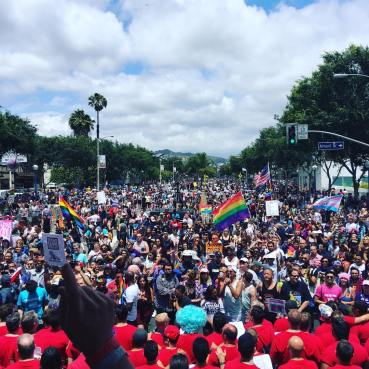
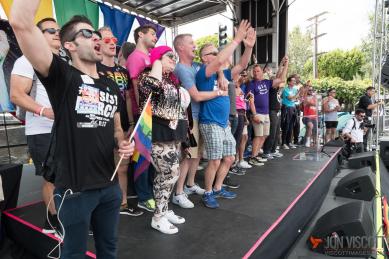
Cover PhotoAlthough my involvement during the 120 days or more that led up to the #ResistMarch happened in a flash, one thing is for certain: miracles exist not because of divine intervention but because G-d places people on this Earth to make positive impacts. The beauty of the #ResistMarch was not just the passion of the organizers but the beauty of the rainbow that came out in full force on June 11

The strength shown by our community was one that, for all intensive purposes, proves that love does conquer all. RuPaul couldn’t have expressed the common and conquering theme better than when he said: “It’s all about love; giving love and being able to receive love. That’s our secret weapon; that’s the one thing they don’t have: our love and our music. That is our activism. That is what we use and what we always use to fight the ugliness.”

That is the one experience that I took most out of the #ResistMarch: the power of love and friendship; the beauty in the unexpected conversation that leads to changing the world, again.  Thank you, Brian. Thank you, for bringing us all together to resist, recharge, and love.
19055531_10158898620590385_6920780108892374453_o

When we come together, we are the Divine.  I didn’t think I could experience that twice in one year; clearly, I was wrong.

John Erickson is the President of the Hollywood Chapter of the National Organization for Women. John is a Ph.D. Candidate in American Religious History at Claremont Graduate University where he is finishing up his dissertation tentatively titled “Step Sons and Step Daughter”: Chosen Communities, Religion, and LGBT Liberation.” John holds a MA in Women’s Studies in Religion; an MA in Applied Women’s Studies; and a BA in English and Women’s Studies. He is the Founding and Past President of the University of Wisconsin Oshkosh’s LGBTQA+ Alumni Association and currently serves as the Chair of the Legislative Committee for the Stonewall Democratic Club, a Diversity and Inclusion Fellow at Claremont Graduate University. He is a permanent contributor to the blog Feminism and Religion, a Co-Founder of the blog The Engaged Gaze, and the Co-Chair of the Queer Studies in Religion Section of the American Academy of Religion’s Western Region, the only regional section of the American Academy of Religion that is dedicated to the exploration of queer studies in religion and other relevant fields in the nation. In April 2017, he was the first openly gay athlete to be inducted into the Wisconsin Volleyball Conference Hall of Fame. Most recently, John was one of the coordinators of the Women’s March Los Angeles, which brought together 750,000 people in downtown Los Angeles on January 21, 2017, and a Committee Member for the #ResistMarch, which brought together 100,000 people from Hollywood to West Hollywood in honor of LA Pride on June 11, 2017.



Mulling over Movies: Moana, Pt. 1 by Elise M. Edwards

elise-edwardsI love going to outdoor movie screenings.  Sitting outdoors on a summer evening with good company brings me joy.  Last week, I went to an screening of Moana, the Disney movie about a teenager who goes on a quest through the Pacific Ocean with the demi-god Maui.  Moana goes on this journey to help her people.  The movie came out last year, but I didn’t see it.  I have to admit that I wasn’t even interested in it until Simone Biles performed a dance to one of Moana’s songs on Dancing with the Stars. It was then that I realized that the movie has an empowering message.  I asked my friend Natalie, who is also a feminist religion scholar, about Moana.  She has three young daughters, so I trusted her to be more current than I am.  Her enthusiastic response sold me, as did her remark, “There’s not even a love story in it!”

Ah, Disney princesses and their love stories!  I’m old enough that I didn’t grow up with the Disney culture that children in the past few decades have, but I haven’t been immune to the Disney princess phenomenon.  I childhood pre-dated DVDs and digital downloads, but I still knew and cherished the Disney characterizations of Snow White, Cinderella, and Sleeping Beauty. These young women were kind and virtuous and beautiful (according to Eurocentric standards), but their stories culminate with marriage to a charming prince.  It’s also problematic that so often, the villains in these movies were older women—wicked stepmothers or evil witches—who were motivated by jealousy and hate.

Continue reading “Mulling over Movies: Moana, Pt. 1 by Elise M. Edwards”