Maybe beautiful things 
don’t only grow from peace,
maybe they grow from the
soil of living,
which holds both
blood and tears
muck and magic.
Last week I tried to work on my book while the household debris whirled around me. We are supposed to be leaving for homeschool co-op in just a few minutes, I still need to take a shower, there are orders to fulfill and I really, really want to format this title page, add two attributions, and re-upload the digital file.
The toilet has a ring of water around it, or is it pee, the children come to report.
There’s a weird smell in the kitchen.
I can’t create like this, I yell.
I want to be inspiring, not so messy, not like this.
I gesture frantically, almost crying, my hair wild, my eyes frenzied.
I only have nine minutes before it is time to leave and I still need to take a shower and I haven’t finished my formatting. I stare at the screen and shout:
I only want to make things
from a place of beauty and peace.
But, then I say:
maybe beautiful things don’t only grow from peace,
maybe they need this too, this mess, in order to flourish.
I abandon my book file, left open on my screen, photo half placed and words askew and I take my shower with my heart beating too fast, my mind spinning with to-dos, and agitation thrumming through my veins.
I hastily dry my hair and we pack the car. We will be late, I know. As fly down the road there is a big buck in the road. It is hunting season and I stop the car on the hill to watch him. Our eyes meet for a moment, he is still, his antlers are wide and beautiful, some of the nicest I’ve ever seen. His shoulders are broad and brown in the early morning sun.
Run free, big guy, I say, run free. If you go up the hill, you will be at our house and it is always a safe place.
This feels both true and beautiful.
A week passes and it is still hunting season, rifle now instead of bow, so my husband and I put on our orange vests before we go out for our morning walks, so that no one will shoot us. I have lived in a state where hunting is an established part of the culture for my entire life, so deer season is “normal” to me and I understand the purposes of it, though I cringe every November to hear the gunshots in the early morning, the wild eyes and swiveling ears of the deer whose home has been invaded with fear and risk after a summer of grazing on wild grasses and berries.
Today, as we walk, we reach the crossroads and something tugs at my attention. I turn back and look into the woods where my eyes catch on the body of the beautiful buck, lying motionless at the base of an oak tree. He has been murdered and then left behind, his large body still and silent, his beautiful antlers against the leaves, the sun glinting on a stripe of white along his belly. His legs are folded against his body, relaxed, this is not a very old kill.
My thoughts of my work and my doing and all the everything that needs my attention fall away and I am struck with grief at this senseless death. I think about his antlers and how I’ve always wanted to find some and I know that someone will come back and cut off his head to remove them. I think for a moment that it could be me who does this, but I don’t have the heart or stomach for it. I imagine taking rosemary and lavender petals to scatter over his body, I imagine laying my hands across his fur and thanking him for being here. I think perhaps that after the vultures and coyotes have done their work I will creep back through the woods and look for him, for his bones, and perhaps I will collect the antlers then, if they have not been chewed by rats or carried off by dogs. I hate that this has happened. It tortures me to walk back by and leave him there, disrespected and alone.
I leave a message for our closest neighbor asking if perhaps he shot a deer that got away and later died in our woods. I message another neighbor and ask if he thinks there is anyway the meat could still be used. The first neighbor calls me back a half hour later, I am surprised to hear his voice on the phone, as we don’t talk often. He is agitated and yelling, not at me, but about the men he found in the road yesterday who killed this animal. He heard the gunshot while cleaning his own deer from the morning and flew down the road to confront them, where he found them standing in the road, truck parked at the crossroads, the deer dead beneath the tree. This is illegal and it disgusts him, his voice shakes as he recounts the story. He tells them that he will always know what they did and they are the ones who have to live with themselves and their actions. They deny it, claim someone else must have done it and drive away, leaving the body behind. He expects they will sneak back in the night to take it, but they have not, and there he lies in the dappled morning sun.
Our employees have arrived to work and the house is full of voices and questions and people waiting for me to do things. I take a shower anyway. Showers are one of those things I occasionally withhold from myself as I desperately try to keep up with everything people need and want from me in a given day, but I take the shower and try to let the adrenaline, the anger, the sense of waste and loss wash away from me. I keep thinking about the deer, his life, my mind turning it over and over, my body filled with sorrow.
As I am putting on my lotion and simultaneously also answering calls from our bank 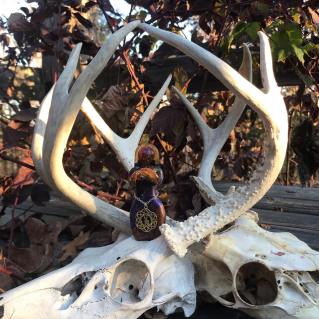 about a new account, feeling rushed and out of breath, there is a knock on the front door. I quickly dress and go out to the living room, my hair still wet and ragged, and find our other neighbor standing there. He is holding two white skulls in his hands, long antlers curving between his fingers. We talk about the buck, about the waste of his life, about the disrespect and senselessness of this action. He is a hunter too and he says he has been watching this deer for more than a year and that you get to know them when you live here, that you see the same ones, sometimes every day, that there are only so many in a given range, and you get to be a part of their lives. We ask him if he knows Limpy, the doe with the broken leg that healed crookedly, but that we see almost every day, sometimes twice a day, in the field across the road.
She raised twin fawns this year, he says.
We look at each other quietly for a moment. I feel a wave of gratitude that I live somewhere where the neighbors, too, know Limpy and her babies.
I hurt my ankle in June of this year and when I could finally walk on the road again, taking my first real walk in six weeks, I saw Limpy and her twins at the end of our driveway. She looked at me for a long time and I felt a sense of kinship with her, two mothers with injured legs, trying our best to keep going.
My neighbor holds the antlered skulls out to me and says he will call the buck in to the conservation department as you are supposed to do. He says this deer has sentimental value to him and he will make a mount with his head and he is offering me these skulls in trade. I take them with gratitude, though it isn’t the same as finding my own. The antlers are whitened and smooth. One has small chew marks along two of its spikes, the others has knobby ridges along the base. They are beautiful. I hold one skull in each hand, antlers curving along my arms. They feel like precious treasures to me, something given, something received, a moment of genuine respect for a needlessly slain creature of these woods we all love.
When Mark and I walk the next morning, the buck’s body has been moved deeper into the woods, out of sight, and there is only a heavy flattened place stained dark red in the carpet of oak leaves across the forest floor and the thick smell of blood in the air to indicate that he was ever there. We know though, we shared this home ground, and I leave rosemary, lavender, and thyme scattered across the blood-soaked leaves.
Molly Remer has been gathering the women to circle, sing, celebrate, 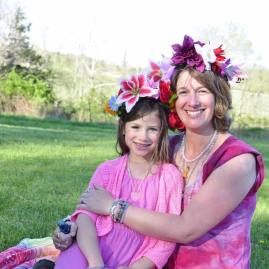 and share since 2008. She plans and facilitates women’s circles, seasonal retreats and rituals, mother-daughter circles, family ceremonies, and red tent circles in rural Missouri. She is a priestess who holds MSW, M.Div, and D.Min degrees and wrote her dissertation about contemporary priestessing in the U.S. Molly and her husband Mark co-create Story Goddesses, original goddess sculptures, ceremony kits, mini goddesses, and jewelry at Brigid’s Grove. Molly is the author of Womanrunes, Earthprayer, the Goddess Devotional, She Lives Her Poems, and The Red Tent Resource Kit and she writes about thealogy, nature, practical priestessing, and the goddess at Patreon, Brigid’s Grove, and Sage Woman Magazine.


 Every morning I walk to the river in the velveteen hour between the vanishing blue night and the coming of the first scarlet, pink, lavender, purple or golden ribbons that stretch across the horizon. Sometimes clouds with heavy gray eyelids mute first light. Either way all my senses except that of sight are on high alert; a deep peace embraces me in the dark. My body knows the way. I murmur to the willows as I pass through the veil and under their bowed bridge. Their response is muted, a song beneath words.
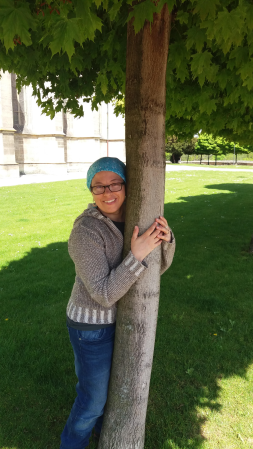 Tomorrow is Tu B’Shevat, the New Year of the Trees, or their birthday. It is the day of the year when all trees, regardless of when they have been planted, turn another year older. The rabbis standardized this day in an effort to minimize complexities, since in the land of Israel, fruit can only be eaten from trees that are four or older (Leviticus 23-25). Tu B’Shevat, then, on a practical level, marks how old fruit bearing trees are.
  Scientist Susan Simard is a professor of forest ecology at the University in Vancouver, British Columbia, who has been studying the below-ground fungal networks that connect trees and facilitate underground inter-tree communication and interaction. Over a period of more than thirty years this field scientist and her students have learned how fungi networks move water, carbon and nutrients such as nitrogen between and among trees as well as across species. Her research has demonstrated that these complex, symbiotic networks in our forests — at the hub of which stand what she calls the “mother trees” — mimic our own neural and social networks. This groundbreaking work on symbiotic plant communication has far-reaching implications that include developing sustainable ways to ‘manage’ forests, and to improve tree and plant resistance to pathogens. Although much of Simard’s research occurs in forests, she has also studied the underground systems of grasslands, wetlands, tundra and alpine ecosystems.
 This morning the sky was on fire before dawn even as I approached the river whose ripples reflected a purple so deep it was almost inked in charcoal – In the Bosque I noticed that one mule deer had used a juniper to scrape his antlers. Otherwise the Earth emanated precious predawn stillness except for the sound of receding river waters slipping over cobbled stones. It was mild; I thought today might be the day…
 I gaze out my bedroom window and hear yet another golden apple hit the ground. The vines that hug the cabin and climb up the screens are heavy with unripe grapes and the light that is filtered through the trees in front of the brook is luminous – lime green tipped in gold – my too sensitive eyes are blessedly well protected by this canopy of late summer leaves.
 My community and many others have been watching in awe as Greta Thunberg makes waves around the world—her lone climate change protest in Sweden growing in a single year into a climate strike with millions of demonstrators around the world. Of course, Greta isn’t asking us to listen to her. She is asking us to listen to the science that will save us. And Greta is not alone: there are young indigenous female protesters like performance poet and peace activist Lyla June Johnston of the Dine (Navajo) and Tsetsehestahese (Cheyenne) peoples and water protector Autumn Peltier of the Anishnaabe people, who are speaking before the UN and in other public settings about global warming, and revitalizing our spiritual relationship with Mother Earth. Yet Greta knows that her fame (and her youth) gives her a platform. She is conscientiously using that platform to testify before Congress and the UN, Tweet, post on Facebook, and do whatever else she can do to make an impact. Recently, I’ve noticed that some people in my home Jewish community, when they post about Greta on social media, have given her a nickname: they call her “the prophetess.”
 Once the new white pine forest that stretches out before me was part of a larger field that belonged to an old farm. The woods cascade down a steep hill on the east side of the house and run parallel with the brook that empties into another that crosses my property in the wetlands below.
  I dream that all of us who are suffering burn-out because of national and world politics come together to plant and nurture trees. Scientists say that planting
