Thanks for Coming (Out): Sexuality, Sports, and Spirituality by John Erickson

I have to be honest, Jason Collins’ admission that he was a homosexual, albeit brave, upset me. While coming out is an completely unique experience to every individual that does it, Jason Collins’ story was just another example of the rampant sexist and heteropatriarachal world that privileges male bodies and sexualities over women’s similar experiences. While I applaud Jason’s story and it’s timing, the first thing I asked to my colleagues was: Where was the hubbub over Sheryl Swoopes or Martina Navratilova?

John Erickson, sports, coming out. Like marking off items on a proverbial checklist, closeted LGBTQ individuals who exist within and outside of the world of professional sports, can recount the numerous things they struggle with in terms of their sexuality.  From fearing of the actual coming out process, dressing in their car or at home to avoid the subtle glances and whispers of individuals in the locker room, to wondering what coming out would mean not only for their game but also for their social and, if they choose, spiritual lives, closeted and out LGBTQ individuals within the multi-billion dollar professional sports industry must grapple with that age old question: what does it mean to be gay and open about it?

The Locker Room

I have to be honest, Jason Collins’ admission that he is a homosexual, albeit brave, upset me.  While I understand that coming out is an completely unique experience to every individual who does it, for me Jason Collins’ story was also an example of the rampant sexist and heteropatriarachal world that privileges male bodies and sexualities over those of women.  While I applaud Jason’s story and the timing, the first thing I asked to my colleagues was: where was the same hubbub over Sheryl Swoopes or Martina Navratilova? Continue reading “Thanks for Coming (Out): Sexuality, Sports, and Spirituality by John Erickson”

(Femen)ism? by Kile Jones

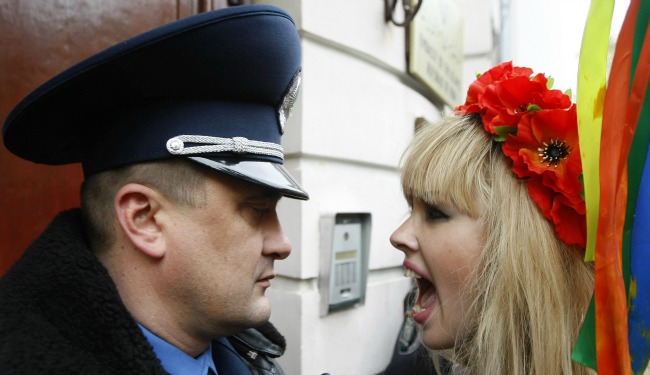
Kile Jones, atheistAs most of us are aware by now, there is a “feminist-sextremist” group from Ukraine called “Femen.”  This group has been very controversial by their public demonstrations of nudity, the words they paint on their bodies, and their explicit condemnations of political structures and organized religions.  They were started by Anna Hutsol in 2008 and have now spread throughout Europe and the Middle East.  The question I pose for this post is: Does Femen harness or hinder the power of the feminist critique?

Image from Konstantin Chernichkin/Reuters

Femen is precisely the kind of movement that pushes us in our understanding of feminism, the means by which it is best expressed, and the issues surrounding moral condemnation and religious sensitivity. Continue reading “(Femen)ism? by Kile Jones”

Protecting our Families: How the U.S. Falls Short in Protecting New Mothers (and Fathers) by Michele Stopera Freyhauf

Freyhauf, Feminism, Religion, Durham, Old Testament, Blogger, Bible, Gender, Violence, Ursuline, John CarrollLast weekend, I had the privilege of speaking at the National Convention for American Mothers, Inc. about motherhood in the 21st Century.  Because this is such a vital issue for mothers that live in the U.S. (since a large majority of families have two full-time wage earners), I thought it would be appropriate to share my speech here.  With the understanding that this a forum for feminism, I believe that this topic fits this forum because it continues to show how unequal the treatment is between the sexes – whether it is pay, position in employment, healthcare, education, or simply balancing the responsibilities of family/career.  For those that live in the United States, there is often a sense of exceptionalism, and as I clearly demonstrate in this speech, we are certainly a far cry from being role models that when it comes to protecting mothers (whether by birth or adoption) and families.

As a side note:  One topic that was not explored, due to lack of data, is how maternity/paternity leave impacts same sex couples who become new parents – I have to believe that this is a topic to also examine (and I am would encourage any feedback here).  

Recently the United States ranked 25 out of 165 countries for being the best place to live if you are a mother.  This number is up from 31 a year ago and places us between Belarus and the Czech Republic.

You may be asking yourself, Why isn’t the United States in the top five or even in the top ten? The answer to that question becomes evident once we examine how that determination is made. The categories examined are:

  • Mother’s education;
  • Child’s Health;
  • Economic status;
  • The Election of women to government office;
  • Breast feeding programs.  In the United States 75% of mothers breastfeed their babies, 35% continue to breastfeed after six weeks. The number shrinks because mothers usually return to work and find it difficult to to pump at the office;
  • Maternal death rate is another factor, which stunned me when I found out that the US has the highest maternal death rate of any industrialized nation. Approximately 1 in 2,100 women are at risk of dying during child birth;
  • Infant death rates is another category.  Infant deaths are estimated to be 8 per 1000 births – a number that throws us behind 40 other countries;

Feminism and Football By Marcia W. Mount Shoop

Marcia headshot“How did race and privilege affect the NCAA investigation of the football program at University of North Carolina?”

This was the question a student posed to me recently when I gave a Skype lecture to a Sports Ethics class at the University of Washington’s Center for Leadership in Athletics

I am going to take a wild guess (and I may be wrong), and assume that most readers of the FAR blog don’t know much about the NCAA investigation of the UNC football program.   I have outed myself on this blog before—I am more than just a feminist theologian; I am also a football coach’s wife.  Lots of people wonder how I manage to pull that off and still look at myself in the mirror.  That’s a complicated question.  I am finding that the challenges presented by our experience at UNC are creating more and more space for the feminist and the coach’s wife to find a common purpose.  Which brings us back to the question at hand—race and privilege and how it played into the football investigation at UNC.

You may want to investigate the many details of this investigation, but I would like to invite this feminist community to see what you think about this question of privilege in particular.   I will provide just a few factual statements for you all.  You tell me if you can think of ways that race and privilege may have been at work to the detriment of certain groups in this situation.  Continue reading “Feminism and Football By Marcia W. Mount Shoop”

Why are We Troubled by a Homeless Jesus? by Michele Stopera Freyhauf

Michele Stopera Freyhauf Durham John Carroll Religion TheologyThere are standard depictions of Jesus that show a Caucasian male with blue eyes (some pictures have the occasional brown eyes), shoulder length brown hair, and usually wearing a tunic with sandals. Jesus’ demeanor is usually victorious, prayerful, inviting, and even reflects humility. Our culture creates an unrealistic depiction of Jesus so that in the United States (at least), we see a savior as a white male representative of the power structures that permeate every facet of life.

There are some variations of this image. The most common is this same image with dark skin. A depiction that makes Jesus more tangible to people of color. If we can accept this variation of Jesus, then why would we be upset when images become more culturally tangible, send a message that encapsulates Jesus’ ministry, or make us stop and think – challenging us to take our rose colored glasses off. When an artist creates an image of Jesus that is different than the standard described above, controversy occurs at varying levels. The artwork is removed or de-commissioned, protests occur, and in extreme cases, the artist will even receive death threats. Here is a small sampling of images:

Jesus-in-Jeans-by-Peter-Royle
Jesus in Jeans (Peter Royle) picture courtesy of Wikipedia http://en.wikipedia.org/wiki/File:Jesus-in-Jeans-by-Peter-Royle.

chocolatejesus
Sweet Jesus (Cosimo Cavallar) picture from Cavallaro’s website (http://www.cosimocavallaro.com/html/chocolate_page.html
Edwina Sandys: http://www.naplesnews.com/news/2008/mar/06/my-life-so-far-edwina-sandys-69-artist/
T Edwina Sandys: http://www.naplesnews.com/news/2008/mar/06/my-life-so-far-edwina-sandys-69-artist/
Crucified Woman at Emmanuel College

Continue reading “Why are We Troubled by a Homeless Jesus? by Michele Stopera Freyhauf”

Women as Stairways to Heaven by Jameelah X. Medina

In mainstream Islam, the ways and sayings of Prophet Muhammad are second in importance only to the Qur’an. There are two prophetic sayings pften quoted when speaking about the high status of women in Islam: 1) “Whoever has two daughters and treats them kindly, they will be a protection for him against the Fire;” and “Paradise lies beneath her [the mother’s] feet.”  These sayings influenced a growingly famous Islamic scholar who stated, “When she is a daughter, she opens a door to jannah [paradise/heaven] for her father. When she is a wife, she completes half of the deen [religion/way of life] of her husband. When she is a mother, jannah lies under her feet. If everyone knew the true status of a Muslim woman in Islam, even the men would want to be women.” This quote is being reposted all over social media sites by both Muslim men and women.

On the surface, the quote is lovely. It works to combat the stereotype of the lowly Muslim woman who has no standing in her religious community. It is posted as proof that women have great status in Islam. However, this quote and the prophetic sayings also have a problematic implication. When I read these quotes, I don’t see them talking about the status of Muslim women. The quotes are very specific and apply ONLY to women who are daughters, women who are wives, and women who are mothers. The implication is that, even though Muslim women and men are from a single soul and have the same essence (the Islamic perspective), women still are not sufficient enough for praise, reverence, and respect just by virtue of being women. They must be some man’s daughter, wife, or mother in order to enjoy elevated status. What does this say to women without fathers, women without husbands, and women without children? It tells them that they have not yet arrived; they are goals yet unrealized. Simply put, they are not enough. Continue reading “Women as Stairways to Heaven by Jameelah X. Medina”

The Roman Catholic Theology of Womanhood by Ivy Helman

The Vatican has creIvy Helmanated an entire theology of womanhood without the input of a single woman!  Searching the Vatican archives reveals a wide range of documents pertaining to women, some of which mention women tersely only in their capacity as workers needing protection (Rerum novarum, 1891) and others are fully dedicated to describing the status, role and mission of women in the family, society and the world (Mulieris dignitatem, 1988).  Within the documents, as time passes, women become their own category of theological importance.  This is due to the influence of feminism on the status and roles of women across the globe.  Yet, there is vehement anti-feminism in the documents as well.

I searched the documents myself, curious as to what the Vatican had to say about womanhood and wrote a book on the topic published by Orbis in Febrary 2012 entitled, Women and the Vatican: An Explanation of Official Documents.  I would like to lay out that theology now.  Continue reading “The Roman Catholic Theology of Womanhood by Ivy Helman”

Gender in Kabbalah by Judith Laura

Judith LauraI first started delving into both Jewish Kabbalah and Hermetic Qabalah in the 1990s, after friends told me these forms of mysticism included both female and male representations of divinity and therefore were gender equitable. They were right about the first part: Kabbalah/Qabalah contain both divine masculine and feminine imaging and male and female images.  But as far as gender equity goes, to use today’s slang, not so much!

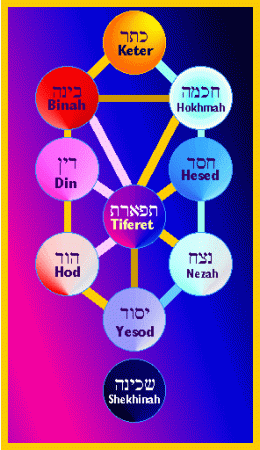
tree of life kabbalah

Though they are both transliterations of the same Hebrew word, as is common I use “Kabbalah” for the Jewish versions, and “Qabalah” for the Hermetic version, best known through its association with the British Hermetic Order of the Golden Dawn, which began in the 19th Century. The word means “that which is received,” with the understanding that it was “received” from ancient times. Though there is one tradition that says Adam was given Kabbalah in the Garden of Eden, the first written material for Kabbalah, Sefir Yetsirah (Book of Creation), is dated to between 200 and 500 C.E. Kabbalistic concepts changed over the centuries, with writings becoming more significant in the 13th century and even more popular in the 16th and 17th centuries.

Beginning with the Sefir Bahir (Bright Book) in late 12th century France, Kabbalah is represented by the Tree of Life, which has round areas transliterated sefirot (Heb. pl.; sing. sefirah) that I think of as fruit and others call “spheres,” but which in the Bahir, are more accurately translated “sapphires.”*  These “divine emanations,” as they are often called in English, are gendered. How equal is the gender representation? Continue reading “Gender in Kabbalah by Judith Laura”

Cosplay and Choice by Sara Frykenberg

Sara FrykenbergCosplay is often a deliberate, interpretive and self-chosen performance of gender and power.  Like drag performers, cosplayers put on a show of the characters they represent; and in my experience, they often do so within diverse, supportive and principally, inclusive communities. 

This week my husband sent me a great blog post he found about cosplay and one woman’s determination that she would no longer tolerate being demeaned, objectified or trivialized because of what she chooses to wear.  Blogger Megan Marie’s post, entitled “What would you do if you weren’t afraid,” inspires me.  She points out and refuses the trappings of rape culture: victim blaming, assumed male control over female sexuality and shame; and claims her right to be who she is.  I, as fellow (what is the female equivalent for fellow???) cosplayer, was also moved by her defense of this creative art.  I have been cosplaying a long time, but I have been too afraid to speak much about this or to directly protest the rejection of these fantasy images within some feminist communities.  So to answer Megan Marie’s question* in her own words, “What would you do if you weren’t afraid? My answer.  I’d write this blog.”

Coplay = costume + play!  It is the recreation of popular characters from video games, comic books, anime, scifi series, fantasy literature or the like.  Cosplayers do this for the fun of it, the craft involved, to express one’s fandom and sometimes, professionally, usually within an arena where fans can enjoy one another’s recreations.  The attempt to embody these characters involves a great deal of work and artistic expression.  Many conventions, like Fanime Con in San Jose, CA, host panels in which fans can learn cosplay skills, such as armor construction, wig making and costume design.  I have cosplayed the following characters: Sailor Star Healer, Eudial and Sailor Iron Mouse from the anime Sailor Moon, Misa

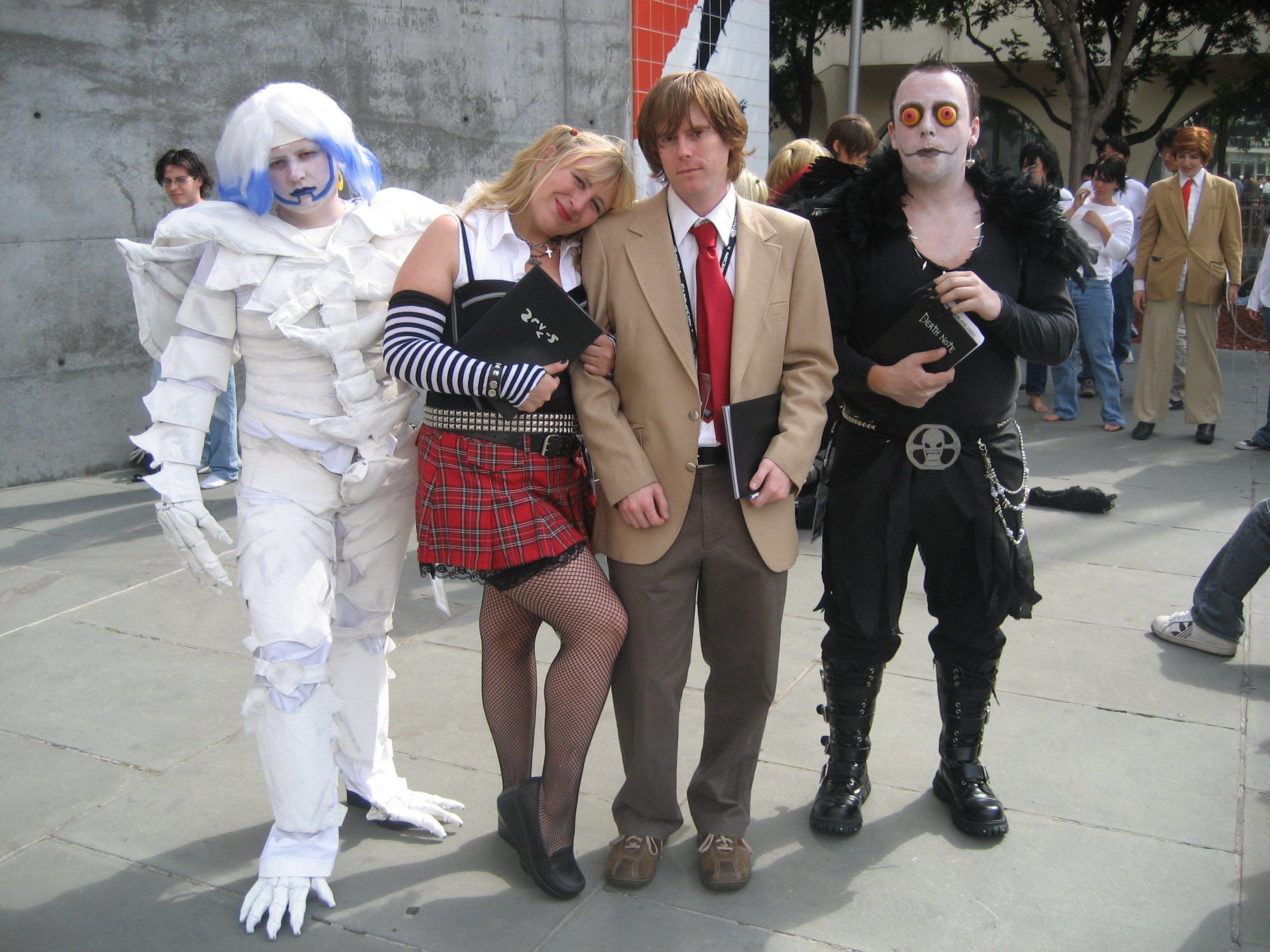
Death Note Cosplay: Misa and Light are in the center, flanked by their respective "Shinigami," or the death gods they are working with
Death Note Cosplay: Misa and Light are in the center, flanked by their respective “Shinigami,” or the death gods they are working with

from the manga Death Note, the Sorceress from He-man, a Star Fleet officer from Star Trek: The Original Series, and most recently, a giant “Angel,” Sachiel from Neon Genesis Evangelion.

Sachiel from Neon Genesis Evangelion: I am trying on my almost finished costume here!

I am currently planning a to make a Metroid out of an umbrella and to cosplay Nyan-kitty at the May conference that my husband (who will be playing Tac-nyan), my sister and many of my friends attend.

So, why the feminist-anxiety?  Continue reading “Cosplay and Choice by Sara Frykenberg”

Marriage as a Commodity (Satisfaction Guaranteed) by Michele Stopera Freyhauf

Freyhauf, Feminism, Religion, Durham, Old Testament, Blogger, Bible, Gender, Violence, Ursuline, John CarrollThis Saturday I will be presenting a paper about Cyberbrides at the United Nations Commission on the Status of Women.  While my focus for that paper is the impact on mothers and families, my research also revealed how some Cyberbrides (or Mail-Order Brides) are selected from internet catalogues with “satisfaction guaranteed” and how “International Marriage Broker” may be a cloak hiding the agencies’ involvement with human trafficking.

Cyberbrides are essentially mail-order brides, but like pen pals, they can chat and exchange pictures on the Internet and interact through video or instant chat.  There are almost 2.9 million website matches that turn up when Google-ing “Mail-Order Brides” within 19 seconds of pressing the “return” button. With the low cost of social media, a new venue to market and display this “commodity” is available.  Presently,  about 30 Facebook sites exist that advertise “Mail-OrderBrides. Continue reading “Marriage as a Commodity (Satisfaction Guaranteed) by Michele Stopera Freyhauf”