Olwen, Welsh Flower and Sun Goddess by Judith Shaw

Judith Shaw photoOlwen (pronounced OHL-wen ), Welsh Flower and Sun Goddess is most probably an ancient Goddess whose original stories and power have been lost to us. Her name means “Golden Wheel,” making Her the opposite of the powerful Sky Goddess, Arianrhod who was known as “Silver Wheel.”  Wherever Olwen walked four white trefoil clover flowers sprung up with each step, thus earning Her the nickname “Lady of the White Tracks.” She was known as the “White Lady of the Day” or “Flower-bringing Golden Wheel of Summer.”

Continue reading “Olwen, Welsh Flower and Sun Goddess by Judith Shaw”

Goddess Politics and the Cauldron of Memory by Kavita Maya

KavitaMaya‘Someone needs to gather the stories, to keep the cauldron,’ said the late Goddess feminist artist Lydia Ruyle during one of the last times we spoke, at the 2014 Glastonbury Goddess Conference. I had hinted at my concerns around conducting doctoral research in the presence of ongoing conflict within the Glastonbury Goddess community (especially when my broadly-stated site of interest is ‘politics’), and in reply she had stressed the need to ‘hold space’ for the different voices and perspectives in the UK Goddess movement, and that conflict would be inevitable. ‘There needs to be a weaver,’ she said.
The following day I recorded an interview with Lydia and some of her friends at Café Galatea on the High Street, which she had been keen to ensure since the previous summer—with poignant foresight, given her death in March 2016. I’m not sure if she was expecting that I should fully take on the role of this ‘weaver’—there are more stories than one PhD thesis can claim to encompass—but the theme is present in my writing. Her words lead me to reflect on the weaving together of politics with memory and storytelling, and on the need to honour the plural histories of the British Goddess movement. Continue reading “Goddess Politics and the Cauldron of Memory by Kavita Maya”

Facing the Moon Alone by Molly Remer

February 2016 030

“When all is said and done I think every Witch should, at some time, face the moon alone, feet planted on the ground, with only his or her voice chanting in the starry night.”

–Laurie Cabot, Power of the Witch

I will never forget the first time I heard someone recite the Charge of the Goddess from memory. Bare-breasted, she strode around the fire in sacred circle at a large goddess festival in Kansas, delivering the words with power, grace, and confident resonance. I thought: I will do that someday.

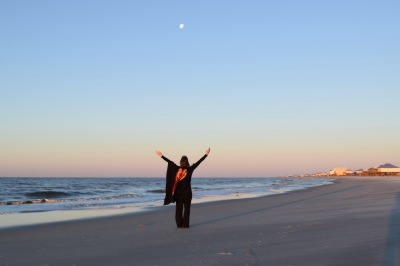
In February of this year, we took a family trip to Dauphin Island. While there, the afternoon of the full moon, I February 2016 148
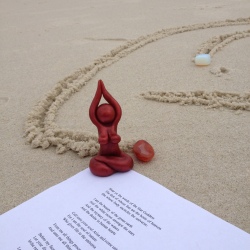
decided that the time had come. I was going to memorize the Charge of the Goddess. First, I thought I would only memorize it a piece at a time. It seemed “too big” to do in a single sitting. I had it printed out on a piece of paper that rapidly became damp with the salty sea air. I drew a labyrinth in the sand with my toes, set one of my goddess sculptures at its entrance, and drew a Womanrunes card.

One stanza at a time, slowly I began to repeat the poem* aloud:

hear ye, the words of the star goddess
the dust of whose feet are the hosts of heaven..
.

Over and over, I said the words, letting them twine around my tongue and in the air, experimenting with cadence and rhythm. After I could reliably repeat one section, I’d move to the next, letting it build in my memory until I could put the two together confidently and then moving to the next.

I am the beauty of the green earth
the white moon amongst the stars..

I stared into the waves, listening to them rise and fall along with my words. My three older children dug in the sand. February 2016 073
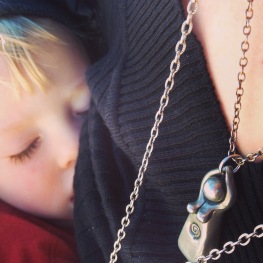
My husband fished. My toddler toddled around and then came to sit on my lap and nursed to sleep for nap time:

before my face
beloved of all…

I whispered into his damp hair. I felt in an altered state of consciousness. The words began to wind their way through me, becoming a part of me, embedded in me. I danced with them as I have never danced with another piece of writing. I felt them merging with me. I sang them aloud. I stated them fast and slow and I built, adding the next line and then the next…

for behold, all acts of love and pleasure
all my rituals.

I turned over hard thealogical questions as the words spun their magic through the air. What does it really mean that “all your learning and seeking shall avail you not, lest your know the mystery.” Do I really feel the goddess within? Do I find her within myself or is she only outside and if she is only outside, does she really exist at all? Tears came to my eyes: do I even like myself?

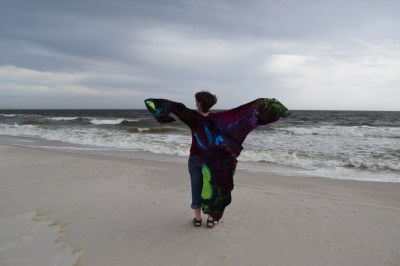
Two hours passed. My baby awoke and returned to digging in the sand. My husband packed up his fishing gear. The sky began to darken and spit rain. I stood and danced the words into the sand with my feet.

let your divine innermost self
be enfolded
in the rapture
of the infinite

I felt rapturous. I felt triumphant. I had done it. Faster and faster my feet stamped the sand as I called the words into the waves. I spun in circles with my toddler chanting and laughing and offering my devotion before the sea, beneath the moon.

the mystery of the waters
the desire in human hearts…

February 2016 179

*I used Shekhinah Mountainwater’s adaptation of the Charge, originally by Doreen Valiente, as included in the book Ariadne’s ThreadMolly 180

Molly has been “gathering the women” to circle, sing, celebrate, and share since 2008. She plans and facilitates women’s circles, seasonal retreats and rituals, mother-daughter circles, family ceremonies, and red tent circles in rural Missouri and teaches online courses in Red Tent facilitation and Practical Priestessing. She is a priestess who holds MSW and M.Div degrees and recently finished her dissertation about contemporary priestessing in the U.S. Molly and her husband Mark co-create original goddess sculptures, ceremony kits, and jewelry at Brigid’s Grove. Molly is the author of Womanrunes, Earthprayer, and The Red Tent Resource Kit. She writes about thealogy, nature, practical priestessing, and the goddess at her Woodspriestess blog. 

Blodeuwedd, Celtic Flower Goddess by Judith Shaw

judith Shaw photoBlodeuwedd, also known as the Ninefold Goddess of the Western Isles of Paradise, was a Goddess like no other in the manner of her birth.  She is one of the main figures in the Mabinogion, the Welsh cycle of stories of the early Celtic Goddesses and Gods.  But to understand Blodeuwedd, her short life, her actions, and her death we must look back to the story of Arianrhod, Celtic Sky Goddess.
Continue reading “Blodeuwedd, Celtic Flower Goddess by Judith Shaw”

Reflections on Researching the Goddess Movement in Britain by Kavita Maya

KavitaMayaI’ve been asked by both academics and Pagans what inspired me to pursue doctoral research on the British Goddess movement: of the many ways that people first click with feminist politics, a story entwined with a ‘spiritual’ impulse might seem unusual, given the slow-to-change secular assumptions of mainstream feminism.

When I reflect on my history, two threads at the core of my early feminist identity leap out: one, the value of thinking and asking questions; the other, ‘feminist spirituality’, which for me describes a profound emotional, intellectual and creative investment in the struggle for a fairer, more inclusive world. Two early ‘click’ moments: as a child, asking persistent questions about the sexist gender roles modeled by those around me (and being told “You’ll understand when you’re older,” which I now recall with a grim irony), and—perhaps unusually—coming across the concepts of patriarchy, feminism and the Goddess by way of 1990s teen fiction about witches. Continue reading “Reflections on Researching the Goddess Movement in Britain by Kavita Maya”

Niamh of the Golden Hair by Judith Shaw

judith Shaw photoNiamh (meaning ‘bright’ or ‘radiant’) of the Golden Hair, one of the Tuatha de Danann and daughter of Mannanan mac Lir, Celtic God of the Sea, was Queen in the land of Tír na nÓg (pronounced Tear na Noge), the most famous of the Celtic Otherworlds.

Continue reading “Niamh of the Golden Hair by Judith Shaw”

Four Reasons We Need To Reclaim The Power of the Divine Feminine Now by Mary Petiet

Mary Petiet photo(Spoiler alert:  She’s already here)

The power of the divine feminine taps into the power of life. The power is accessible to everyone as the equal opportunity energy surrounding and connecting all living things. The power is ancient, and meditative practices such as yoga, which in Sanskrit means linking to the divine, can connect us to this power. When we make the connection, we find the balance we need to realize our highest selves, and through that balance we can realize the highest self of the larger society.  To reclaim the divine feminine, we need only remember, and as more and more of us remember, we heal first ourselves, and ultimately the planet.

1. She is the route back to the self.

In her mother aspect the divine feminine offers a route back to the self and She is all-inclusive. She embraces all of creation, men, women and nature, and we find Her when we reach back far enough into history and our own consciousness. She was there from our very beginning, through the Paleolithic and the Neolithic, when we celebrated her in carved figurines. She was there when we made the shift to agriculture, clear as the full moon, the goddess with her circular all encompassing worldview, birth, life, death and birth again. The goddess as mother, the goddess whose body is the earth which nurtures us all. She is there now in your deepest consciousness, you need only remember, and when you do, She will guide you back to yourself.

Continue reading “Four Reasons We Need To Reclaim The Power of the Divine Feminine Now by Mary Petiet”

It’s Autumn in the Southern Hemisphere – not Spring/Eostar by Glenys Livingstone

GlenysDespite the chocolate bunnies, eggs and toy chickens in the shops along with the coaxing to buy and celebrate Easter at this time in Australia, it is not Spring: Earth here does not seem to co-operate with the Consumer Faith, built as it is around the Northern Hemisphere and dominant Christian calendar. In the Southern Hemisphere it is Autumn, the dark part of the day is lengthening.

On March 20th at 4:30 UT Earth will be perfectly poised in balance for a moment: it is a global moment of Equinox – one of the annual two. Humans have celebrated it for millennia, perhaps for many tens of thousands of years, in ways appropriate to various regions, in both the South and the North of the Planet. The light and dark parts of the day in the South and in the North of our planet, are of equal length at this time. In the Northern Hemisphere it is Spring, and Easter is commonly celebrated: with those of Earth-based tradition celebrating the moment and season of Equinox with the name of Eostar. Continue reading “It’s Autumn in the Southern Hemisphere – not Spring/Eostar by Glenys Livingstone”

Caroline Schelling’s 4th Letter by Stuart Dean

Caroline Schelling

Caroline Schelling (‘Caroline’) wrote the fourth letter of hers that survives (the ‘4th Letter’) on October 7, 1778, shortly after she had turned 15, to a girl she met at boarding school who was to become her lifelong friend (Luise).  The intensity of her friendship with Luise is evident already in the 4th Letter, for she tells Luise that in writing to her she “portrays her entire soul.”  What prompted such depth of feeling for this letter relates not just to a significant moment in Caroline’s life but in every person’s life.  In the second paragraph she refers to what was most likely her first sexual relationship.  Given that context, Caroline demonstrates remarkable emotional maturity and intellectual sophistication in how she expresses herself.

She begins by referring to the “sensations of my heart,” telling Luise how she struggles to find “adequate words” to express them.  She is not, she proudly insists, an “enthusiast” who simply gives into feelings, insisting instead on the importance of “going over” (Überlegung) them herself.  Though Caroline was not taught Latin, it seems as if she had been taught the relevance to German of a Latin treatise from the 4th century CE on the method for defining words.  Caroline’s ‘going over’ her feelings before writing Luise is consistent with its methodology: first, to confront the question of whether something even exists (an sit, Existenz) and then determining, to the extent possible, what it is (quid sit, Wesen) and what its qualities are (quale sit, Eigenschaften)–i.e., its relationship to other words (grammar) and hence how it can be communicated.  

This methodology, which is applicable to a wide range of disciplines (e.g., legal argumentation, psychiatric diagnosis), is also analogous to a language theory Charles Segal argued is implicit in what remains of the writings of the 5th century BCE Sicilian Gorgias, a theory Segal related to Sappho’s poetry.  That is relevant, because given the failed sexual relationship about which Caroline writes to Luise, the 4th Letter bears comparison to two poems by Sappho (S. 31 and S. 1) that Caroline surely then knew in translation.  Caroline’s “sensations of my heart” is directly comparable to the palpitations of the heart Sappho refers to in the second stanza of S. 31.  The immediate effects are comparable; Sappho cannot speak and Caroline cannot find “adequate words.”  Though S. 31 appears to break off, S. 1 can be read as a continuation of it.  There Sappho prays for divine intervention (Aphrodite) to deal with a failed sexual relationship; the closing prayer of its final stanza is analogous to the last sentence of the 4th Letter’s first paragraph: “Lord, you who know my heart . . . fulfill no wishes that are not pleasing to you, I am depending on you!” 

In each case it would seem the answer is anticipated to be one that is not heard or read but rather felt in the heart, intuitively understood as the center point of all bodily feelings.  That would be not an abstraction from the senses but an inward intensification of them.  Such intensification becomes the basis for its outward expression not just in words, but in all forms of art.  

Caroline grew up during a time of renewed interest in ancient Greek art and particularly nude sculpture, which rightly can be taken to symbolize the belief in the sacredness of the entire human body (a belief that correlates with heart centeredness).  It is notable that the floruit of such sculpture predates Plato by almost a century and quite literally embodies principles utterly antithetical to his philosophy.  It is also analogous to another art form that predates him and that he disparaged: reciting poetry (whether or not incorporated into a theatrical production).  Poetic recitation requires fully identifying with the poet and poem to such a degree that it can be thought of as internalized sculpting.

The principles underlying sculpture and recitation are thus similar and of general applicability.  Caroline, who enjoyed (and was appreciated for) reciting poetry, makes the point in a review she wrote of a book of essays on artistic appreciation (the “Review”).  To judge art, she says, it is necessary to penetrate “deeply into the meaning and sensibility of both it and its initiator . . . surrendering oneself in quiet reflection to a disposition of loving, receptive observation . . . [to be] transpose[d] . . . into the world of the poet or artist.”  She defends the book’s use of a fictional friar to voice religious reverence for art, effectively equating artistic appreciation with religious devotion, since it is only from feeling the divine within (i.e., internalizing god as the artist) that the divine outside is to be understood.   

This was not something new for Caroline, as is evident from the 4th Letter that was written nearly twenty years before the Review.  Not only does she seem to have internalized Sappho, but the opening line of S. 31 (a man, “equal to the gods”) and the closing line of S. 1 (“my comrade,” the goddess) arguably encouraged her transition in the 4th Letter’s first paragraph from describing her feelings to Luise (psychology) to praying to God (theology).  That transition anticipates the identification of psychology with theology Caroline articulates in the Review.  

The remote antiquity of this identification and its association with goddess worship to which Sappho attests, as well as the recognition of it by Caroline at such a young age deserve attention, for it has quite a history, especially in German culture.  Goethe quoted two lines of a 1st century CE Latin poem on astrology that essentially echo it in the guestbook atop Mount Brocken on September 4, 1784: who is able to know heaven except by a gift from heaven, who finds god unless a part of the gods is within them.  It is not known when Caroline met Goethe; it has been speculated that he was the father of her first daughter, Auguste, born April 28, 1785.  In August 1784 Caroline was living in a mining town not far from Brocken.

The opening paragraph of an essay published by Caroline’s third husband in 1809, only months before her death, contains a reference to the principle of knowing the god outside from the god within, correctly noting that its connection with Empedocles proves it predates Plato.  In 1936 Heidegger characterized that essay as “one of the most profound works” of Western philosophy.  In my next post(s) I hope to show that its profundity relates to a critique of Plato (and other philosophers) that derives from Caroline and her appreciation of ancient Greek female spirituality, and not to glorifying supermen.

Stuart WordPress photoStuart Dean has a B.A. (Tulane, 1976) and J.D. (Cornell, 1995) and is currently an independent researcher and writer living in New York City.  He has studied, practiced and taught Tai Chi, Yoga and related disciplines for over forty years.  Stuart has a blog on Sappho and the implications of her poetry for understanding the past, present and future: http://studysappho.blogspot.com/

“Seeking Harbor in Our Histories” – ASWM 2016 Conference

aswmThe Association for the Study of Women & Mythology (ASWM) will be hosting this year’s Conference, “Seeking Harbor in Our Histories: Lights in the Darkness” at the Boston Marriot Burlington Hotel on 1-2 April 2016.

ASWM conferences strive to support the scholarship, artistry, & practice of those who explore and engage the sacred feminine through study and creativity. Offering keynote presentations at this year’s conference are Dr. Elinor Gadon, Dr. Margaret Bruchac, and Dr. Lucia Ciavola Birnbaum.

On Friday night, there will be a plenary session and book-signing moderated by Miriam Robbins Dexter and Vicki Noble and featuring Max Dashu, Starr Goode, Mama Donna Henes, Donna Read, Genevieve Vaughan, Cristina Biaggi, Lydia Ruyle, Miranda Shaw, Elinor Gadon, and Susun Weed. They will be sharing stories from the anthology, Foremothers of the Women’s Spirituality Movement: Elders and Visionaries. FAR contributor Carol P. Christ has a chapter in the book.

FAR is excited to share that three of our contributors are on this year’s conference schedule!

Nancy Vedder-Shults will be joining the “Artists, Activists, & Scientists and the Lineage of the Goddess” panel with her presentation, Science and Divination: The Blurring Lines between the Secular and the Sacred. 

Jill Hammer will present The King and the Priestess: Mythic Motifs and Motives in the Tale of Judah and Tamar as part of the “Male-Female Relationships in the Hebrew Texts: Three Feminist Analyses” panel.

Kate Brunner will be participating in the “Women’s Spirituality, Transformative Scholarship and Personal Quest” panel with Rhiannon, Great Queen of the Mabinogi: Ancient Mythology in Modern Context. She will also be offering her meditative writing workshop, Becoming Branwen the Peaceweaver. 

In addition to the main conference, there will be a Matriarchal Studies Day seminar and celebration, in the same location the day before (31 Mar). Hosted by Vicki Noble and Lydia Ruyle, the program looks to be a great addition to the weekend. Dr. Heide Goettner-Abendroth, founder of Modern Matriarchal Studies will present via Skype. Other presenters will include Max Dashu, Polly Wood, Beverly Little Thunder, and Genevieve Vaughan, exploring woman-centered arts, themes of motherhood, and the gift economy. There will be a keynote presentation by Lucia Chiavola Birnbaum, and evening entertainment by folksinger, Julie Felix.

For registration information & more conference details, see the ASWM 2016 Conference blog.

Feminism & Religion Project contributors past, present, & future interested in connecting with FAR at the conference, are encouraged to get in touch with Kate Brunner at feminismandreligionblog@gmail.com. If there is enough interest, we may be able to organize meeting up for a meal together some time during the weekend.