


As Above So Below
Yes, I believe we are made in god’s image.
If god is the wild, passionate, loud, sexual, sizzling, dancing fires of creation.
And should I ever forget my fiery, heavenly vision, the sun comes out every day to remind me.
And I ask myself, which is more miraculous? Our local star feeding earthly life?
Or me, reflecting the sun, feeling the passion, sizzling in response?
Jacob Dreams and So Do We
(inspired by Genesis 28:12)
As darkness slips into light,
dawn,
with its unique melody,
grows brighter.
As light slips into darkness,
dusk,
with its mysterious possibilities,
settles softly upon the land.
Creation is oneness, but we need duality to experience sex, symphonies, hot fudge sundaes.
Creation is pure love, but it is to the passions of the human heart that we owe our earthwalk
Dawn and dusk hold open the thresholds of mystery inviting our human hearts to experience . . .
The sacred dance where one becomes two becomes three.
The sacred song where three becomes two becomes one.
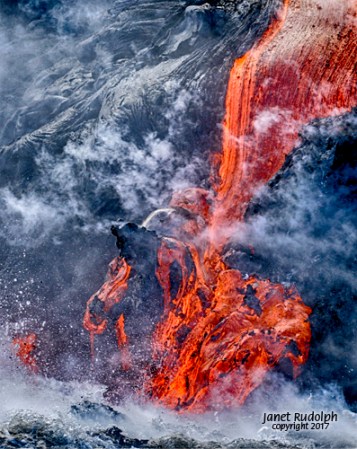
Pele’s Birth Dance
Twinkling stars ignite waves of fire that explode into a tumultuous, joyful noise:
“EH YEH, EH YEH, EH YEH.”
And Mother Earth awakens.
Matter bathed in Pele’s cauldron flares up, erupting into waves of baby earth while roaring:
“EH YEH, I AM, EH YEH.”
As seeds rise from great watery oceans of fire, my heart swells, breathing air into newly forged matter and causing my breath to become song:
“I AM, EH YEH, I AM.”
Fire,
that reflects flame-drenched stars,
that reflects Pele’s dance,
that reflects the passionate seed,
echoes within my belly until I glow with waves of love which burst forth to sing:
“I AM, I AM, I AM.”
And then . . .
Riding a watery wave that gushes forth new life, my newborn erupts from my body, then twinkles, then cries tumultuous joyful noise:
“EH YEH, EH YEH, WAHHHHhhhhhh.”
(Note: “Eh yeh” is God’s name in phonetic Hebrew as given to Moses in Genesis 3:14. “I am” is its traditional translation into English)

Janet Rudolph has written three books on the subject of ancient Biblical Teachings. One Gods: The Mystic Pagan’s Guide to the Bible, When Eve Was a Goddess: A Shamanic Look at the Bible, and the just recently released book, When Moses Was a Shaman. For more information visit her website at /www.mysticpagan.com/
 Enter
Enter 
 One of the projects I am working on these days is an essay on the religion of ancient Crete for a series of books on various aspects of the Minoan site of Gournia.
 The Torah parshah Ki Teitzei, Deutornomy 21:10 to 25:19, contains 74 of the 613 commandments/mitzvot found in the Torah. These mitzvot cover a wide range of topics and concerns. For example, there are mitzvot about how to sow and harvest your fields and others about aiding those in need, including animals. Some of the mitzvot describe how and why divorces can be decreed, to whom can one charge interest, and the punishments for various crimes. There is a mitzvah concerning the requirement to erect a fence on one’s roof to prevent people from falling off, one about not wearing clothes of the opposite gender, one about returning and/or caring for lost property and another detailing from what type of material one’s clothes can be made.

 It’s about every three years when we at Feminism and Religions put out a solicitation for a new intern to join our team. Back in 2013 we had the great privilege of having
