Me, Too: How do we heal rape culture? — Part 1 by Trelawney Grenfell-Muir

Along with others, I have felt relief, sorrow, and frustration watching hundreds of “me, too” posts and narratives flood my feed. Relief that our society is paying attention to the epidemic of misogynist violence in a new way, that we are having crucial conversations about how bad it is and what to do about it. Sorrow at the amount of suffering and oppression it highlights (I will not say reveals… anyone who bothered to look would know the scope and severity of this nightmare). Frustration that it seems no matter how many media campaigns emerge – #VDay, #YesAllWomen, etc – I cannot tell whether we are making any progress at all. It does not seem to me that my daughters are any safer today than they were ten years ago. If anything, it seems that our culture has begun accepting open, flagrant misogyny in new and unprecedented ways and degrees.

However, it does seem that more and more people are pointing out that in order to stop most rape and harassment, we must teach boys and men not to rape and harass people, especially not girls and women who are the main victims of abuse. Various types of pledges, apologies, question prompts, confessions, and other statements from male allies have emerged on social media. In addition, there’s the usual round of women criticizing each of these responses from male allies. As usual, the Left loves to eat its own.

I view allies on a spectrum, and I try to recognize where different men are on this spectrum, and how to help them move forward to the next level. If we truly want to heal rape culture, if we truly want to build a world that is safer for each generation, we must put down our egos, our need to win every argument, our smugly satisfied self-righteousness, and adopt effective strategies that will actually do what we claim to want to do. Continue reading “Me, Too: How do we heal rape culture? — Part 1 by Trelawney Grenfell-Muir”

In Memory of Joseph R. LaGuardia: The Good and Faithful Servant by Gina Messina

There are so many massive tragedies in the world that need to be addressed at the moment. However, for me, there is only one that I want to write about today and it is the passing of my dear friend, Joseph LaGuardia. Although he often referred to himself as a “nobody,” Joe is a person who touched countless lives and made our world a more loving place.

Joe was the first person to welcome me to Ursuline College more than four years ago. Before I began my position as dean, Joe, who was serving as interim dean, met with me every week for about 2 months. As we both transitioned to new roles, we exchanged gifts without knowing the other had purchased one. We laughed that we both bought each other books. Joe shared with me his book of poetry Life Seasons, which of course is brilliant. And I gave Joe the book The Presidents’ Club and joked with him that as only those who had served as presidents knew what it was like in the oval office, he and I were in the Dean’s Club, and we were among the few who knew what it was like to serve in the dean’s office.

I was so fortunate that Joe agreed to continue to mentor me and we met weekly for breakfast, lunch, etc. to discuss how to manage the many things that would pop up in the world of academic administration. It was not long before Joe and I became very close friends. Continue reading “In Memory of Joseph R. LaGuardia: The Good and Faithful Servant by Gina Messina”

Restricting Access to Birth Control is Immoral by Katey Zeh

On a hot August day in 2012, I was taking my usual monthly trip to Walgreens to pick up my birth control prescription. As I pulled out my wallet to cover the co-pay, I was pleasantly surprised when the pharmacist informed me that I didn’t owe anything. It was the first month that the contraceptive mandate included in the Affordable Care Act required health insurance companies to provide contraceptives without a copay.

pills-1354782_1920

Over the years my birth control pills had cost me between $30-50 a month. It might not sound like much, but as a young professional working in the nonprofit sector, it was something I had to budget for carefully. I was also paying my own insurance premiums at the time. Throughout most of my twenties I worked as a contractor, which meant I didn’t qualify for employer-provided insurance, and with my limited budget, I had to settle for less-than-ideal coverage.

When I discovered that the cost of my birth control would be covered completely under my premiums, I wanted to show my appreciation to the Obama Administration. I quickly snapped a picture of my pharmacy receipt that showed my total as “$0.00” and posted in on Facebook with the simple phrase, “Birth control with no copay. Thanks Obamacare!”

tumblr_m8exo7olqp1rdr9obo1_1280

The next morning I woke up to find my image had gone somewhat viral after the Planned Parenthood and Barack Obama social media teams had shared it on their platforms. I had a lot of support, but as you might imagine, the backlash was hellacious. I was incredibly grateful that I’d been wise enough not to capture any of my personal information in the picture I’d taken. Here are a few examples of the messages I got.

“I don’t want to pay for you to have the power to sleep around.”

“It really disgusts me that MY tax dollars are paying for other people to have protected sex and abortions. That money could go into my college fund or help pay for a car or help pay for medication that I actually NEED, but nope. The government decided that my money is better used to pay for someone else to have protected sex. I really hope you all enjoy spending MY hard earned money.”

There’s absolutely nothing factually accurate about these two comments from trolls–I was in a committed relationship and paying for my birth control prescription through paying my insurance premiums–but they do capture some of the most common arguments made against women having the ability to make decisions about our bodies and lives.

  • Women who have sex and want to avoid pregnancy should be shamed.
  • We should not do anything to support a woman making a decision about her life and body.
  • Any social program that supports women’s reproductive decision is a burden on taxpayers.

The pervasiveness of these beliefs and the disdain for women’s autonomy among white conservative men is why the Trump administration has no qualms about its plans to rescind this policy that has helped over 55 million women over the last five years. What is the premise of this decision? Religious freedom.

There is nothing moral about restricting a person’s access to the tools and resources they need to plan their lives, care for their bodies, and dream about their futures.

In March of 2014 I stood outside the Supreme Court building to speak my truth in protest of the argument of “religious freedom” used (successfully, I hate to say) in the Hobby Lobby case. I spoke these words:

As a young woman, a family planning advocate, and a Christian, I stand in solidarity with millions of women in this country whose access to contraception is at stake today.  I do this not in spite of my faith, but because of my faith.

I stand upon the firm foundation of my Methodist faith that has declared health care as a right, and access to contraception a moral good that enables women and couples to make responsible, ethical decisions about the timing and spacing of their families. To permit an employer to restrict that access through financial hardship or other means would impose upon my religious freedom—and the religious freedom of millions of other like-minded people of faith.
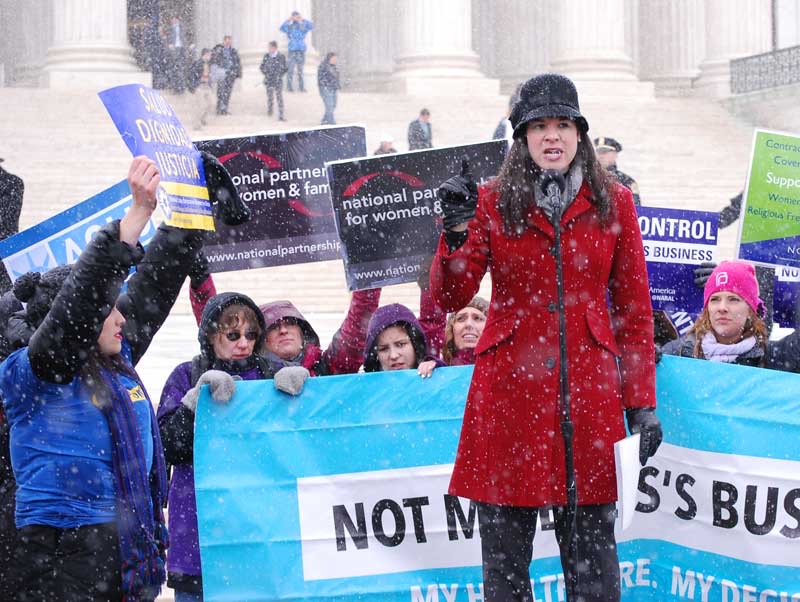
scotuszeh11.jpgWhat few people knew at the time was that when I gave that speech,  I was 10 weeks pregnant with my daughter who will turn three later this month. It was a planned pregnancy and a cause for joy in my life, even though physically I felt terrible. Looking back now I see how critical access to birth control was in creating the family I wanted. It allowed me to become a parent at the time that was right for me.

Isn’t that what all of us ought to be striving for?

 

RA82Katey Zeh, M.Div is a strategist, writer,  and speaker who inspires communities to create a more just, compassionate world.  She has written for outlets including Huffington Post, Sojourners, Religion Dispatches, Response magazine, the Good Mother Project, and the Journal for Feminist Studies in Religion. She is the co-host of Kindreds, a podcast for soul sisters. Her book Women Rise Up will be published by the FAR Press in March of 2018.  Find her on Twitter at @kateyzeh or on her website kateyzeh.com. 

Sisterhood, Service, Sovereignty: The Living Spirit of Avalon by Elizabeth Cunningham

Like so many women, I read Marion Zimmer Bradley’s The Mists of Avalon and got caught up in her vision of the Holy Isle and the priestesses who knew how to navigate those mists and travel between the worlds. Like so many women, I wished Avalon existed still.

In fact, Avalon does exist, because Jhenah Telyndru did more than wish. In 1995 she founded The Sisterhood of Avalon. Twenty-two years later, the Sisterhood is going strong and growing, attracting members from all over the world. I urge you to explore their website where the Sisters speak eloquently about their vision, structure, and purpose.

Continue reading “Sisterhood, Service, Sovereignty: The Living Spirit of Avalon by Elizabeth Cunningham”

An Algorithm for Capturing White Heteropatriarchy: The Woman Caught in Adultery and the Failure of the Civil Rights and Feminist Movements to Embrace Intersectionality by Blanche Cook


The church occasioned one of my first conscious experiences with inequality — Sunday school to be exact. I was nine and bedecked in black platform shoes and a bright pink polyester suit.  It was the 70s, a moment in fashion history never to be revisited.  My Sunday school teacher, a spiritually angelic woman, was explaining the demise of the Woman Caught in Adultery. According to the story, the leaders of law and religion wanted to stone the woman to death for having intercourse with a man that was not her husband.  Although she was vulnerable to the death penalty, the man was not exposed to any punishment.  This lopsided sanctioning plagued my young mind.  Little did I know, I would spend my legal career, as a federal sex trafficking prosecutor and as a legal scholar, trying to vindicate the Woman Caught in Adultery.

Continue reading “An Algorithm for Capturing White Heteropatriarchy: The Woman Caught in Adultery and the Failure of the Civil Rights and Feminist Movements to Embrace Intersectionality by Blanche Cook”

Nobel Peace Prize 2017: ICAN and Those Who Can’t by Elisabeth Schilling

If there is any sanity in the world, it has come from the Nobel Peace Prize of 2017, which was awarded to ICAN, the International Campaign to Abolish Nuclear Weapons. They received the award for the work they have done on the Treaty for the Prohibition of Nuclear Weapons. According to the ICAN site, the agreement was adopted July 2017 and is backed by 122 nations. If signing the Treaty, a nation must agree to refrain from the following:

“[. . .] developing, testing, producing, manufacturing, transferring, possessing, stockpiling, using or threatening to use nuclear weapons, or allowing nuclear weapons to be stationed on their territory. [. . .] A nation that possesses nuclear weapons may join the treaty, so long as it agrees to destroy them in accordance with a legally binding, time-bound plan.”[1] A nation cannot encourage or support another nation to hold them either.

Continue reading “Nobel Peace Prize 2017: ICAN and Those Who Can’t by Elisabeth Schilling”

“Queen Sugar:” Must-See Ecowomanist TV by Elise M. Edwards

elise-edwardsHave you been watching “Queen Sugar”?  It is a thoughtful, compelling, and gorgeous TV show that evokes ecowomanist sensibilities.

“Queen Sugar” is a television drama in its second season on OWN, Oprah Winfrey’s network. It was created by celebrated filmmaker Ava DuVernay, who is also the show’s executive producer.  The show has an all-female directing team and an inclusive crew.  Like many of the original series on OWN, “Queen Sugar” features a predominately African-American cast, and like many other programs on the network, it delivers content intended to stir the viewer’s soul.  But notably, “Queen Sugar”’s soulful messages are not mediated by the cadre of life coaches and inspirational leaders often seen on Oprah’s network.  Instead, it is the fictional Bordelon family who invites us to reflect on their world and ours. The series’ three main characters, Nova, Charley, and Ralph Angel, are siblings who take over their father’s sugar cane farm in Louisiana after his death. Their narrative and the lush cinematography that captures it offers viewers the opportunity to consider the complexity, joy, and hardship of African-American characters who are rarely depicted on screen.  The show’s themes and aesthetics are expressive of ecowomanist spirituality.

Continue reading ““Queen Sugar:” Must-See Ecowomanist TV by Elise M. Edwards”

The Last Time, by Molly Remer

I lie in bed with him, cementing the details in my memory. The way the morning air is heavy and green. The sound of last night’s raindrops continuing to drip from the overfull gutters on the roof. The insistent stab of a single-note bird song in the air. His head nestles in the crook of my arm the way it has done every morning for three years. Blond hair against my nose, breathing in the slightly baby smell of him. “This is the last time,” I whisper softly. “We are all done after this. This is the last time we will have nonnies.”

This is not the first last time for me, but it is the last, last time.  The first baby was born 14 years ago and gathered to my breast with all the tenderness and uncertainty and instinctiveness of a first, first. “Do you want nursies?” I whisper to that new little boy, and we begin the next steps in our bond, nursing for nearly three years, until one day, six weeks away from the birth of the next baby boy, I decide that we truly have to be done. I am a breastfeeding counselor for other nursing mothers and I feel like I should want to tandem nurse my two boys. I fondly envision their hands joining across my body, the easy love and camaraderie between them blossoming through this shared time with their mother. But, I feel an intense irritation with nursing while pregnant, nearly a sense of revulsion and the almost irresistible urge to shove away my sweet little boy as I prepare to greet the life of another. I talk to my midwife about my feelings and she explains that with her own two daughters, the agitated feeling at nursing the older one did not go away with the birth of the second, but instead became dramatically worse. After hearing this, I feel panicky and I decide we do, in fact, have to wean. He is a very verbal and precocious toddler and I am easily able to explain to him that it is time to be finished nursing. One night though, he lies in bed with me crying and begging to nurse. He says he really needs to. I tell him, “remember, we’re all done, but if you really, really need me, if you really, really still need to have nursies, you can.” He doesn’t nurse, but instead falls asleep, reassured that while our nursing relationship might be over, I’m still here.

Continue reading “The Last Time, by Molly Remer”

Painting Breast Cancer Goddess by Rev. Dr. Angela Yarber

October is Breast Cancer Awareness Month, though I imagine most of us are already relatively aware. One in eight women will have breast cancer. Pink is everywhere. It’s difficult to find a person who hasn’t been impacted by breast cancer on a personal level. In 2003, my mom was diagnosed. Radiation, a lumpectomy, and ten years later she was dubbed cancer free. When I finished my Ph.D. in 2009, I did a stint as a Research Assistant for a fabulous liturgical studies scholar working on a book that examined and created rituals for women with breast cancer. My task was researching everything written on breast cancer that intersected with feminism, womanism, religion, spirituality, and ritual.


Audre Lorde’s Cancer Journals struck me profoundly. The critiques weighed heavy as a movement that began with destigmatizing breast cancer and offering solidarity to patients has transformed into a pinkified commodity. Whether it’s the lack of transparency in major breast cancer foundations, pinkification, the essentializing conversations that equate breasts with womanhood, lack of access to comprehensive health coverage, the role of the meat and dairy industry in increased risks of breast cancer, the talk of “surviving” and “fighting” as though those who don’t survive aren’t fighters, or the complete lack of representation of women of color in any pink marketing (seriously, do a google image search of “breast cancer headwraps” and feast your eyes upon an endless array of young, white women), breast cancer awareness has been commodified so that helping cancer patients is second to profit. Amidst these pink teddy bears delicately embroidered with the word “fighter,” one can only wonder what we can actually do and offer and create to be supportive of those with breast cancer. What rituals might we offer? What sacred spaces might we create? What is a feminist response? A spiritual response?

Continue reading “Painting Breast Cancer Goddess by Rev. Dr. Angela Yarber”

Empowering Toys and the Problem of Class Divisions by Katie M. Deaver

I recently noticed that I’ve been spending a lot of time thinking about financial security, the way class systems work in the United States context, and how these types of realities inform my feminism.  Part of this is no doubt due to the fact that for the first time in my life I am not a student with multiple part time jobs, but rather am a “real” adult working full time at a job that offers retirement and medical benefits.

As I’ve written about before, I grew up in a poor family in rural Wisconsin and as a result I am often hyper vigilant about my finances.  While I likely go a bit overboard when organizing my budgeting, balancing, saving, and spending this type of organizing is something I can control.  The simple act of paying a bill, or determining how much I can spend on groceries this week gives me a profound sense of safety because for the first time there really is enough coming in to support my basic needs.

Continue reading “Empowering Toys and the Problem of Class Divisions by Katie M. Deaver”