Anne Hutchinson, America’s First Feminist Theologian: 1591-1643 by Carol P. Christ

Carol Christ in Lesbos“She had rather been a husband than a wife; and a preacher than a hearer; and a magistrate than a subject.” Reverend Hugh Peter of Salem

Anne Hutchinson was banished from the Massachusetts Bay Colony for heresy in 1637 and excommunicated from the Puritan Church of Boston in 1638. Her banishment came just three years after she, her husband, and eleven living children arrived in America seeking the freedom to practice their religion as they saw fit. Governor Michael Dukakis pardoned her in 1987. Historian Howard Zinn called her a true American hero.
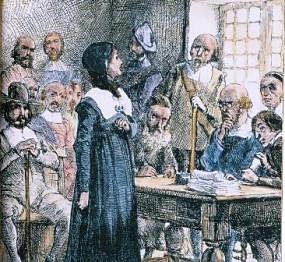
anne hutchinson trialI managed to get through graduate school in Religious Studies without ever having studied the theology of Anne Hutchinson,* though I vaguely remember references (probably with smirks of disapproval) to the “Antinomian Controversy” which is associated with her name. I recall Anne Hutchinson’s name because of an article published in Feminist Studies in the 1970s, when I had just begun to study women and religion. However it was not until recently that I learned of her place in history through reading American Jezebel by Eve LaPlante.

Hutchinson was accused of theological errors in her trials. The Calvinist doctrine of predestination figured heavily in the accusations. But the real issue at stake was that Anne dared to follow her own inner knowing, to articulate it theologically, and to teach her views against the grain of the Puritan authorities in Boston. Continue reading “Anne Hutchinson, America’s First Feminist Theologian: 1591-1643 by Carol P. Christ”
O Madre Nostra Cara by Kaalii Cargill

kaalii-pic-edit

My historical novel, DAUGHTERS OF TIME, traces a line of mothers and daughters through 4000 years as they carry the way of the Goddess from ancient Sumer to the present day. In 1926, a daughter in the lineage is born in Southern Italy:

“Marias family had lived in the village and surrounding area for longer than anyone could remember. Like all the girls of her village, she grew up a Catholic, yet on Christmas Eve she gathered with the other women to perform a ritual in the Church that no man was allowed to see. The words she spoke would have been familiar to her many, many times great grandmother, Meh-tan, who once met a Queen in Ursalimmu.It did not occur to Maria that the ritual was not in keeping with the teachings of the Church; it was what her mother and all the mothers before her had done on Christmas Eve to honour the Great Mother.

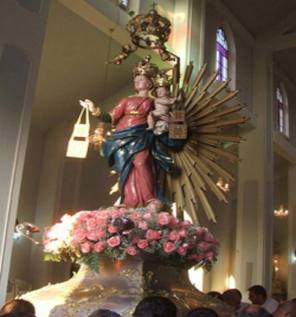
Five years after writing about my fictional Maria, I stood in the church in Calabria where my grandmother Carmella once met with the other women on Christmas Eve. And the Great Mother was still there – the Madonna del Carmine a Varapodio, whom the people call “O Madre nostra cara.”

Kargill

The transition from Goddess to Madonna is very tangible in Calabria . . . Continue reading “O Madre Nostra Cara by Kaalii Cargill”

You Can’t Save Everyone by Oxana Poberejnaia

oxanaIn my previous post here on Feminism and Religion, “Emerging Energy Wisdom” I suggested we should develop new feminist wisdom for young women of the world, which will hopefully allow them to avoid some of the mistakes we have made (some irreparable). The gist of that wisdom would be “conserve your energy!”

Some of these mistakes originated in our being unaware of the limitations in a patriarchal society. I for instance thought that since I knew I was intelligent powerful and energetic I could affect any positive change I wanted. I also believed I could help anyone. I disregarded my own needs, including energy needs, as well as being blind to the objective conditions of patriarchy.

Today I would like to give an example, from fiction, of how this energy wisdom might work. In its application, I believe, this wisdom is related both to the Buddhist teaching of self-reliance and to the idea that each person must find their own connection to Goddess and God from modern paganism.

Continue reading “You Can’t Save Everyone by Oxana Poberejnaia”

Honoring Our Mothers, Honoring Our Selves by Safa Plenty


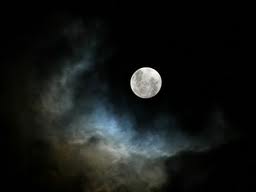
moon

“The moon has always been the primary symbol for female energy; its cycle around the earth takes approximately twenty-nine days, the same amount of time as the average woman’s menstrual cycle. It is often felt that as the pull of the moon affects the waters of the world, so does its motion affect the body of woman.” —Women’s Medicine Ways’ Cross-Cultural Rites of Passage by Marcia Starck 

Her full moon arose today,
sprinkling liquid stardust
onto her bathroom floor,
decorating her mattress
with vibrant hues of deep red,
staining her pajama pants
with artistic, circular symmetry.

For days, she had waited
for the completion of her moon,
while the sun shun
its luminous rays upon her,
the fall equinox bringing that
massive star into greater centrality.

And on a night, her moon had not set,
she sang to the four directions,
shattering myths of tainted womanhood,
tales of storks placing fragile care packages,
under willow trees.

Sang to Grandmother Moon,
Honoring the feminine Divine,
Celebrating her Sacred Waters,
Occupying her sanctified space
for the rejuvenation of Mother Earth,
honoring our Mothers,
honoring our selves.

wpid-wp-1409462860041.jpeg

Safa N. Plenty is currently pursing her Ph.D at Claremont Lincoln School of Theology in the area of Practical Theology, Spiritual Formation and Education. She holds a Masters of Social Work from Columbia University and an undergraduate degree in interdisciplinary studies with a minor in Africana Studies. For the past three years, she has worked as a K-12 education contractor and assistant counselor at a community college. Her research interests include Sufism, Attachment to God, indigenous cosmology, particularly Native American and Australian spirituality and somatic psychology. She is also interested in religious mysticism, mindfulness practice in Buddhism and the role of feminism and religion in cultivating a peacemaking capacity among young Muslim women. She is currently working to develop a faith based healthy relationships program for Mothers and Daughters. She enjoys writing poetry, research, and contemplative practice and tuning in with nature.

How Shall We Then Live? by Esther Nelson

esther-nelsonPresident Obama, responding to the beheading of American journalist, James Foley, by ISIL (Islamic State of Iraq and the Levant), said, “ISIL speaks for no religion…and no faith teaches people to massacre innocents….ISIL is not Islamic” (August 20, 2014). I don’t believe President Obama realizes the tangled thicket he’s entered with those words.
We don’t like to think of our faith traditions as places that harbor theologies or ideologies that promote death and destruction. We’d rather think along the lines of what Huston Smith (b. 1919), a philosopher and religious scholar, asserts: “If we take the world’s enduring religions at their best, we discover the distilled wisdom of the human race.” So words that reflect “religions at their best”–love, justice, mercy, compassion, peace, fairness, kindness, truthfulness, and charity are what come to the minds of most people when thinking about how faith traditions should manifest themselves in the world.

This proclivity to think of religion as weighted on the side of “best” is most noticeable when faith traditions express themselves dualistically–good/bad, right/wrong, sacred/profane, pure/impure, etc. Those things labeled “bad” most often get ascribed to an anti-god or Satan. Monotheistic religions (Judaism, Christianity, and Islam) have a more dualistic bent than do Goddess traditions, Hinduism, and Buddhism.

In addition, when we understand our sacred writings to be “revealed,” meaning information has been given to humanity by a divine source–information that could not be known other than through revelation–we become more prone to dualistic thinking. The “Revealer of Truth” (God) brings light to a wayward humanity. God (a symbol that often gets reified) easily fills the role of being and defining all that is “good” although “good” is a relative term. Kill a journalist? Bomb an abortion clinic? Start a war? Feed the hungry? Educate children? Eradicate Ebola? Humans have engaged in all these activities in the name of God. Each activity has been defined as “good.” Continue reading “How Shall We Then Live? by Esther Nelson”

You Are What You Read by Martha Cecilia Ovadia

10298689_10104523891581853_7256973903379376739_nWhen it comes to my family, I’ve always felt different. One of my earliest memories from when I was really young was being told that I felt things too passionately—that I felt too much. What was never said but was implied was that I felt dissent too much, too often, too vocally. It made people uncomfortable. It made my family uncomfortable. When it came to understanding my faith/religious path, my family and I started diverging early on, never really meeting again—at least not for now.

When I was about five, I remember asking why women could not be priests. My mother brushed it aside and said we could be nuns. She was blind to the inherent misogyny behind the same Church that so many of her female family members had built (we come from a long line of nuns and Jesuits). I thought maybe someday I could be a woman priest. I would change it all. I would be Pope Joan. 

When I was thirteen, I started noticing the wealth involved in the Roman Catholic Church, the opulence of the lived Catholic life. When I asked my parents why the Church did not lead in example and live in poverty using its wealth to actively live the gospel, I was told, “ This wealth is a gift to humanity. It is there for all of us, a patrimony to those who open their hearts.” I wasn’t talking about art, I was talking about the RCC’s gold assets—valued in the billions —but it didn’t matter. I’ve seen my family donate to Church building funds my entire life—buildings that were then sold off to pay for the Church’s offenses later on. Still, I thought if I became more involved, with the “right kind of Catholics”, I would be able to change the Church from within.  Continue reading “You Are What You Read by Martha Cecilia Ovadia”

Casa Coatlicue by Erica Granados De La Rosa

Erica GDLR 2On a corner adjacent to a cantina, across the street from a home full of barefoot children running through open doorways, and a few houses down from a paleteria y fruteria in San Antonio, Texas, sits a bright white house dressed up in orange trimmings – Casa Coatlicue[1]. Before you walk through the gate you notice a raised bed of herbs, a garden, a large collection of potted succulents, and a metate[2] on the ground. Walking inside you can’t help but smell the sage, copal, and other herbs and incense that have left their smoky traces on the walls of the living room, the kitchen, and then the bedroom. As the house begins to introduce itself, you notice altars in corners and crevices of each room. Your curiosity begins to churn as you notice pictures and canvasses on the walls of ancient and present day cultural symbols, including one poster that reads “This land was Mexican once, and indigenous always,” and a large picture of Selena Quintanilla that captures her warm smile and beautiful black hair. As soon as you begin to take in the colors and ancient smells, the house is introduced to you by name, Casa Coatlicue, the home of four queer young healers, dreamers, lovers, artists, scholars, and spiritual activists who are reclaiming the life-giving traditions of their ancestors.
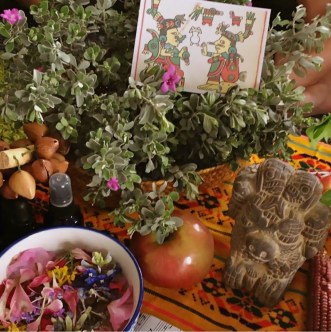
Community altar from  workshop
Community altar from workshop

Earlier this year, I was invited to a curanderismo workshop hosted at Casa Coatlicue. The word curanderismo had an air of secrecy, power, and nostalgia of home for me. I understood curanderismo as the medicine and magic of our grandmothers, and increasingly the forgotten inheritance of our communities. As I spoke with the residents of Casa Coatlicue, we began to identify the chronic erasure and appropriation of brown folks’ spiritual traditions, food, art, and customs by predominantly white, new age culture. Saddened by the loss and the historical disconnect of our people, we collectively affirmed the urgency and importance of relearning and reclaiming our own spiritual traditions not only to tap back into our cultural identity as native and mestizo people but also to tap into a powerful tool for the transformation of our current realities. In the midst of historic and present day manifestations of systemic violence against us – young brown bodies being gunned down in our streets, whole communities being persecuted, incarcerated, and displaced, as well as forced sterilization and assimilation- there is a critical need to tap into radical and sustainable ways to not only resist but to heal. Continue reading “Casa Coatlicue by Erica Granados De La Rosa”

ISIS and the Larger Muslim Crisis by Hanadi Riyad

Hanadi Riyad croppedIt is heartening to hear the many condemnations Muslim scholars have issued of ISIS and its methods and actions. One of the latest attempts comes in the form of an open letter addressed by a coalition of one hundred and twenty six Muslim “scholars” from across the world to Abu Bakr al Baghdadi and ISIS followers and supporters. The seventeen page letter is one of the most detailed responses to ISIS I have read. However, just like other responses, it fell short of my expectations as a Muslim woman. I checked the list of the signatories and I could not find any women amongst them.
I am saddened to note that the authors of the letter fall into the same mistake they accuse ISIS of: they quote some Quraanic verses and Hadiths selectively, out of context, and portray them as sufficient rebuttal against ISIS actions, never mind the sources, verses, and Hadiths ISIS has been quoting just as selectively to justify its crimes. The letter explains about the methodology of Islamic legal theory (usul al-fiqh) that it stipulates “to consider everything that has been revealed relating to a particular question in its entirety, without depending on only parts of it, and then to judge if one is qualified based on all available scriptural sources.” There’s no explicit logical explanation for why the parts of the scripture and interpretations quoted by the writers of the letter should be given precedence over the ones quoted by ISIS.

The implicit reason, however, resides in the authors’ assertion of their authority as Sunni “scholars”  and their opinion as “a scholarly opinion.” We should take their word because they have the authority that ISIS does not. The assumption that ISIS cannot count amongst its ranks scholars is neither explained nor defended. The doctrinal connection between ISIS and Wahhabi ideology upheld by many Saudi scholars – like ibn Baz and his disciples— goes unacknowledged. Continue reading “ISIS and the Larger Muslim Crisis by Hanadi Riyad”

Writing: Changing the World and Ourselves. By Ivy Helman

I still remember the first tim20140903_180423e I read Mary Daly’s Gyn/Ecology. It awoke something within me. Her use of language, the power of her writing and the ease with which she created new words taught me so much about the world around me and about the way the language, and subsequently its use in writing, shapes lives, choices, abilities and destinies. She also taught me about myself.

I was hooked, but not just on Mary Daly. Shortly after I finished her book, I moved onto other feminists writing about religion like Katie Cannon, Judith Plaskow, Alice Walker, Carol Christ, Rita Gross, Gloria Anzaldua, Audre Lorde, Adrienne Rich, Margaret Farley and Starhawk to name just a few. All of them, in fact every feminist I’ve ever read, has shown me the way in which words have power and how words speak truth to power. Ever since, I’ve wanted to be the kind of writer whose words carry a power that not only affects people but also inspires a more just, more equal, more compassionate and more humane world. In other words, I wanted to be a writer activist.

Yet, I’ve always carried around with me a sneaky suspicion that people don’t consider writers true activists. If you aren’t holding a sign, screaming or participating in some sort of public demonstration or civil disobedience, then you have no right to call yourself an activist. Is that really true? Continue reading “Writing: Changing the World and Ourselves. By Ivy Helman”

Painting Mother Teresa by Angela Yarber

angelaOf all my Holy Women Icons, Mother Teresa joins Blessed Mary in being one of the most familiar, and often the one least cited for the cause of feminism. Joining Virginia Woolf , the Shulamite, Mary Daly, Baby Suggs, Pachamama and Gaia, Frida Kahlo, Salome, Guadalupe and Mary, Fatima, Sojourner Truth, Saraswati, Jarena Lee, Isadora Duncan, Miriam, Lilith, Georgia O’Keeffe, Guanyin, Dorothy Day, Sappho, Jephthah’s daughter, Anna Julia Cooper, the Holy Woman Icon archetype, Maya Angelou, Martha Graham, Pauli Murray, La Negrita, Tiamat/tehom, and all my other Holy Women Icons with a folk feminist twist is this holy Catholic nun.

When I first began the Holy Women Icons project, she was an obvious woman who came to mind, but I resisted painting her for several years. Perhaps it’s because her story is so familiar. Maybe it’s because this pillar of humility and service embodies so many virtues that have been used to oppress women for centuries. I cannot quite articulate my resistance, but it was real. Continue reading “Painting Mother Teresa by Angela Yarber”