No Honor for A Career of Hate by amina wadud

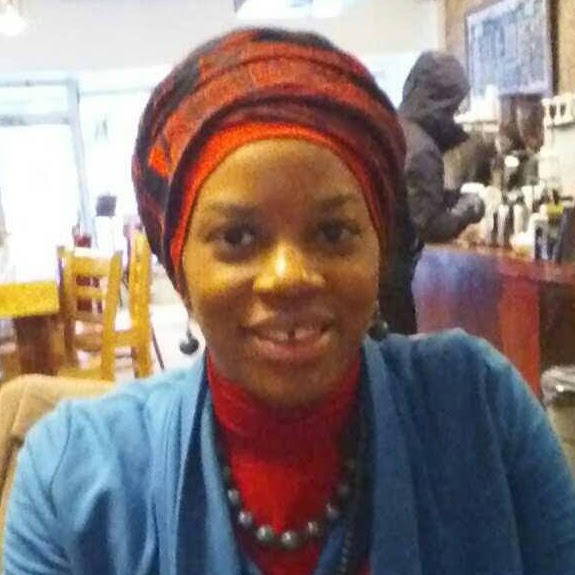
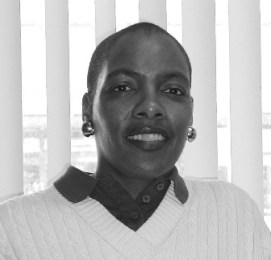
amina 2014 - croppedA recent decision by Brandeis University (founded in 1948 as a nonsectarian Jewish community-sponsored, coeducational institution) to take back its offer to give Ayaan Hirsi Ali an honorary doctorate hit the media with the usual storm over such a controversial figure.

Most of the resistance to her, as a public figure, comes because of her own categorical statements against Islam. Not only does she choose to be an atheist, but she lambasts those who do not make her same choice. Her sweeping statements are meant to galvanize support against the Islam she has suffered from both as a child in a conservative family and as colleague of a brutally murdered film maker. She lost her bid for refugee status in Holland for lying about her past and was taken lovingly into the arms of certain institutions (like the conservative think tank, American Enterprise Institute  and tea party politicians, like Pamela Gellar). All manner of official trickery was put in her favor such that she enjoys something millions of her country men and women from Somalia would probably never hope to see: US citizenship and institutional support. Continue reading “No Honor for A Career of Hate by amina wadud”

What’s Good About Good Friday? by Barbara Ardinger

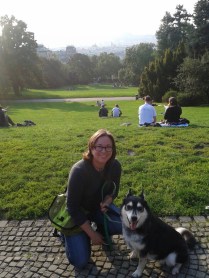
Barbara ArdingerI grew up Calvinist and Republican in a suburb of St. Louis, Missouri. My parents belonged to—but rarely attended—Immanuel Evangelical & Reformed Church in Ferguson, Missouri. When children reached the age of twelve, they were “confirmed” in the church, which meant taking a Bible class taught by the minister, Rev. Press, and then going through a ceremony that made them eligible to take communion, which in that church was grape juice and tasteless crackers. Transubstantiation? I learned what the word meant, but I had (and still have) no idea if it really happens.

Ascension by John Singleton Copley (1775)

I’ve always been one to ask untidy questions, so of course I asked a lot of questions in confirmation class. God tells us half a dozen times in the Old Testament, for example, that he is a “jealous god.” How, I asked Rev. Press, can a jealous god be a loving god? What’s good about a jealous god? (A couple decades later, when I was studying the Aramaic Bible as translated by George M. Lamsa from the Pshitta manuscripts, I learned that the correct word is “zealous.” That was no help. I still don’t see much good in either jealousy or zealotry.) A week or two later, I asked Rev. Press, “What’s good about Good Friday?” Shortly thereafter, my mother advised me to stop asking questions in confirmation class. (Can we assume she’d received a pastoral phone call?) Continue reading “What’s Good About Good Friday? by Barbara Ardinger”

Crucifixion, Resurrection, and the Reversal of Power by Kelly Brown Douglas

Rev.-Dr.-Kelly-Brown-Douglas - Version 2

Within the Christian tradition, this week – l known as Holy Week – is perhaps the most significant week on the Christian calendar.  During this week Christians are called to contemplate and to remember the core events of Christian identity—the crucifixion and resurrection of Jesus.  Given the focus of this week for many Christians I am sharing my theological reflections on the crucifixion-resurrection event.

As I begin this reflection, it is important to recall that which I and others have pointed out in other places. In Jesus’ first century Roman world crucifixion was reserved for slaves, enemy soldiers and those held in the highest contempt and with lowest regard in society. To be crucified was, for the most part, an indication of how worthless and devalued by established power an individual was.  It also indicated how much of a threat that person was believed to be to the order of things. There was a decided crucified class of people. These were essentially the castigated and demonized as well as the ones who defied the status quo of power. It is in this respect that I believe Jesus’ crucifixion affirms his identification with the marginalized and outcasts. Indeed, on the cross Jesus fully divests himself of all pretensions to power and anything that would compromise his bond with those most othered in the world. The reality of the cross further affirms the profundity of god’s bond with put-upon bodies..

Continue reading “Crucifixion, Resurrection, and the Reversal of Power by Kelly Brown Douglas”

Curiosity About Everything and the Language of the Goddess by Carol P. Christ

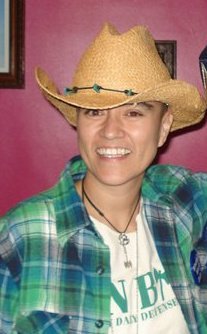
carol christMy recent discovery of Marija Gimbutas on Youtube rekindled my admiration for her work. In her slide-lecture “The World of the Goddess” Marija Gimbutas allows us to follow the line of reasoning she used to decipher the “language of the Goddess” in Old Europe.

Careful attention to her lecture shows that Gimbutas did not close her eyes, dream, and then attach her own ideas and intuitions to the artifacts she later discussed. Rather, she catalogued groups of images with similar symbolism and used her knowledge of nature (what does a water bird or an owl look like?) and folklore (she collected thousands of songs connected to the agricultural and life cycles in her native Lithuania in the 1930s) to unlock the meaning of ancient symbols.

I suspect that most of the critics of Gimbutas lack the knowledge she gained through her wide curiosity about life. Do other archeologists as a group know what specific species of water birds or owls really look like? Do they have the same kind of knowledge of folklore and folk traditions that Gimbutas had?   Continue reading “Curiosity About Everything and the Language of the Goddess by Carol P. Christ”

Pesach, Patriachy and the Unfinished Work of Liberation.

headshot2Pesach, or Passover, begins tomorrow at sunset. It has always seemed strange to me that a festival centered on liberation begins with a focus on housework and cleanliness to the point where one is almost a slave to the process of chametz (leavened food) removal.  Not only that, but the spiritual interpretation of what the chametz represents adds to this conundrum.

The Rabbis of the Talmud teach us that chametz represents egotism and arrogance. The divine instruction to eat only unleavened bread for the festival of Pesach is a call to cultivate humility because they believe that our inflated sense of self-worth causes harm to other human beings as we value ourselves and our lives more than them. As we remove the chametz from our homes, we are also supposed to be removing the self-centeredness, arrogance and egotism within ourselves. Cultivating humility redirects our attention to all those parts of our lives that have suffered by being too self-centered, including our relationship with the Holy One. Continue reading “Pesach, Patriachy and the Unfinished Work of Liberation.”

Painting Maya Angelou by Angela Yarber

angelaAuthor. Performer. Activist. Poet. Actress. Playwright. There are few others whose accomplishments are as prestigious, prolific, or expansive as Maya Angelou’s. I initially encountered her work in a ninth grade literature class. The first of her seven autobiographies was our assigned reading. I voraciously consumed every word of I Know Why the Caged Bird Sings, my heart filled with grief, my eyes filled with tears, my mind filled with questions. It is no wonder this book is the most acclaimed of all her autobiographies, books of poetry, and essays. As a fourteen year-old, my mind was opened to the power of stories, particularly the stories of those vastly different from oneself, and to the oppression black women like Angelou experienced in the United States. As a native white Southerner, I Know Why the Caged Bird Sings was my first foray into grappling with the nuances of white privilege.

In college, my creative writing professor packed all ten of the creative writing minors into a van to drive to a neighboring college where Angelou was lecturing. I sat in awe, riveted by every word. And upon the completion of my Ph.D., I moved to Winston-Salem, the place Angelou calls home. I have yet to meet her. If I could, I’d surely hand her the icon I painted in her honor, knowing that my words would fail to express how profound my gratitude is for the work she has done in our world. Continue reading “Painting Maya Angelou by Angela Yarber”

A feminist closet? by Linn Marie Tonstad

Linn Marie TonstadEvery now and again, a budding systematic theologian comes to my office and wants to talk about how to avoid being pegged as a feminist, and therewith avoid not being taken seriously as a theologian. Sometimes the students are feminists, but don’t want that aspect of their work to dominate or perhaps even to be visible for a time; in other cases, the students aren’t feminist – or didn’t start out that way – but are having experiences as they enter the guild that are raising these concerns for them in a new way. Perhaps professors are assuming that they are feminist simply because they are female, or perhaps male students are dominating in class and the professor is doing nothing to rein them in.

These students seek me out knowing that I am an avowed feminist and an avowedly feminist theologian. But they are concerned about the effects being or appearing feminist might have on their future careers. After all, they want to join the theological conversation in order to shape it – and their ambitions are right and justified. Continue reading “A feminist closet? by Linn Marie Tonstad”

Gendered Imagery of God (Part 2) by Elise M. Edwards

Elise Edwards

In my previous post, I shared some of the ways in which I’ve been wrestling with gendered imagery for God, the first person of the Christian Trinity often referred to as God the Father. In this entry, I’d like to reflect on ways I am reconsidering the gender of the Christ.

It is only recently, after reading Melinda Bielas’ post “Waiting for Jesus… I mean, Superman” (December 17, 2013), that I began to question male language for the Christ. I got into an interesting conversation with Grace Kao in January about it. My thoughts on this topic are still unformed and more theologically “speculative” than I usually share on this site, but I’d love to hear what you think. I think it is important for Christian feminists to consider the doctrines of the faith and assess where they support the co-humanity of women and when they degrade it. Continue reading “Gendered Imagery of God (Part 2) by Elise M. Edwards”

Pap Smears I Have Known by Molly

IMG_0522Your body is your own. This may seem obvious. But to inhabit your physical self fully, with no apology, is a true act of power.”

–Camille Maurine (Meditation Secrets for Women)

“I used to have fantasies…about women in a state of revolution. I saw them getting up out of their beds and refusing the knife, refusing to be tied down, refusing to submit…Women’s health care will not improve until women reject the present system and begin instead to develop less destructive means of creating and maintaining a state of wellness.”

Dr. Michelle Harrison (A Woman in Residence)

One afternoon at the skating rink for homeschool playgroup, a few of my friends sit in a hard plastic booth and the conversation turns to pap smears and pelvic exams. Later, I read Michele Freyhauf’s post about her hysterectomy experience and the skating rink pap smear stories come back to me with vivid clarity.  Being a woman is such an embodied experience and we have so many stories to tell through and of our bodies. During my conversation with my friends, I warn them: watch for my new show–Pap Smears I Have Known. At the time, several other friends are preparing for a local production of the Vagina Monologues and I have a vision: The Pap Smear Diaries. But, really, how often do we have a chance to tell our Pap smear stories, our pelvic exam stories? Where are they in our culture and do they matter? Continue reading “Pap Smears I Have Known by Molly”

Watching “Noah” Brought Me Closer to Humanity by Andreea Nica

Andreea Nica, pentecostalismAs a child, I enjoyed the story of Noah’s Ark. I would often imagine pairs of animals running for safety in Noah’s architecturally majestic haven. Practical questions didn’t enter my mind during this blissful period of naivety. I ignored the part where God expressed regret in creating humanity, or when Noah gets drunk and lies bare naked for his children to cover his shame. My bible study teacher would explain to us that the point of the story was that Noah, a holy man, trusted God and carried out his will.

Disclaimer: I understand that the film is not meant to be an exact representation of the story in the bible, but loosely based around it. Also, if you plan on watching the film, read at your discretion.

In the film, Noah’s character is played by leading actor Russell Crowe, who appears strong, confident, and zealous in his trust in God – all necessary qualities to fulfill God’s demand of killing off the rest of humanity because of their wickedness. Later in the film, Noah realizes that he and his family are also wicked leading to his revelation, ahem, God’s revelation, that humanity must cease with Noah’s family. This doesn’t pan out too well with his children and wife. It was also bad news for Emma Watson, the orphan girl Noah’s family saves and raises as their own, who after accepting that she is barren is miraculously healed and gives birth to two girls. Noah decides that the female infants must die according to God’s will to end humanity. Continue reading “Watching “Noah” Brought Me Closer to Humanity by Andreea Nica”