
The Problem of Jehosheba: Reading One Biblical Character in Two Different Feminist Ways by Jill Hammer

Tucked away in II Kings 11 is the story of a mother-daughter feud that is personal, political, and ultimately fatal. Jehu, a charismatic military commander, is anointed by Elisha as the next king of the northern kingdom of Israel. Jehu kills the previous king of Israel, Jehoram, and also Jehoram’s mother Jezebel (yes, that Jezebel—the famous/infamous queen). As part of his violent rise to power, Jehu also kills Ahaziah, king of the southern kingdom of Judah. Ahaziah’s death should mean that Athaliah (Atalya), who is queen mother of Judah as well as the daughter of Jezebel, cedes power to a new king and a new queen mother. Instead, according to the Book of Kings, Athaliah has the rest of the king’s sons and grandsons murdered, and seizes the throne for herself. 

All seems lost for the Judean line, except that Jehosheba (Yehosheva), wife of the high priest Jehoiada and sister of the murdered King Ahaziah, saves one of Ahaziah’s sons, along with the child’s wetnurse, and hides them both in the Temple. Jehosehba keeps the boy, Joash, and his nurse in the Temple until he is six years old. At that time, Jehosheba’s husband, the high priest, anoints Joash king, stages a coup, and executes Athaliah as a usurper. Jehosheba’s action saves the Davidic line. The collection of Jewish legends known as Otzar Midrashim lists Jehosheba as one of the righteous women of the Jewish people.

Continue reading “The Problem of Jehosheba: Reading One Biblical Character in Two Different Feminist Ways by Jill Hammer”
Beauty in the Heart of the Beholder by Janet Maika’i Rudolph

In the past two years, I began a project which I call biblical poetry. I had been doing my own translations of biblical verse based on the hieroglyphic meanings of Hebrew words. Ancient Hebrew or Semitic Early writing grew out of the hieroglyphs of Egypt. Since hieroglyphs are pictures, we are able to use the rebuses or picture puzzles to glean the original or at least older meanings of words. I have begun to see these a route to interpreting meanings from before the dawn of patriarchy. This door to understanding appeals to my religious/spiritual/feminist sensibilities. At first, I attempted to stay somewhat true to the well-known meanings as they have come down through the ages. When I began my poetry project, I broke out of that structure to reveal the more mystical/shamanic/pagan meanings that I find beneath the words. At the bottom of this post, I have links to a few of my past biblical poetry posts.

The bible is quite large, so this is an encompassing project with lots of material to explore. This month, I wanted to take a look at how the concept of beauty is treated in the bible. The word for beauty is yaphah. Yaphah can also mean miracle and wonder as well as beauty. Let’s stop for a minute to unpack that. When we think of the word beauty in our culture, the thought is generally about how someone looks (unusually a female someone). But just the Hebrew word alone broadens the meaning. If beauty is someone or something that is wondrous and has miraculous qualities than it goes well beyond cultural standards of how someone looks. If you love someone, they would be beautiful to you because they would be wondrous. Biblical usages and translations tend to focus on beauty, mostly women, sometimes cows (yep cows) and a few handsome men in the mix. But I found that yaphah doesn’t have to be a vision that relies on one’s eyes.

Continue reading “Beauty in the Heart of the Beholder by Janet Maika’i Rudolph”

Moses and the Rambo Problem by Janet Maika’i Rudolph

Moses is an interesting character is in the pantheon of religious leaders. He is such a major personage, considered the founder of Judaism and yet there are no extra-biblical accounts of his life and his deeds. He only exists in the bible. You’d have thought that such a major event as leading a whole class of people away from Egyptian slavers, would have shown up on the radar of other written or mythical accounts from the time. Nothing!

Even his name is interesting. When the Egyptian princess gathered Moses out of the waters she said:

She named him Moses, explaining,

“I drew him out of the water.”

Exodus 2:10

This is one meaning of his name. But there are others. In Egypt, the land where he was born and raised, the M-SH (variations: m-s or m-ss) root simply means “son.” Or it can mean “child” in a non-patriarchal sense. We see this in other Egyptian names Ramses is the child of the sun god Ra. Tutmose is the child of Tut. 

Continue reading “Moses and the Rambo Problem by Janet Maika’i Rudolph”

Voice-ing the HEaRt: The Sixty-Six Books of the Bible by Margot Van Sluytman

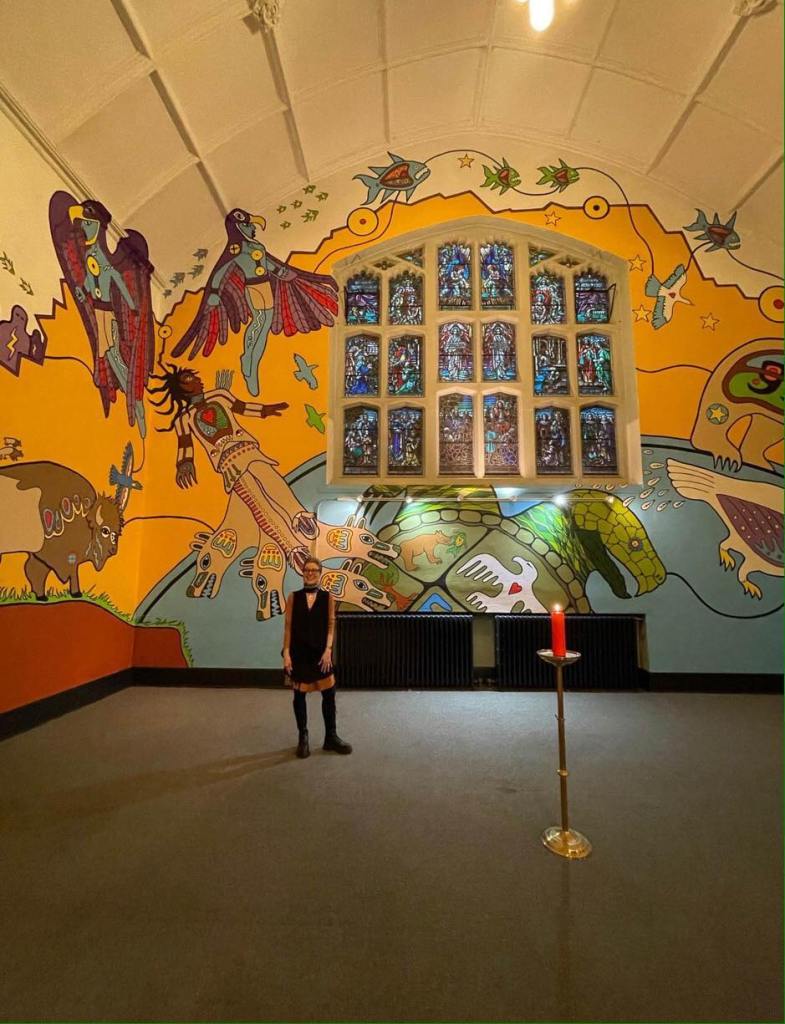
Wall of Welcome, photo by Troy Gonsalves

When Reverend Anne Hines of Roncesvalles United Church in Toronto invited me to write a poem for Easter Sunday 2020, I had no idea that this invitation would become a dance with Word via words, that would alter my very own relating and relationship with my métier: poetry. A relationship that began to take me back into reading The Bible in a manner that shone a powerful light on the fact of that book’s capacity to shake, quake, challenge, and enlighten from the place of love, Wisdom, and indeed, inclusivity.

Each Monday I receive three to four words or phrases based on the book around which the Sunday sharing will be grounded. I read the chapter. I read with the HEaRt of womyn’s voice-ing. I read to unearth, to divine, to HEaR what is being invited, and how. The underpinning of my HEaRt’s listening, is the question: how does Godde wish for us to love?

Continue reading “Voice-ing the HEaRt: The Sixty-Six Books of the Bible by Margot Van Sluytman”

Eden, Eve and a Tale of Seeds by Janet Maika’i Rudolph

Last month I wrote about the Garden of Eden. You can read it here:

In that post, I described how Eden is essentially a garden of treasures. What are those treasures? I believe that they are seeds, the most prolific and creative element for spreading life here on Earth. Below is my own fantastical story about the Garden and how the seeds came to reside there.

Sinuous and serpentine, Hawwah, Hayyat, Eve emerged from Apsû, carrying within her seeds, fertilized eggs, and all the fruitfulness and abundance therein. 

Continue reading “Eden, Eve and a Tale of Seeds by Janet Maika’i Rudolph”

Behold! The Treasures of Eden by Janet Maika’i Rudolph

The place and purpose of the Garden of Eden is a topic of endless fascination and interpretation. This blogpost looks at two biblical passages and the word eden itself to see what we can learn about its meanings. At its most basic, Eden is a garden of treasure and delight.

As I’ve written before, the written form of Ancient Hebrew words comes from the hieroglyphic tradition of Egypt. The pictures of the letters form a picture puzzle or rebus. The word roots are generally two or three letters. I use script called Semitic Early for my baseline of study.

Continue reading “Behold! The Treasures of Eden by Janet Maika’i Rudolph”

Asherah, Blessed, Asherah by Janet Maika’i Rudolph

Once upon a time, the Great Goddess was the spiritual focal point of ancient culture. Her worship included honoring women, living in harmony with the earth, and cherishing the processes of the cycles of nature. Asherah was one of those Goddesses. When the Patriarchs moved in and worked to suppress the old goddess religions, Asherah and her fellow Goddesses were diminished, and in a propaganda coup we might recognize today, defined Her as evil. I imagine that some brave people fought to hold onto the Goddess in Her glory but when they saw they were losing the battle, they encoded Her and Her Sister Goddesses into their cultural mythology. Hidden in this manner, She found Her way into the bible. If we can uncover those codes, we can reclaim Her, others and their Earth-based spirituality.

Continue reading “Asherah, Blessed, Asherah by Janet Maika’i Rudolph”

Heart Vibration: Biblical Poetry by Janet MaiKa’i Rudolph

My inspiration for biblical verses this month comes from the lovely and soulful translations of Rabbi Yael Levy in her book Journey through the Wilderness (subtitled: A Mindfulness Approach to the Ancient Jewish Practice of Counting the Omer). She has given me permission to quote her translations (thank you!). I use 2 of her verses in this blogpost.

One of her translations aspects I found most fascinating is that of YHVH (LORD in the bible). She uses Mystery. I have used Mother/Father Creator, and more lately, Vibration.Being. I love her usage. It taps into the magic that YHVH is the ultimate Mystery of all creation. These beautiful translations are meaningful, differing, yet connected aspects of the holy name. These prism-like views come together to make an even more exquisite truth.  

For today’s blogpost my main focus is on several verses from Psalm 119. It is poetry which talks about the heart and chesed, or in English, lovingkindness.

Continue reading “Heart Vibration: Biblical Poetry by Janet MaiKa’i Rudolph”

A Mystical Journey: Psalm 93 by Janet Rudolph MaiKa’i

Sometimes I’m asked where I get my inspirations for verses to explore. In this case it was from the God Squad’s Rabbi Marc Gellman who discussed Psalm 93 in a recent column. In his analysis, he used Psalm 93 to wax poetic about how powerful god is outside of nature. In fact, he declared that the worship of nature is idolatry because it only points toward God but can’t completely match God’s majesty. Ahem and Excuse me! With my ire raised, I had to go and look at the Hebrew from my own Mystic Pagan perspective. Rabbi Gelman looks at these verses and his take-away is that “God is more powerful than even the most powerful storm.” Ahem and Excuse me again!  

After delving into the Hebrew words, I see a whole other side to this powerful Psalm. I see the “power of God” [as he would say] or the “beauty of the divine [as I would say],” is that most awesome ability to midwife creation and birth. In other words, to make love manifest. I see in Psalm 93, an esoteric poem bursting with motion that begins by creating a place (Earth) for life to exist. This poem is filled with sound vibrations, thunderous surf, the movement of water and descriptions of thresholds. As the motion unfolds, one is invited to participate in the energies [powers] of the divine pouring out through these threshold gateways.

Continue reading “A Mystical Journey: Psalm 93 by Janet Rudolph MaiKa’i”

Biblical Poetry, 5th Installment

This is the 5th in a series of work I have been doing to translate passages of the bible into poetry that strips out the patriarchal overlays. You can read the previous posts.

In this installment I am grouping together some passages that deal with vibrational energy and its role in creation. We humans often express sacred vibration as song or chant. When we get into the vibrational flow they are truly uplifting. In the translations below, I have kept two of the words in Hebrew because of their wonderful vibrational essences:

Continue reading “Biblical Poetry, 5th Installment”