Second Class Rape Victims: Rape Hierarchy and Gender Conflict

Deconstructing masculinity isn’t the key to solving social, sexual, and domestic violence across the world but it is a step worth taking when attempting to engage men in affecting change to stop these violent actions since men, statistically are the perpetrators of such crimes that both cause such outcry as well as perpetual silence.

johnThe most disturbing part of the 2006 documentary Deliver Us from Evil isn’t the fact that Father Oliver O’Grady is rewarded by the Catholic Church with a new congregation in Ireland after his short stint in prison for the rape of dozens of children in the 1970s, but rather the hierarchy of gendered victimization which is often created throughout the various rape cases that are both reported and unreported throughout history.

I am often troubled by the ways in which rape cases are discussed and deconstructed via mediums such as blogs, online communities, social media networks, the news, and popular culture.  No series of events troubled me more than the Jerry Sandusky trial, but more importantly, the ways in which the young boys and adult men who were subjected to Sandusky’s abuse quickly overshadowed the other rape cases that are reported on a daily basis, specifically those involving young girls and women. Continue reading “Second Class Rape Victims: Rape Hierarchy and Gender Conflict”

On Pronouns and Liberation in the Classroom by Ivy Helman

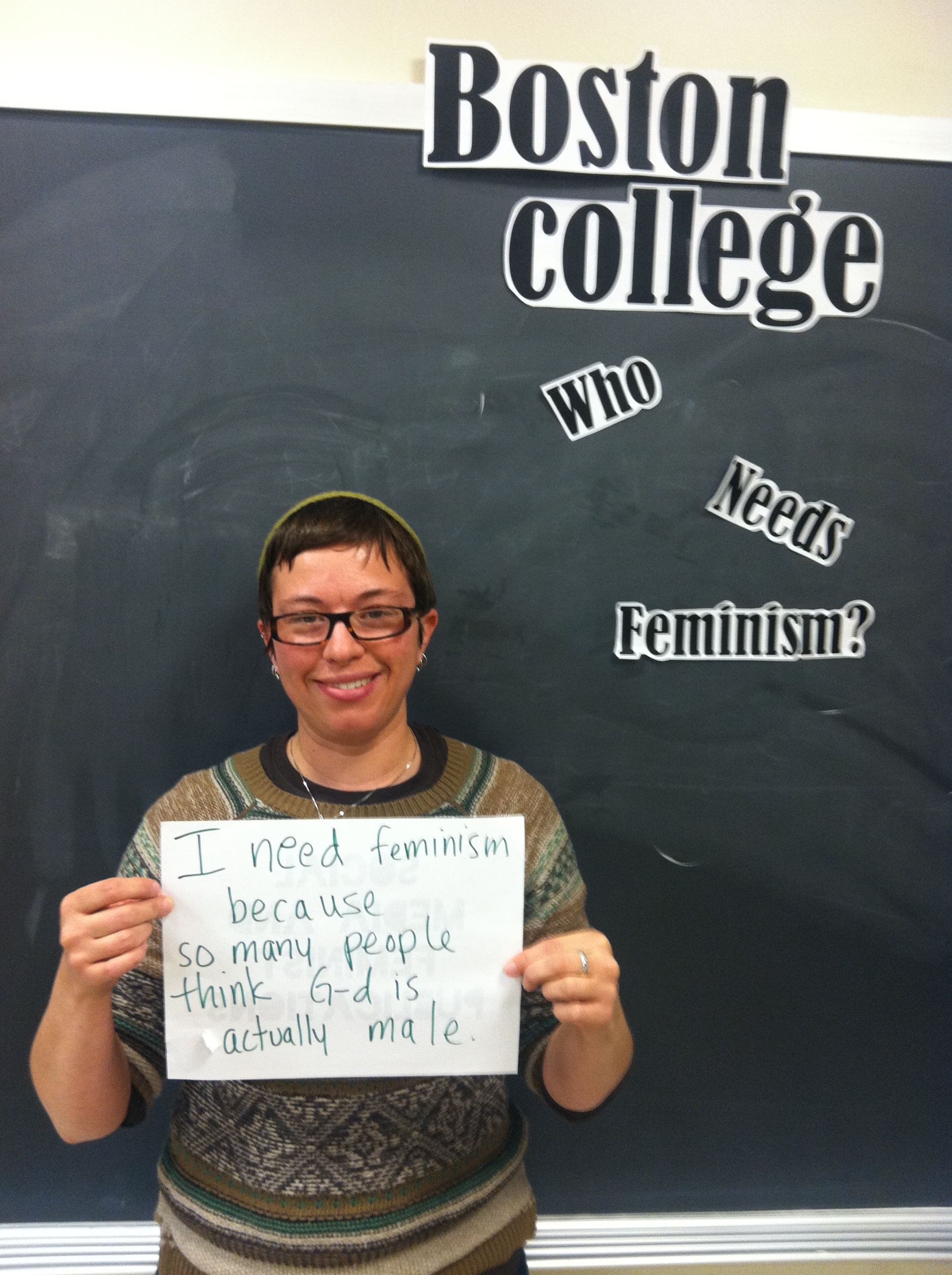
photoIn my introduction to Christianity class, almost every one of my students (who come from diverse religious backgrounds – primarily Roman Catholic, Protestant and Muslim), continues to believe that the best image if not the only appropriate image for G-d is male.  When probed they may speak generically about G-d as genderless, an entity or spiritual presence of some kind, yet conclude by affirming their belief that G-d is male often by adding something along the lines that G-d is best described as Father.  Some go so far in these affirmations that they articulate G-d’s maleness as fact.  It never fails that every semester I struggle with how to address this basic feminist issue within the classroom.

At least as early as 1973, Mary Daly, in Beyond G-d the Father: Towards a Philosophy of Women’s Liberation, articulated the problematic basis of the relationship between gender and divine imagery.  She argues that “If G-d in ‘his’ heaven is a father ruling ‘his’ people, then it is in the ‘nature’ of things and according to divine plan and the order of the universe that society be male-dominated.”  In other words, if maleness is associated with divinity, then the power, domination and running of society by men seems to be divinely ordained. Continue reading “On Pronouns and Liberation in the Classroom by Ivy Helman”

And Thus God made a Covenant with Hagar in the Wilderness by Michele Stopera Freyhauf

Freyhauf, Feminism, Religion, Durham, Old Testament, Blogger, BibleWe are familiar with the covenant God made with Abraham and Moses, but are you aware that God also made a covenant with Hagar?

In the wilderness Hagar encounters a deity at the well named Beer-lahai-roi (Genesis 16). Water and wells are important because they symbolize fertility and life. Wells for women are common places where they met their future spouses. Because wanderers in the desert need water to survive, water itself becomes a symbolic of life-giving or life.

In the seemingly barren dessert, the fertile Hagar finds out that she is pregnant and going to be the mother of many children. Hagar is promised progeny in a motherless state.  According to Pamela Tamarkin Reis, this is called the “after-me” descendants, which guarantees Hagar that her children will live for “immeasurable generations;” a pattern that fits within the scope of this promise. This same promise of progeny is also given to Eve in Genesis 3:20, providing and interesting parallelism between Eve and Hagar.

It is worth pointing out the irony exists in this promise.  Sarai uses Hagar to “build her up.” According to Nahum Sarna, to be built up in terms of the number of children that you have, implies that you are mother to a dynasty.  In this pericope, however, it is Hagar, not Sarai that is built up through this divine promise.

This patterns of promise exists within the birth narrative through the annunciation of Ishmael and the promise of progeny.  It is through this narrative that Hagar enters into a covenantal relationship with the deity.  According to J. H. Jarrell, birth narratives have six common elements that establish this relationship:  mother’s status, protest, offer, son’s future forecast, Yahweh naming, and acceptance of the contract. Hagar’s story contain these elements:

  1. Mother’s Status:  Hagar is without child because she is a virgin (16:1).
  2. Protest:  Hagar flees from her mistress (16:8).
  3. Offer:  Return to your mistress and submit to her authority (16:9).
  4. Son’s Future Forecast:  He will live at the east of all his brothers (16:12).
  5. Yahweh Naming:  You will bear a son Ishmael because the Lord has given heed to your affliction (16:11).
  6. Acceptance of the Contract:  She called the name of the Lord (16:13).

Continue reading “And Thus God made a Covenant with Hagar in the Wilderness by Michele Stopera Freyhauf”

Don’t Worry, I Won’t Marry Your Girlfriend: Sexuality, Identity, and the Easy Laugh

No longer having to deconstruct the larger cultural and sexual narratives, heterosexuals who do not support marriage equality or feel threatened by homosexuals return to their one source of power that reinforces the ideology that they are on the right path: the Bible. “Marriage is between a man a woman,” or “A man shall not lie with another man as he would a woman,” becomes the newly reinforced heterosexual rallying cry and the progressive progress that occurred in the past becomes nothing more than a joke.

johnI must say, I will be the first to admit that the recent outbreak of videos promulgating the idea that gay men will marry a straight guy’s girlfriend or lesbians will marry a straight girl’s boyfriend all for the sake of marriage equality left me stifling my laughter as I attempted to pay attention in class.

However, after the calamity died down I took a moment to reflect upon the intrinsically embedded aspects of misdirected norms of sexuality, gender, and misogyny latent within the laugh lines and the guffaws throughout each video. Continue reading “Don’t Worry, I Won’t Marry Your Girlfriend: Sexuality, Identity, and the Easy Laugh”

The David Syndrome? By Marcia Mount Shoop

Is it just me, or does anyone else feel like we’re all in Junior High or High School again with the Petraeus scandal?  There is drama at every turn with boundaries crossed and accusations slung across every lunch table there is.

When I was a teenager we didn’t have emails, Facebook , and Twitter (thanks be to God).  We passed notes.  I remember getting a really mean one scrawled in deliberately messy handwriting to maintain anonymity about how annoying I was to the “populace” (yes I remember that word was in there) because I didn’t wear make up and I thought I was “so smart.”

Just like today’s cyber detectives who figured out Paula Broadwell’s identity from the fingerprints we all leave behind in the online lives we lead, I traced this note back to its source.  I did it the old fashioned way—I asked around.  Unfortunately I found out it was from a “friend” and teammate of mine.  When I went to her house and confronted her she admitted it.  Turns out she was envious about a boy.  Little did she know at the time that the boy she wished for was abusive and I was living in my own secret hell.  I remember thinking to myself “you can have him.”   The stakes seemed so high back then—friendships, acceptance, one’s whole sense of self were hopelessly tangled up in tenuous, even dangerous, relationships. Continue reading “The David Syndrome? By Marcia Mount Shoop”

Why Men (and Women) Can’t Have It All by John Erickson

Can women have it all? Possibly. Can men ever have it all? Maybe. Regardless of however we put it, the are ills to every good deed in the world and we need to get back to understanding how and why we use each other in order to fully understand that behind every good man might be a good woman but also behind every good women there might also be a good man.

Growing up, my favorite movie was The Associate staring Whoopi Goldberg as a woman at a Wall Street firm attempting to climb her way up the corporate ladder through hard work and dedication.  Her character Laurel Ayres does all the work and comes up with the ideas that clients eventually invest in, her partner Frank takes all the credit and eventually surpasses her at work by getting the promotion she had been vying for.  In a prodigious scene that I still vividly remember from my childhood, Laurel quits her job and starts an investment firm on her own; betting every cent and piece of property she has on the eventual success of her new business adventure.

In an attempt to break through the proverbial glass ceiling and play with the big boys of Wall Street, Laurel eventually discovers that although she can be (and is) the genius behind many of the great ideas that would save companies millions, she still needs to have her ideas expelled by a man she creates in order to win over clients, which eventually leads her to become successful.  However, while Laurel is reaping in the benefits of having Mr. Cutty, her made up business partner, by her side, she eventually learns that no matter what she does she will always be secondary to her male business partner. Continue reading “Why Men (and Women) Can’t Have It All by John Erickson”

A Semester of “Gendering Mormonism” by Patrick Mason

Readers of FAR have been treated to a number of posts over the past few months from members of the “Gendering Mormonism” class I taught this semester at Claremont Graduate University.  I was fairly apprehensive in offering the course.  For one, I’m not a scholar of gender, gender studies, feminist theory, feminist theology, queer studies, queer theology, or anything related—I’m a historian of American religion, and most of my training to that effect was about the white guys in American religion (most of whom, you’ll be shocked to learn, weren’t exactly feminists).  I have also spent some time in international peace studies, where I got a crash course in issues of gender justice.  But I entered this course as a relative novice.  This is one of the fun things about being a member of a graduate faculty—as a professor I don’t have to pretend to be the fount of all wisdom all the time, and I learn a lot from students who are often more expert in a particular field than I am. Continue reading “A Semester of “Gendering Mormonism” by Patrick Mason”

Sanctioned Ignorance and the Theological Academy By Egon Cohen

Namsoon Kang writes that dislocation can be a theologically transformative process of self-discovery, using the metaphor of the “homeless traveler . . . leaving home for Home.” Kang also states that one’s identity—one’s location as traveler—is necessarily influenced by one’s position along axes of identity such as race, religion, ethnicity, class, gender, ability, and sexuality. And it is at this interstice that I, and many other liberationist theologians, grapple with issues of privilege. We are committed to traveling with the marginalized, but our luggage is packed with advantages denied to our companions. Indeed, as individuals with the luxury of pursuing advanced theological studies, most academic theologians operate within a space of significant privilege.

In this regard, I have observed four main typologies of response: (1) denial, (2) guilt, (3) cataloguing, and (4) instrumentalizing. It is hard to constructively engage the first type of response within the present discussion—the existence of such institutionalized privileges is one of my implicit operating premises, so I will bracket this analysis for another occasion. Similarly, I believe that the constructive/transformational capacity of guilt for or detailed acknowledgment of privilege is quite limited. So the question becomes, how do white and/or male and/or heterosexual and/or “first world” theologians instrumentalize our privileges for and (more importantly) with our “fellow travelers”? Continue reading “Sanctioned Ignorance and the Theological Academy By Egon Cohen”

Infantilizing Women, Sexualizing Girls By Grace Yia-Hei Kao

Continue reading “Infantilizing Women, Sexualizing Girls By Grace Yia-Hei Kao”

“It’s About Power”: Reflecting Upon and Pondering About Men in Feminism and Religion By John Erickson

The following is a guest post by John Erickson, doctoral student in Women’s Studies in Religion at Claremont Graduate University.  His research interests involve an interdisciplinary approach and are influenced by his time as the director of a women’s center and active member in the GLBTQ and women’s rights movements.  His work is inspired by the intersectionality of the feminism, queer identity, and religious political and cultural rhetoric.  He is the author of the blog, From Wisconsin, with Love and can be followed on Twitter at @jerickson85.

I must confess I have been struggling with writing this blog entry for a couple of months.  Although I don’t usually find myself at a loss for words, when discussing the role of men in feminism and religion, I must admit, I did not know what to say.

While thinking about my positionality within feminism, both as a man and self-identified feminist, I was continually brought back to the time where I felt as if I didn’t belong.  When my place as both an ally and advocate for gender and sexual equality was challenged not by other men who didn’t understand me but by a group of fellow female students in my first ever graduate class in Women’s Studies at Claremont Graduate University.

The overarching feeling that I can recall from the memory is how scary the prospect of a man in a women’s studies class appears to be.  What place did I have sitting in what has been traditionally defined as a “safe space” and more importantly, how would my presence in the classroom affect the open and empowering nature that women’s studies classes have symbolically represented in both the world of activism and academia?   Continue reading ““It’s About Power”: Reflecting Upon and Pondering About Men in Feminism and Religion By John Erickson”