Besides being advocates of social justice, the prophets of Israel were advocates of “exclusive monotheism,” exclusively “male monotheism,” “religious othering,” and “religious prejudice.”
Many progressive Jews and Christians find inspiration in prophets because of their insistence that their God cares about the poor and “the widow at the gate.” For progressive Christians, Jesus stands in the prophetic tradition, and the core of his message is “concern for the poor.” For progressive Jews the prophetic tradition is the root of their concern for human rights.
Those who locate their spirituality and concern for social justice in the prophets can point proudly to Martin Luther King and the many priests, ministers, and rabbis, as well as ordinary Christians and Jews who marched with him as exemplars of the prophetic tradition.
Throughout my “bible-thumping, smitten with God” years, I scribbled countless thoughts and prayers in four devotional journals. Recently I came across these journals, wiping away the years of dust accumulated. As I have been detaching from the Pentecostal god, it was a painful, downright mortifying experience to read through my past communication with god. This god seemed so foreign now given my liberated, enlightened, evolved self. I remember writing to and about Him, but I couldn’t help thinking how dysfunctional and convoluted the language I used really was.
I love you Father. Take me…surrender me to your will…your ways. Let me not lean on my own understanding and foolishness.
Mary Daly in Beyond God the Father advocates, “Time to go beyond God the Father. Don’t you see? If God is male, then the male is God. Reclaim the right to name your self, your world, your God. The liberation of language is rooted in the liberation of ourselves. Be a wild woman…God is not A Being. God is Be-ing.”
Many social scientists contend that language is the foundation of our socially constructed realities. We use language as a creative tool and guide to frame our perceptions of the world around us. We also use language to create our own unique creative expressions. That even though we share and appropriate from the accessible pool of creative expressions, each individual designs and discovers their own true form. Continue reading “The Mosaic Language of God by Andreea Nica”
There’s a lot of hullabaloo these days about belief in God, atheism, separation of religion and state. However, like it or not, Western civilization is a Christian one.
Ever since the Roman Empire officially became Christian in the 4th century Christianity has formed an integral part of the Greco-Roman culture, forging the West’s crystallization.
And within this religious-political-cultural matrix, women have been striving for equality of power in virtually every field. Most of the time men had the upper hand.
Yet in Christianity’s early maturation period an egalitarian approach to the gender issue was the accepted norm. Following a good start in gender power sharing in the Early Christian Church, this enlightened approach gradually changed for the worse. In the early 6th century women found themselves stigmatized and demoted from almost all the major roles in church service and liturgy.
A few days ago I had the pleasure of giving a talk at the Secular Student Alliance Conference on how non-believing persons can work with Churches. Amidst the chaos of conferences–managing your time, deciding which talks to attend, and making sure you have enough water (it was a Burning Ring of Fire outside in Tempe, AZ)–I got to meet some pretty incredible secular women.
One of them was Heina Dadabhoy.
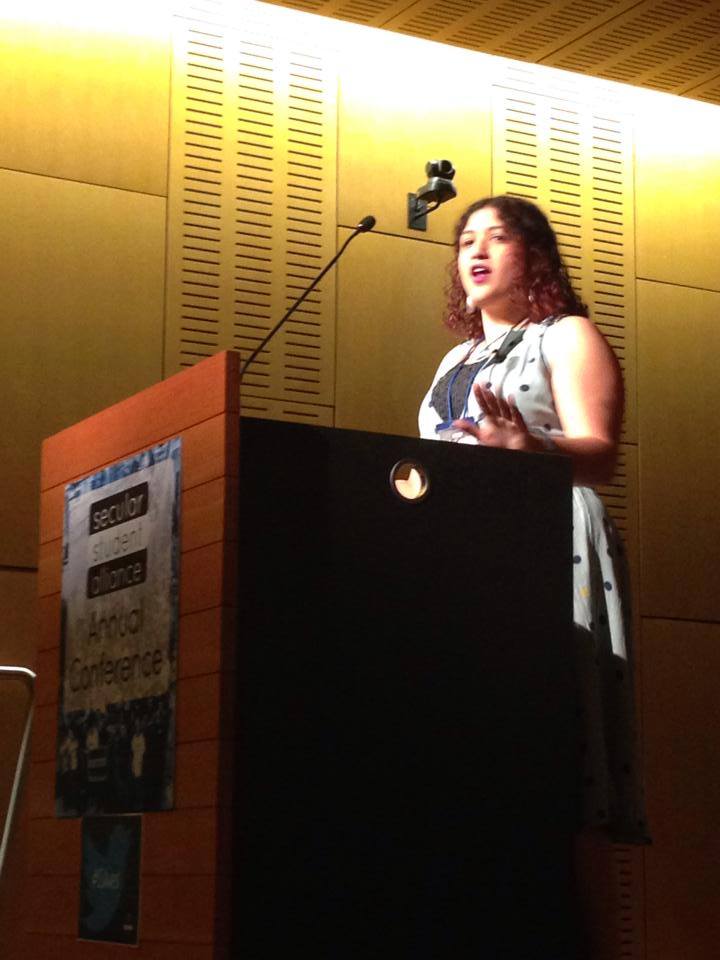
Heina speaking at SSA.
Former Muslim, blogger at Freethought Blogs, and overall bad-ass, Heina spoke about ways in which secular groups can create a more welcoming environment for ex-Muslims and Muslims beginning to doubt. Her talk, “Of Murtids and Muslims,” (a “murtid” is a public apostate) was not only about her experiences coming out as a secular humanist, but considered some of the absurd questions people ask her (and other ex-Muslims) about leaving Islam. “So did your parents try to honor kill you?” “Have you gone through FGM?” It was disturbingly humorous.
What I considered to be Heina’s main point, was that we should respect each others’ individual differences and not generalize and caricature all Muslims with the depictions of some. “Just because you read Ayaan Hirsi Ali’s book,” Heina notes, “does not make you an expert on Islam.” Heina made sure to emphasize the radical diversity that exists in Islam. She also spoke of the some of the issues that people go through when they leave Islam: How do I create a new identity when my old one was intricately tied up in my Muslim community, family, and culture? How do I navigate popular culture when I have missed a bunch of it? How do I find myself in this new secular world? Heina’s answers were refreshingly honest and insightful.
P.S. Aisha (one of Muhammed’s wives) should not simply be reduced to the young person Muhammed married; she was also a war leader, influential Muslim thinker, and someone who contributed greatly to early Islam. This is, of course, Heina’s insight.
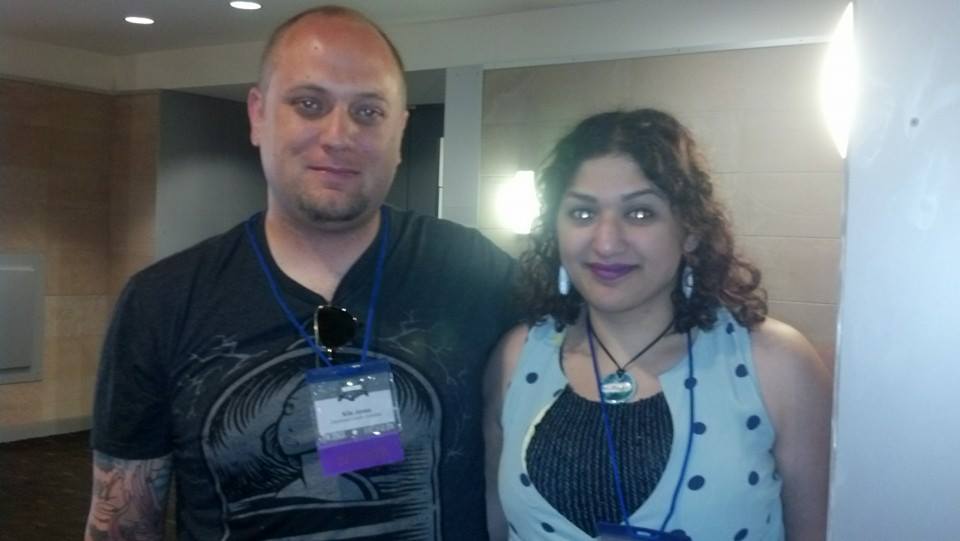
Me and Heina at SSA
Another awesome secular woman I met, was Sarah Morehead.
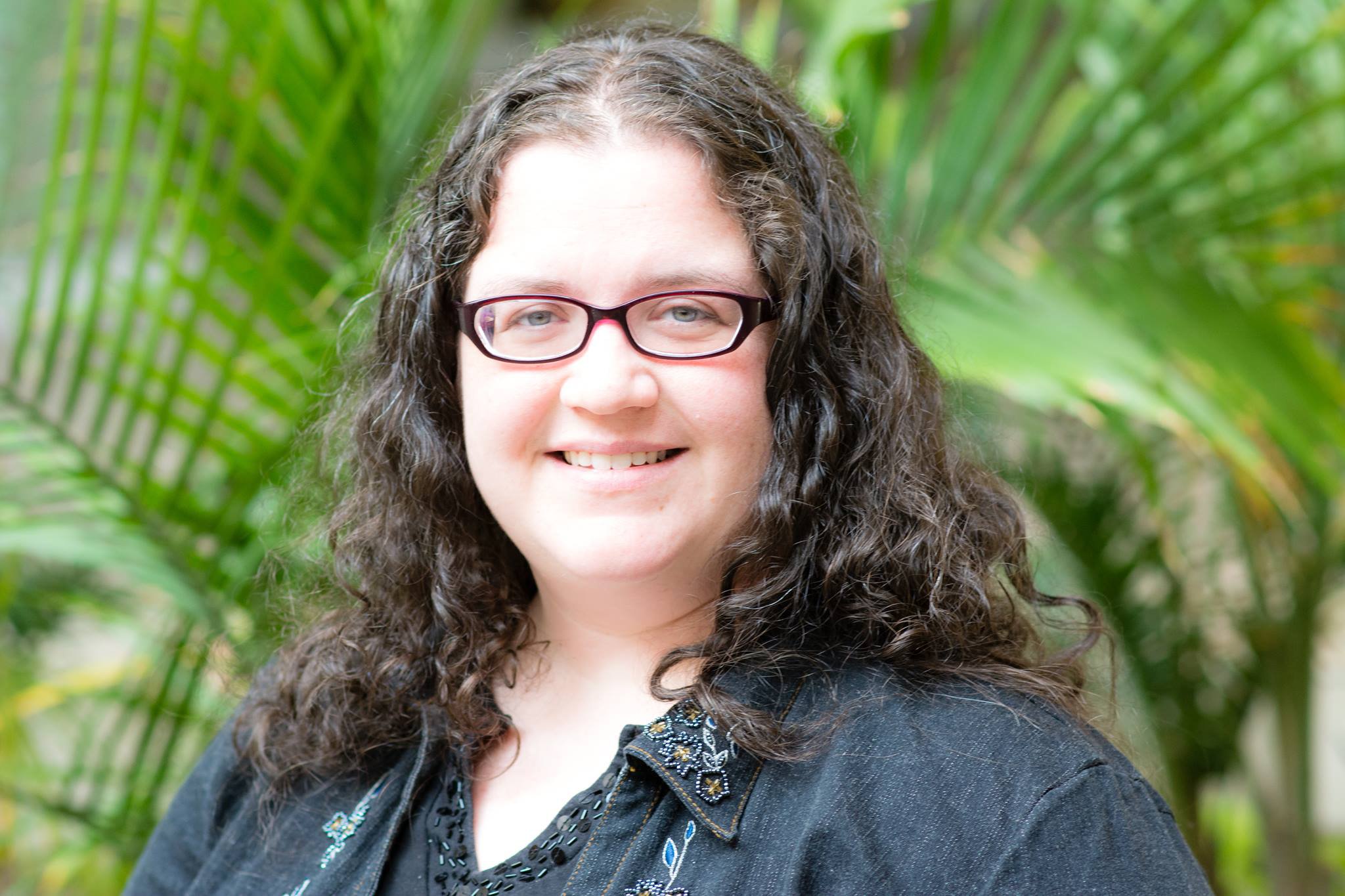
Sarah. Photo from Apostacon.
Sarah is a former evangelical Southern Baptist, Executive Director of the “Recovering From Religion” project, and another overall bad-ass. She spoke on how to start up a Recovering From Religion group on your campus. Here is a blurb about Recovering From Religion,
“If you are one of the many people who have determined that religion no longer has a place in their life, but are still dealing with the after-effects in some way or another, Recovering From Religion (RR) may be just the right spot for you. Many people come to a point that they no longer accept the supernatural explanations for the world around them, or they realize just how much conflict religious belief creates. It can be difficult to leave religion because family and culture put so much pressure on us to stay and pretend to believe the unbelievable. If this is you, we want to help you find your way out. Don’t let people convince you that you just didn’t have ‘enough’ faith, or that you just haven’t found the “right” religion.”
Sarah and I chatted (and often laughed) about our old experiences as conservative Christians. We discussed some of the funny language (Christian-eze) we used to use, the various levels of guilt and shame that were cast upon us, and how science helps explain some of the interesting displays of piety often seen at Pentecostal services. Sarah’s jovial and welcoming demeanor was calming, and as an Executive Director for a project aimed at helping people “recover” from religion, I cannot think of a better person for the job.
Lyz. Photo by SSA.
The last woman I have in mind is Lyz Liddell.
Lyz is the Director of Campus Organizing for the Secular Student Alliance. I have an interview I did with her a while back, on this very blog! Besides running around with her headset on, standing on chairs for announcements, and generally keeping the world of SSA from not crumbling into oblivion, Lyz is a great motivation and example. If you are ever interested in starting a SSA group on your campus, talk to her.
To all those who attended this years SSA West, or who are involved with helping secular students: Unite!
Kile Jones holds a Bachelors of Theology (B.Th.) from Faith Seminary, a Masters of Theological Studies (M.T.S.) and a Masters of Sacred Theology (S.T.M.) from Boston University, and is a current Ph.D. in Religion student at Claremont Lincoln University. He also holds a Certificate in Science and Religion from the Boston Theological Institute. Mr. Jones has been published in Zygon: Journal of Religion and Science, Philosophy Now, Free Inquiry, World Futures, Human Affairs, and the Secular Web. He is the Founder/Editor-in-Chief of Claremont Journal of Religion (www.claremontjournal.com), and is the Founder/Director of Interview an Atheist at Church Day (interviewatheists.wordpress.com).
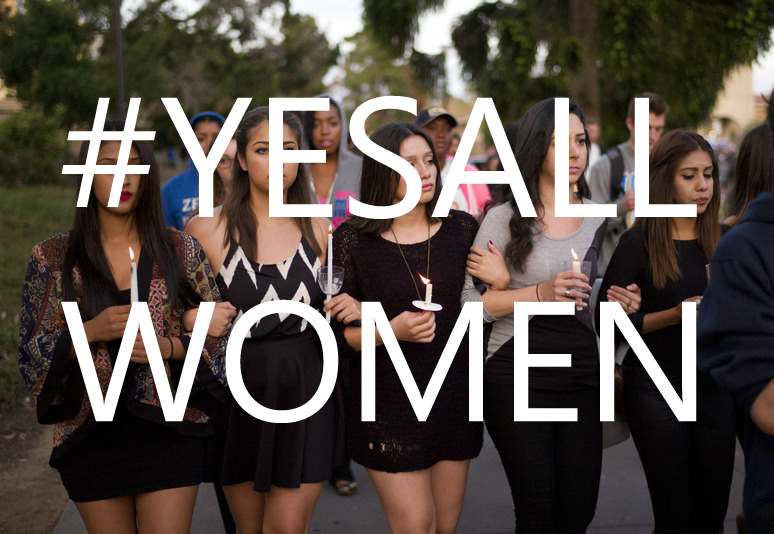
#YesAllWomen proved that although not all men commit horrible crimes against women, the men that often get the headlines and create the most controversy are the ones that need to be watched out for.
The one thing I typically will choose to do on the rare occasion that I’m able to sit down and relax is to watch a documentary. While some people may go to the gym, read a book, or hang with friends, I typically choose to stay in, nestle up on my couch, and learn. While on my last bout of relaxation, I chose to watch the HBO documentary Questioning Darwin. Although it offers very little new insight into the evolution vs. creationism debate, it does offer an interesting new way to look at the recent social media hashtag war feminists, allies, and supporters found themselves in over the #YesAllWomen movement that took the world by storm.
Now, before I discuss #YesAllWomen, I have to admit that I did not enter into the safe space women created for themselves to tell tales of the horrible things they have and have had to face on a daily basis. I firmly believe that men should not have entered into the digital space Continue reading “#YesAllWomen, the Darwin Debate, and the God Complex by John Erickson”
My recent literary digests have included memoirs and nonfiction audiobooks on sex, relationships, and non-monogamy. A recent listen, Open: Love, Sex and Life in an Open Marriage by feminist activist Jenny Block, provides insight into the paradigmatic features of open marriage drawing on the personal experiences of a bisexual woman. Currently, I’m musing over my latest read: The Ethical Slut: A Practical Guide to Polyamory, Open Relationships & Other Adventures written by psychotherapist Dossie Easton and author and sex educator Janet W. Hardy. Through my literary adventures, I can’t help but reflect on my own sexual conditioning and upbringing in the Pentecostal church.
The authors of these feminist-friendly, sex-positive books and social movements did not exist in the church I grew up in, and I feel quite saddened by this. While my sexual conditioning in the church was far from liberating, these reads have helped me realize that the religious community wasn’t as mundane as I thought. My early sex education which was conservative consisted of the anatomical and biological basics (Arizona education system, need I say more?) and early conditioning of sex morals and ethics in the church. The latter was more influential to my perception of sex, gender, and relationships. Of course the media and my peers constructed my views of sexual culture and gender norms, but the church had the greatest impact during my childhood and adolescence. Continue reading “Christian Sex Ain’t So Vanilla by Andreea Nica”
Since my last contribution to Feminism and Religion my interest in Sappho and her influence has led me to a detailed analysis of Luke 1:27-45 (hereafter, the “Conception Story”). I want to share two observations from that analysis that I think will be of interest to readers of this blog. Both relate to the generally agreed upon fact that Luke was a physician and in particular to knowledge he can be assumed to have had of female anatomy based on evidence from approximately contemporaneous sources.
My first observation relates to the fact that Luke lived during a time when the existence of ovaries in women had only recently been discovered and their function correctly understood. While this had obvious implications for Greek medical theory, it would appear to have affected how Luke himself interpreted the source material he had for the Conception Story and hence how he told that story. My second observation, based on what is known of Greek gynecology, is that Luke would have correctly understood that although as a medical term ‘virginity’ does refer to the physical fact that sexual intercourse has not occurred, it does not necessarily or even often have an anatomical meaning. That observation leads directly to investigating whether ‘virgin’ as used by Luke may have a primarily metaphysical rather than physical meaning.
Though in general the ‘glory days’ of Classical Greece belonged to the centuries well before Luke’s time, that is not true of Greek medicine. Notwithstanding promising origins in a sexual egalitarianism that was in principle consistent with modern medicine, Greek medicine regressed substantially with Aristotle, who introduced the notion that the male’s contribution to reproduction was the active one and the female’s merely the passive provision of the material for its success. Not only did Aristotle not know of ovaries, even after their discovery it is far from clear when exactly their function was fully understood (the best evidence is about a half century after Luke). Once that happened, however, Greek medicine moved back towards the sexual egalitarianism of its origins (the ‘two seed theory’ of reproduction), repudiating Aristotle’s theory (the ‘single seed theory’ of reproduction). Continue reading “The Physician Luke, the Virgin Mary and the Poet Sappho by Stuart Dean”
As a child, I enjoyed the story of Noah’s Ark. I would often imagine pairs of animals running for safety in Noah’s architecturally majestic haven. Practical questions didn’t enter my mind during this blissful period of naivety. I ignored the part where God expressed regret in creating humanity, or when Noah gets drunk and lies bare naked for his children to cover his shame. My bible study teacher would explain to us that the point of the story was that Noah, a holy man, trusted God and carried out his will.
Disclaimer: I understand that the film is not meant to be an exact representation of the story in the bible, but loosely based around it. Also, if you plan on watching the film, read at your discretion.
In the film, Noah’s character is played by leading actor Russell Crowe, who appears strong, confident, and zealous in his trust in God – all necessary qualities to fulfill God’s demand of killing off the rest of humanity because of their wickedness. Later in the film, Noah realizes that he and his family are also wicked leading to his revelation, ahem, God’s revelation, that humanity must cease with Noah’s family. This doesn’t pan out too well with his children and wife. It was also bad news for Emma Watson, the orphan girl Noah’s family saves and raises as their own, who after accepting that she is barren is miraculously healed and gives birth to two girls. Noah decides that the female infants must die according to God’s will to end humanity. Continue reading “Watching “Noah” Brought Me Closer to Humanity by Andreea Nica”
Phelps didn’t just live a life filled with hate but he also embodied the very reasoning why so many communities cannot cross that proverbial bridge to work together to see past their differences and maybe never will. In the case of Phelps, sticks and stones may break our bones, but words really do hurt.
Fred Phelps, an American Pastor who headed the Westboro Baptist Church in Topeka, Kansas died at the age of 84 on March 19, 2014. While some individuals leave behind legacies of their good deeds and loving memories, the only thing Phelps left behind was a family and church founded on the principle of hate.
A frequent eyesore at various events ranging from military funerals and gay pride gatherings to mainstream events that captured the attention of our pop-culture obsessed society, Fred Phelps and his clan believed it was their sacred duty to warn others of God’s anger over the growing acceptance of not only modernity in general but also issues like gay rights and abortion. From slogans and signs such as ‘God Hates Fags’ to ‘Thank God for IEDs (Improvised Explosive Devices), Phelps has caused many controversies both during his lifetime and after his death.
The story of Exodus, through a liberation lens, has different meanings depending on the person’s experience in life. I recently experienced my own kind of liberation, a freedom from decades old enslavement. Through this realization, I celebrated with many other women with the reminder – you are not alone!
The story of the Exodus is a familiar one. It is a text of oppression, journey, and freedom – a freedom that finds us in new surroundings, a place of revelation and transformation. Many have written about the Exodus text found in the Hebrew Scriptures from different ideological lenses and social locations. For me, I propose to apply this to menopause (also known as the “change”).
It is not too far fetched to look at menopause as a transformative event in a woman’s life. For a woman like me, who struggled with the disease Endometriosis since my teen years, menopause it is not only transformative, but liberative. The only effective treatment for this disease (for me) was the injections of Lupron Depot that put my body in “medical menopause.” Because of that experience, I felt like my body was being liberated from disease – this disease that debilitated me monthly or, at the very least, caused me tremendous pain.
A few weeks ago, I had the experience of attending a musical with a group of friends. I am not in the habit of blogging about my personal life, but I cannot help but wonder if my story and experience might help another. The problem about “the change” is that we joke about it and usually face it with unbelievable dread. I propose to look at the “change” as a positive – a new beginning, with a reminder to all women out there – you are not alone!
I received this revelation several months after my surgery at a musical named – you guessed it – Menopause! What started out as a much needed get together of friends turned into an awakening and celebration. Something that has me celebrating the change – even as I fan myself through the hot flashes (I prefer “personal summers”), tear-up during emotional commercials for no reason (something I haven’t experienced since pregnancy), clinching my teeth due to a quick-igniting temper that causes me to exercise remarkable restrain (and you thought patience was a gift to children and teens), to searching every cabinet for that holy grail of comfort food – chocolate. As I reflected on that evening, it occurred to me that I was living my own exodus story and the very thing that enslaved me can no longer hurt me – I am now free – renewed and emerged, but still in a strange wilderness that holds different challenges. Continue reading “Encountering “the Change” as a Personal Exodus and Liberation by Michele Stopera Freyhauf”